
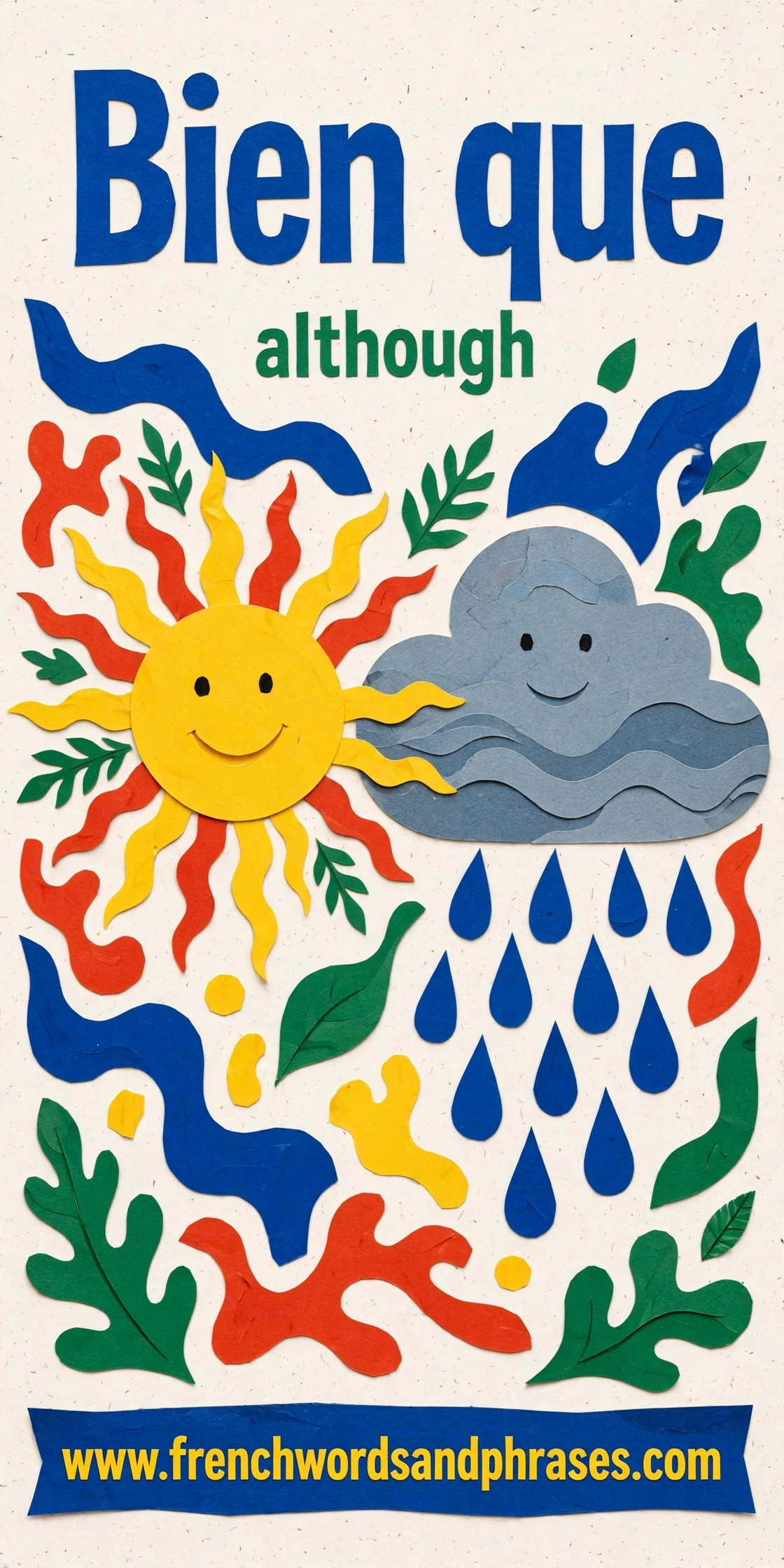
A French Word to Live By
Translate Bien que to English
/bjɛ̃ kə/
Bien que means although.
The picnic is packed, the sky is black, and someone at the table smiles: « Bien qu’il pleuve, on y va. » — Although it’s raining, we’re going. Bien que is the word French reaches for when a fact should stop you… and doesn’t.
In this guide, you’ll learn what bien que means in English, how it concedes a fact without surrendering to it, why the verb after it must be in the subjunctive, and how it differs from quoique and même si. Explore French examples, English translations, and practice quizzes.
Understanding the French Conjunction Bien que
Bien que is a French subordinating conjunction of concession — the great ‘and yet’ of the language. It introduces a clause that seems to argue against the main clause, and then lets the main clause win anyway.
It means although. The pattern is a small drama in two acts: bien qu’il soit riche, il est malheureux — although he is rich, he is unhappy. The bien que clause states the obstacle; the main clause steps over it. And the verb inside the obstacle clause goes into the subjunctive, every time.
Type: Subordinating conjunction — concession
What it does: Concedes a fact, then lets the main clause override it
What follows it: A full clause: subject + verb
Mood after it: Subjunctive — always
One important usage detail: bien que elides before a vowel — bien qu’il pleuve, bien qu’elle vienne. The que loses its final -e, exactly like parce qu’il. Forgetting the apostrophe is the most common written slip with this word.
Experience the Word
Bien que is the conjunction of graceful defiance — the word that admits the problem and goes ahead anyway.
Imagine a grandmother lacing up her walking shoes while the rain rattles the shutters. Her grandson protests: « mais il pleut ! » She answers, buttoning her coat: « bien que je sois vieille, je marche tous les jours » — although I am old, I walk every day.
You have not just linked two clauses. You have conceded the storm and refused to cancel the walk.
How to Use Bien que in French: Complete Guide
Let’s explore how bien que works in French, beginning with the whole word on one card.
Bien que at a Glance
Before the details, here is the whole word on one card.
The Whole Word on One Card
Meaning, job, pattern and mood — bien que in four lines.
| Point | Bien que |
|---|---|
| Meaning | although |
| Job | concedes an obstacle — then overrides it |
| What follows | a full clause — subject + verb |
| Mood | subjunctive, always |
Example
Bien qu’il pleuve, nous sortons.
Although it’s raining, we’re going out.
How Bien que Links: Obstacle First, Victory After
Bien que glues an obstacle clause to a main clause that refuses to be stopped. The obstacle can come first, with a comma, or trail behind the main clause.
| Pattern | Example |
|---|---|
| obstacle first + comma | bien qu’elle soit fatiguée, elle continue — although she is tired, she carries on |
| main clause first | nous partons bien qu’il fasse froid — we are leaving although it is cold |
| two different subjects | bien que le magasin soit fermé, la boulangerie est ouverte — although the shop is closed, the bakery is open |
| obstacle in the past | bien qu’il ait plu, la fête a eu lieu dehors — although it rained, the party took place outside |
Example
Bien que le train soit en retard, nous arrivons à l’heure.
Although the train is late, we’re arriving on time.
Quick Quiz 1
Bien qu’il pleuve, on sort. — Is the rain causing the outing, or failing to stop it?
Reveal the answer
Failing to stop it — bien que concedes an obstacle.
Bien qu’il pleuve, on sort.
Although it’s raining, we’re going out.
The Mood Question: Always the Subjunctive
Bien que never takes the indicative. The conceded fact is treated as background scenery, not as the point being asserted — and French marks that with the subjunctive. Here are the forms you will meet most:
| Verb (subjunctive present) | After bien que |
|---|---|
| être → soit / soyons / soient | bien qu’il soit tard — although it is late |
| avoir → ait / ayons / aient | bien qu’elle ait raison — although she is right |
| faire → fasse | bien qu’il fasse beau — although the weather is nice |
| aller → aille | bien que nous allions lentement — although we are going slowly |
| pouvoir → puisse | bien que tu puisses refuser — although you may refuse |
Example
Bien que vous soyez occupés, écoutez-moi.
Although you are busy, listen to me.
Where Bien que Goes: Front Door or Back Seat
Bien que is comfortable at the head of the sentence or in the middle. At the head, its clause is set off by a comma; in the middle, French usually runs on without one.
| Position | Example |
|---|---|
| Start of the sentence + comma | bien qu’il soit petit, il est fort — although he is small, he is strong |
| Middle of the sentence | elle sourit bien qu’elle soit triste — she smiles although she is sad |
| Elision before a vowel | bien qu’il, bien qu’elle, bien qu’on — never ‘bien que il’ |
| Register | neutral to slightly formal; in relaxed speech même si often takes its place |
Example
Bien que ce soit difficile, je continue.
Although it is difficult, I am carrying on.
Quick Quiz 2
Choose the correct form: Bien que tu ______ (être) jeune, tu es sage. — es or sois?
Reveal the answer
sois — bien que always takes the subjunctive.
Bien que tu sois jeune, tu es sage.
Although you are young, you are wise.
Everyday Expressions with Bien que
Bien que turns up in polite disagreements, modest confessions and weather reports that refuse to ruin plans.
| Expression | In English |
|---|---|
| bien que ce soit vrai | although that may be true |
| bien qu’il soit tard | although it’s late |
| bien que je sache… | although I know… (the start of a modest objection) |
| bien que cela puisse paraître étrange | although it may seem strange |
| bien qu’entre nous… | although, between you and me… |
Example
Bien que ce soit loin, je viens te voir.
Although it’s far, I’m coming to see you.
Close Cousins: Bien que, Quoique, Même si, Malgré
Four ways to concede ground in French — two take the subjunctive, one takes the indicative, and one is not a conjunction at all.
| Word | The difference |
|---|---|
| bien que | although + clause + subjunctive; the obstacle is a real fact |
| quoique | the same meaning and the same subjunctive — written as ONE word, a touch more literary |
| même si | ‘even if’ + indicative; leans towards the hypothetical — même s’il pleut demain |
| malgré | a preposition, not a conjunction: malgré + noun — malgré la pluie, despite the rain |
Example
Même s’il neige demain, nous partirons, bien que la route soit longue.
Even if it snows tomorrow, we’ll leave, although the road is long.
Quick Quiz 3
Which cousin concedes with the INDICATIVE, not the subjunctive — bien que or même si?
Reveal the answer
même si — it keeps the indicative.
Même s’il pleut, on sort.
Even if it rains, we’re going out.
Bien que and Its Neighbours
Concession has a whole neighbourhood in French — words that yield ground, and words that hold it.
| French | In English |
|---|---|
| quoique | although (one word, subjunctive) |
| même si | even if (indicative) |
| malgré tout | in spite of everything (adverb) |
| pourtant | yet, however (the main clause fights back) |
| alors que | whereas (contrast between two facts) |
Example
Bien qu’il soit malade, il travaille ; pourtant, il devrait se reposer.
Although he is ill, he works; and yet, he should rest.
Watch Out: The Traps Around Bien que
The classic error with bien que is a mood error — the indicative slipping in where the subjunctive belongs.
| Trap | The truth |
|---|---|
| bien qu’il est fatigué | wrong mood: bien qu’il SOIT fatigué — subjunctive, always |
| bien que il pleut | two errors in one: elide (bien qu’il) AND use the subjunctive (bien qu’il pleuve) |
| bien que + infinitive | not possible: bien que needs a clause — bien que je sois fatigué, or malgré ma fatigue |
| bien = ‘many’ | bien des gens means ‘many people’ — a different bien entirely |
Example
Bien qu’elle ait peur, elle plonge.
Although she is afraid, she dives in.
Quick Quiz 4
Fix this sentence: Bien que il est riche, il est triste.
Reveal the answer
Bien qu’il soit riche, il est triste. — elision (bien qu’) plus the subjunctive (soit).
Although he is rich, he is sad.
Bien que in Everyday French: Real-Life Examples
Now that you know the word, let’s see how bien que appears in everyday French.
Example 1 — Weather defiance
Bien qu’il fasse froid, les enfants jouent dehors.
Although it’s cold, the children are playing outside.
Example 2 — At work
Bien que la réunion soit longue, tout le monde reste.
Although the meeting is long, everyone stays.
Example 3 — Honest food talk
Bien que ce fromage soit fort, je l’adore.
Although this cheese is strong, I love it.
Example 4 — Family
Bien qu’elle ait quatre-vingts ans, ma grand-mère danse encore.
Although she is eighty, my grandmother still dances.
Example 5 — Travel
Bien que nous soyons en retard, le train attend.
Although we are late, the train is waiting.
Example 6 — A small confession
Bien que je déteste l’hiver, j’aime la neige.
Although I hate winter, I love snow.
Beyond Translation: The Meaning of Bien que
English says although for the meaning of bien que — but look at the French pieces: bien, ‘well’, and que, ‘that’. Well-that-it-rains, we go out. The concession is almost polite: the obstacle is received courteously, given its full clause and its subjunctive… and then politely outvoted.
Bien que is how French loses an argument gracefully — with itself.
Master it, and your French gains a whole register of nuance: not the flat ‘but’ of opposition, but the raised eyebrow of a fact acknowledged and quietly set aside.
How to Remember the French Conjunction Bien que
Remember it this way: Bien que is the polite obstacle — it bows to the problem, then walks straight past it.
- You concede the obstacle first — bien qu’il pleuve — then let the main clause win.
- You pay the subjunctive toll — soit, ait, fasse, aille — every single time.
- You elide before vowels — bien qu’il, never ‘bien que il’.
The key idea is bien que concedes a fact, demands the subjunctive, and lets the main clause win.
Test Your Knowledge of Bien que
Let’s see how much you’ve learned. Try answering these questions before revealing the answers.
Question 1
What does bien que mean?
Reveal the answer
Although — it introduces a conceded obstacle.
Question 2
Which mood follows bien que?
Reveal the answer
The subjunctive — always: bien qu’il soit, bien qu’elle ait.
Question 3
Translate: Although she is tired, she smiles.
Reveal the answer
Bien qu’elle soit fatiguée, elle sourit.
Question 4
What is the difference between bien que and même si?
Reveal the answer
bien que + subjunctive concedes a real fact; même si + indicative means ‘even if’ and leans hypothetical.
Question 5
Complete the sentence:
Bien que nous ______ (avoir) peu d’argent, nous voyageons.
Reveal the answer
ayons — the subjunctive of avoir.
Bien que nous ayons peu d’argent, nous voyageons.
Although we have little money, we travel.
Your Final Challenge
Can You Use It?
How would you say this in French?
“Although it’s Sunday, the bakery is open.”
Reveal the answer
Bien que ce soit dimanche, la boulangerie est ouverte.
Although it’s Sunday, the bakery is open.
A little French. A little curiosity. A richer everyday life.
LEARN FRENCH ONE WORD AT A TIME




