A French Word to Live By
How to Conjugate Bichonner in French
/bi.ʃɔ.ne/
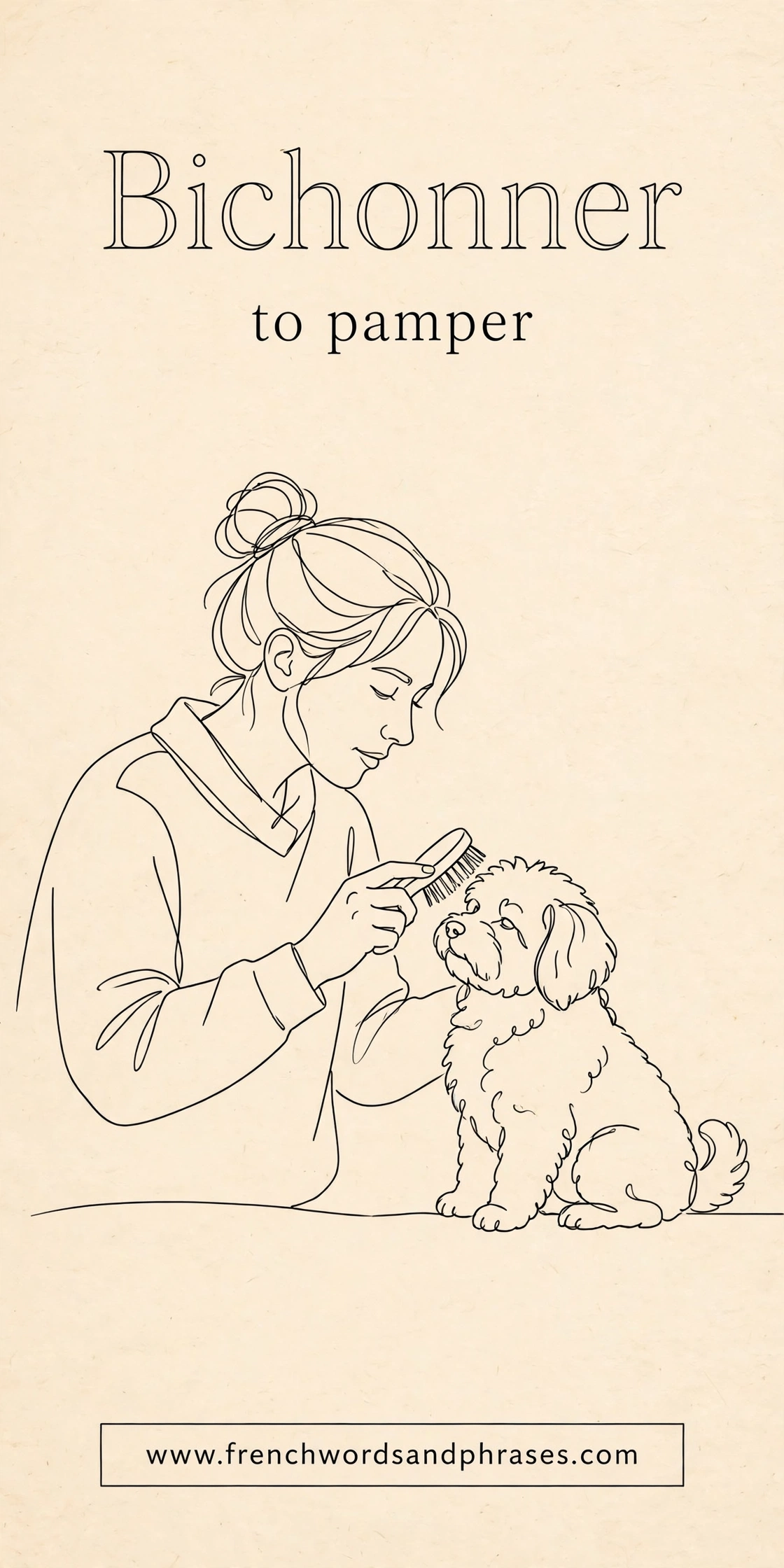
Bichonner means to pamper — to fuss over someone or something with endless little attentions, the way one pampers a lapdog.
A man polishing his old car for the third Sunday in a row, a grandmother who has cooked her grandson’s favourite dish before he even arrives, a gardener tucking his roses in for the winter — bichonner is the verb of devoted fussing: to pamper, to tend, to lavish care on what you love.
In this guide, you’ll learn how to conjugate bichonner in all the major French tenses and moods. Explore complete conjugation tables, French examples, English translations, and practice quizzes.
Understanding the French Verb Bichonner
Bichonner is a regular French verb belonging to the first group of verbs, those ending in -er.
It means to pamper. It is used of people (grandchildren, guests, customers), of treasured objects (cars, boats, motorbikes) and of houses and gardens. The pampering is always affectionate and a little excessive — that excess is exactly what the word adds to soigner or entretenir.
Verb classification: First group (-er)
Auxiliary verb: Avoir
Past participle: bichonné
Present participle: bichonnant
English equivalents: To pamper, to fuss over, to doll up; bichonner ses petits-enfants — to pamper one’s grandchildren; bichonner sa voiture — to lavish care on one’s car; se bichonner — to doll oneself up; un bichon — a bichon, a little lapdog breed.
One important detail: bichonner is the verb of un bichon — the small, white, thoroughly spoiled lapdog. To bichonner someone is to treat them like a bichon: brushed, fed, admired and never left wanting. The plain verb takes a direct object — bichonner ses invités, bichonner son jardin — and its reflexive twin se bichonner means to doll oneself up, to get oneself ready with great care. The verb is regular: je bichonne, nous bichonnons. Its closest synonym is chouchouter, to spoil a favourite.
Experience the Word
Bichonner is the verb of loving care with the volume turned up — nothing is too much trouble for the person, the car or the garden being pampered.
Imagine a retired sailor and his little boat. Every spring he sands her, paints her, oils every hinge and polishes the brass until it mirrors his face. The other boats in the harbour get maintenance; his gets devotion — il la bichonne, and the whole port knows the boat is the best-kept in Brittany.
The boat does not sail any faster for it. She is pampered — bichonnée — because love, in this harbour, is measured in polish.
How to Conjugate Bichonner: Complete French Conjugation Guide
Let’s explore every major conjugation of bichonner, beginning with the indicative mood.
How to Conjugate Bichonner in the Indicative Mood
The indicative mood is used to express facts, observations, actions, and events.
How to Conjugate Bichonner in the Present Tense (Présent)
Used for actions happening now, habitual actions, and general truths.
| Subject | Conjugation |
|---|---|
| je | bichonne |
| tu | bichonnes |
| il / elle | bichonne |
| nous | bichonnons |
| vous | bichonnez |
| ils / elles | bichonnent |
Example
Elle bichonne sa vieille voiture comme un trésor.
She pampers her old car like a treasure.
Quick Quiz 1
Complete the sentence:
Nous ______ nos invités ce week-end.
Reveal the answer
bichonnons
Nous bichonnons nos invités ce week-end.
We are pampering our guests this weekend.
How to Conjugate Bichonner in the Passé Composé
Used for completed actions in the past. Bichonner takes the auxiliary verb avoir.
| Subject | Conjugation |
|---|---|
| j’ | ai bichonné |
| tu | as bichonné |
| il / elle | a bichonné |
| nous | avons bichonné |
| vous | avez bichonné |
| ils / elles | ont bichonné |
Example
Ils ont bichonné leurs invités pendant tout le week-end.
They pampered their guests all weekend long.
How to Conjugate Bichonner in the Imparfait (Imperfect Tense)
Used for habitual past actions, descriptions, and ongoing situations in the past.
| Subject | Conjugation |
|---|---|
| je | bichonnais |
| tu | bichonnais |
| il / elle | bichonnait |
| nous | bichonnions |
| vous | bichonniez |
| ils / elles | bichonnaient |
Example
Mon grand-père bichonnait son jardin chaque matin.
My grandfather used to fuss over his garden every morning.
Quick Quiz 2
Choose the correct form:
They pampered their guests.
Ils ______ leurs invités. (ont bichonné / sont bichonnés)
Reveal the answer
ont bichonné
Ils ont bichonné leurs invités.
Bichonner takes avoir.
How to Conjugate Bichonner in the Plus-que-parfait
Used to describe an action that had already been completed before another past event.
| Subject | Conjugation |
|---|---|
| j’ | avais bichonné |
| tu | avais bichonné |
| il / elle | avait bichonné |
| nous | avions bichonné |
| vous | aviez bichonné |
| ils / elles | avaient bichonné |
Example
Elle avait bichonné la maison avant l’arrivée des acheteurs.
She had spruced up the house before the buyers arrived.
How to Conjugate Bichonner in the Passé Simple
Primarily used in formal writing, literature, and historical narratives. It is rarely used in everyday conversation.
| Subject | Conjugation |
|---|---|
| je | bichonnai |
| tu | bichonnas |
| il / elle | bichonna |
| nous | bichonnâmes |
| vous | bichonnâtes |
| ils / elles | bichonnèrent |
Example
Pendant des années, il bichonna ce vieux bateau sans relâche.
For years, he pampered that old boat without respite.
How to Conjugate Bichonner in the Passé Antérieur
A literary tense used to express an action completed immediately before another past action, generally in the passé simple.
| Subject | Conjugation |
|---|---|
| j’ | eus bichonné |
| tu | eus bichonné |
| il / elle | eut bichonné |
| nous | eûmes bichonné |
| vous | eûtes bichonné |
| ils / elles | eurent bichonné |
Example
Quand elle eut bichonné ses petits-enfants toute la journée, elle s’endormit dans son fauteuil.
When she had pampered her grandchildren all day, she fell asleep in her armchair.
How to Conjugate Bichonner in the Future Tense (Futur Simple)
Used to describe actions that will take place in the future.
| Subject | Conjugation |
|---|---|
| je | bichonnerai |
| tu | bichonneras |
| il / elle | bichonnera |
| nous | bichonnerons |
| vous | bichonnerez |
| ils / elles | bichonneront |
Example
Demain, je bichonnerai mes plantes avant les vacances.
Tomorrow, I will tend to my plants carefully before the holidays.
How to Conjugate Bichonner in the Futur Antérieur (Future Perfect)
Used for an action that will have been completed before a particular point in the future.
| Subject | Conjugation |
|---|---|
| j’ | aurai bichonné |
| tu | auras bichonné |
| il / elle | aura bichonné |
| nous | aurons bichonné |
| vous | aurez bichonné |
| ils / elles | auront bichonné |
Example
À la fin du week-end, ils auront bichonné tous leurs invités.
By the end of the weekend, they will have pampered all their guests.
How to Conjugate Bichonner in the Near Future (Futur Proche)
Used to describe something that is going to happen soon. Formed with aller + infinitive.
| Subject | Conjugation |
|---|---|
| je | vais bichonner |
| tu | vas bichonner |
| il / elle | va bichonner |
| nous | allons bichonner |
| vous | allez bichonner |
| ils / elles | vont bichonner |
Example
Elle va encore bichonner son chien avec un nouveau manteau.
She is going to pamper her dog with a new coat again.
How to Conjugate Bichonner in the Conditional Mood
The conditional mood expresses what would happen under certain circumstances. It is also frequently used to make polite requests or express wishes.
How to Conjugate Bichonner in the Present Conditional
| Subject | Conjugation |
|---|---|
| je | bichonnerais |
| tu | bichonnerais |
| il / elle | bichonnerait |
| nous | bichonnerions |
| vous | bichonneriez |
| ils / elles | bichonneraient |
Example
Avec plus de temps, il bichonnerait chaque coin de la maison.
With more time, he would lavish care on every corner of the house.
How to Conjugate Bichonner in the Past Conditional
| Subject | Conjugation |
|---|---|
| j’ | aurais bichonné |
| tu | aurais bichonné |
| il / elle | aurait bichonné |
| nous | aurions bichonné |
| vous | auriez bichonné |
| ils / elles | auraient bichonné |
Example
Elle aurait bichonné ses invités si elle avait su plus tôt.
She would have pampered her guests if she had known sooner.
Bichonner in the Literary Past Conditional Form
This less common literary form uses the imperfect subjunctive of avoir.
| Subject | Conjugation |
|---|---|
| j’ | eusse bichonné |
| tu | eusses bichonné |
| il / elle | eût bichonné |
| nous | eussions bichonné |
| vous | eussiez bichonné |
| ils / elles | eussent bichonné |
Example
Il eût bichonné ce jardin toute sa vie.
He would have fussed over that garden all his life.
How to Conjugate Bichonner in the Subjunctive Mood
The subjunctive is used to express wishes, emotions, doubts, necessity, and uncertainty. It frequently follows expressions such as il faut que (it is necessary that) or bien que (although).
How to Conjugate Bichonner in the Present Subjunctive
| Subject | Conjugation |
|---|---|
| que je | bichonne |
| que tu | bichonnes |
| qu’il / qu’elle | bichonne |
| que nous | bichonnions |
| que vous | bichonniez |
| qu’ils / qu’elles | bichonnent |
Example
Il faut que tu bichonnes tes invités ce soir.
You must pamper your guests tonight.
Quick Quiz 3
Complete the sentence using the subjunctive:
Il faut que vous ______ votre vieille voiture.
Reveal the answer
bichonniez
Il faut que vous bichonniez votre vieille voiture.
You must pamper your old car.
How to Conjugate Bichonner in the Imperfect Subjunctive
A literary tense, rarely encountered in modern spoken French.
| Subject | Conjugation |
|---|---|
| que je | bichonnasse |
| que tu | bichonnasses |
| qu’il / qu’elle | bichonnât |
| que nous | bichonnassions |
| que vous | bichonnassiez |
| qu’ils / qu’elles | bichonnassent |
Example
Elle veillait à ce qu’on bichonnât les anciens du village.
She made sure the village elders were well looked after.
How to Conjugate Bichonner in the Pluperfect Subjunctive
A literary construction used to express an action completed before another past action.
| Subject | Conjugation |
|---|---|
| que j’ | eusse bichonné |
| que tu | eusses bichonné |
| qu’il / qu’elle | eût bichonné |
| que nous | eussions bichonné |
| que vous | eussiez bichonné |
| qu’ils / qu’elles | eussent bichonné |
Example
On savait qu’elle eût bichonné ses enfants toute leur enfance.
Everyone knew she had pampered her children throughout their childhood.
How to Conjugate Bichonner in the Past Subjunctive
| Subject | Conjugation |
|---|---|
| que j’ | aie bichonné |
| que tu | aies bichonné |
| qu’il / qu’elle | ait bichonné |
| que nous | ayons bichonné |
| que vous | ayez bichonné |
| qu’ils / qu’elles | aient bichonné |
Example
Je suis touché qu’elle ait bichonné mes parents.
I am touched that she pampered my parents.
How to Conjugate Bichonner in the Imperative
The imperative is used to give commands, instructions, invitations, or suggestions. Subject pronouns are omitted.
How to Conjugate Bichonner in the Present Imperative
| Person | Conjugation |
|---|---|
| (tu) | bichonne |
| (nous) | bichonnons |
| (vous) | bichonnez |
Example
Bichonne un peu tes invités, ils viennent de loin !
Pamper your guests a little, they have come a long way!
Quick Quiz 4
How would you say Pamper your guests a little (tu form)?
Reveal the answer
Bichonne un peu tes invités !
French Participles of Bichonner
Participles are verb forms that can be used in compound tenses and other grammatical constructions.
Present Participle of Bichonner
bichonnant
En bichonnant sa moto, il oublie tous ses soucis.
While pampering his motorbike, he forgets all his worries.
Past Participle of Bichonner
bichonné
Bichonnée par ses grands-parents, la petite rayonne.
Pampered by her grandparents, the little girl is beaming.
Bichonner in Everyday French: Real-Life Examples
Now that you know the conjugations, let’s see how bichonner appears in everyday French.
Example 1 — Present
Elle bichonne sa voiture chaque dimanche.
She pampers her car every Sunday.
Example 2 — Passé composé
Ils ont bichonné leurs invités.
They pampered their guests.
Example 3 — Imparfait
Mon grand-père bichonnait son jardin.
My grandfather used to fuss over his garden.
Example 4 — Future
Je bichonnerai mes plantes demain.
I will tend to my plants tomorrow.
Example 5 — Conditional
Il bichonnerait sa maison avec plus de temps.
He would lavish care on his house with more time.
Example 6 — Imperative
Bichonne tes invités, ils viennent de loin !
Pamper your guests, they have come a long way!
Beyond Translation: The Meaning of Bichonner
The bichon is a little white lapdog, bred for centuries to be carried, brushed and adored — and French simply turned the dog into a verb.
To bichonner is to treat the world like a bichon.
Grandchildren, vintage cars and rose bushes all qualify. English pamper is close, but it has lost its animal; the French word still has the lapdog sitting in the middle of it, wearing a ribbon.
How to Remember the French Verb Bichonner
Remember it this way: Bichonner is about the lapdog brushed, fed and adored.
- Un bichon is the pampered little lapdog: to bichonner is to treat someone like a bichon.
- Direct object for others (bichonner ses invités); se bichonner for dolling yourself up.
- Regular -er: je bichonne, nous bichonnons, past participle bichonné.
The key idea is the lapdog brushed, fed and adored.
Test Your Knowledge of Bichonner
Let’s see how much you’ve learned. Try answering these questions before revealing the answers.
Question 1
What animal hides inside the verb bichonner?
Reveal the answer
Un bichon — the little white lapdog, pampered for centuries; to bichonner is to treat someone or something the same way.
Question 2
How do you say She pampers her grandchildren in French?
Reveal the answer
Elle bichonne ses petits-enfants.
Question 3
Translate: They pampered their guests all weekend.
Reveal the answer
Ils ont bichonné leurs invités pendant tout le week-end.
Question 4
What is the past participle of bichonner?
Reveal the answer
Bichonné.
Question 5
Complete the sentence:
Il faut que tu ______ tes invités ce soir.
Reveal the answer
bichonnes
Il faut que tu bichonnes tes invités ce soir.
You must pamper your guests tonight.
Your Final Challenge
Can You Use It?
How would you say this in French?
He has been pampering his old motorbike for twenty years, and it shines like on the first day.
Reveal the answer
Il bichonne sa vieille moto depuis vingt ans, et elle brille comme au premier jour.
He has been pampering his old motorbike for twenty years, and it shines like on the first day.
A little French. A little curiosity. A richer everyday life.
LEARN FRENCH ONE WORD AT A TIME