A French Word to Live By
How to Conjugate Beurrer in French
/bœ.ʁe/
Beurrer means to butter — to spread butter on bread, or to grease a baking dish so that nothing sticks.
Morning toast under a knife, a cake tin prepared with a brush, a frying pan filmed with gold before the eggs arrive — beurrer is the small, essential verb of the French kitchen: wherever butter goes on before something else can happen, someone has beurré.
In this guide, you’ll learn how to conjugate beurrer in all the major French tenses and moods. Explore complete conjugation tables, French examples, English translations, and practice quizzes.
Understanding the French Verb Beurrer
Beurrer is a regular French verb belonging to the first group of verbs, those ending in -er.
It means to butter. It is the cook’s verb first — tartines at breakfast, moulds and pans before baking — and the word behind a small crowd of expressions: compter pour du beurre, to count for nothing, and faire son beurre, to make one’s profit, literally to make one’s butter.
Verb classification: First group (-er)
Auxiliary verb: Avoir
Past participle: beurré
Present participle: beurrant
English equivalents: To butter; beurrer une tartine — to butter a slice of toast; beurrer un moule — to butter a baking tin; beurré des deux côtés — buttered on both sides; le beurre — butter.
One important detail: beurrer is a regular -er verb — je beurre, nous beurrons with the double r kept throughout, past participle beurré — and it lives two lives. In the kitchen it is literal and precise: beurrer une tartine, to butter a slice of toast; beurrer un moule, to butter a tin so the cake turns out. Outside the kitchen, its participle changes meaning completely: être beurré, in familiar French, means to be drunk — the bridge to its reflexive cousin se beurrer, to get roaring drunk.
Experience the Word
Beurrer is the verb of the first, quiet preparation — nothing cooks, toasts or turns out of its tin until someone has beurré.
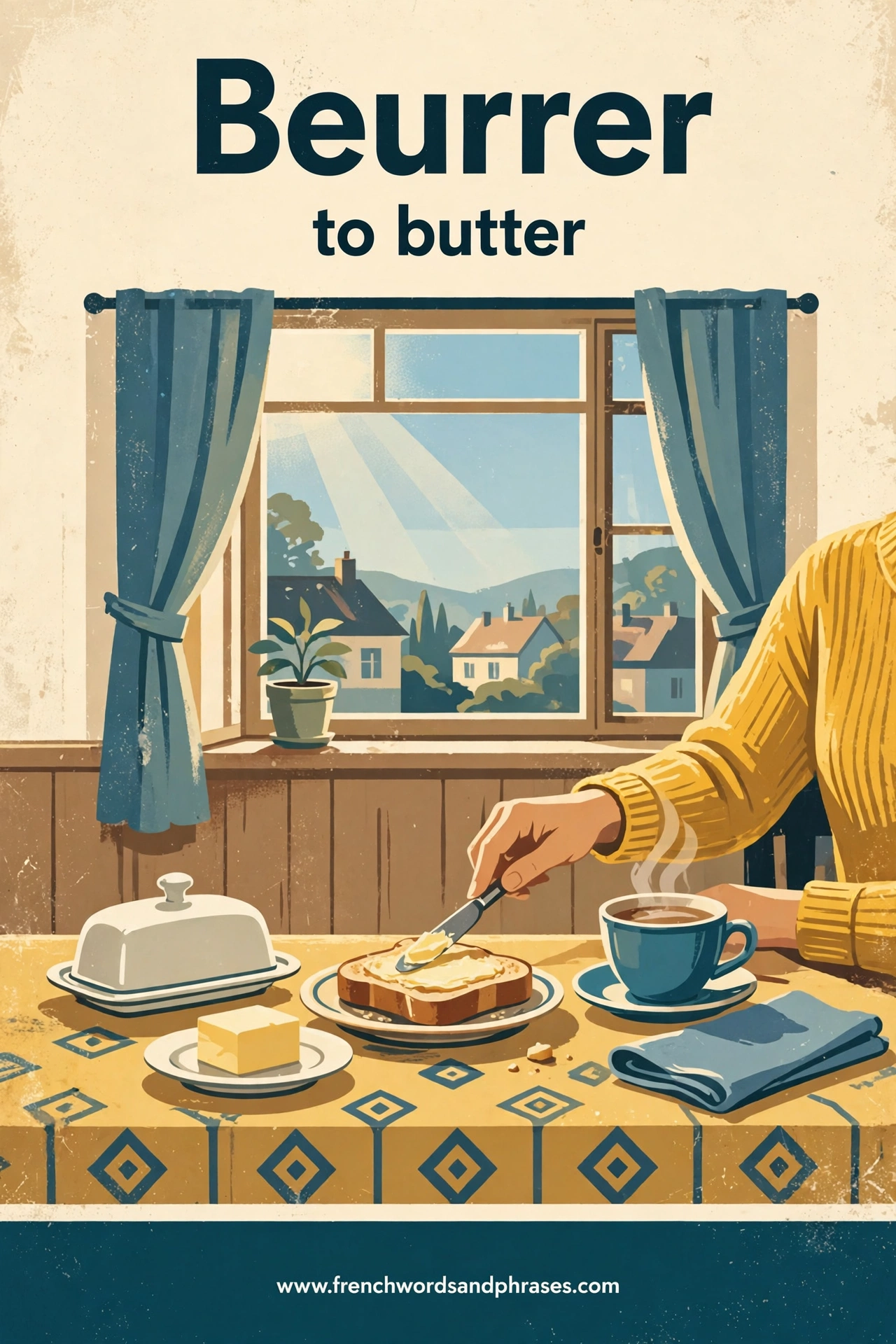
Imagine a farmhouse kitchen at seven in the morning. The bread is still warm, the butter soft from the pantry, and grandmother butters each slice slowly, edge to edge, des deux côtés when the grandchildren are watching — because in this house, an unbuttered corner is a small failure of love.
It takes ten seconds and nobody applauds. She has buttered — elle a beurré — and breakfast is suddenly a feast.
How to Conjugate Beurrer: Complete French Conjugation Guide
Let’s explore every major conjugation of beurrer, beginning with the indicative mood.
How to Conjugate Beurrer in the Indicative Mood
The indicative mood is used to express facts, observations, actions, and events.
How to Conjugate Beurrer in the Present Tense (Présent)
Used for actions happening now, habitual actions, and general truths.
| Subject | Conjugation |
|---|---|
| je | beurre |
| tu | beurres |
| il / elle | beurre |
| nous | beurrons |
| vous | beurrez |
| ils / elles | beurrent |
Example
Elle beurre généreusement ses tartines chaque matin.
She butters her toast generously every morning.
Quick Quiz 1
Complete the sentence:
Nous ______ le moule avant la pâte.
Reveal the answer
beurrons
Nous beurrons le moule avant la pâte.
We butter the tin before the batter.
How to Conjugate Beurrer in the Passé Composé
Used for completed actions in the past. Beurrer takes the auxiliary verb avoir.
| Subject | Conjugation |
|---|---|
| j’ | ai beurré |
| tu | as beurré |
| il / elle | a beurré |
| nous | avons beurré |
| vous | avez beurré |
| ils / elles | ont beurré |
Example
J’ai beurré le moule avant d’y verser la pâte.
I buttered the tin before pouring in the batter.
How to Conjugate Beurrer in the Imparfait (Imperfect Tense)
Used for habitual past actions, descriptions, and ongoing situations in the past.
| Subject | Conjugation |
|---|---|
| je | beurrais |
| tu | beurrais |
| il / elle | beurrait |
| nous | beurrions |
| vous | beurriez |
| ils / elles | beurraient |
Example
Grand-mère beurrait le plat avec un pinceau.
Grandmother used to butter the dish with a brush.
Quick Quiz 2
Choose the correct form:
I buttered the tin.
J’______ le moule. (ai beurré / suis beurré)
Reveal the answer
ai beurré
J’ai beurré le moule.
Beurrer takes avoir — suis beurré would mean I am drunk!
How to Conjugate Beurrer in the Plus-que-parfait
Used to describe an action that had already been completed before another past event.
| Subject | Conjugation |
|---|---|
| j’ | avais beurré |
| tu | avais beurré |
| il / elle | avait beurré |
| nous | avions beurré |
| vous | aviez beurré |
| ils / elles | avaient beurré |
Example
Il avait beurré les toasts avant l’arrivée des invités.
He had buttered the toasts before the guests arrived.
How to Conjugate Beurrer in the Passé Simple
Primarily used in formal writing, literature, and historical narratives. It is rarely used in everyday conversation.
| Subject | Conjugation |
|---|---|
| je | beurrai |
| tu | beurras |
| il / elle | beurra |
| nous | beurrâmes |
| vous | beurrâtes |
| ils / elles | beurrèrent |
Example
Le cuisinier beurra le plat et le mit au four.
The cook buttered the dish and put it in the oven.
How to Conjugate Beurrer in the Passé Antérieur
A literary tense used to express an action completed immediately before another past action, generally in the passé simple.
| Subject | Conjugation |
|---|---|
| j’ | eus beurré |
| tu | eus beurré |
| il / elle | eut beurré |
| nous | eûmes beurré |
| vous | eûtes beurré |
| ils / elles | eurent beurré |
Example
Quand elle eut beurré la poêle, elle y cassa les œufs.
When she had buttered the pan, she cracked the eggs into it.
How to Conjugate Beurrer in the Future Tense (Futur Simple)
Used to describe actions that will take place in the future.
| Subject | Conjugation |
|---|---|
| je | beurrerai |
| tu | beurreras |
| il / elle | beurrera |
| nous | beurrerons |
| vous | beurrerez |
| ils / elles | beurreront |
Example
Demain, tu beurreras les tartines pour tout le monde.
Tomorrow, you will butter the toast for everyone.
How to Conjugate Beurrer in the Futur Antérieur (Future Perfect)
Used for an action that will have been completed before a particular point in the future.
| Subject | Conjugation |
|---|---|
| j’ | aurai beurré |
| tu | auras beurré |
| il / elle | aura beurré |
| nous | aurons beurré |
| vous | aurez beurré |
| ils / elles | auront beurré |
Example
À huit heures, j’aurai beurré toutes les tranches.
By eight o’clock, I will have buttered all the slices.
How to Conjugate Beurrer in the Near Future (Futur Proche)
Used to describe something that is going to happen soon. Formed with aller + infinitive.
| Subject | Conjugation |
|---|---|
| je | vais beurrer |
| tu | vas beurrer |
| il / elle | va beurrer |
| nous | allons beurrer |
| vous | allez beurrer |
| ils / elles | vont beurrer |
Example
Attends, je vais beurrer le moule d’abord.
Wait, I am going to butter the tin first.
How to Conjugate Beurrer in the Conditional Mood
The conditional mood expresses what would happen under certain circumstances. It is also frequently used to make polite requests or express wishes.
How to Conjugate Beurrer in the Present Conditional
| Subject | Conjugation |
|---|---|
| je | beurrerais |
| tu | beurrerais |
| il / elle | beurrerait |
| nous | beurrerions |
| vous | beurreriez |
| ils / elles | beurreraient |
Example
Avec du beurre salé, je beurrerais même les légumes.
With salted butter, I would butter even the vegetables.
How to Conjugate Beurrer in the Past Conditional
| Subject | Conjugation |
|---|---|
| j’ | aurais beurré |
| tu | aurais beurré |
| il / elle | aurait beurré |
| nous | aurions beurré |
| vous | auriez beurré |
| ils / elles | auraient beurré |
Example
Le gâteau aurait moins collé si tu avais beurré le moule.
The cake would have stuck less if you had buttered the tin.
Beurrer in the Literary Past Conditional Form
This less common literary form uses the imperfect subjunctive of avoir.
| Subject | Conjugation |
|---|---|
| j’ | eusse beurré |
| tu | eusses beurré |
| il / elle | eût beurré |
| nous | eussions beurré |
| vous | eussiez beurré |
| ils / elles | eussent beurré |
Example
Il eût beurré ses tartines avec le même soin sans la pénurie de guerre.
He would have buttered his toast with the same care without the wartime shortage.
How to Conjugate Beurrer in the Subjunctive Mood
The subjunctive is used to express wishes, emotions, doubts, necessity, and uncertainty. It frequently follows expressions such as il faut que (it is necessary that) or bien que (although).
How to Conjugate Beurrer in the Present Subjunctive
| Subject | Conjugation |
|---|---|
| que je | beurre |
| que tu | beurres |
| qu’il / qu’elle | beurre |
| que nous | beurrions |
| que vous | beurriez |
| qu’ils / qu’elles | beurrent |
Example
Il faut que tu beurres le plat avant de commencer.
You must butter the dish before starting.
Quick Quiz 3
Complete the sentence using the subjunctive:
Il faut que vous ______ les tartines.
Reveal the answer
beurriez
Il faut que vous beurriez les tartines.
You must butter the toasts.
How to Conjugate Beurrer in the Imperfect Subjunctive
A literary tense, rarely encountered in modern spoken French.
| Subject | Conjugation |
|---|---|
| que je | beurrasse |
| que tu | beurrasses |
| qu’il / qu’elle | beurrât |
| que nous | beurrassions |
| que vous | beurrassiez |
| qu’ils / qu’elles | beurrassent |
Example
Elle voulait que je beurrasse les deux faces de la tartine.
She wanted me to butter both sides of the toast.
How to Conjugate Beurrer in the Pluperfect Subjunctive
A literary construction used to express an action completed before another past action.
| Subject | Conjugation |
|---|---|
| que j’ | eusse beurré |
| que tu | eusses beurré |
| qu’il / qu’elle | eût beurré |
| que nous | eussions beurré |
| que vous | eussiez beurré |
| qu’ils / qu’elles | eussent beurré |
Example
On racontait qu’il eût beurré sa tartine des deux côtés.
People said he had buttered his toast on both sides.
How to Conjugate Beurrer in the Past Subjunctive
| Subject | Conjugation |
|---|---|
| que j’ | aie beurré |
| que tu | aies beurré |
| qu’il / qu’elle | ait beurré |
| que nous | ayons beurré |
| que vous | ayez beurré |
| qu’ils / qu’elles | aient beurré |
Example
Je suis content que tu aies beurré le moule à temps.
I am glad you buttered the tin in time.
How to Conjugate Beurrer in the Imperative
The imperative is used to give commands, instructions, invitations, or suggestions. Subject pronouns are omitted.
How to Conjugate Beurrer in the Present Imperative
| Person | Conjugation |
|---|---|
| (tu) | beurre |
| (nous) | beurrons |
| (vous) | beurrez |
Example
Beurre bien le plat, sinon le gratin attachera !
Butter the dish well, or the gratin will stick!
Quick Quiz 4
How would you say Butter the dish well (tu form)?
Reveal the answer
Beurre bien le plat !
French Participles of Beurrer
Participles are verb forms that can be used in compound tenses and other grammatical constructions.
Present Participle of Beurrer
beurrant
En beurrant le moule, pense aussi aux bords.
When buttering the tin, remember the edges too.
Past Participle of Beurrer
beurré
Beurrée des deux côtés, la tartine fond dans la bouche.
Buttered on both sides, the toast melts in the mouth.
Beurrer in Everyday French: Real-Life Examples
Now that you know the conjugations, let’s see how beurrer appears in everyday French.
Example 1 — Present
Elle beurre ses tartines chaque matin.
She butters her toast every morning.
Example 2 — Passé composé
J’ai beurré le moule avant la pâte.
I buttered the tin before the batter.
Example 3 — Imparfait
Grand-mère beurrait le plat avec un pinceau.
Grandmother used to butter the dish with a brush.
Example 4 — Future
Tu beurreras les tartines pour tout le monde.
You will butter the toast for everyone.
Example 5 — Conditional
Je beurrerais même les légumes avec du beurre salé.
I would butter even the vegetables with salted butter.
Example 6 — Imperative
Beurre bien le plat !
Butter the dish well!
Beyond Translation: The Meaning of Beurrer
Butter is serious in France, and its verb has wandered far from the kitchen. To compter pour du beurre is to count for nothing at all; to faire son beurre is to make a tidy profit out of a situation; and to promise la lune et le beurre would be to promise the earth.
And the participle escaped furthest of all.
Somewhere between the butter dish and the bottle, beurré came to mean drunk — soaked, greased, well and truly buttered — which is why this modest kitchen verb has a wild reflexive twin, se beurrer.
How to Remember the French Verb Beurrer
Remember it this way: Beurrer is about butter spread edge to edge on the morning toast.
- Two kitchen jobs: beurrer une tartine (toast) and beurrer un moule (a tin, so nothing sticks).
- The double r never changes: je beurre, nous beurrons, past participle beurré.
- Watch the participle outside the kitchen: être beurré, in familiar French, means to be drunk.
The key idea is butter spread edge to edge on the morning toast.
Test Your Knowledge of Beurrer
Let’s see how much you’ve learned. Try answering these questions before revealing the answers.
Question 1
Why do recipes insist that you beurre le moule before the batter goes in?
Reveal the answer
So nothing sticks — a buttered tin lets the cake turn out cleanly.
Question 2
How do you say I buttered the tin before pouring in the batter in French?
Reveal the answer
J’ai beurré le moule avant d’y verser la pâte.
Question 3
Translate: She butters her toast generously every morning.
Reveal the answer
Elle beurre généreusement ses tartines chaque matin.
Question 4
What is the past participle of beurrer?
Reveal the answer
Beurré — and in familiar French, être beurré means to be drunk.
Question 5
Complete the sentence:
Il faut que tu ______ le plat avant de commencer.
Reveal the answer
beurres
Il faut que tu beurres le plat avant de commencer.
You must butter the dish before starting.
Your Final Challenge
Can You Use It?
How would you say this in French?
She butters her toast on both sides, because life is too short for dry bread.
Reveal the answer
Elle beurre sa tartine des deux côtés, parce que la vie est trop courte pour le pain sec.
She butters her toast on both sides, because life is too short for dry bread.
A little French. A little curiosity. A richer everyday life.
LEARN FRENCH ONE WORD AT A TIME