A French Word to Live By
How to Conjugate Besogner in French
/bə.zɔ.ɲe/
Besogner means to slave away — to work long and hard at a humble task, without glory and without rest.
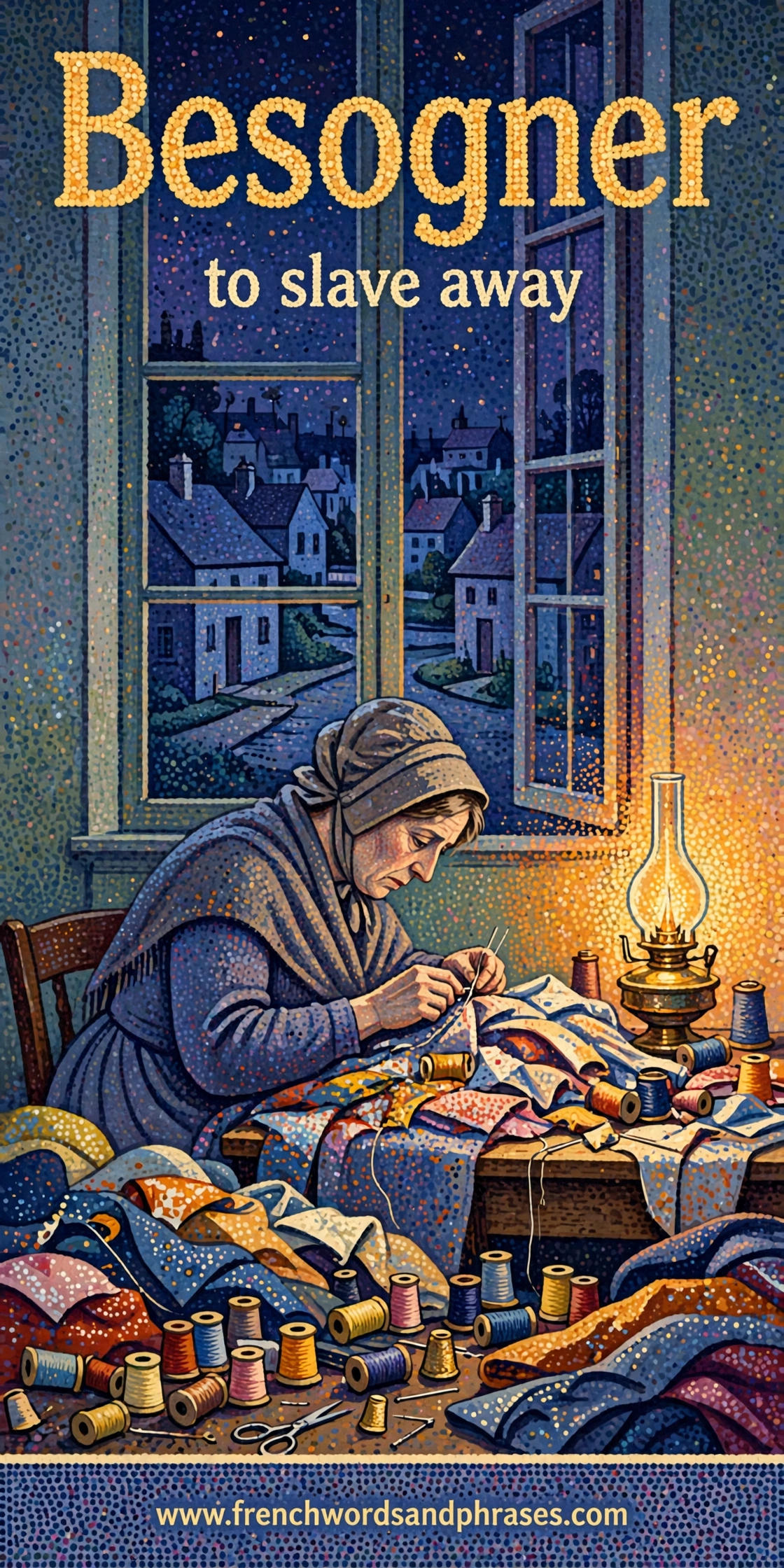
An old carpenter planing a board at dawn, a seamstress bent over her needle by lamplight, a clerk copying ledgers long after the office empties — besogner is the literary verb of humble, endless work: no talent on display, just hours, patience and worn hands.
In this guide, you’ll learn how to conjugate besogner in all the major French tenses and moods. Explore complete conjugation tables, French examples, English translations, and practice quizzes.
Understanding the French Verb Besogner
Besogner is a regular French verb belonging to the first group of verbs, those ending in -er.
It means to slave away. It is used of work that is long, repetitive and unglamorous — copying, sewing, digging, filing — and it always carries sympathy for the worker. Nobody besogne at a brilliant career; one besogne at a task that simply has to be finished.
Verb classification: First group (-er)
Auxiliary verb: Avoir
Past participle: besogné
Present participle: besognant
English equivalents: To toil, to drudge, to slave away; besogner à quelque chose — to labour at something; besogner du matin au soir — to toil from morning to night; la besogne — the task, the job at hand (the noun is far commoner than the verb).
One important detail: besogner is a regular -er verb — je besogne, nous besognons, past participle besogné — and the letters gn sound like the middle of oignon: /ɲ/. The real trap is register: the verb itself is literary and old-fashioned, the word of novels and grandparents, while its noun la besogne is alive in everyday French — une sale besogne, dirty work; faire la besogne, to do the job. Learn the verb for reading, and the noun for speaking.
Experience the Word
Besogner is the verb of work without witnesses — the hours nobody applauds, repeated until the task is done.
Imagine a village workshop in 1900. The joiner arrives before the church bell, planes, saws and glues until dark, and eats his soup standing up. He is not building a masterpiece; he is mending chairs and coffins — il besogne, day after day, and the village runs on his patience.
There is no glory in it and no complaint either. He has toiled — besogné — and the work is simply, solidly done.
How to Conjugate Besogner: Complete French Conjugation Guide
Let’s explore every major conjugation of besogner, beginning with the indicative mood.
How to Conjugate Besogner in the Indicative Mood
The indicative mood is used to express facts, observations, actions, and events.
How to Conjugate Besogner in the Present Tense (Présent)
Used for actions happening now, habitual actions, and general truths.
| Subject | Conjugation |
|---|---|
| je | besogne |
| tu | besognes |
| il / elle | besogne |
| nous | besognons |
| vous | besognez |
| ils / elles | besognent |
Example
Les artisans besognent du matin au soir dans leur atelier.
The craftsmen toil from morning to night in their workshop.
Quick Quiz 1
Complete the sentence:
Nous ______ du matin au soir.
Reveal the answer
besognons
Nous besognons du matin au soir.
We toil from morning to night.
How to Conjugate Besogner in the Passé Composé
Used for completed actions in the past. Besogner takes the auxiliary verb avoir.
| Subject | Conjugation |
|---|---|
| j’ | ai besogné |
| tu | as besogné |
| il / elle | a besogné |
| nous | avons besogné |
| vous | avez besogné |
| ils / elles | ont besogné |
Example
Il a besogné toute sa vie pour nourrir sa famille.
He slaved away all his life to feed his family.
How to Conjugate Besogner in the Imparfait (Imperfect Tense)
Used for habitual past actions, descriptions, and ongoing situations in the past.
| Subject | Conjugation |
|---|---|
| je | besognais |
| tu | besognais |
| il / elle | besognait |
| nous | besognions |
| vous | besogniez |
| ils / elles | besognaient |
Example
Nos grands-pères besognaient dans les champs sans relâche.
Our grandfathers used to toil in the fields without respite.
Quick Quiz 2
Choose the correct form:
He slaved away all his life.
Il ______ toute sa vie. (a besogné / est besogné)
Reveal the answer
a besogné
Il a besogné toute sa vie.
Besogner takes avoir.
How to Conjugate Besogner in the Plus-que-parfait
Used to describe an action that had already been completed before another past event.
| Subject | Conjugation |
|---|---|
| j’ | avais besogné |
| tu | avais besogné |
| il / elle | avait besogné |
| nous | avions besogné |
| vous | aviez besogné |
| ils / elles | avaient besogné |
Example
Elle avait besogné des années avant de voir son livre publié.
She had laboured for years before seeing her book published.
How to Conjugate Besogner in the Passé Simple
Primarily used in formal writing, literature, and historical narratives. It is rarely used in everyday conversation.
| Subject | Conjugation |
|---|---|
| je | besognai |
| tu | besognas |
| il / elle | besogna |
| nous | besognâmes |
| vous | besognâtes |
| ils / elles | besognèrent |
Example
Le vieux menuisier besogna jusqu’à son dernier jour.
The old carpenter toiled until his last day.
How to Conjugate Besogner in the Passé Antérieur
A literary tense used to express an action completed immediately before another past action, generally in the passé simple.
| Subject | Conjugation |
|---|---|
| j’ | eus besogné |
| tu | eus besogné |
| il / elle | eut besogné |
| nous | eûmes besogné |
| vous | eûtes besogné |
| ils / elles | eurent besogné |
Example
Quand il eut besogné toute la journée, il s’endormit sur la table.
When he had slaved all day, he fell asleep at the table.
How to Conjugate Besogner in the Future Tense (Futur Simple)
Used to describe actions that will take place in the future.
| Subject | Conjugation |
|---|---|
| je | besognerai |
| tu | besogneras |
| il / elle | besognera |
| nous | besognerons |
| vous | besognerez |
| ils / elles | besogneront |
Example
Demain, nous besognerons encore sur ce chantier.
Tomorrow, we shall toil again on this building site.
How to Conjugate Besogner in the Futur Antérieur (Future Perfect)
Used for an action that will have been completed before a particular point in the future.
| Subject | Conjugation |
|---|---|
| j’ | aurai besogné |
| tu | auras besogné |
| il / elle | aura besogné |
| nous | aurons besogné |
| vous | aurez besogné |
| ils / elles | auront besogné |
Example
À la fin du mois, ils auront besogné cent heures sur ce projet.
By the end of the month, they will have slaved a hundred hours on this project.
How to Conjugate Besogner in the Near Future (Futur Proche)
Used to describe something that is going to happen soon. Formed with aller + infinitive.
| Subject | Conjugation |
|---|---|
| je | vais besogner |
| tu | vas besogner |
| il / elle | va besogner |
| nous | allons besogner |
| vous | allez besogner |
| ils / elles | vont besogner |
Example
Allez, on va besogner un peu avant le dîner !
Come on, we are going to do a bit of work before dinner!
How to Conjugate Besogner in the Conditional Mood
The conditional mood expresses what would happen under certain circumstances. It is also frequently used to make polite requests or express wishes.
How to Conjugate Besogner in the Present Conditional
| Subject | Conjugation |
|---|---|
| je | besognerais |
| tu | besognerais |
| il / elle | besognerait |
| nous | besognerions |
| vous | besogneriez |
| ils / elles | besogneraient |
Example
Sans cette machine, vous besogneriez deux fois plus.
Without this machine, you would toil twice as much.
How to Conjugate Besogner in the Past Conditional
| Subject | Conjugation |
|---|---|
| j’ | aurais besogné |
| tu | aurais besogné |
| il / elle | aurait besogné |
| nous | aurions besogné |
| vous | auriez besogné |
| ils / elles | auraient besogné |
Example
Il aurait besogné toute la nuit si on ne l’avait pas arrêté.
He would have slaved all night if no one had stopped him.
Besogner in the Literary Past Conditional Form
This less common literary form uses the imperfect subjunctive of avoir.
| Subject | Conjugation |
|---|---|
| j’ | eusse besogné |
| tu | eusses besogné |
| il / elle | eût besogné |
| nous | eussions besogné |
| vous | eussiez besogné |
| ils / elles | eussent besogné |
Example
Il eût besogné jusqu’à l’aube pour finir la commande.
He would have toiled until dawn to finish the order.
How to Conjugate Besogner in the Subjunctive Mood
The subjunctive is used to express wishes, emotions, doubts, necessity, and uncertainty. It frequently follows expressions such as il faut que (it is necessary that) or bien que (although).
How to Conjugate Besogner in the Present Subjunctive
| Subject | Conjugation |
|---|---|
| que je | besogne |
| que tu | besognes |
| qu’il / qu’elle | besogne |
| que nous | besognions |
| que vous | besogniez |
| qu’ils / qu’elles | besognent |
Example
Il faut que chacun besogne sans se plaindre.
Everyone must toil without complaining.
Quick Quiz 3
Complete the sentence using the subjunctive:
Il faut que vous ______ sans vous plaindre.
Reveal the answer
besogniez
Il faut que vous besogniez sans vous plaindre.
You must toil without complaining.
How to Conjugate Besogner in the Imperfect Subjunctive
A literary tense, rarely encountered in modern spoken French.
| Subject | Conjugation |
|---|---|
| que je | besognasse |
| que tu | besognasses |
| qu’il / qu’elle | besognât |
| que nous | besognassions |
| que vous | besognassiez |
| qu’ils / qu’elles | besognassent |
Example
Le patron exigeait que les ouvriers besognassent le dimanche.
The boss demanded that the workers slave away on Sundays.
How to Conjugate Besogner in the Pluperfect Subjunctive
A literary construction used to express an action completed before another past action.
| Subject | Conjugation |
|---|---|
| que j’ | eusse besogné |
| que tu | eusses besogné |
| qu’il / qu’elle | eût besogné |
| que nous | eussions besogné |
| que vous | eussiez besogné |
| qu’ils / qu’elles | eussent besogné |
Example
On disait qu’il eût besogné toute sa vie pour rien.
People said he had toiled all his life for nothing.
How to Conjugate Besogner in the Past Subjunctive
| Subject | Conjugation |
|---|---|
| que j’ | aie besogné |
| que tu | aies besogné |
| qu’il / qu’elle | ait besogné |
| que nous | ayons besogné |
| que vous | ayez besogné |
| qu’ils / qu’elles | aient besogné |
Example
Je suis content que tu aies besogné sérieusement cette semaine.
I am glad you worked hard this week.
How to Conjugate Besogner in the Imperative
The imperative is used to give commands, instructions, invitations, or suggestions. Subject pronouns are omitted.
How to Conjugate Besogner in the Present Imperative
| Person | Conjugation |
|---|---|
| (tu) | besogne |
| (nous) | besognons |
| (vous) | besognez |
Example
Besogne sans relâche, le succès viendra !
Toil without respite, success will come!
Quick Quiz 4
How would you say Toil without respite (tu form)?
Reveal the answer
Besogne sans relâche !
French Participles of Besogner
Participles are verb forms that can be used in compound tenses and other grammatical constructions.
Present Participle of Besogner
besognant
En besognant jour et nuit, elle a terminé sa thèse.
By toiling day and night, she finished her thesis.
Past Participle of Besogner
besogné
Besogné pendant des mois, ce rapport a enfin été remis au directeur.
Laboured over for months, this report was finally handed to the director.
Besogner in Everyday French: Real-Life Examples
Now that you know the conjugations, let’s see how besogner appears in everyday French.
Example 1 — Present
Les artisans besognent du matin au soir.
The craftsmen toil from morning to night.
Example 2 — Passé composé
Il a besogné toute sa vie.
He slaved away all his life.
Example 3 — Imparfait
Nos grands-pères besognaient dans les champs.
Our grandfathers used to toil in the fields.
Example 4 — Future
Nous besognerons encore demain.
We shall toil again tomorrow.
Example 5 — Conditional
Vous besogneriez deux fois plus sans la machine.
You would toil twice as much without the machine.
Example 6 — Imperative
Besogne sans relâche !
Toil without respite!
Beyond Translation: The Meaning of Besogner
The verb may be retiring, but its noun runs modern France: la besogne is the task at hand, and French still says faire la sale besogne — to do the dirty work — aimer la besogne bien faite, to love a job well done, and s’abattre sur la besogne, to fall to work.
Besogner is the humble ancestor of them all.
Where travailler is neutral and trimer is slang, besogner keeps the smell of the workshop: wood shavings, lamp oil, and work done properly because it had to be.
How to Remember the French Verb Besogner
Remember it this way: Besogner is about the old craftsman at his bench, dawn to dusk.
- The noun is the everyday word: la besogne — une sale besogne, dirty work; the verb is its literary elder.
- It means humble, endless work: besogner du matin au soir, to toil from morning to night.
- Regular -er, with gn like oignon: je besogne, nous besognons, past participle besogné.
The key idea is the old craftsman at his bench, dawn to dusk.
Test Your Knowledge of Besogner
Let’s see how much you’ve learned. Try answering these questions before revealing the answers.
Question 1
Which is commoner in modern French, the verb besogner or the noun la besogne?
Reveal the answer
La besogne — the noun is everyday French (une sale besogne); the verb is literary and old-fashioned.
Question 2
How do you say He slaved away all his life in French?
Reveal the answer
Il a besogné toute sa vie.
Question 3
Translate: The craftsmen toil from morning to night.
Reveal the answer
Les artisans besognent du matin au soir.
Question 4
What is the past participle of besogner?
Reveal the answer
Besogné.
Question 5
Complete the sentence:
Il faut que chacun ______ sans se plaindre.
Reveal the answer
besogne
Il faut que chacun besogne sans se plaindre.
Everyone must toil without complaining.
Your Final Challenge
Can You Use It?
How would you say this in French?
He slaved away all his life in his little workshop, and his furniture still lives on.
Reveal the answer
Il besogna toute sa vie dans son petit atelier, et ses meubles vivent encore.
He slaved away all his life in his little workshop, and his furniture still lives on.
A little French. A little curiosity. A richer everyday life.
LEARN FRENCH ONE WORD AT A TIME