A French Word to Live By
Translate Barbe à papa to English
/baʁb a pa.pa/
Barbe à papa means cotton candy — the pink spun-sugar cloud sold at fairs and funfairs.
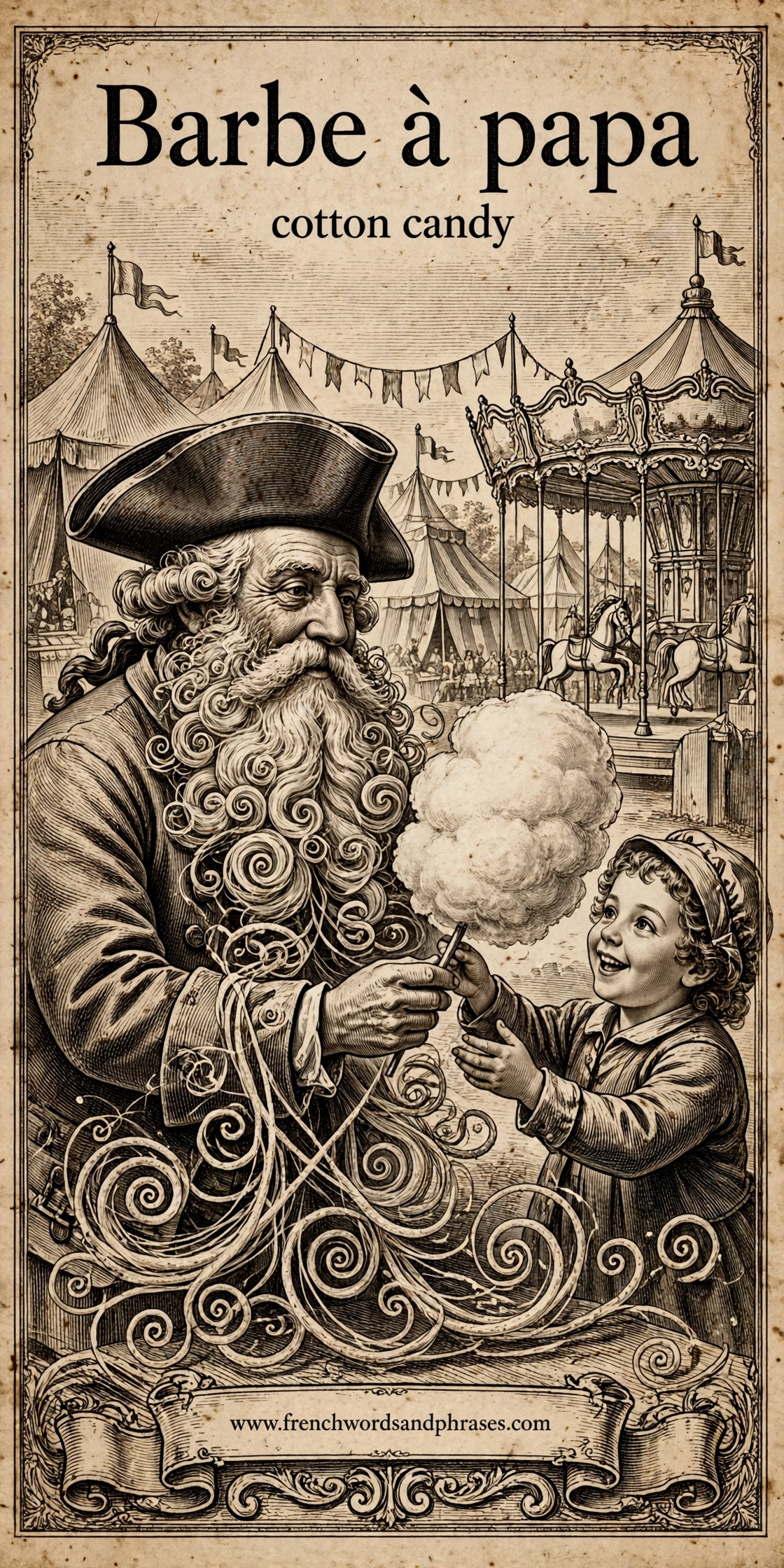
The fair is at its loudest — music from the carousel, the smell of hot sugar in the air. A little girl on her father’s shoulders points at the machine where a pink cloud is growing on a stick, and asks for the thing by the only name it has ever had: « Papa, une barbe à papa ! »
Let’s explore how barbe à papa works in French, beginning with the whole phrase on one card.
Understanding the French Phrase Barbe à papa
Barbe à papa is a French expression — a food name built from barbe (a beard) and à papa (daddy’s). The spun sugar, wound in soft wisps around a stick, looked to its inventors like a father’s white beard: the sweet is named for the beard it imitates, pink cloud and all.
It means cotton candy — the fairground sweet made by spinning hot sugar into fine threads and gathering them into a cloud on a stick. In Britain the same cloud is called candy floss. Nothing about it is a beard, and no father is involved: it is pure picture-naming, the poetry French applies to its sweets.
Type: Food name — a fairground sweet (noun phrase)
Answers the need: Asking for, offering or remembering the spun-sugar cloud at a fair
Register: Neutral and affectionate — the word of childhood, fairs and seaside stalls
Strength: Pure nostalgia — few French words taste as strongly of being seven years old
One important usage detail: barbe à papa is feminine — une barbe à papa — and the phrase never changes: des barbes à papa for several. Note that papa is the informal word for dad (père is the formal one), which keeps the name cosy. And do not expect the sweet to always be pink: blue and white clouds exist, but the name — and the beard — stay the same.
Experience the Word
Barbe à papa is the fair itself, made edible — a cloud you are allowed to eat with your fingers, badly.
Imagine the machine spinning, the threads gathering, the cloud growing bigger than the child’s head. Ten minutes later it is gone, leaving pink fingers, a pink chin and a memory that will outlast every ride on the fairground.
French could have called it sugar wool or sweet cloud. It chose a father’s beard — because French sweets are named by people who look at the world with affection.
How to Use Barbe à papa in French: Complete Guide
Let’s explore how barbe à papa works in French, beginning with the whole phrase on one card.
Barbe à papa at a Glance
The Whole Phrase on One Card
Real meaning, literal picture, English twin and register — barbe à papa in five lines.
| Point | Barbe à papa |
|---|---|
| What it really means | cotton candy — spun sugar gathered into a cloud on a stick |
| Word for word | daddy’s beard — the wispy cloud looks like a soft white beard |
| English equivalent | cotton candy (US) / candy floss (UK) |
| Register | neutral and affectionate — childhood and fairgrounds |
| Use it for | fairs, funfairs, seaside stalls, circus intervals |
Example
Les enfants réclament une barbe à papa devant le manège.
The children are asking for cotton candy in front of the carousel.
Word by Word: Building the Cloud
Three small pieces — take them one by one and the sugar starts to spin.
| Word | Literal meaning | Its job in the phrase |
|---|---|---|
| barbe | beard | the picture: soft wisps of sugar, like a beard |
| à | of, belonging to | the little link that gives the beard an owner |
| papa | dad, daddy | the informal word for father — the beard is his |
Example
Une barbe rose sur un bâton, et voilà la barbe à papa.
A pink beard on a stick, and there is the cotton candy.
Quick Quiz 1
Why is cotton candy called a beard in French?
Reveal the answer
Because of its look — the fine spun-sugar wisps resemble a soft, fluffy beard, and papa gives it its cosy owner.
Avec sa barbe à papa, elle ressemble au Père Noël.
With her cotton candy, she looks like Father Christmas.
When You Say It: The Fairground Moments
Barbe à papa fires at moments like these — the music is loud, the lights are on, and small hands are pointing.
| Situation | Example |
|---|---|
| At the fair | une barbe à papa, s’il te plaît ! — a cotton candy, please! |
| Choosing the colour | elle veut la barbe à papa rose — she wants the pink cotton candy |
| Sticky fingers | il a de la barbe à papa partout sur les doigts — he has cotton candy all over his fingers |
| Remembering childhood | la barbe à papa, c’était le goût des fêtes — cotton candy was the taste of fairs |
| At the circus | à l’entracte, une barbe à papa pour les enfants — at the interval, cotton candy for the children |
Example
À la fête foraine, impossible de refuser une barbe à papa.
At the fairground, it’s impossible to refuse a cotton candy.
Make It Yours: The Cloud for Every Fair
The phrase is a fixed noun — what changes is how many clouds, and whose hands they are melting on.
| Form | French | In English |
|---|---|---|
| One cloud | une barbe à papa | a cotton candy |
| Several | des barbes à papa | cotton candies |
| Asking for one | je voudrais une barbe à papa | I’d like a cotton candy |
| The pink one | la barbe à papa rose | the pink cotton candy |
| Eating it | manger une barbe à papa | to eat a cotton candy |
| The machine | la machine à barbe à papa | the cotton candy machine |
Example
Je voudrais une barbe à papa rose, la plus grande.
I’d like a pink cotton candy, the biggest one.
Quick Quiz 2
Is it un or une barbe à papa?
Reveal the answer
Une — barbe is feminine, and the whole phrase follows it: une barbe à papa.
Elle tient une énorme barbe à papa à deux mains.
She is holding a huge cotton candy in both hands.
Everyday Expressions: Building on the Cloud
Barbe à papa slots into these everyday frames — each one ready to use as it stands.
| Frame | In English |
|---|---|
| une barbe à papa | a cotton candy |
| une barbe à papa rose | a pink cotton candy |
| la machine à barbe à papa | the cotton candy machine |
| des doigts pleins de barbe à papa | fingers covered in cotton candy |
| le goût de la barbe à papa | the taste of cotton candy |
Example
Le goût de la barbe à papa, c’est le goût des vacances.
The taste of cotton candy is the taste of holidays.
Close Cousins: The Other Fairground Sweets
The French fairground is a small patisserie of pictures — the beard is the cloud; its cousins are apples, pralines and whips of sugar.
| Expression | The difference |
|---|---|
| barbe à papa | cotton candy — the spun-sugar cloud |
| une pomme d’amour | a toffee apple — literally an ‘apple of love’, glossy red on its stick |
| des chouchous | candied peanuts sold warm at fairs and beaches |
| une gaufre | a waffle — the fairground classic, dusted with sugar |
| un manège | a carousel — not a sweet, but the cloud’s natural neighbour |
Example
Une pomme d’amour pour lui, une barbe à papa pour elle.
A toffee apple for him, a cotton candy for her.
Quick Quiz 3
What is une pomme d’amour at the fair — a love letter, or a sweet?
Reveal the answer
A sweet — a toffee apple: an apple in a glossy red sugar coat, on a stick.
La pomme d’amour brille comme un bijou rouge.
The toffee apple shines like a red jewel.
Barbe à papa and Its Neighbours
The fairground shelf around the phrase — rides, stalls and sugar in every form.
| French | In English |
|---|---|
| la fête foraine | the funfair |
| un manège | a carousel, a merry-go-round |
| la grande roue | the big wheel |
| le sucre | sugar |
| un bâton | a stick |
| collant | sticky |
Example
Près de la grande roue, le stand de barbe à papa ne désemplit pas.
Near the big wheel, the cotton candy stall is always busy.
Watch Out: The Traps Around Barbe à papa
The traps: two English names for one cloud, a beard that is not on a face, and a father who is never there.
| Trap | The truth |
|---|---|
| two English twins | cotton candy in America, candy floss in Britain — one French name covers both |
| not a real beard | nobody is describing a father’s face: the beard is the shape of the sweet, nothing more |
| papa, not père | the name uses papa, the cosy word — ‘barbe à père’ does not exist |
| the cloud can change colour | pink is classic, blue exists — the name never changes with the dye |
Example
Barbe bleue ou barbe rose, c’est toujours une barbe à papa.
Blue beard or pink beard, it’s still cotton candy.
Quick Quiz 4
True or false: barbe à papa is named after a real father with a sweet tooth.
Reveal the answer
False — it is named for the look: spun sugar wisps that resemble a soft beard. No particular father is involved.
La barbe du Père Noël est blanche, celle-ci est rose.
Father Christmas’s beard is white; this one is pink.
Barbe à papa in Everyday French: Real-Life Examples
Now that you know the word, let’s see how barbe à papa appears in everyday French.
Example 1 — At the fair
Les enfants veulent une barbe à papa avant le manège.
The children want a cotton candy before the carousel.
Example 2 — The pink one
Elle a choisi la plus grande barbe à papa rose.
She chose the biggest pink cotton candy.
Example 3 — Sticky fingers
Il a les doigts pleins de barbe à papa.
His fingers are covered in cotton candy.
Example 4 — At the circus
À l’entracte, tout le monde achète une barbe à papa.
At the interval, everyone buys a cotton candy.
Example 5 — Childhood memory
La barbe à papa me rappelle les fêtes de mon enfance.
Cotton candy reminds me of the fairs of my childhood.
Example 6 — The stall
Le stand de barbe à papa est juste à côté de la grande roue.
The cotton candy stall is right next to the big wheel.
Beyond Translation: The Meaning of Barbe à papa
English names the sweet after its materials — cotton, candy, floss: a small inventory of what it is made of. French names it after a person who is not there: a father, his beard, transformed into sugar and sold on a stick. The French name is useless as a description and perfect as a memory.
Barbe à papa is proof that French prefers a picture to a recipe — you do not eat ingredients, you eat a story.
Every French adult who orders one is, for exactly ten minutes, seven years old again.
How to Remember the French Phrase Barbe à papa
Remember it this way: Barbe à papa is the fairground cloud — spun sugar wearing a father’s beard as its name and its portrait.
- You picture the wisps — fine sugar threads, soft and fluffy as a beard: the name is a portrait.
- You keep papa, not père — the cosy word is part of the recipe, and it never changes.
- You order with une — une barbe à papa, feminine, however many clouds you buy.
The key idea is barbe à papa means cotton candy — the spun-sugar cloud named after a father’s beard.
Test Your Knowledge of Barbe à papa
Let’s see how much you’ve learned. Try answering these questions before revealing the answers.
Question 1
What does barbe à papa mean?
Reveal the answer
Cotton candy — the spun-sugar cloud sold at fairs (candy floss in Britain).
Question 2
Why is it called a beard?
Reveal the answer
Because the fine sugar wisps look like a soft, fluffy beard — papa’s beard, in the affectionate picture.
Question 3
Is it un or une barbe à papa?
Reveal the answer
Une — barbe is feminine, and the phrase follows it.
Question 4
What is une pomme d’amour at the fair?
Reveal the answer
A toffee apple — an apple in a glossy red sugar coat on a stick, the beard’s fairground cousin.
Question 5
Complete the sentence:
Les enfants réclament une ______ à papa. (The children are asking for a cotton candy.)
Reveal the answer
barbe
Les enfants réclament une barbe à papa.
The children are asking for a cotton candy.
Your Final Challenge
Can You Use It?
How would you say this in French?
“The children are asking for cotton candy.”
Reveal the answer
Les enfants réclament une barbe à papa.
The children are asking for cotton candy.
A little French. A little curiosity. A richer everyday life.
LEARN FRENCH ONE WORD AT A TIME