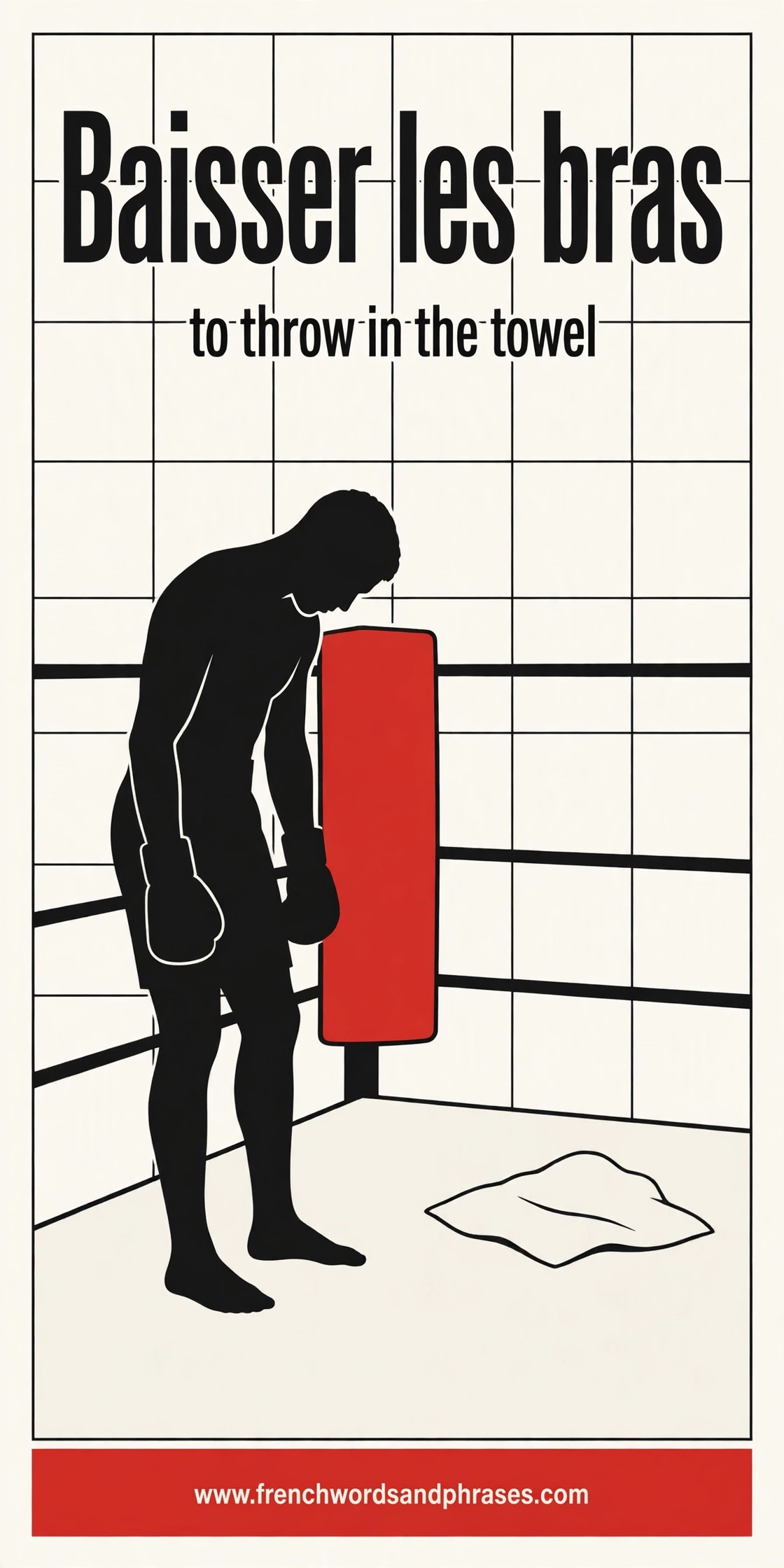
A French Word to Live By
Translate Baisser les bras to English
/be.se le bʁa/
Baisser les bras means to give up — to let your arms drop and stop fighting.
The community hall is half painted, the volunteers are down to three, and the ladder suddenly looks very tall. The oldest volunteer looks at the wall, at her brush, and sighs: « On ne va pas baisser les bras maintenant. » Brushes go back into the paint. In French, dropping your arms is the one thing you announce you will not do.
Let’s explore how baisser les bras works in French, beginning with the whole phrase on one card.
Understanding the French Phrase Baisser les bras
Baisser les bras is a French idiomatic expression built from baisser (to lower) and les bras (the arms). The picture is the body giving up before the mind says it: arms that were raised to work, to fight, to carry — dropping to the sides.
It means to give up — to stop trying, to abandon the effort in the face of difficulty. Raised arms work, box, build and resist; lowered arms are the white flag of the body. The phrase lives most often in its negative, as a rallying cry — il ne faut pas baisser les bras, don’t give up — said by coaches, parents and friends at exactly the moment when giving up looks tempting.
Type: Idiomatic expression — effort (verb + body-part picture)
Answers the need: Saying someone gave up — or urging them not to
Register: Neutral — everyday speech and writing; at home in speeches too
Strength: Serious — a real surrender, not a pause for breath
One important usage detail: the phrase’s favourite home is the negative imperative — ne baisse pas les bras, ne baissons pas les bras — encouragement shouted at the exact moment of discouragement. In the positive it reports a defeat: après trois refus, il a fini par baisser les bras. The arms are always plural, les bras, and baisser never becomes lever: raising them again is reprendre courage, a different phrase.
Experience the Word
Baisser les bras is surrender you can see — no words needed, the shoulders say it first.
Imagine the young boxer in the village gym, arms heavy as lead in the last round, gloves sinking an inch at a time. The old trainer has seen that droop a hundred times and knows it for what it is: not tiredness, but the beginning of giving up. His whole philosophy fits in one shout from the corner: baisse pas les bras !
French trusts the body to tell the truth about courage. Effort lives in raised arms; the moment they fall, the story changes.
How to Use Baisser les bras in French: Complete Guide
Let’s explore how baisser les bras works in French, beginning with the whole phrase on one card.
Baisser les bras at a Glance
The Whole Phrase on One Card
Real meaning, literal picture, English twin and register — baisser les bras in five lines.
| Point | Baisser les bras |
|---|---|
| What it really means | to give up, to stop trying |
| Word for word | to lower the arms |
| English equivalent | to throw in the towel / to give up / to quit |
| Register | neutral — and a classic rallying cry in the negative |
| Use it for | abandoned projects, lost causes, and the moment just before them |
Example
Après des mois d’efforts, il a baissé les bras.
After months of effort, he gave up.
Word by Word: Building the Surrender
Three small pieces — take them one by one and the arms begin to fall.
| Word | Literal meaning | Its job in the phrase |
|---|---|---|
| baisser | to lower | the movement of surrender — what was raised comes down |
| les | the | the definite article — both arms, the working pair |
| bras | arms | the body’s tools for work and fighting — when they drop, the effort ends |
Example
Baisser les bras, ce n’est pas son genre.
Giving up is not her style.
Quick Quiz 1
What are the arms doing in baisser les bras — rising or dropping?
Reveal the answer
Dropping — baisser is to lower. Arms raised are effort; arms lowered are the end of it.
Fatigué, il a laissé tomber ses bras et il a baissé les bras.
Tired, he let his arms fall and gave up.
When You Say It: The Giving-Up Moments
Baisser les bras fires at moments like these — wherever an effort ends, or nearly ends.
| Situation | Example |
|---|---|
| The rallying cry | allez, on ne baisse pas les bras ! — come on, don’t give up! |
| After repeated failure | après trois échecs, elle a failli baisser les bras — after three failures, she nearly gave up |
| A project abandoned | le projet tombait, tout le monde baissait les bras — the project was collapsing, everyone was giving up |
| A parent’s encouragement | ne baisse pas les bras, tu y es presque — don’t give up, you’re nearly there |
| Refusing to quit | baisser les bras ? jamais ! — give up? never! |
Example
On a failli baisser les bras, puis la solution est arrivée.
We nearly gave up, then the solution arrived.
Make It Yours: The Arms for Every Person
Baisser is a regular -er verb; les bras never changes, whatever the subject.
| Form | French | In English |
|---|---|---|
| He gave up | il a baissé les bras | he gave up |
| Don’t give up (tu) | ne baisse pas les bras | don’t give up |
| Let’s not give up | ne baissons pas les bras | let’s not give up |
| She nearly gave up | elle a failli baisser les bras | she nearly gave up |
| They never give up | ils ne baissent jamais les bras | they never give up |
| Question | tu ne vas pas baisser les bras ? | you’re not going to give up, are you? |
Example
Ne baissons pas les bras, le plus dur est fait.
Let’s not give up, the hardest part is done.
Quick Quiz 2
Which form is the classic encouragement — baisse les bras or ne baisse pas les bras?
Reveal the answer
Ne baisse pas les bras — the phrase lives in the negative: the arms must stay up.
Ne baisse pas les bras, on arrive au bout.
Don’t give up, we’re nearly there.
Everyday Expressions: Building on the Arms
Baisser les bras slots into these everyday frames — each one ready to use as it stands.
| Frame | In English |
|---|---|
| baisser les bras | to give up |
| ne pas baisser les bras | to not give up — the rallying version |
| faillir baisser les bras | to nearly give up |
| baisser les bras devant les difficultés | to give up in the face of difficulties |
| ce n’est pas le moment de baisser les bras | this is not the moment to give up |
Example
Ce n’est pas le moment de baisser les bras, on touche au but.
This is not the moment to give up, we’re within reach of the goal.
Close Cousins: The Other Ways to Stop
French has a whole shelf of stopping phrases — the arms are the visible one; its cousins throw, abandon and let go.
| Expression | The difference |
|---|---|
| baisser les bras | to give up — the arms drop; serious, and classic in the negative |
| jeter l’éponge | to throw in the towel — boxing’s version; French throws a sponge, not a towel |
| abandonner | to give up, to abandon — the plain verb, no picture attached |
| lâcher prise | to let go — releasing your grip, often wiser and calmer than surrender |
| laisser tomber | to drop it, to let it go — informal, for plans and people alike |
Example
Il a lâché prise sur le détail, mais il n’a pas baissé les bras sur le projet.
He let go of the detail, but he didn’t give up on the project.
Quick Quiz 3
English throws a towel; what does French throw in jeter l’éponge?
Reveal the answer
A sponge — l’éponge. The boxing corner’s sponge does the towel’s job in French.
Après dix rounds, son coin a jeté l’éponge.
After ten rounds, his corner threw in the sponge.
Baisser les bras and Its Neighbours
The effort shelf around the phrase — the trying, the tiring and the carrying on.
| French | In English |
|---|---|
| persévérer | to persevere — the arms staying up, as a verb |
| le découragement | discouragement — the feeling before the drop |
| tenir bon | to hold on, to hang in there |
| reprendre courage | to take heart again |
| un effort | an effort |
| abandonner | to give up — the plain cousin |
Example
Malgré le découragement, elle a tenu bon et n’a pas baissé les bras.
Despite the discouragement, she held on and did not give up.
Watch Out: The Traps Around Baisser les bras
The traps: a gym instruction with the same words, arms that must stay plural, and a towel that becomes a sponge.
| Trap | The truth |
|---|---|
| the literal gym version | in a fitness class, baissez les bras really does mean lower your arms — context decides between instruction and surrender |
| always les bras | the phrase needs both arms, plural: les bras. One arm is a different, smaller gesture |
| not lever | lever les bras is to raise your arms — surrender’s exact opposite, and a sign of arrest or celebration elsewhere |
| the English towel | translating ‘throw in the towel’ word for word fails — French throws l’éponge, the sponge |
Example
Au cours de gym, on baisse les bras ; dans la vie, on évite.
In gym class, you lower your arms; in life, you avoid it.
Quick Quiz 4
True or false: in a French gym class, baissez les bras means ‘give up’.
Reveal the answer
False — there it is a plain instruction: lower your arms. The idiom needs a struggle, not a stretching mat.
Baissez les bras, respirez, on reprend.
Lower your arms, breathe, we start again.
Baisser les bras in Everyday French: Real-Life Examples
Now that you know the word, let’s see how baisser les bras appears in everyday French.
Example 1 — The rallying cry
Allez, on ne baisse pas les bras, on continue !
Come on, don’t give up, let’s keep going!
Example 2 — After the failures
Après trois refus, il a failli baisser les bras.
After three refusals, he nearly gave up.
Example 3 — The parent’s voice
Ne baisse pas les bras, tu es presque au bout.
Don’t give up, you’re nearly there.
Example 4 — The abandoned project
Tout le monde baissait les bras, le projet semblait perdu.
Everyone was giving up, the project seemed lost.
Example 5 — The refusal
Baisser les bras ? Pas question !
Give up? No way!
Example 6 — The last effort
Ce n’est pas le moment de baisser les bras.
This is not the moment to give up.
Beyond Translation: The Meaning of Baisser les bras
English gives up — a direction, upwards, as if effort were handed back to the sky. It throws in towels. French simply watches the body: arms that work are raised, and the whole story of surrender is in the two seconds when they fall. No equipment, no referee — just shoulders.
To baisser les bras is to let the body sign the letter of resignation.
Which is why the negative is a shout: keep the arms up, and the resignation stays unsigned.
How to Remember the French Phrase Baisser les bras
Remember it this way: Baisser les bras is surrender drawn in shoulders — raised arms work and fight; the moment they drop, the effort is over.
- You picture the drop — baisser is to lower, and the falling arms are the white flag of the body.
- You keep it plural and definite — les bras, both arms, every time.
- You live in the negative — the phrase’s true home is the shout: ne baisse pas les bras !
The key idea is baisser les bras means to give up — your arms dropping when the fight goes out of you.
Test Your Knowledge of Baisser les bras
Let’s see how much you’ve learned. Try answering these questions before revealing the answers.
Question 1
What does baisser les bras mean?
Reveal the answer
To give up — to stop trying and abandon the effort, as arms drop in surrender.
Question 2
In what form is the phrase most often heard?
Reveal the answer
In the negative — ne baisse pas les bras, don’t give up: a rallying cry at the moment of discouragement.
Question 3
How do you say ‘let’s not give up’?
Reveal the answer
Ne baissons pas les bras — the imperative of baisser, arms plural.
Question 4
What does French throw in jeter l’éponge, where English throws a towel?
Reveal the answer
A sponge — l’éponge, from the boxing corner, like baisser les bras a picture of surrender.
Question 5
Complete the sentence:
Ne baisse pas les ______, tu y es presque. (Don’t give up, you’re nearly there.)
Reveal the answer
bras
Ne baisse pas les bras, tu y es presque.
Don’t give up, you’re nearly there.
Your Final Challenge
Can You Use It?
How would you say this in French?
“Don’t give up, you’re nearly there.”
Reveal the answer
Ne baisse pas les bras, tu y es presque.
Don’t give up, you’re nearly there.
A little French. A little curiosity. A richer everyday life.
LEARN FRENCH ONE WORD AT A TIME