A French Word to Live By
Translate Avoir un QI d’huître to English
/a.vwaʁ œ̃ ky.i dɥitʁ/
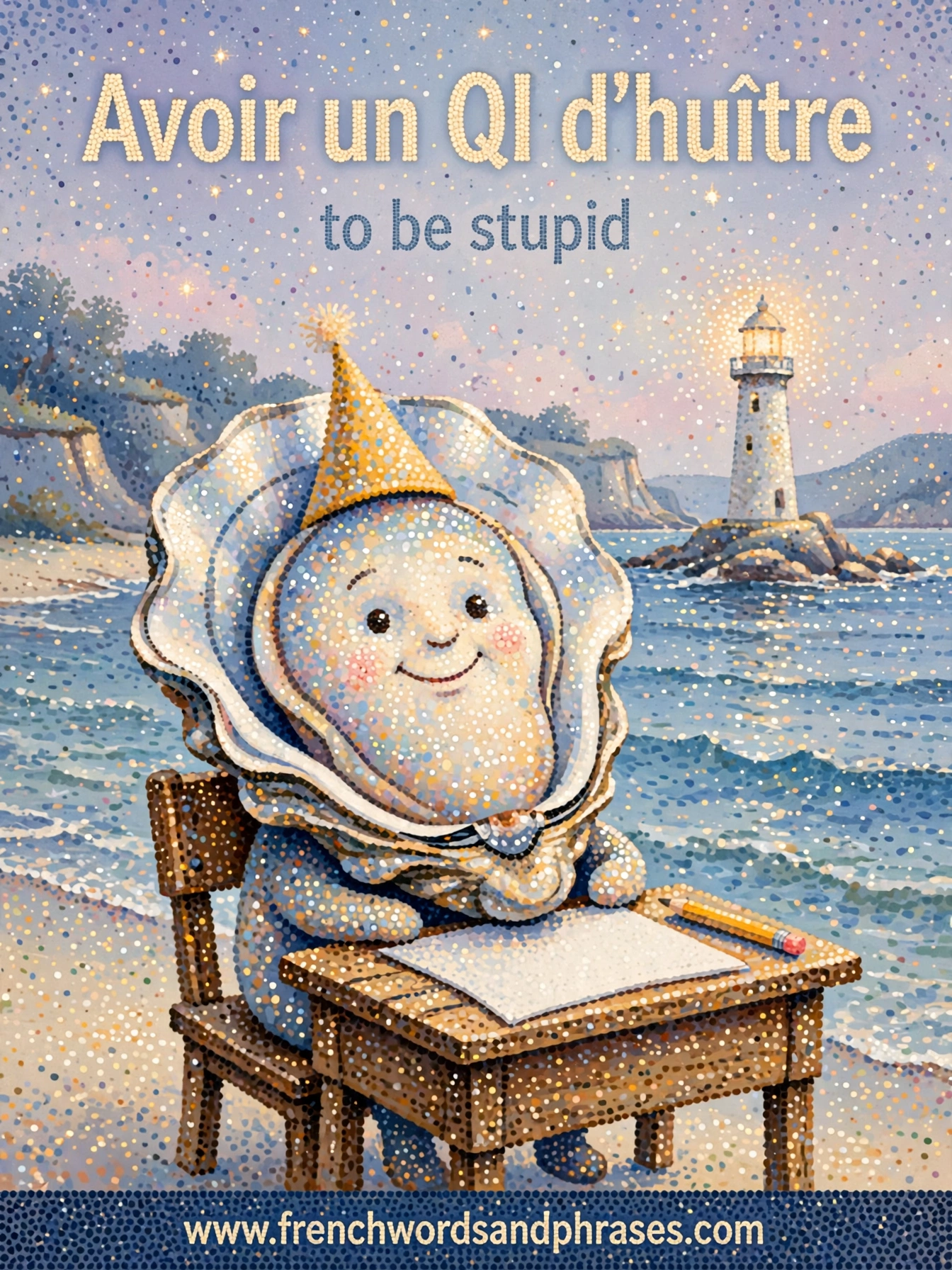
Avoir un QI d’huître means to be stupid (humorous, informal).
You have locked the keys in the car. Again. With the spare set sitting in your other coat, also in the car. Your friend, who has watched the whole performance in silence, finally delivers the verdict the whole street is thinking — and because it involves the measured intelligence of a shellfish, everyone, including you, bursts out laughing.
Let’s explore how avoir un QI d’huître works in French, beginning with the whole phrase on one card.
Understanding the French Phrase Avoir un QI d’huître
Avoir un QI d’huître is a humorous French idiom built from avoir (to have), un QI (an IQ — quotient intellectuel) and huître (an oyster). The joke is a measurement: an oyster has no brain to speak of, so its IQ is zero — and anyone who has just done something spectacularly stupid is awarded the same score.
It means to be stupid — but as a joke, not a diagnosis. It is the phrase you aim at yourself after locking the keys in the car, or teasingly at a friend who has put the milk in the cupboard and the cups in the fridge. Said with a smile it is pure comedy; said coldly to a stranger, it becomes a real insult.
Type: Idiom — avoir + noun phrase (un QI d’huître, an oyster’s IQ)
Answers the need: Joking that someone — often yourself — has done something really stupid
Register: Informal and humorous — teasing among friends; an insult if aimed coldly
Strength: Comic maximum — the oyster scores zero, and that is the joke
One important usage detail: this idiom is a joke, and it lands best when aimed at yourself — j’ai vraiment un QI d’huître, I have been so stupid. The same words said seriously about someone else stop being funny. Keep it for friends, family and your own finest blunders.
Experience the Word
Avoir un QI d’huître is the insult French designed to be forgiven — nobody can stay offended by a shellfish.
Imagine the fishmonger’s stall at the market, the oysters lined up in their crate, famously silent, famously brainless. The stallholder has just given a customer change for twenty euros from a ten-euro note, notices, and taps the crate: today, he announces to the queue, his IQ matches his stock. The queue laughs; the customer is repaid; the oyster takes the blame.
French humour loves a measured insult. Not just stupid — scientifically, seafood-level stupid.
How to Use Avoir un QI d’huître in French: Complete Guide
Let’s explore how avoir un QI d’huître works in French, beginning with the whole phrase on one card.
Avoir un QI d’huître at a Glance
The Whole Phrase on One Card
Real meaning, literal building blocks, English twin and register — the oyster’s IQ in five lines.
| Point | Avoir un QI d’huître |
|---|---|
| What it really means | to be stupid — as a joke about a daft moment |
| Word for word | to have the IQ of an oyster |
| English equivalent | to be as thick as two short planks / to have the brains of a rocking horse |
| Register | informal and humorous — teasing; an insult if said coldly |
| Use it for | your own blunders first, friends’ blunders second — always with a smile |
Example
J’ai perdu mes clés deux fois cette semaine, j’ai vraiment un QI d’huître.
I’ve lost my keys twice this week, I really am stupid.
Word by Word: Building the Score
Three pieces — a verb, a test score, and a shellfish with nothing to declare.
| Word | Literal meaning | Its job in the phrase |
|---|---|---|
| avoir | to have | the engine — you possess the score, like a result on a certificate |
| un QI | an IQ | quotient intellectuel — pronounced as French letters, roughly kee-ee |
| d’huître | of an oyster | huître is a feminine noun, an oyster — the elision d’ smooths the two vowels together |
Example
Il faut un QI d’huître pour rater une question pareille.
You’d have to be really stupid to miss a question like that.
Quick Quiz 1
Why an oyster, of all creatures?
Reveal the answer
Because an oyster has no brain — its IQ would be zero, which is exactly the score the joke awards.
J’ai un QI d’huître ce matin, j’ai mis le lait dans le placard.
I’m being stupid this morning, I put the milk in the cupboard.
When You Say It: The Finest Blunders
The phrase belongs to the moments after a blunder — keys lost, milk misplaced, exams fumbled.
| Situation | Example |
|---|---|
| About yourself, laughing | j’ai un QI d’huître, j’ai cherché mes lunettes sur mon nez — I’m so stupid, I looked for my glasses on my nose |
| Teasing a friend | tu as un QI d’huître, tu as mis ton portable au frigo — you’re so daft, you put your phone in the fridge |
| After a silly mistake | il faut vraiment avoir un QI d’huître pour oublier son propre anniversaire — you’d really have to be stupid to forget your own birthday |
| Softening a criticism | sans avoir un QI d’huître, on peut se tromper — without being stupid, anyone can make a mistake |
Example
Elle s’est trompée de jour pour l’examen — un vrai QI d’huître, dit-elle en riant.
She got the exam day wrong — a real oyster IQ, she says, laughing.
Make It Yours: Awarding the Score
Avoir conjugates for the unfortunate holder — the oyster and its score never change.
| Form | French | In English |
|---|---|---|
| For me | j’ai un QI d’huître | I’m being stupid |
| For you (tu) | tu as un QI d’huître | you’re being stupid |
| For him | il a un QI d’huître | he’s being stupid |
| In the past | j’ai eu un QI d’huître sur ce coup-là | I was really stupid on that one |
| As a question | j’ai un QI d’huître ou quoi ? | am I stupid or what? |
| The requirement joke | il faut un QI d’huître pour rater ça | you’d have to be stupid to miss that |
Example
Vous avez un QI d’huître ou vous faites semblant ?
Are you being stupid or are you pretending?
Quick Quiz 2
How do you blame your own blunder with this idiom?
Reveal the answer
J’ai un QI d’huître — aimed at yourself, the joke is at its funniest and safest.
J’ai un QI d’huître, j’ai envoyé le message à la mauvaise personne.
I’m so stupid, I sent the message to the wrong person.
Everyday Expressions: Building on the Oyster
Avoir un QI d’huître slots into these everyday frames — each one ready to use as it stands.
| Frame | In English |
|---|---|
| j’ai vraiment un QI d’huître | I really am being stupid |
| un QI d’huître, ce matin | an oyster IQ this morning (joking) |
| il faut un QI d’huître pour… | you’d have to be stupid to… |
| tu as un QI d’huître ou quoi ? | are you stupid or what? (teasing) |
| pas besoin d’un QI d’huître pour comprendre | you don’t need to be a genius to understand (ironic flip) |
Example
Il faut un QI d’huître pour partir sans parapluie aujourd’hui.
You’d have to be stupid to go out without an umbrella today.
Close Cousins: The Daft Family
French measures stupidity in several comic currencies — the oyster is the seafood denomination.
| Expression | The difference |
|---|---|
| avoir un QI d’huître | the measured joke — an IQ of zero, humorous and informal |
| être bête comme ses pieds | as daft as his feet — informal, a touch stronger and less witty |
| ne pas être futé | to not be very sharp — mild, indirect, almost polite |
| ne pas avoir inventé l’eau chaude | didn’t invent hot water — gentle teasing about brightness |
| avoir deux neurones | to have two brain cells — modern humorous slang, close in spirit |
Example
Il n’a pas inventé l’eau chaude, mais il est gentil.
He didn’t invent hot water, but he’s kind.
Quick Quiz 3
Which cousin is mildest for a delicate situation: un QI d’huître or ne pas être futé?
Reveal the answer
Ne pas être futé — not very sharp is indirect and mild; the oyster is a full comic insult, best kept for friends and yourself.
Il n’est pas très futé, le pauvre.
He’s not very sharp, poor thing.
Avoir un QI d’huître and Its Neighbours
The brains shelf around the phrase — the bright side and the dim side.
| French | In English |
|---|---|
| être intelligent | to be intelligent |
| être malin | to be clever, cunning |
| être futé | to be sharp, quick-witted |
| être brillant | to be brilliant |
| être distrait | to be absent-minded — a different failing |
| être bête | to be stupid — the plain, unfunny word |
Example
Elle est brillante, mais aujourd’hui elle a eu un QI d’huître.
She is brilliant, but today she had an oyster moment.
Watch Out: The Traps Around the Oyster
The traps: a joke that can bite, an apostrophe that matters, and letters pronounced the French way.
| Trap | The truth |
|---|---|
| aiming it seriously at a stranger | the idiom is teasing — said coldly, it is a plain insult; aim it at yourself first |
| writing de huître in full | the vowels collide — French elides: d’huître, with the apostrophe |
| saying QI the English way | in French the letters are pronounced roughly kee-ee — un QI, never an English IQ |
| using it in formal writing | reports and exams need neutre wording: manquer de jugement, not seafood |
Example
Un QI d’huître, moi ? Jamais avant le café.
An oyster IQ, me? Never before coffee.
Quick Quiz 4
True or false: avoir un QI d’huître is a safe, polite phrase for a formal report.
Reveal the answer
False — it is informal teasing. In formal writing, choose a neutral phrase like manquer de jugement.
J’ai eu un QI d’huître, j’ai oublié la réunion.
I was really stupid, I forgot the meeting.
Avoir un QI d’huître in Everyday French: Real-Life Examples
Now that you know the word, let’s see how avoir un QI d’huître appears in everyday French.
Example 1 — The locked car
Les clés sont dans la voiture fermée : j’ai un QI d’huître.
The keys are in the locked car: I’m so stupid.
Example 2 — The wrong day
Je suis venu un dimanche pour un rendez-vous du lundi — QI d’huître.
I came on Sunday for a Monday appointment — oyster IQ.
Example 3 — Teasing a brother
Tu as mis le sucre dans la soupe ? Tu as un QI d’huître.
You put sugar in the soup? You’re so daft.
Example 4 — The exam
Il faut un QI d’huître pour rater une question aussi simple.
You’d have to be really stupid to miss such a simple question.
Example 5 — Self-defence
Je n’ai pas un QI d’huître, je suis juste fatigué.
I don’t have an oyster IQ, I’m just tired.
Example 6 — The glasses hunt
Elle cherchait ses lunettes sur sa tête : un vrai QI d’huître, a-t-elle ri.
She was looking for her glasses on her head: a real oyster IQ, she laughed.
Beyond Translation: The Meaning of Avoir un QI d’huître
The oyster has been French shorthand for cheerful brainlessness for generations — a creature that never learns, never speaks, and famously cannot even close its own shell without help. Adding a modern IQ score to an ancient insult is the joke’s engine: the stupidity is not just felt, it is measured, certified, and served by the dozen.
To have un QI d’huître is to fail an exam set by a shellfish.
That is why the phrase survives every generation of slang: it lets French speakers call themselves idiots and make the whole room laugh in the same breath.
How to Remember the French Phrase Avoir un QI d’huître
Remember it this way: Picture the exam results pinned up at the fish market: the oyster, bottom of the class, with a score of zero — because it has no brain at all. Anyone having a truly daft moment joins it down there.
- You award the oyster a score of zero — no brain, no IQ, no mercy, all comedy.
- You aim it at yourself first: j’ai un QI d’huître is a joke; said coldly at others, it bites.
- You keep the apostrophe and the French letters: d’huître, and QI said the French way.
The key idea is avoir un QI d’huître means to be stupid — an IQ of zero, humorous and informal, best aimed at yourself.
Test Your Knowledge of Avoir un QI d’huître
Let’s see how much you’ve learned. Try answering these questions before revealing the answers.
Question 1
What does avoir un QI d’huître mean?
Reveal the answer
To be stupid — jokingly, as if your IQ matched an oyster’s: zero.
Question 2
Why is the phrase funny rather than cruel?
Reveal the answer
Because it is a comic measurement aimed mostly at yourself or friends — the oyster makes the insult absurd.
Question 3
What does QI stand for?
Reveal the answer
Quotient intellectuel — the French for IQ, pronounced as French letters.
Question 4
Translate: I’m so stupid, I forgot my own phone number.
Reveal the answer
J’ai un QI d’huître, j’ai oublié mon propre numéro de téléphone.
Question 5
Complete the sentence:
Il faut un QI ______ pour rater ça. (You’d have to be stupid to miss that.)
Reveal the answer
d’huître
Il faut un QI d’huître pour rater ça.
You’d have to be stupid to miss that.
Your Final Challenge
Can You Use It?
How would you say this in French?
“I was so stupid, I locked my keys in the car.”
Reveal the answer
J’ai eu un QI d’huître, j’ai enfermé mes clés dans la voiture.
I was so stupid, I locked my keys in the car.
A little French. A little curiosity. A richer everyday life.
LEARN FRENCH ONE WORD AT A TIME