A French Word to Live By
Translate Avoir tort to English
/a.vwaʁ tɔʁ/
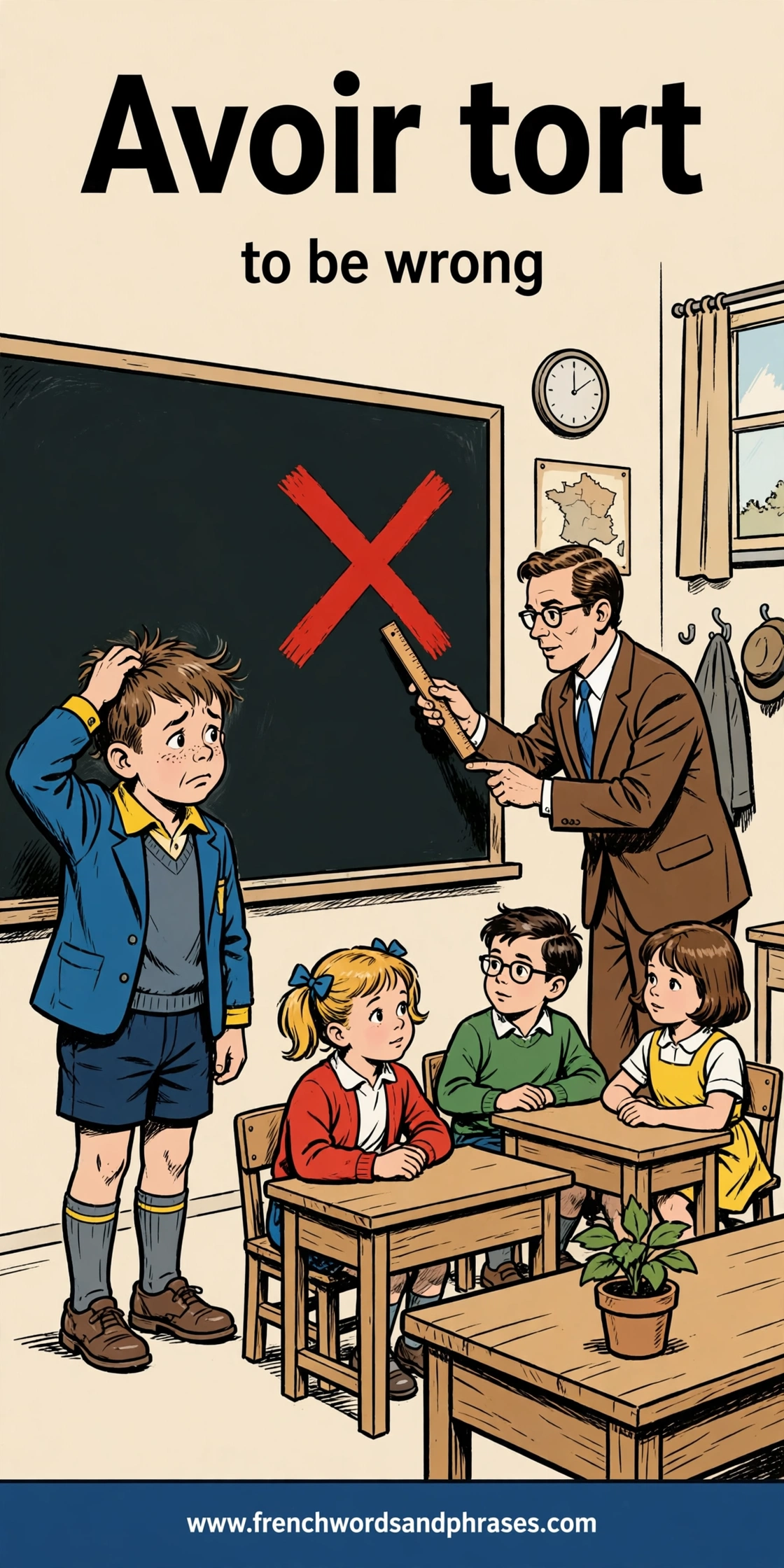
Avoir tort means to be wrong — to be mistaken in what you say, think or do.
For twenty minutes, the driver has insisted the village is ‘just after this bend’. Three bends, one farm track and a herd of unimpressed cows later, his wife unfolds the map, looks at him over her glasses, and delivers the smallest verdict in French: « Tu as tort. » He laughs, and turns the car around.
Let’s explore how avoir tort works in French, beginning with the whole phrase on one card.
Understanding the French Phrase Avoir tort
Avoir tort is a French expression built from avoir (to have) and tort (a wrong, a fault — from Latin tortum, something twisted). It is the exact mirror of avoir raison: where raison is the right you hold, tort is the wrong you carry.
It means to be wrong, to be mistaken — about a fact, a direction, a judgement, a person. The thing you are wrong about doing attaches with de + infinitive: tu as tort de te fâcher, you are wrong to get angry. And tort lives a second life as a noun of blame: les torts sont partagés, the blame is shared; donner tort à quelqu’un, to declare someone wrong.
Type: Expression — judgement (avoir + noun tort)
Answers the need: Saying someone is wrong or mistaken — or admitting it yourself
Register: Neutral — every argument, every classroom, every family car
Strength: Direct — a clear verdict, softened in practice by tone and by si tu veux
One important usage detail: never je suis tort — wrongness is had in French, not been, exactly like raison. The admission has its own graceful formula: je reconnais que j’ai eu tort, I admit I was wrong. And mind the noun’s other frames: avoir tort de + infinitive judges an action, while faire du tort à quelqu’un means to harm someone — a different tort altogether.
Experience the Word
Avoir tort is the phrase French arguments are built to avoid — and the one that, pronounced first about yourself, ends them fastest.
Imagine the two brothers disputing their father’s will at the notary’s office, voices rising over a signature from 1987. The notary, who has seen four generations of this family, waits for the silence and asks one question: « Et si vous aviez tort tous les deux ? » What if you were both wrong? The room exhales. It is the most useful question in the language.
French, the nation of the debate, keeps the surrender flag neatly folded in the same drawer as the trophy. Avoir raison wins the point; reconnaître son tort wins the room.
How to Use Avoir tort in French: Complete Guide
Let’s explore how avoir tort works in French, beginning with the whole phrase on one card.
Avoir tort at a Glance
The Whole Phrase on One Card
Real meaning, literal picture, English twin and register — avoir tort in five lines.
| Point | Avoir tort |
|---|---|
| What it really means | to be wrong — your claim, judgement or course of action is mistaken |
| Word for word | to have wrong (tort = a wrong, a fault) |
| English equivalent | to be wrong / to be mistaken |
| Register | neutral — everywhere; direct, so tone does the softening |
| Use it for | wrong facts, wrong turns, wrong judgements — and gracious admissions |
Example
Tu as tort, le magasin ferme à huit heures.
You are wrong, the shop closes at eight o’clock.
Word by Word: Building the Wrong
Two pieces — the verb that holds, and the twisted thing it holds.
| Word | Literal meaning | Its job in the phrase |
|---|---|---|
| avoir | to have | the holder — wrongness is carried in French, like raison, peur and faim |
| tort | a wrong, a fault | the noun — from Latin tortum, ‘twisted’; no article inside the phrase |
| de | to | the bridge to the action judged: tort de se fâcher, wrong to get angry |
Example
Elle a tort de ne pas vérifier.
She is wrong not to check.
Quick Quiz 1
What is the exact opposite of avoir tort?
Reveal the answer
Avoir raison — the mirror twin: raison is the right you hold, tort is the wrong you carry.
Cette fois, c’est moi qui ai tort et toi qui as raison.
This time, I am the one who is wrong and you are right.
When You Say It: The Wrong Moments
Avoir tort fires at moments like these — a fact corrected, a turn missed, an admission made.
| Situation | Example |
|---|---|
| Correcting a fact | tu as tort, nous sommes mardi — you are wrong, it’s Tuesday |
| The missed turn | il a eu tort de tourner à gauche — he was wrong to turn left |
| Judging an action | elle a tort de se fâcher pour si peu — she is wrong to get angry over so little |
| The admission | je reconnais que j’ai eu tort — I admit that I was wrong |
| Shared blame | les torts sont partagés — both sides are in the wrong |
Example
Je l’avoue, j’ai eu tort de douter de toi.
I admit it, I was wrong to doubt you.
Make It Yours: Wrong for Every Person
Avoir bends for the person; donner tort hands the verdict down.
| Form | French | In English |
|---|---|---|
| I am wrong | j’ai tort | I am wrong |
| You are wrong | tu as tort | you are wrong |
| He was wrong | il a eu tort | he was wrong |
| Wrong to do | avoir tort de + infinitive | to be wrong to do something |
| To declare someone wrong | donner tort à quelqu’un | to rule against someone, to say they are wrong |
| Completely wrong | avoir tout à fait tort | to be completely wrong |
Example
Le professeur a donné tort aux deux élèves.
The teacher declared both pupils wrong.
Quick Quiz 2
How do you say ‘you are wrong to worry’?
Reveal the answer
Tu as tort de t’inquiéter — de + infinitive names the action being judged.
Vous avez tort de vous fâcher, tout s’explique.
You are wrong to get angry, everything can be explained.
Everyday Expressions: Building on the Wrong
Avoir tort slots into these everyday frames — each one ready to use as it stands.
| Frame | In English |
|---|---|
| avoir tort | to be wrong |
| avoir tort de + infinitive | to be wrong to do something |
| donner tort à quelqu’un | to declare someone wrong, to rule against them |
| les torts sont partagés | the blame is shared — both sides are wrong |
| reconnaître ses torts | to admit your faults, to own up to being wrong |
Example
Il a reconnu ses torts devant tout le monde.
He admitted his faults in front of everyone.
Close Cousins: The Other Wrong Words
French separates kinds of wrongness — avoir tort judges the claim; its cousins mistake, err or do harm.
| Expression | The difference |
|---|---|
| avoir tort | to be wrong — the verdict on a claim or an action |
| avoir raison | to be right — the exact mirror twin |
| se tromper | to make a mistake, to get it wrong — the act of erring itself |
| être dans l’erreur | to be in error — formal, the state described from outside |
| faire du tort à quelqu’un | to harm someone, to wrong them — tort as damage, not error |
Example
Il s’est trompé de rue, mais il n’a fait de tort à personne.
He took the wrong street, but he harmed no one.
Quick Quiz 3
Which cousin means to harm someone — se tromper or faire du tort?
Reveal the answer
Faire du tort à quelqu’un — there, tort is damage done to a person, not a mistaken claim.
Cette rumeur a fait beaucoup de tort à sa carrière.
That rumour did great harm to his career.
Avoir tort and Its Neighbours
The argument shelf around the phrase — errors, blame and the making of peace.
| French | In English |
|---|---|
| une erreur | a mistake, an error |
| la faute | the fault, the blame — c’est ma faute, it’s my fault |
| s’excuser | to apologise — what follows the admission |
| pardonner | to forgive — the answer to the apology |
| un malentendu | a misunderstanding — where both sides had tort |
| se réconcilier | to make up, to be reconciled |
Example
C’était un malentendu, et ils se sont réconciliés.
It was a misunderstanding, and they made up.
Watch Out: The Traps Around Avoir tort
The traps: being instead of having, harm hiding inside the same noun, and a twisted road that is only a road.
| Trap | The truth |
|---|---|
| je suis tort | never — wrongness is had: j’ai tort, the mirror of j’ai raison |
| avoir tort vs faire du tort | avoir tort judges you mistaken; faire du tort à quelqu’un accuses you of harming them — a much heavier charge |
| à tort is an adverb | accuser à tort means to accuse wrongly, unjustly — à tort et à travers, recklessly, at random |
| tort is not a road | un chemin tortueux is a winding road — the same Latin root (twisted), but no blame involved |
Example
Il a été accusé à tort et relâché le lendemain.
He was wrongly accused and released the next day.
Quick Quiz 4
True or false: à tort et à travers means carefully and methodically.
Reveal the answer
False — it means recklessly, at random, without rhyme or reason.
Il dépense son argent à tort et à travers.
He spends his money recklessly, on anything and everything.
Avoir tort in Everyday French: Real-Life Examples
Now that you know the word, let’s see how avoir tort appears in everyday French.
Example 1 — The correction
Tu as tort, la réunion est jeudi, pas mercredi.
You are wrong, the meeting is on Thursday, not Wednesday.
Example 2 — The admission
Je reconnais que j’ai eu tort de me fâcher.
I admit I was wrong to get angry.
Example 3 — The wrong turn
Nous avons eu tort de prendre cette route.
We were wrong to take this road.
Example 4 — Judging an action
Elle a tort de vendre la maison si vite.
She is wrong to sell the house so quickly.
Example 5 — Shared blame
Dans cette dispute, les torts sont partagés.
In this quarrel, the blame is shared.
Example 6 — The verdict
Le juge a donné tort à l’entreprise.
The judge ruled against the company.
Beyond Translation: The Meaning of Avoir tort
Tort comes from the Latin for twisted — and the picture still works: to avoir tort is to be holding the twisted version of the truth, the bent copy. Its twin raison is the straight one. Between them, the pair runs French intellectual life like a two-party system: every claim at every table is quietly sorted, raison or tort.
Avoir tort is only a disaster if you keep holding it — the phrase itself invites you to put it down.
That is the secret of reconnaître ses torts, admitting your wrongs: in a culture that prizes the argument, the graceful concession is the highest-status move of all — it proves you value the truth more than the trophy.
How to Remember the French Phrase Avoir tort
Remember it this way: Avoir tort is holding the twisted copy of the truth — tort is the bent one, raison the straight one, and you can always put the bent one down.
- You switch the verb — English is wrong, French a tort; tort is the mirror of raison and shares its grammar.
- You judge actions with de — avoir tort de se fâcher, wrong to get angry.
- You keep harm separate — faire du tort à quelqu’un is damaging them, a heavier charge than being mistaken.
The key idea is avoir tort means to be wrong — the twisted copy of the truth, mirror of avoir raison.
Test Your Knowledge of Avoir tort
Let’s see how much you’ve learned. Try answering these questions before revealing the answers.
Question 1
What does avoir tort mean?
Reveal the answer
To be wrong — to be mistaken in what you say, think or do.
Question 2
How do you say ‘I admit I was wrong’?
Reveal the answer
Je reconnais que j’ai eu tort — the graceful French formula for conceding.
Question 3
How do you say ‘she is wrong to sell the house’?
Reveal the answer
Elle a tort de vendre la maison — de + infinitive judges the action.
Question 4
What does faire du tort à quelqu’un mean?
Reveal the answer
To harm someone, to wrong them — tort as damage, not as a mistaken claim.
Question 5
Complete the sentence:
Vous ______ tort, le train part à midi. (You are wrong, the train leaves at noon.)
Reveal the answer
avez
Vous avez tort, le train part à midi.
You are wrong, the train leaves at noon.
Your Final Challenge
Can You Use It?
How would you say this in French?
“You are wrong, the train leaves at noon.”
Reveal the answer
Tu as tort, le train part à midi.
You are wrong, the train leaves at noon.
A little French. A little curiosity. A richer everyday life.
LEARN FRENCH ONE WORD AT A TIME