A French Word to Live By
Translate Avoir sommeil to English
/a.vwaʁ sɔ.mɛj/
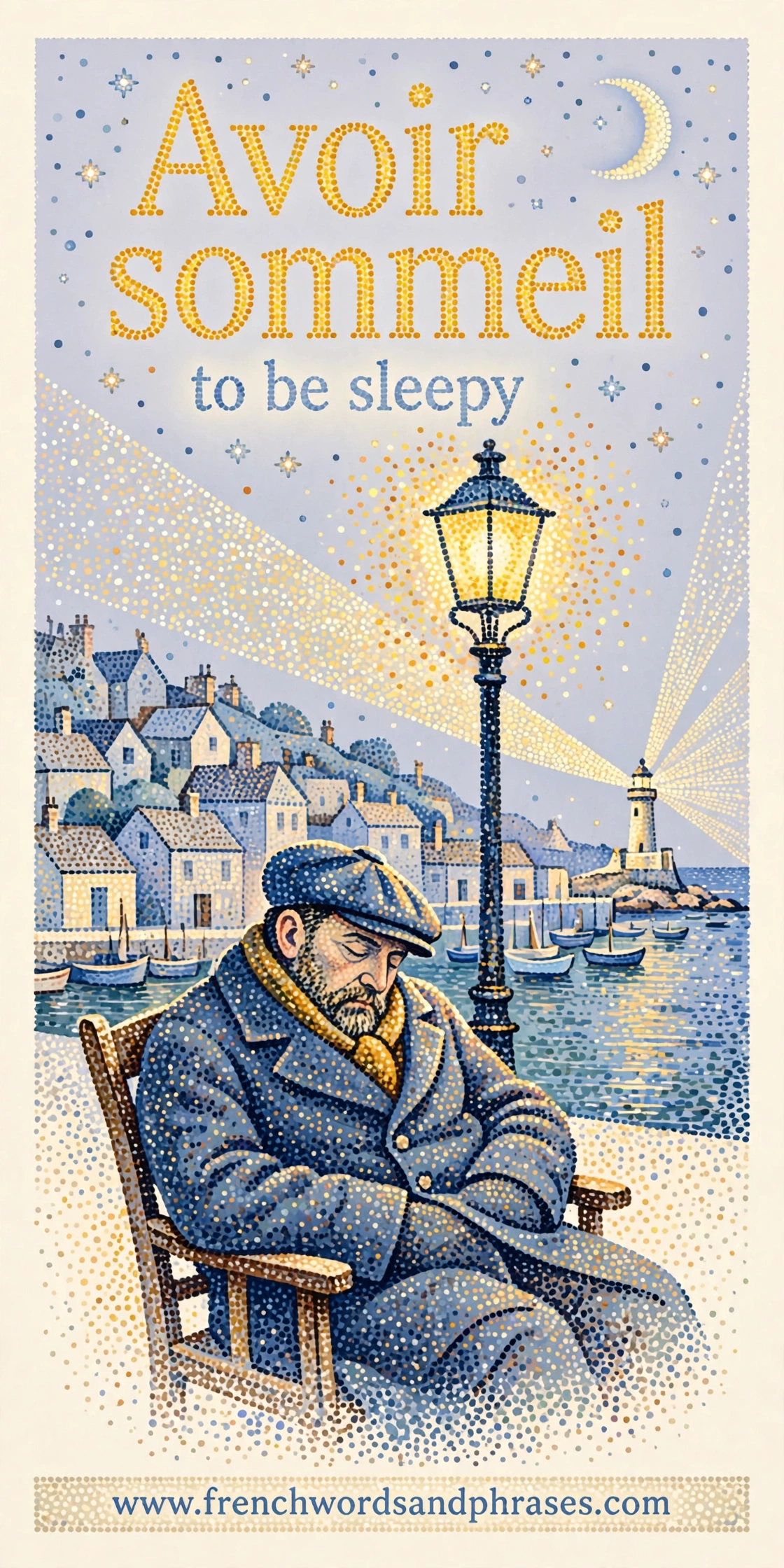
Avoir sommeil means to be sleepy, to feel tired and ready for sleep.
The film is only halfway through, but the little girl in the third row has gone quiet, her head tipping sideways onto her father’s arm. He does not need to ask. « Tu as sommeil, » he whispers, and carries her out to the car — in French, sleepiness is something you have, like a coat that has grown too heavy.
Let’s explore how avoir sommeil works in French, beginning with the whole phrase on one card.
Understanding the French Phrase Avoir sommeil
Avoir sommeil is a French expression built from avoir (to have) and le sommeil (sleep). It names sleepiness — the drooping, yawning state before sleep — and belongs to the avoir family of body states alongside avoir faim, avoir soif and avoir chaud.
It means to be sleepy, to feel ready for sleep. It is not quite the same as être fatigué, to be tired: fatigue is the worn battery, sommeil is the eyelids. You can be fatigué without sommeil (after a long week) and have sommeil without real fatigue (in a warm room after lunch). When the sleepiness wins, French says s’endormir — to fall asleep.
Type: Expression — body states (avoir + noun sommeil)
Answers the need: Saying you are sleepy and ready for bed
Register: Neutral — everywhere, and the classic phrase of children at bedtime
Strength: Gentle — from a first yawn (un peu sommeil) to falling asleep at the table
One important usage detail: je suis sommeil is impossible — sleepiness is had. Sommeil itself is the noun for sleep (le sommeil réparateur, restorative sleep), and it keeps its article everywhere except inside this phrase: avoir sommeil, but le sommeil de l’enfant, the child’s sleep. For the irresistible attack of sleepiness, French has a vivid cousin: avoir un coup de barre, to be suddenly wiped out.
Experience the Word
Avoir sommeil is the phrase that ends every French childhood evening — the signal, admitted or denounced, that the day is over.
Imagine the long drive home from the coast, motorway lights strobing past. In the back seat, a small voice fights the obvious for ten heroic minutes — je n’ai pas sommeil — and then silence, mid-sentence. The parents smile at each other in the dark. The phrase lost, as it always loses, to the thing itself.
French gives sleepiness the dignity of a possession. You have sommeil the way you have a ticket — and sooner or later, it gets used.
How to Use Avoir sommeil in French: Complete Guide
Let’s explore how avoir sommeil works in French, beginning with the whole phrase on one card.
Avoir sommeil at a Glance
The Whole Phrase on One Card
Real meaning, literal picture, English twin and register — avoir sommeil in five lines.
| Point | Avoir sommeil |
|---|---|
| What it really means | to be sleepy — to feel ready for sleep |
| Word for word | to have sleep (sommeil = sleep) |
| English equivalent | to be sleepy / to feel sleepy / to be drowsy |
| Register | neutral — everywhere; the bedtime phrase of children |
| Use it for | yawning children, late evenings, long drives and warm rooms after lunch |
Example
Les enfants ont sommeil, il est temps de rentrer.
The children are sleepy, it is time to go home.
Word by Word: Building the Sleepiness
Two pieces — the verb that holds the state, and the noun that is already half asleep.
| Word | Literal meaning | Its job in the phrase |
|---|---|---|
| avoir | to have | the holder — sleepiness is a possession in French, not an identity |
| sommeil | sleep | the noun — masculine, le sommeil; inside the phrase it drops its article |
Example
J’ai sommeil, je vais me coucher tôt.
I am sleepy, I am going to bed early.
Quick Quiz 1
What is the difference between avoir sommeil and être fatigué?
Reveal the answer
Sommeil is the eyelids, fatigue is the battery — you can be tired without being sleepy, and sleepy after lunch without being truly tired.
Je suis fatigué mais je n’ai pas sommeil.
I am tired but I am not sleepy.
When You Say It: The Sleepy Moments
Avoir sommeil fires at moments like these — the film still running, the road still long, the eyelids losing.
| Situation | Example |
|---|---|
| A child at bedtime | tu as sommeil, au lit ! — you are sleepy, off to bed! |
| During a film | elle a sommeil avant même la fin du film — she is sleepy before the film even ends |
| On a long drive | si tu as sommeil, on s’arrête — if you are sleepy, we stop |
| After lunch | après ce repas, tout le monde a sommeil — after that meal, everyone is sleepy |
| Denying it, heroically | je n’ai pas sommeil, je veux finir le chapitre — I am not sleepy, I want to finish the chapter |
Example
Il a sommeil mais il refuse d’aller se coucher.
He is sleepy but refuses to go to bed.
Make It Yours: Sleepiness for Every Person
Avoir bends for the person; the state deepens from a yawn to a collapse.
| Form | French | In English |
|---|---|---|
| I am sleepy | j’ai sommeil | I am sleepy |
| Very sleepy | j’ai très sommeil | I am very sleepy |
| A little sleepy | j’ai un peu sommeil | I am a little sleepy |
| In the past | elle avait sommeil | she was sleepy |
| Not sleepy | je n’ai pas sommeil | I am not sleepy |
| Falling asleep | je m’endors | I am falling asleep — the next step |
Example
À minuit, tout le monde avait sommeil.
By midnight, everyone was sleepy.
Quick Quiz 2
How do you say ‘I am not sleepy’ — the heroic child’s version?
Reveal the answer
Je n’ai pas sommeil — ne… pas wraps avoir, sommeil stays bare.
Je n’ai pas sommeil, encore une histoire !
I am not sleepy, one more story!
Everyday Expressions: Building on the Sleep
Avoir sommeil slots into these everyday frames — each one ready to use as it stands.
| Frame | In English |
|---|---|
| avoir sommeil | to be sleepy |
| avoir un coup de barre | to be suddenly wiped out — sleepiness arriving like a blow |
| tomber de sommeil | to be dropping with sleep — sleepiness at maximum |
| lutter contre le sommeil | to fight off sleep |
| un marchand de sable | the sandman — who brings the sommeil to children |
Example
Après le repas, il a eu un vrai coup de barre.
After the meal, he was suddenly wiped out.
Close Cousins: The Other Tired Words
French grades the end of the day finely — sommeil is the drooping one; its cousins are worn, exhausted or already asleep.
| Expression | The difference |
|---|---|
| avoir sommeil | to be sleepy — eyelids heavy, bed calling |
| être fatigué | to be tired — the general worn-out state, body or mind |
| être épuisé | to be exhausted — tired at maximum, nothing left |
| s’endormir | to fall asleep — the moment sommeil wins |
| avoir les yeux qui se ferment | to have your eyes closing on you — sleepiness described in pictures |
Example
Épuisée, elle s’est endormie sur le canapé.
Exhausted, she fell asleep on the sofa.
Quick Quiz 3
Which cousin is the moment sleepiness wins — the falling asleep itself?
Reveal the answer
S’endormir — avoir sommeil is the approach; s’endormir is the landing.
Il s’est endormi pendant le film.
He fell asleep during the film.
Avoir sommeil and Its Neighbours
The bedtime shelf around the phrase — the state, the bed and the morning after.
| French | In English |
|---|---|
| dormir | to sleep — the verb of the state itself |
| se coucher | to go to bed |
| un bâillement | a yawn — sleepiness announcing itself |
| la sieste | the nap — the afternoon answer to sommeil |
| bien dormir | to sleep well |
| se réveiller | to wake up — the far end of the story |
Example
Un bâillement, puis deux : le marchand de sable est passé.
One yawn, then two: the sandman has been.
Watch Out: The Traps Around Avoir sommeil
The traps: being instead of having, a sleep that is a fish, and tiredness that is not sleepiness.
| Trap | The truth |
|---|---|
| je suis sommeil | never — sleepiness is had: j’ai sommeil, like the whole body-state family |
| sommeil vs somme | un somme is a short nap (faire un somme), and la somme is a sum of money — one letter changes the nap into a bank transfer |
| fatigué is not sommeil | after a week of work you are fatigué; in the warm cinema you avez sommeil — French keeps the two apart and so should you |
| the article outside the phrase | inside: avoir sommeil; outside, sommeil is a normal noun with its article — le sommeil de bébé, baby’s sleep |
Example
Après le déjeuner, il a fait un petit somme sur le canapé.
After lunch, he had a little nap on the sofa.
Quick Quiz 4
True or false: faire un somme means to do a sum, a calculation.
Reveal the answer
False — faire un somme is to have a nap; the sum of money is la somme, a different word wearing the same letters.
Elle fait un somme pendant que le bébé dort.
She has a nap while the baby sleeps.
Avoir sommeil in Everyday French: Real-Life Examples
Now that you know the word, let’s see how avoir sommeil appears in everyday French.
Example 1 — Bedtime
Tu as sommeil, mon petit, il est l’heure de dormir.
You are sleepy, little one, it is time to sleep.
Example 2 — The long drive
Si tu as sommeil, arrête-toi à la prochaine aire.
If you are sleepy, stop at the next rest area.
Example 3 — After lunch
Après ce festin, j’ai sommeil, je ferais bien une sieste.
After that feast, I am sleepy, I could do with a nap.
Example 4 — The denial
Je n’ai pas sommeil, je veux voir la fin du film.
I am not sleepy, I want to see the end of the film.
Example 5 — At the office
Il a eu un coup de barre en pleine réunion.
He was suddenly wiped out in the middle of the meeting.
Example 6 — Dropping off
Elle tombe de sommeil, mettez-la au lit.
She is dropping with sleep, put her to bed.
Beyond Translation: The Meaning of Avoir sommeil
English is sleepy — drowsiness as a trait, almost a personality for the evening. French has sommeil — sleep itself, carried in advance like a parcel to be delivered to the bed. The phrase quietly reverses the journey: you do not go to sleep; sleep comes to you, and avoir sommeil is simply noticing it has arrived.
Avoir sommeil is the moment the day hands you back to the night, gift-wrapped.
No wonder the phrase belongs to children and those who love them: it is the one body state nobody argues with, and its only cure is surrender.
How to Remember the French Phrase Avoir sommeil
Remember it this way: Avoir sommeil is sleep arriving early and sitting on your eyelids — you have it the way you have a heavy parcel, and the only sensible move is to put it, and yourself, down.
- You switch the verb — English is sleepy, French a sommeil; the body states are had, never been.
- You separate the cousins — sommeil is the eyelids, fatigué is the battery; know which one you are reporting.
- You watch the near-twin — un somme is a nap, la somme is money; sommeil is sleep itself.
The key idea is avoir sommeil means to be sleepy — sleep arriving early, carried like a parcel to bed.
Test Your Knowledge of Avoir sommeil
Let’s see how much you’ve learned. Try answering these questions before revealing the answers.
Question 1
What does avoir sommeil mean?
Reveal the answer
To be sleepy — to feel ready for sleep; literally, to have sleep.
Question 2
How is avoir sommeil different from être fatigué?
Reveal the answer
Sommeil is sleepiness (the eyelids); fatigué is tiredness (the battery) — you can be one without the other.
Question 3
How do you say ‘I am not sleepy’?
Reveal the answer
Je n’ai pas sommeil — the heroic denial of every French childhood.
Question 4
What does avoir un coup de barre mean?
Reveal the answer
To be suddenly wiped out — a wave of sleepiness or exhaustion arriving all at once.
Question 5
Complete the sentence:
Les enfants ______ sommeil après la fête. (The children are sleepy after the party.)
Reveal the answer
ont
Les enfants ont sommeil après la fête.
The children are sleepy after the party.
Your Final Challenge
Can You Use It?
How would you say this in French?
“The children are sleepy, it is time to go home.”
Reveal the answer
Les enfants ont sommeil, il est temps de rentrer.
The children are sleepy, it is time to go home.
A little French. A little curiosity. A richer everyday life.
LEARN FRENCH ONE WORD AT A TIME