A French Word to Live By
Translate Avoir mal à to English
/a.vwaʁ mal a/
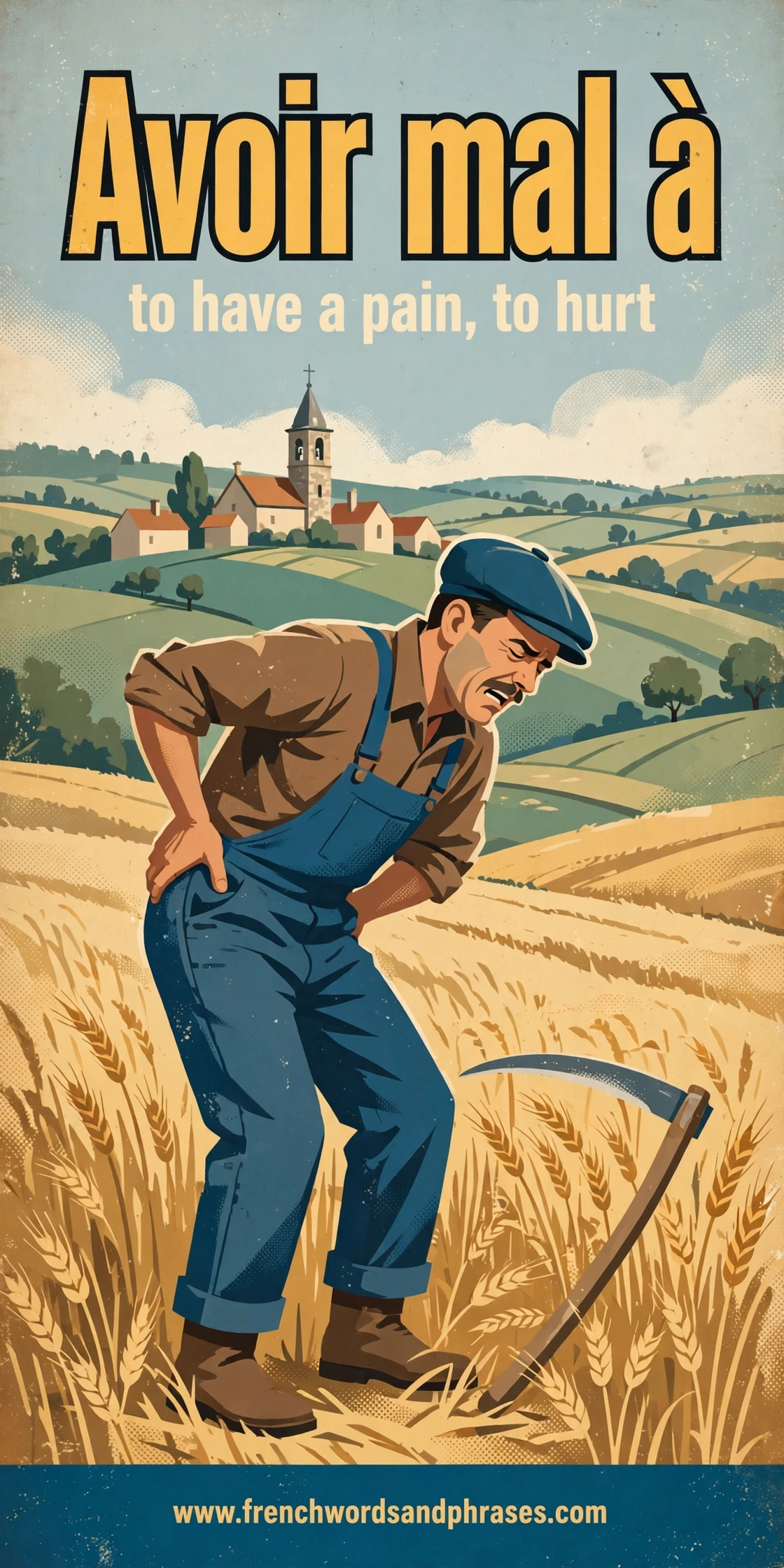
Avoir mal à means to have a pain, to hurt — the way French says a part of the body aches.
The dentist’s waiting room, ten in the morning. A little boy holds his cheek with both hands and whispers it to his mother, in the exact words every French child learns before the age of five: « Maman, j’ai mal aux dents. »
Let’s explore how avoir mal à works in French, beginning with the whole phrase on one card.
Understanding the French Phrase Avoir mal à
Avoir mal à is a French expression built from avoir (to have), mal (pain, ache — a masculine noun here) and à (to, at). Where English gives the pain to the body part — my head hurts — French gives it to the person: j’ai mal à la tête, I have pain at the head.
It means to have a pain, to hurt — in a named part of the body. Nothing is grammatically broken in your head or your tooth: French simply reports pain the way it reports hunger or cold, as something you have. The body part follows à, and à fuses with the article: à la tête, au dos, aux dents.
Type: Everyday expression — the body (avoir + mal + à + body part)
Answers the need: Saying that a part of your body hurts or aches
Register: Neutral — everywhere, from the playground to the doctor’s surgery
Strength: Flexible — from a slight ache to a real pain, the context sets the level
One important usage detail: à merges with the article of the body part — à + le becomes au (j’ai mal au ventre), à + les becomes aux (j’ai mal aux pieds), while à la and à l’ stay as they are (à la tête, à l’épaule). Avoir itself conjugates normally: j’ai mal, tu as mal, nous avons mal.
Experience the Word
Avoir mal à is usually the first complete French sentence a child ever needs — and the first one every visitor to France ends up using.
Imagine the pharmacist on a Sunday morning, the hiker with the blister, the grandfather after the garden. Each one arrives with the same small sentence and a hand pressed to the spot. Three words, and help is already on its way.
French treats pain as a possession you can point to. You do not suffer the ache — you have it, you name it, and you hand it over to someone who can help.
How to Use Avoir mal à in French: Complete Guide
Let’s explore how avoir mal à works in French, beginning with the whole phrase on one card.
Avoir mal à at a Glance
The Whole Phrase on One Card
Real meaning, literal picture, English twin and register — avoir mal à in five lines.
| Point | Avoir mal à |
|---|---|
| What it really means | to have a pain, to hurt — in a named part of the body |
| Word for word | to have pain at — j’ai mal à la tête, I have pain at the head |
| English equivalent | my … hurts / I have a …ache |
| Register | neutral — safe everywhere, with doctors and grandmothers alike |
| Use it for | headaches, toothaches, sore backs — any ache you can point to |
Example
J’ai mal à la tête depuis ce matin.
I have had a headache since this morning.
Word by Word: Building the Ache
Three small pieces — take them one by one and the sentence builds itself.
| Word | Literal meaning | Its job in the phrase |
|---|---|---|
| avoir | to have | the verb that holds the pain — j’ai, tu as, il a |
| mal | pain, ache | a masculine noun here: the pain itself, le mal |
| à | at, to | points to the place that hurts — and fuses with the article: au, aux |
Example
Elle a mal au dos après le déménagement.
She has a sore back after the move.
Quick Quiz 1
How does French say ‘my head hurts’ — with être or with avoir?
Reveal the answer
With avoir — j’ai mal à la tête: French gives the pain to the person, not to the head.
J’ai mal à la tête, je vais me coucher.
My head hurts, I’m going to lie down.
When You Say It: The Aching Moments
Avoir mal à fires at moments like these — wherever something hurts and someone needs to know.
| Situation | Example |
|---|---|
| At the doctor’s | j’ai mal au ventre depuis hier — my stomach has hurt since yesterday |
| A child’s tooth | il a mal aux dents — he has toothache |
| After sport | nous avons mal aux jambes — our legs ache |
| At the desk | j’ai mal aux yeux le soir — my eyes hurt in the evening |
| Asking after someone | tu as encore mal au genou ? — does your knee still hurt? |
Example
Après la randonnée, tout le monde avait mal aux pieds.
After the hike, everyone’s feet were aching.
Make It Yours: The Pain for Every Body Part
The frame never changes — only the article and the body part move.
| Form | French | In English |
|---|---|---|
| Head | j’ai mal à la tête | my head hurts |
| Stomach | j’ai mal au ventre | my stomach hurts |
| Teeth | j’ai mal aux dents | I have toothache |
| Throat | j’ai mal à la gorge | I have a sore throat |
| Back | il a mal au dos | his back hurts |
| Feet | elle a mal aux pieds | her feet hurt |
Example
Le bébé a mal aux dents et pleure toute la nuit.
The baby has toothache and cries all night.
Quick Quiz 2
‘I have a sore throat’: j’ai mal à la gorge or j’ai mal au gorge?
Reveal the answer
J’ai mal à la gorge — gorge is feminine, so à la stays as it is; au is only for masculine words like le dos.
Avec ce froid, j’ai mal à la gorge.
With this cold, I have a sore throat.
Everyday Expressions: Building on the Ache
Avoir mal à slots into these everyday frames — each one ready to use as it stands.
| Frame | In English |
|---|---|
| avoir mal à la tête | to have a headache |
| avoir mal au cœur | to feel sick, nauseous — literally pain at the heart |
| avoir mal aux dents | to have toothache |
| avoir un mal de chien | to be in terrible pain — informal, literally a dog’s pain |
| ça fait mal | that hurts — said of the thing that causes the pain |
Example
En voiture, elle a toujours mal au cœur.
In the car, she always feels sick.
Close Cousins: The Other Ways to Hurt
French has a whole shelf of pain phrases — avoir mal à is the everyday one; its cousins name the pain, feel it or cause it.
| Expression | The difference |
|---|---|
| avoir mal à | to have a pain somewhere — the standard, neutral way |
| avoir un mal de tête | to have a headache — names the pain as a thing: un mal de tête, un mal de dents |
| faire mal | to hurt someone or something — le soleil me fait mal aux yeux, the sun hurts my eyes |
| souffrir de | to suffer from — stronger and more medical: souffrir d’une maladie |
| avoir une douleur à | to have a pain at — the doctor’s word, une douleur, more clinical |
Example
Ce bruit me fait mal à la tête.
That noise is giving me a headache.
Quick Quiz 3
The bright light is hurting your eyes. Do you avez mal or does it faire mal?
Reveal the answer
It fait mal — la lumière me fait mal aux yeux. Avoir mal states your pain; faire mal names what causes it.
Éteins la lampe, elle me fait mal aux yeux.
Turn the lamp off, it is hurting my eyes.
Avoir mal à and Its Neighbours
The surgery shelf around the phrase — the ache, the illness and the cure.
| French | In English |
|---|---|
| un mal de tête | a headache |
| la douleur | pain — the clinical word |
| être malade | to be ill |
| un médicament | a medicine |
| le médecin | the doctor |
| se sentir mieux | to feel better |
Example
Le médecin lui a donné un médicament contre le mal de tête.
The doctor gave her a medicine for the headache.
Watch Out: The Traps Around Avoir mal à
The traps: the wrong verb, a missing fusion, and a heart that is not romantic.
| Trap | The truth |
|---|---|
| English ‘hurts’ misleads | never say ma tête fait mal for your own headache — the person has the pain: j’ai mal à la tête |
| à must fuse | à + le = au, à + les = aux: j’ai mal au dos, j’ai mal aux dents — never à le dos |
| mal au cœur is not heartbreak | avoir mal au cœur means to feel sick to your stomach, not to be lovesick |
| mal is two words in one | as an adverb mal means badly (il chante mal); in this phrase it is the noun, pain |
Example
Il a mal au cœur en bateau, pas mal à la tête.
He feels seasick on boats, he does not have a headache.
Quick Quiz 4
True or false: j’ai mal au cœur means ‘my heart is broken’.
Reveal the answer
False — it means I feel sick, nauseous. For a broken heart, French says j’ai le cœur brisé.
Après le repas, elle avait mal au cœur.
After the meal, she felt sick.
Avoir mal à in Everyday French: Real-Life Examples
Now that you know the word, let’s see how avoir mal à appears in everyday French.
Example 1 — At the doctor’s
Docteur, j’ai mal au ventre depuis deux jours.
Doctor, my stomach has been hurting for two days.
Example 2 — A child’s cheek
Mon fils a mal aux dents, il n’a pas dormi.
My son has toothache, he did not sleep.
Example 3 — After the match
Après le match, ils avaient tous mal aux jambes.
After the match, all their legs were aching.
Example 4 — At the office
Je passe la journée devant l’écran, alors j’ai mal aux yeux.
I spend the day in front of the screen, so my eyes hurt.
Example 5 — The heavy bag
Ce sac est trop lourd, j’ai mal à l’épaule.
This bag is too heavy, my shoulder hurts.
Example 6 — Checking on grandma
Tu as encore mal au genou, mamie ?
Does your knee still hurt, grandma?
Beyond Translation: The Meaning of Avoir mal à
English hands the pain to the body: the head hurts, the tooth aches, as if each part complained on its own. French keeps the pain with the person — you have it, the way you have hunger, the way you have time.
To say j’ai mal à la tête is to stay the owner of your own body, even when it hurts.
And there is something hopeful in the grammar: what you have, you can describe, locate, and one day put down.
How to Remember the French Phrase Avoir mal à
Remember it this way: Avoir mal à is pain kept in your own hands — you have it, you point to where it lives, and à does the pointing.
- You give the pain to the person — j’ai mal, never the body part’s own verb.
- You fuse à without thinking — au dos, aux dents, à la tête, à l’épaule.
- You keep mal au cœur for nausea — it is the stomach complaining, not the heart breaking.
The key idea is avoir mal à means to have a pain — j’ai mal à la tête, my head hurts.
Test Your Knowledge of Avoir mal à
Let’s see how much you’ve learned. Try answering these questions before revealing the answers.
Question 1
What does j’ai mal aux dents mean?
Reveal the answer
I have toothache — literally, I have pain at the teeth.
Question 2
Why does French use avoir here, not être?
Reveal the answer
Because French gives the pain to the person — like hunger or cold, pain is something you have: j’ai mal, j’ai faim, j’ai froid.
Question 3
How do you say ‘his back hurts’?
Reveal the answer
Il a mal au dos — à + le fuses into au.
Question 4
What is the difference between avoir mal à la tête and avoir un mal de tête?
Reveal the answer
Almost none in meaning — the first points at the place (pain at the head), the second names the thing (a headache). Both are correct and common.
Question 5
Complete the sentence:
Après le ski, nous avons mal ______ jambes. (After skiing, our legs ache.)
Reveal the answer
aux
Après le ski, nous avons mal aux jambes.
After skiing, our legs ache.
Your Final Challenge
Can You Use It?
How would you say this in French?
“My head hurts and my feet ache.”
Reveal the answer
J’ai mal à la tête et j’ai mal aux pieds.
My head hurts and my feet ache.
A little French. A little curiosity. A richer everyday life.
LEARN FRENCH ONE WORD AT A TIME