A French Word to Live By
Translate Avoir l’âge de to English
/a.vwaʁ laʒ də/
Avoir l’âge de means to be … years old — the phrase French uses to give an age.
First day of school, and the teacher kneels down beside a small girl with a ribbon in her hair. She does not ask her name first — she asks the question every French childhood is measured by: « Tu as quel âge ? »
Let’s explore how avoir l’âge de works in French, beginning with the whole phrase on one card.
Understanding the French Phrase Avoir l’âge de
Avoir l’âge de is a French expression built from avoir (to have), l’âge (the age — a masculine noun) and de (of). English says you ARE an age; French says you HAVE it — you carry your years the way you carry your name, and the number slots into the frame: avoir dix ans.
It means to be … years old. Nobody is being weighed or measured: in French, age is a possession, counted in years held. The everyday working form drops the word âge itself — quel âge as-tu ? and j’ai trente ans — but the full frame, avoir l’âge de, is the one that compares: il a l’âge de mon frère, he is my brother’s age.
Type: Everyday expression — age (avoir + l’âge + de)
Answers the need: Giving an age, asking an age, comparing two ages
Register: Neutral — everywhere, from the schoolyard to the passport office
Strength: Exact — it carries a precise number of years
One important usage detail: the number of years is said with ans, never années, in this frame — j’ai vingt ans. And the classic trap is the English verb: never je suis vingt ans. French is firm about it — you are not your age, you have it: j’ai, tu as, il a, nous avons, vous avez, ils ont.
Experience the Word
Avoir l’âge de is the phrase of birthdays, school forms and first meetings — the first fact French asks about a child.
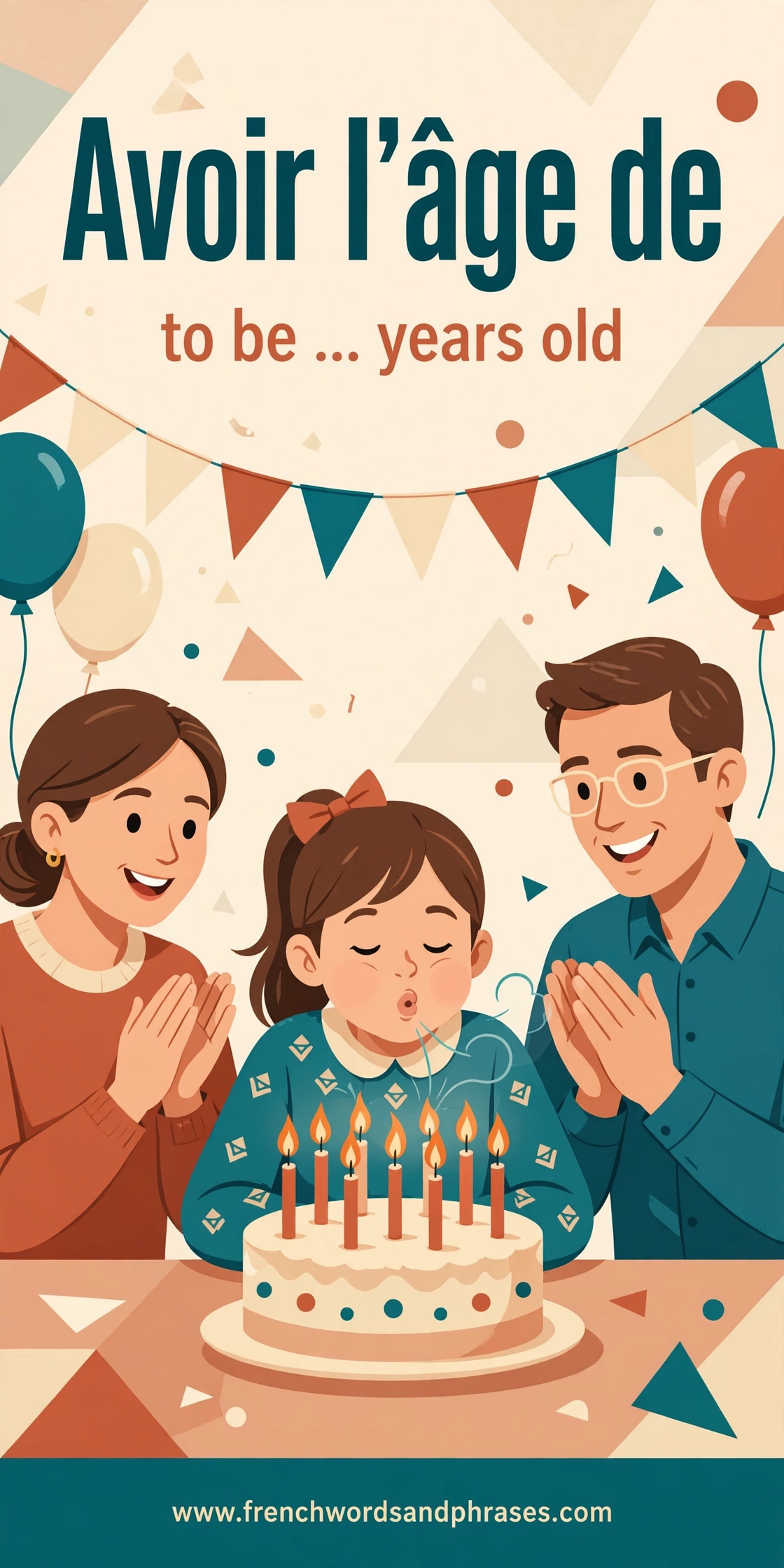
Imagine the birthday table, the candles counted one by one. The child does not announce that she IS seven; she announces what she HAS — sept ans, held up like a treasure, seven fingers in the air. In French, every year is something you have gained and kept.
That is the gentle philosophy inside the grammar. Years are not what you are — they are what you have collected.
How to Use Avoir l’âge de in French: Complete Guide
Let’s explore how avoir l’âge de works in French, beginning with the whole phrase on one card.
Avoir l’âge de at a Glance
The Whole Phrase on One Card
Real meaning, literal picture, English twin and register — avoir l’âge de in five lines.
| Point | Avoir l’âge de |
|---|---|
| What it really means | to be … years old — to have reached a given age |
| Word for word | to have the age of — j’ai l’âge de Paul, I have the age of Paul |
| English equivalent | to be … years old / to be the age of |
| Register | neutral — safe everywhere |
| Use it for | ages, birthdays, comparisons of age, forms and introductions |
Example
Ma fille a l’âge de votre fils.
My daughter is the same age as your son.
Word by Word: Building the Age
Three small pieces — take them one by one and the years stack up.
| Word | Literal meaning | Its job in the phrase |
|---|---|---|
| avoir | to have | the verb that holds the years — j’ai, tu as, il a |
| l’âge | the age | a masculine noun: un âge, l’âge de… |
| de | of | the little link — the age OF someone, or of a number of years |
Example
Il a l’âge de partir seul en vacances.
He is old enough to go on holiday alone.
Quick Quiz 1
‘She is ten years old’: elle est dix ans or elle a dix ans?
Reveal the answer
Elle a dix ans — French has its ages, it is never them. Être would sound like she is made of years.
Elle a dix ans et elle lit déjà des romans.
She is ten years old and she already reads novels.
When You Say It: The Age Moments
Avoir l’âge de fires at moments like these — wherever years are asked, given or compared.
| Situation | Example |
|---|---|
| Asking a child | tu as quel âge ? — how old are you? |
| On a form | il faut avoir dix-huit ans — you must be eighteen |
| Comparing | elle a l’âge de ma sœur — she is my sister’s age |
| Old enough | tu as l’âge de comprendre — you are old enough to understand |
| Guessing | il a l’âge de mon père, à peu près — he is about my father’s age |
Example
Pour ce film, il faut avoir douze ans.
For this film, you have to be twelve years old.
Make It Yours: The Age for Every Person
Avoir conjugates, the number changes — and ans never becomes années.
| Form | French | In English |
|---|---|---|
| I am seven | j’ai sept ans | I am seven years old |
| You are ten | tu as dix ans | you are ten years old |
| He is twenty | il a vingt ans | he is twenty years old |
| We are thirty | nous avons trente ans | we are thirty years old |
| The question | quel âge avez-vous ? | how old are you? |
| Same age | ils ont le même âge | they are the same age |
Example
Quel âge avez-vous ? — J’ai quarante ans.
How old are you? — I am forty years old.
Quick Quiz 2
Which is right: j’ai vingt ans or j’ai vingt années?
Reveal the answer
J’ai vingt ans — ages are counted in ans. Années measures stretches of time, not the age you have.
Elle a vingt ans cette année.
She is twenty this year.
Everyday Expressions: Building on the Age
Avoir l’âge de slots into these everyday frames — each one ready to use as it stands.
| Frame | In English |
|---|---|
| avoir … ans | to be … years old — the everyday working form |
| avoir le même âge | to be the same age |
| avoir l’âge de faire quelque chose | to be old enough to do something |
| ne pas faire son âge | to not look your age — a compliment |
| avoir l’âge de raison | to reach the age of reason — about seven years old |
Example
Tu ne fais pas ton âge, c’est incroyable.
You do not look your age, it is incredible.
Close Cousins: The Other Ways to Count Years
French has a whole shelf of age phrases — avoir l’âge de is the neutral one; its cousins celebrate, hide or round the number.
| Expression | The difference |
|---|---|
| avoir l’âge de | to be the age of — the frame itself, exact and neutral |
| avoir … ans | the everyday form — the word âge disappears, the number stays |
| fêter ses … ans | to celebrate your …th birthday — the party version |
| être âgé de … ans | to be aged … — formal, written, for documents and reports |
| avoir une vingtaine d’années | to be about twenty — the rounded, guessing version |
Example
Elle va fêter ses quatre-vingts ans en juin.
She is going to celebrate her eightieth birthday in June.
Quick Quiz 3
On an official form you read: âgé de 45 ans. Which everyday phrase says the same thing?
Reveal the answer
Avoir 45 ans — être âgé de is the formal, written twin of the everyday avoir frame.
Il a 45 ans, comme l’indique le formulaire.
He is 45, as the form states.
Avoir l’âge de and Its Neighbours
The birthday shelf around the phrase — the years, the party and the cake.
| French | In English |
|---|---|
| un anniversaire | a birthday |
| les bougies | the candles |
| un cadeau | a present |
| vieillir | to grow old, to age |
| rajeunir | to look younger, to feel younger |
| un siècle | a century — for the very grand ages |
Example
Pour son anniversaire, elle a soufflé cent bougies.
For her birthday, she blew out a hundred candles.
Watch Out: The Traps Around Avoir l’âge de
The traps: the English verb sneaking in, the wrong word for years, and a question that drops its word order.
| Trap | The truth |
|---|---|
| être + age | never je suis vingt ans — French has ages: j’ai vingt ans |
| ans, not années | années counts durations (trois années d’études); ages take ans |
| the question | quel âge as-tu ? — âge comes first, then the verb: not tu as quel âge in careful French |
| l’âge is masculine | un âge, le bel âge — but the phrase keeps the elided l’âge de |
Example
Elle a dix ans, pas dix années : elle les a, ses années.
She is ten years old, not ten durations: the years are hers.
Quick Quiz 4
True or false: je suis trente ans is correct French for ‘I am thirty’.
Reveal the answer
False — j’ai trente ans. In French you have your age, you are never it.
J’ai trente ans et deux enfants.
I am thirty, with two children.
Avoir l’âge de in Everyday French: Real-Life Examples
Now that you know the word, let’s see how avoir l’âge de appears in everyday French.
Example 1 — First day of school
Tu as quel âge ? — J’ai six ans.
How old are you? — I am six years old.
Example 2 — At the cinema
Il faut avoir seize ans pour voir ce film.
You have to be sixteen to see this film.
Example 3 — Comparing cousins
Mon cousin a l’âge de mon frère.
My cousin is the same age as my brother.
Example 4 — The compliment
Vous avez soixante ans ? Vous ne les faites pas.
You are sixty? You do not look it.
Example 5 — Old enough
Elle a l’âge de voyager seule maintenant.
She is old enough to travel alone now.
Example 6 — The twins
Les jumeaux ont le même âge, évidemment.
The twins are the same age, obviously.
Beyond Translation: The Meaning of Avoir l’âge de
English is its age — I am thirty — as if the years were your substance, your very material. French has its age, the way it has a coat or a house: something acquired, kept, and one day handed on in stories.
To avoir l’âge de someone is to stand beside them in the great queue of years, holding the same number.
Perhaps that is why French birthdays feel like harvests: each year is not what you become, but what you have gathered.
How to Remember the French Phrase Avoir l’âge de
Remember it this way: Avoir l’âge de is the harvest of years — you do not be your age in French, you have it, candle by candle.
- You reach for avoir, never être — j’ai vingt ans, and the trap is closed.
- You count in ans — années is for measuring stretches of time, not for ages you hold.
- You ask it French-style — quel âge as-tu ?, with âge at the front of the question.
The key idea is avoir l’âge de means to be … years old — j’ai vingt ans, I have twenty years.
Test Your Knowledge of Avoir l’âge de
Let’s see how much you’ve learned. Try answering these questions before revealing the answers.
Question 1
What does tu as quel âge ? mean?
Reveal the answer
How old are you? — literally, you have what age?
Question 2
How do you say ‘she is fifteen years old’?
Reveal the answer
Elle a quinze ans — avoir, plus the number, plus ans.
Question 3
What does il a l’âge de mon frère mean?
Reveal the answer
He is my brother’s age — the full frame compares two ages.
Question 4
What is the formal, written version of il a 45 ans?
Reveal the answer
Il est âgé de 45 ans — être âgé de belongs to forms and documents.
Question 5
Complete the sentence:
Ma grand-mère ______ quatre-vingt-dix ans. (My grandmother is ninety years old.)
Reveal the answer
a
Ma grand-mère a quatre-vingt-dix ans.
My grandmother is ninety years old.
Your Final Challenge
Can You Use It?
How would you say this in French?
“My little brother is eight years old.”
Reveal the answer
Mon petit frère a huit ans.
My little brother is eight years old.
A little French. A little curiosity. A richer everyday life.
LEARN FRENCH ONE WORD AT A TIME