A French Word to Live By
Translate Avoir le temps to English
/a.vwaʁ lə tɑ̃/
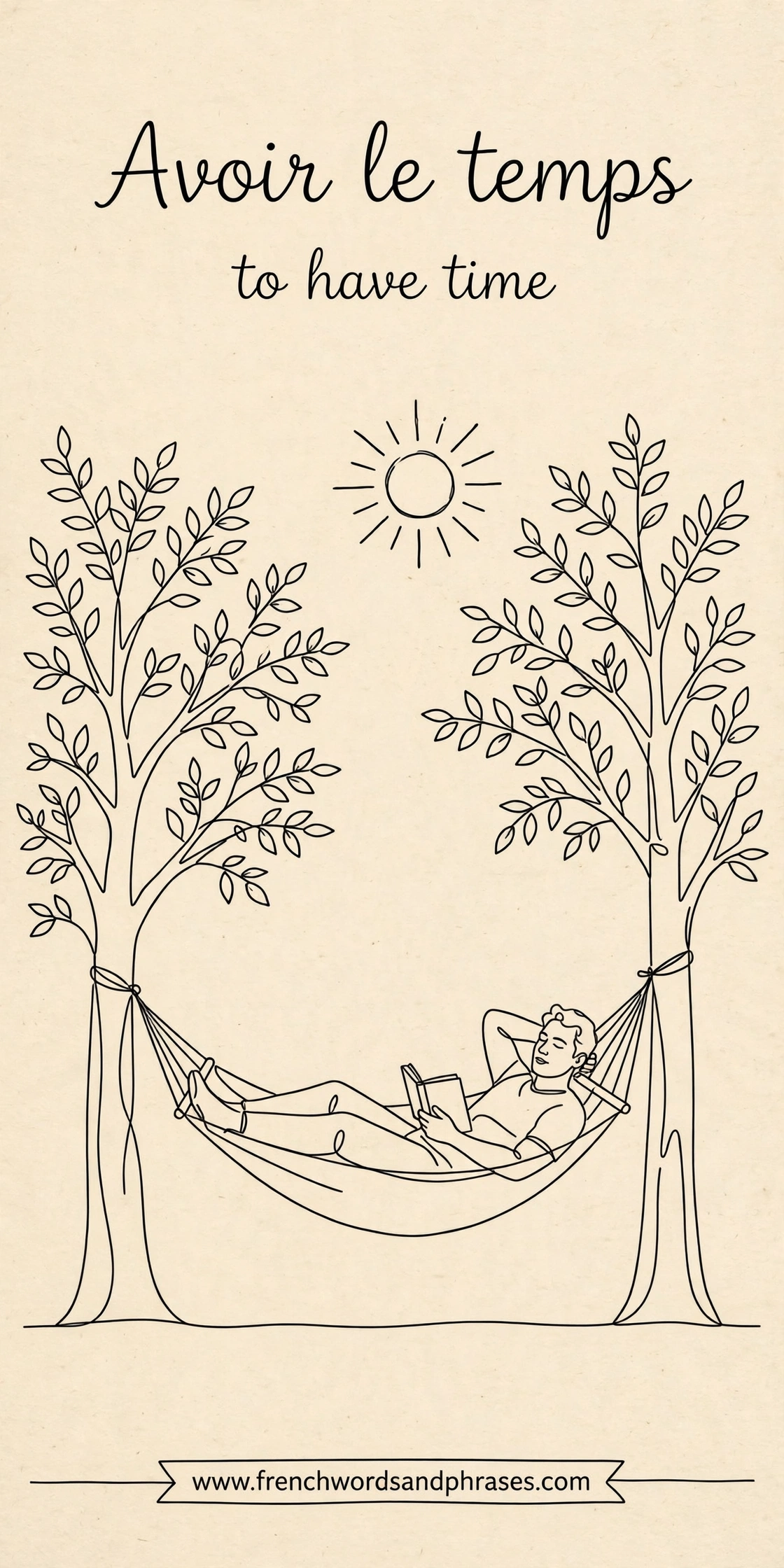
Avoir le temps means to have time — to have time to do something.
Saturday morning, no alarm, no list, no train to catch. Your neighbour knocks with two cups of coffee and a dangerous question: « Tu as le temps de m’aider à monter cette étagère ? » You look at the long, empty day, and for once the answer is the rarest one in modern life: « Oui, j’ai le temps. »
Let’s explore how avoir le temps works in French, beginning with the whole phrase on one card.
Understanding the French Phrase Avoir le temps
Avoir le temps is a French expression built from avoir (to have) and le temps (time — the time available, time as a resource). Almost always completed by de + infinitive, it says the hours are there for the thing you want or need to do.
It means to have time to do something. J’ai le temps de finir: the clock is not against me. The phrase lives in the great modern negotiation — requests, favours, deadlines — and its negative, je n’ai pas le temps, is perhaps the most spoken sentence in France. Note carefully: this is time as a resource, not the time of day; for that, French asks vous avez l’heure ?
Type: Expression — availability (avoir + le temps + de + infinitive)
Answers the need: Saying you have — or do not have — time for something
Register: Neutral — safe everywhere, from the kitchen to the boardroom
Strength: Everyday and total — its negative is the modern world’s motto
One important usage detail: the phrase nearly always carries its purpose with it — avoir le temps de + infinitive. Bare j’ai le temps works as an answer (‘have you time?’ — ‘yes, I have time’), but the full shape names the task. And temps is also the word for weather — le temps est beau — so context, as ever, drives the meaning home.
Experience the Word
Avoir le temps is the phrase of the open afternoon — the one that turns a request from an intrusion into a pleasure.
Imagine a retired clockmaker in Besançon, a man who spent fifty years repairing other people’s hours. Visitors ask if retirement is long. He smiles: for the first time in his life, he says, j’ai le temps — and he says it like a man describing a fortune.
French treats time as a possession that can be had, taken, lost and given. Prendre le temps, donner du temps, avoir le temps — a whole economy of hours, in three small phrases.
How to Use Avoir le temps in French: Complete Guide
Let’s explore how avoir le temps works in French, beginning with the whole phrase on one card.
Avoir le temps at a Glance
The Whole Phrase on One Card
Real meaning, literal building blocks, English twin and register — avoir le temps in five lines.
| Point | Avoir le temps |
|---|---|
| What it really means | to have time — to have time available for something |
| Word for word | to have the time |
| English equivalent | to have time (to do something) / to have the time |
| Register | neutral — safe everywhere |
| Use it for | favours, deadlines, plans — the daily economy of hours |
Example
J’ai le temps de passer à la banque avant midi.
I have time to go to the bank before midday.
Word by Word: Building the Free Hours
Two pieces — the having verb, and time itself, the resource being counted.
| Word | Literal meaning | Its job in the phrase |
|---|---|---|
| avoir | to have | the verb of possession — time, here, is a thing you can hold or lack |
| le temps | time | time as a resource and a duration — not the clock reading, which is l’heure |
Example
Nous avons le temps de prendre un café.
We have time to have a coffee.
Quick Quiz 1
A stranger asks vous avez l’heure ? and your friend answers about his free afternoon. What went wrong?
Reveal the answer
He confused l’heure with le temps — l’heure is the time of day; le temps is time available. The stranger only wanted the clock.
Vous avez l’heure ? Il est quatre heures.
Do you have the time? It is four o’clock.
When You Say It: The Hours Available
Avoir le temps fires at moments like these — a favour weighed, a deadline checked, a rare free hour announced.
| Situation | Example |
|---|---|
| Accepting a favour | j’ai le temps de t’aider, ne t’inquiète pas — I have time to help you, don’t worry |
| Refusing, politely | je n’ai pas le temps aujourd’hui, désolé — I don’t have time today, sorry |
| Before a deadline | nous avons encore le temps de corriger le texte — we still have time to correct the text |
| On holiday | en vacances, on a le temps de vivre — on holiday, you have time to live |
| Asking | tu as le temps de relire mon message ? — do you have time to reread my message? |
Example
Il n’a jamais le temps de téléphoner à sa mère.
He never has time to phone his mother.
Make It Yours: Time for Every Person
Avoir conjugates as usual; de + infinitive names what the time is for.
| Form | French | In English |
|---|---|---|
| I have time | j’ai le temps de finir | I have time to finish |
| Negative | je n’ai pas le temps | I don’t have time |
| In the past | nous avions le temps de discuter | we had time to talk |
| Question | vous avez le temps de signer ? | do you have time to sign? |
| Barely | j’ai à peine le temps de manger | I barely have time to eat |
| Plenty | tu as tout le temps | you have all the time in the world |
Example
Prenez votre temps, vous avez tout le temps.
Take your time, you have all the time in the world.
Quick Quiz 2
How do you say ‘I barely have time to eat’?
Reveal the answer
J’ai à peine le temps de manger — à peine, barely, slips between avoir and le temps.
Entre deux réunions, il a à peine le temps de respirer.
Between two meetings, he barely has time to breathe.
Everyday Expressions: Building on the Free Time
Avoir le temps slots into these everyday frames — each one ready to use as it stands.
| Frame | In English |
|---|---|
| avoir le temps de + infinitive | to have time to do something |
| ne pas avoir le temps | to not have time — the great modern refusal |
| avoir tout le temps | to have all the time in the world |
| prendre le temps de | to take the time to — the deliberate twin |
| avoir le temps qu’il faut | to have as much time as it takes |
Example
Prenez le temps de lire le contrat avant de signer.
Take the time to read the contract before signing.
Close Cousins: The Other Time Phrases
French spends time in several phrases — le temps is the resource; its cousins take it, lose it and kill it.
| Expression | The difference |
|---|---|
| avoir le temps | to have time — the resource is in your hands |
| prendre le temps de | to take the time to — you decide to spend the time, slowly and well |
| perdre du temps | to waste, to lose time — the resource slipping away |
| gagner du temps | to gain, to save time — the resource recovered |
| passer le temps | to pass the time — filling hours that hang heavy |
Example
En réparant le vélo ce soir, on gagnera du temps demain.
By fixing the bike tonight, we will save time tomorrow.
Quick Quiz 3
Which cousin means you deliberately slow down and spend the time properly?
Reveal the answer
Prendre le temps de — to take the time to: a choice, not just an availability.
Elle prend toujours le temps d’écouter ses élèves.
She always takes the time to listen to her pupils.
Avoir le temps and Its Neighbours
The time shelf around the phrase — having it, lacking it, and the weather that shares its name.
| French | In English |
|---|---|
| être pressé | to be in a hurry — the state of having no time |
| être débordé | to be swamped, overwhelmed with work |
| le temps libre | free time, leisure time |
| à temps | in time — arriving before it is too late |
| de temps en temps | from time to time |
| le temps (météo) | the weather — the same word, a different sky: quel temps fait-il ? |
Example
De temps en temps, il faut savoir ne rien faire.
From time to time, you have to know how to do nothing.
Watch Out: The Traps Around Avoir le temps
The traps: the clock twin, the weather twin, and the missing purpose.
| Trap | The truth |
|---|---|
| le temps vs l’heure | avoir le temps is having hours available; avoir l’heure is knowing the clock — the twins must never swap jobs |
| temps also means weather | quel temps fait-il ? asks about the sky, not your diary — context separates them instantly |
| the bare negative | je n’ai pas le temps is complete and famously final — adding de + infinitive explains what there is no time for |
| fois is not temps | une fois is one occasion, one time as a count — trois fois, three times; duration and resource are temps |
Example
Trois fois cette semaine, il n’a pas eu le temps de déjeuner.
Three times this week, he did not have time for lunch.
Quick Quiz 4
True or false: quel temps fait-il ? asks whether you are busy today.
Reveal the answer
False — it asks about the weather. Temps carries both time and weather; this set question is always the sky.
Quel temps fait-il chez toi ? Ici, il pleut.
What is the weather like at yours? Here, it is raining.
Avoir le temps in Everyday French: Real-Life Examples
Now that you know the word, let’s see how avoir le temps appears in everyday French.
Example 1 — A free Saturday
Samedi, j’ai le temps de jardiner toute la matinée.
On Saturday, I have time to garden all morning.
Example 2 — The polite refusal
Je n’ai pas le temps cette semaine, essayons lundi.
I don’t have time this week, let’s try Monday.
Example 3 — Helping a neighbour
Tu as le temps de m’aider à porter cette table ?
Do you have time to help me carry this table?
Example 4 — Before the train
Nous avons le temps de prendre un café, le train est en retard.
We have time for a coffee, the train is late.
Example 5 — Barely
Elle a à peine le temps de manger entre ses cours.
She barely has time to eat between her classes.
Example 6 — All the time in the world
À la retraite, il a enfin tout le temps de lire.
In retirement, he finally has all the time in the world to read.
Beyond Translation: The Meaning of Avoir le temps
Every economy has its scarcest currency, and in the modern world it is the hour. French grammar knew it early: time is something you avoir — have, hold, run out of. The phrase avoir le temps is therefore never just about clocks; it is about wealth, freedom and generosity, because giving someone your time is giving the one thing that cannot be earned back.
Je n’ai pas le temps may be the most spoken sentence in France — and j’ai le temps, said slowly, its most luxurious reply.
Learn to hear the difference and you have learned something about the country, not just the language.
How to Remember the French Phrase Avoir le temps
Remember it this way: Avoir le temps is time in your hands — an afternoon you own outright, to spend or to give away.
- You picture the open diary — le temps is the resource; the clock reading is l’heure, a different possession.
- You attach the purpose — avoir le temps de + infinitive names what the hours are for.
- You keep the generous twin — prendre le temps de: to take the time, deliberately and well.
The key idea is avoir le temps means to have time — hours available, usually with de + infinitive naming the task.
Test Your Knowledge of Avoir le temps
Let’s see how much you’ve learned. Try answering these questions before revealing the answers.
Question 1
What does avoir le temps mean?
Reveal the answer
To have time available — usually to do something: avoir le temps de + infinitive.
Question 2
What is the difference between avoir le temps and avoir l’heure?
Reveal the answer
Le temps is free time; l’heure is the time of day — one is a resource, the other is the clock.
Question 3
How do you say ‘I don’t have time’?
Reveal the answer
Je n’ai pas le temps — the famous modern refusal, complete as it stands.
Question 4
Which cousin means ‘to take the time to do something properly’?
Reveal the answer
Prendre le temps de — the deliberate spending of the hours you have.
Question 5
Complete the sentence:
Tu as le temps ______ relire ce texte ? (Do you have time to reread this text?)
Reveal the answer
de
Tu as le temps de relire ce texte ?
Do you have time to reread this text?
Your Final Challenge
Can You Use It?
How would you say this in French?
“I have time to help you.”
Reveal the answer
J’ai le temps de t’aider.
I have time to help you.
A little French. A little curiosity. A richer everyday life.
LEARN FRENCH ONE WORD AT A TIME