A French Word to Live By
Translate Avoir le mal de mer to English
/a.vwaʁ lə mal də mɛʁ/
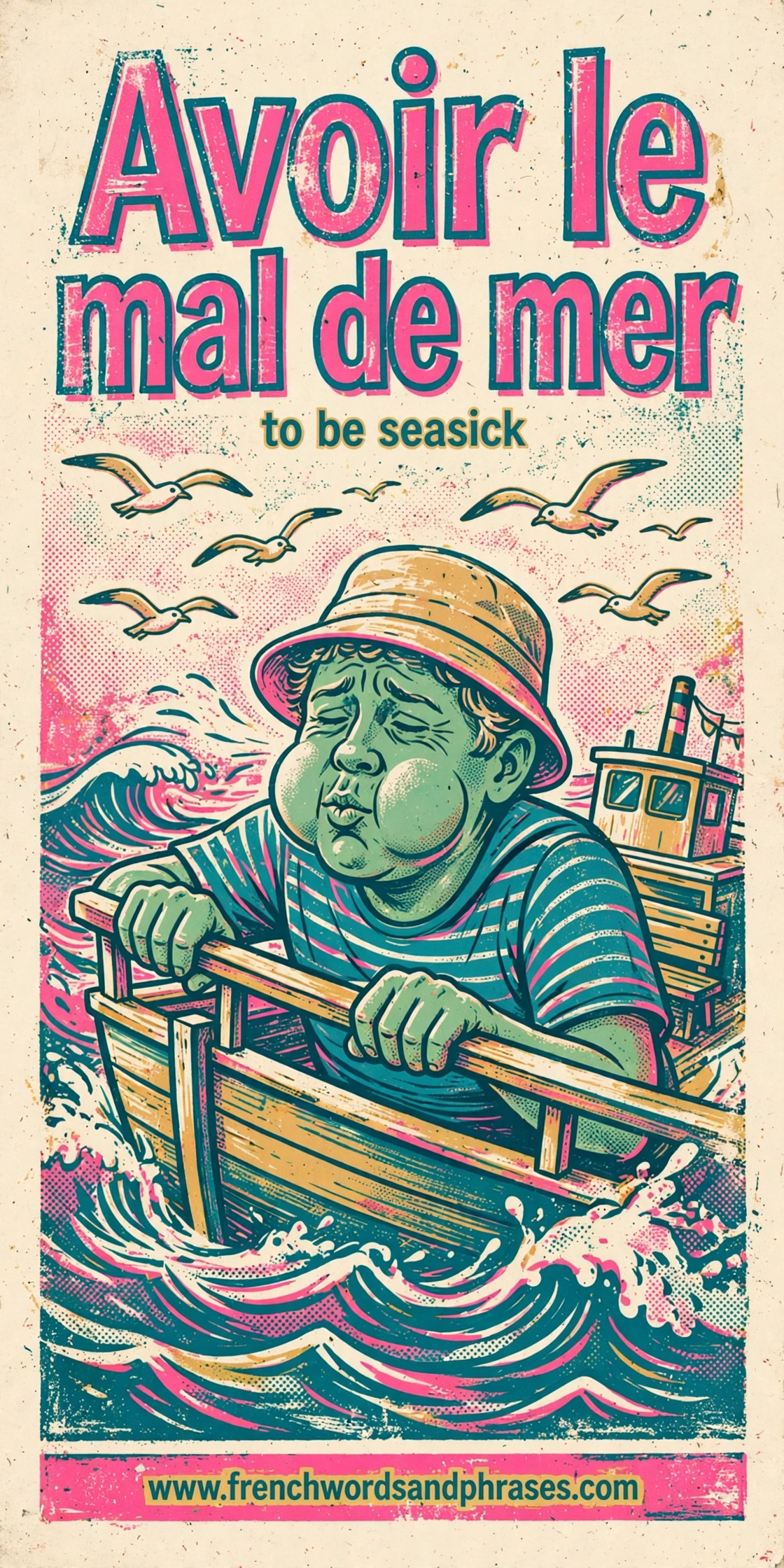
Avoir le mal de mer means to be seasick — to feel ill from the motion of a boat.
Twenty minutes out of the harbour at Saint-Malo, the ferry meets the open sea and begins its slow, rolling climb over the waves. The man who was laughing over his coffee has gone quiet, then green, and is gripping the rail with both hands. His wife pats his shoulder: « Tu as le mal de mer, viens respirer dehors. »
Let’s explore how avoir le mal de mer works in French, beginning with the whole phrase on one card.
Understanding the French Phrase Avoir le mal de mer
Avoir le mal de mer is a French expression built from avoir (to have), le mal (the pain, the sickness) and de mer (of the sea). It names the nausea and dizziness caused by the motion of a boat — the sea’s own particular illness.
It means to be seasick. French builds the idea with mal, the great word of pains and sicknesses — mal de tête, mal aux dents — and assigns the sea its own: le mal de mer. The same pattern gives the travellers’ cousins: le mal de l’air for airsickness and le mal des transports for travel sickness in general.
Type: Expression — health (avoir + le mal de + noun)
Answers the need: Saying that the motion of a boat is making you ill
Register: Neutral — safe everywhere, on every ferry and fishing boat
Strength: Honest and complete — from mild queasiness to full misery
One important usage detail: the pattern is avoir le mal de + the place or vehicle — le mal de mer, le mal de l’air — but for cars and coaches French more often says être malade en voiture. On the boat itself, the kindest sentence is practical: sortir prendre l’air, to go out and get some air, the sailor’s first remedy.
Experience the Word
Avoir le mal de mer is the phrase of the rail and the horizon — of passengers who boarded cheerfully and are now studying the sea with deep suspicion.
Imagine the night ferry to Corsica in a rising wind: the dining room empties course by course, and the crew, who have seen it all, move quietly with glasses of water and kind directions to the deck. Nobody laughs. Everyone aboard has either had le mal de mer or expects it.
The phrase carries no shame in French. The sea is stronger than any stomach, and saying so is simply seamanship.
How to Use Avoir le mal de mer in French: Complete Guide
Let’s explore how avoir le mal de mer works in French, beginning with the whole phrase on one card.
Avoir le mal de mer at a Glance
The Whole Phrase on One Card
Real meaning, literal building blocks, English twin and register — avoir le mal de mer in five lines.
| Point | Avoir le mal de mer |
|---|---|
| What it really means | to be seasick — ill from the motion of a boat |
| Word for word | to have the sickness of the sea |
| English equivalent | to be seasick / to feel seasick |
| Register | neutral — safe everywhere |
| Use it for | ferries, fishing boats, sailing trips — any stomach beaten by waves |
Example
Sur le bateau, j’ai toujours le mal de mer.
On boats, I always get seasick.
Word by Word: Building the Seasickness
Three pieces — the having verb, the sickness word, and the sea that causes it.
| Word | Literal meaning | Its job in the phrase |
|---|---|---|
| avoir | to have | the verb that holds the illness — sickness, in French, is something you have |
| le mal | the pain, the sickness | the great French word of aches: mal de tête, mal de dos, mal de mer |
| de mer | of the sea | names the culprit — the sea and its motion do this to you |
Example
Le mal de mer l’a pris dès la sortie du port.
Seasickness took him as soon as they left the harbour.
Quick Quiz 1
Which word carries the sickness in the phrase — mal or mer?
Reveal the answer
Mal — the pain/sickness word of mal de tête and mal aux dents; mer only names where it strikes.
Un mal de tête en mer, c’est le mal de mer en plus.
A headache at sea is seasickness on top.
When You Say It: The Rolling Moments
Avoir le mal de mer fires at moments like these — the harbour fades, the swell rises, and faces change colour.
| Situation | Example |
|---|---|
| Confessing it | j’ai le mal de mer, je vais sur le pont — I am seasick, I am going up on deck |
| About a child | le petit a le mal de mer, donne-lui de l’eau — the little one is seasick, give him some water |
| Warning beforehand | prends un comprimé, sinon tu auras le mal de mer — take a tablet, or you will be seasick |
| Asking the crew | vous avez quelque chose contre le mal de mer ? — do you have anything for seasickness? |
| Afterwards, laughing | j’ai eu le mal de mer tout le voyage — I was seasick the whole crossing |
Example
Dès que le bateau a quitté le quai, elle a eu le mal de mer.
As soon as the boat left the quay, she felt seasick.
Make It Yours: The Seasickness for Every Traveller
Avoir conjugates as usual; the remedies around the phrase are as useful as the phrase itself.
| Form | French | In English |
|---|---|---|
| I am seasick | j’ai le mal de mer | I am seasick |
| She gets seasick | elle a le mal de mer en bateau | she gets seasick on boats |
| In the past | nous avons eu le mal de mer | we were seasick |
| The remedy — fresh air | va prendre l’air sur le pont | go and get some air on deck |
| The remedy — the horizon | regarde l’horizon, ça aide | look at the horizon, it helps |
| Prevention | un comprimé contre le mal de mer | a tablet against seasickness |
Example
Regarde l’horizon et respire lentement, le mal de mer va passer.
Look at the horizon and breathe slowly, the seasickness will pass.
Quick Quiz 2
What is the sailor’s first remedy, in French?
Reveal the answer
Prendre l’air et regarder l’horizon — get fresh air on deck and fix your eyes on the horizon.
Sur le pont, face à l’horizon, il a vite oublié son mal de mer.
On deck, facing the horizon, he soon forgot his seasickness.
Everyday Expressions: Building on the Seasickness
Avoir le mal de mer slots into these everyday frames — each one ready to use as it stands.
| Frame | In English |
|---|---|
| avoir le mal de mer | to be seasick |
| avoir le mal de l’air | to be airsick — the aeroplane cousin |
| avoir le mal des transports | to get travel sick — cars, coaches, everything |
| être malade en voiture | to be car sick — the everyday road version |
| un comprimé contre le mal de mer | a tablet for seasickness |
Example
Elle a le mal des transports, même en voiture.
She gets travel sick, even in a car.
Close Cousins: The Other Motion Sicknesses
French gives every vehicle its own sickness — le mal de mer is the sea’s; its cousins ride the air and the road.
| Expression | The difference |
|---|---|
| avoir le mal de mer | to be seasick — boats and the sea |
| avoir le mal de l’air | to be airsick — aeroplanes |
| être malade en voiture | to be car sick — the road version, said with être malade |
| avoir des nausées | to feel nauseous — the symptom itself, whatever the cause |
| avoir le pied marin | to have your sea legs — the happy opposite: the sea does not trouble you at all |
Example
Le vieux pêcheur a le pied marin, le mal de mer, il ne connaît pas.
The old fisherman has his sea legs; seasickness, he does not know it.
Quick Quiz 3
Which cousin is the happy opposite — the sailor the sea never troubles?
Reveal the answer
Avoir le pied marin — to have your sea legs: steady on a rolling deck, immune to le mal de mer.
Après trois traversées, elle a enfin le pied marin.
After three crossings, she finally has her sea legs.
Avoir le mal de mer and Its Neighbours
The shipboard shelf around the phrase — symptoms, remedies and the sea itself.
| French | In English |
|---|---|
| le pont | the deck — where the fresh air is |
| la houle | the swell — the rolling motion that causes it |
| des nausées | nausea, feeling sick |
| prendre l’air | to get some fresh air |
| l’horizon | the horizon — the fixed point that calms the stomach |
| le pied marin | sea legs — immunity earned by practice |
Example
La houle était forte, et la moitié des passagers avait le mal de mer.
The swell was heavy, and half the passengers were seasick.
Watch Out: The Traps Around Avoir le mal de mer
The traps: mal’s many jobs, and a sickness for every vehicle.
| Trap | The truth |
|---|---|
| mal is not ‘bad’ here | mal can mean badly or evil elsewhere — in le mal de mer it is the noun: pain, sickness |
| one sickness per vehicle | sea is mal de mer, air is mal de l’air, road is usually être malade en voiture — do not give the car a mal de mer |
| être malade vs avoir le mal | être malade en bateau works too, but the classic, complete phrase is avoir le mal de mer |
| mer vs mère | la mer is the sea; la mère is the mother — same sound, different spelling, very different sentence |
Example
La mer était calme, personne n’a eu le mal de mer.
The sea was calm, nobody was seasick.
Quick Quiz 4
True or false: a passenger sick in a taxi has le mal de mer.
Reveal the answer
False — le mal de mer belongs to boats. In a car, say être malade en voiture or le mal des transports.
Elle est malade en voiture, mais jamais en bateau.
She is car sick, but never seasick.
Avoir le mal de mer in Everyday French: Real-Life Examples
Now that you know the word, let’s see how avoir le mal de mer appears in everyday French.
Example 1 — On the ferry
Vingt minutes après le départ, il a eu le mal de mer.
Twenty minutes after departure, he felt seasick.
Example 2 — A warning
Si tu lis en bateau, tu auras le mal de mer.
If you read on the boat, you will get seasick.
Example 3 — Asking for help
Vous avez un comprimé contre le mal de mer ?
Do you have a tablet for seasickness?
Example 4 — A child
La petite a le mal de mer, sortons sur le pont.
The little girl is seasick, let’s go out on deck.
Example 5 — The remedy
Regarde l’horizon, ton mal de mer va passer.
Look at the horizon, your seasickness will pass.
Example 6 — The proud sailor
Moi, je n’ai jamais le mal de mer, j’ai le pied marin.
Me, I never get seasick, I have my sea legs.
Beyond Translation: The Meaning of Avoir le mal de mer
French builds its sicknesses like addresses: the mal lives somewhere — in the head, in the teeth, at sea. Le mal de mer gives the ocean an almost medical personality: it is not that you are weak, it is that the sea has a specific illness reserved for its passengers, known to every crew that ever sailed.
Avoir le mal de mer is a confession the sea forgives instantly — even its oldest sailors began as green passengers at a rail.
And the language keeps the promotion ready: survive enough crossings and the mal de mer is replaced by le pied marin, the sea legs of the initiated.
How to Remember the French Phrase Avoir le mal de mer
Remember it this way: Avoir le mal de mer is the sea’s own address for sickness — mal, the pain word, posted to the waves.
- You file it with the other mal phrases — mal de tête, mal de dos, and the sea’s own: mal de mer.
- You match the sickness to the vehicle — mer for boats, l’air for planes, être malade en voiture for cars.
- You keep the remedy with the phrase — prendre l’air, regarder l’horizon: air and horizon, in that order.
The key idea is avoir le mal de mer means to be seasick — the mal, the sickness word, assigned to the sea.
Test Your Knowledge of Avoir le mal de mer
Let’s see how much you’ve learned. Try answering these questions before revealing the answers.
Question 1
What does avoir le mal de mer mean?
Reveal the answer
To be seasick — to feel ill from the motion of a boat.
Question 2
Which word means the sickness in the phrase?
Reveal the answer
Mal — the pain and sickness word, as in mal de tête; mer names the sea that causes it.
Question 3
How do you say ‘to be airsick’?
Reveal the answer
Avoir le mal de l’air — the same pattern, with the air in place of the sea.
Question 4
What is the happy opposite — the sailor the sea never troubles?
Reveal the answer
Avoir le pied marin — to have your sea legs.
Question 5
Complete the sentence:
Sur ce ferry, tout le monde a le mal de ______. (On this ferry, everyone is seasick.)
Reveal the answer
mer
Sur ce ferry, tout le monde a le mal de mer.
On this ferry, everyone is seasick.
Your Final Challenge
Can You Use It?
How would you say this in French?
“On boats, I always get seasick.”
Reveal the answer
En bateau, j’ai toujours le mal de mer.
On boats, I always get seasick.
A little French. A little curiosity. A richer everyday life.
LEARN FRENCH ONE WORD AT A TIME