A French Word to Live By
Translate Avoir froid to English
/a.vwaʁ fʁwa/
Avoir froid means to be cold — to feel cold (said of a person, not of the weather).
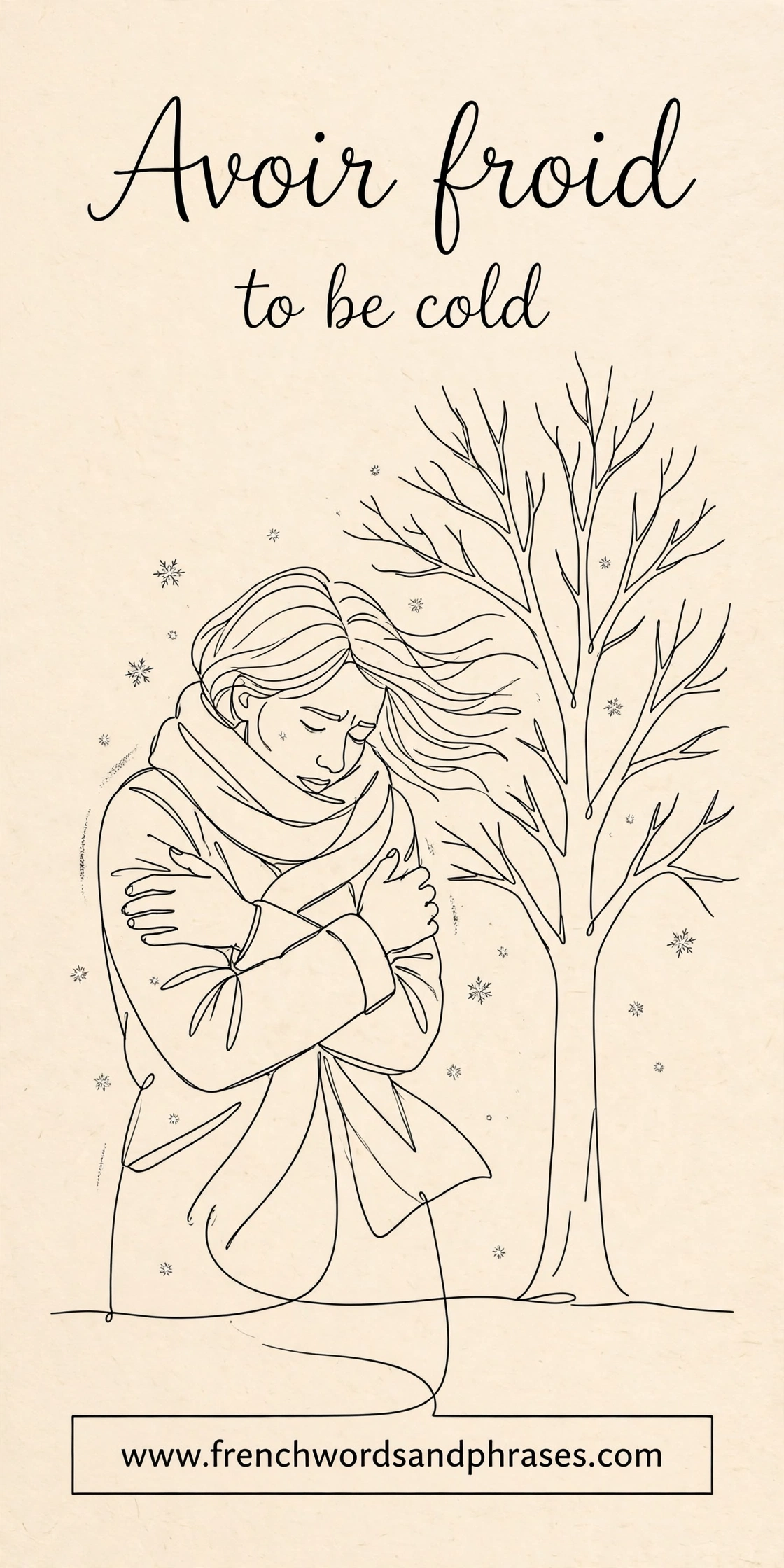
November on a platform in Strasbourg, and the delayed train is nowhere in sight. Your friend stamps her feet, pulls her scarf up to her chin and laughs through chattering teeth: « J’ai froid ! » The weather is the stationmaster’s business; the cold she has is her own.
Let’s explore how avoir froid works in French, beginning with the whole phrase on one card.
Understanding the French Phrase Avoir froid
Avoir froid is a French expression built from avoir (to have) and froid (cold, coldness). It describes a person who feels cold — the cold lives in your body, not in the sky. For the weather itself, French switches verbs entirely: il fait froid.
It means to be cold, to feel cold — said of a person (or an animal, or a pair of hands). English learners reach instinctively for je suis froid, but that sentence describes a cold personality or a cold corpse. The living, shivering truth is j’ai froid: the cold is something you have, like its warm twin j’ai chaud.
Type: Expression — body state (avoir + froid, no article)
Answers the need: Saying that you (a person) feel cold
Register: Neutral — the only everyday way to say it, safe everywhere
Strength: Adjustable — un peu froid, très froid, froid aux mains, aux pieds
One important usage detail: keep the two colds apart. People have cold — j’ai froid, elle a froid aux pieds. The weather makes cold — il fait froid aujourd’hui. Objects simply are cold with être: la soupe est froide, the soup is cold (froid agrees: froide for a feminine noun). Three verbs, three jobs.
Experience the Word
Avoir froid is the body’s weather report — personal, precise, and always asking for a remedy: a coat, a fire, a hot drink.
Imagine the Christmas market at dusk, the lights on, the vin chaud steaming — and a child who has refused gloves all afternoon suddenly quiet, hands deep in her pockets. Grandmother needs no thermometer. J’ai froid, the child admits, and the gloves appear like magic.
French is exact about where cold lives. The sky makes it, things are it, and people have it — and what you have, you can be helped with.
How to Use Avoir froid in French: Complete Guide
Let’s explore how avoir froid works in French, beginning with the whole phrase on one card.
Avoir froid at a Glance
The Whole Phrase on One Card
Real meaning, literal picture, English twin and register — avoir froid in five lines.
| Point | Avoir froid |
|---|---|
| What it really means | to feel cold — a person is cold |
| Word for word | to have cold |
| English equivalent | to be cold / to feel cold |
| Register | neutral — the standard phrase, safe everywhere |
| Use it for | yourself, children, travellers — anyone with skin and a winter |
Example
J’ai froid, je vais mettre un pull.
I’m cold, I’ll put on a jumper.
Word by Word: Building the Cold
Two small pieces — take them one by one and winter builds itself.
| Word | Literal meaning | Its job in the phrase |
|---|---|---|
| avoir | to have | the verb of possession — the cold is carried by the person who feels it |
| froid | cold, coldness | a noun here, le froid — but in the set phrase the article drops away |
Example
Elle a froid aux mains, donne-lui des gants.
Her hands are cold — give her some gloves.
Quick Quiz 1
It is a freezing day outside. Do you say j’ai froid or il fait froid about the day itself?
Reveal the answer
Il fait froid — the weather makes cold. J’ai froid is the report from inside your own coat.
Il fait froid aujourd’hui, et moi, j’ai froid malgré le manteau.
It is cold today, and as for me, I’m cold despite my coat.
When You Say It: The Shivering Moments
Avoir froid fires at moments like these — the cold is in a person, and usually in a particular place.
| Situation | Example |
|---|---|
| Waiting outside | on a froid à attendre le bus — we’re cold waiting for the bus |
| Cold hands | elle a froid aux mains — her hands are cold |
| Cold feet | j’ai froid aux pieds dans ces chaussures — my feet are cold in these shoes |
| In a cold room | les élèves ont froid dans la classe — the pupils are cold in the classroom |
| Getting warmer | je n’ai plus froid, merci — I’m not cold any more, thanks |
Example
Ferme la fenêtre, s’il te plaît, on a froid.
Close the window, please — we’re cold.
Make It Yours: Cold in Every Degree
The phrase locates the cold and grades it — a shiver, a freeze, or just cold ears.
| Form | French | In English |
|---|---|---|
| I’m cold | j’ai froid | I am cold |
| A little cold | j’ai un peu froid | I’m a little cold |
| Very cold | j’ai très froid | I’m very cold |
| Cold in a place | j’ai froid aux oreilles | my ears are cold |
| Not cold | je n’ai pas froid | I’m not cold |
| Question | tu as froid ? je te prête mon écharpe | are you cold? I’ll lend you my scarf |
Example
Tu as froid ? Viens près du feu.
Are you cold? Come close to the fire.
Quick Quiz 2
A friend says il est froid about the new neighbour. Is the neighbour shivering?
Reveal the answer
No — il est froid about a person means he is cold in manner, distant and unfriendly. The shivering version is il a froid.
Il a froid, mais il n’est pas froid : il sourit à tout le monde.
He is cold, but he is not a cold person: he smiles at everyone.
Everyday Expressions: Building on the Cold
Avoir froid slots into these everyday frames — each one ready to use as it stands.
| Frame | In English |
|---|---|
| avoir froid | to be cold, to feel cold |
| avoir froid aux mains / aux pieds | to have cold hands / feet |
| avoir très froid | to be very cold |
| ne plus avoir froid | to not be cold any more |
| avoir froid dans le dos | to have a cold back — and, in stories, a shiver down the spine |
Example
Avec ce manteau, tu n’auras plus froid.
With this coat, you won’t be cold any more.
Close Cousins: The Other Temperatures
Avoir froid belongs to the avoir family of body states — meet the relatives and the weather verb that is not one of them.
| Expression | The difference |
|---|---|
| avoir froid | to feel cold — the cold in your body |
| avoir chaud | to feel hot — the warm twin, same construction |
| il fait froid | it is cold (weather) — faire, not avoir, and no person in sight |
| avoir faim | to be hungry — the family’s appetite member |
| grelotter | to shiver — what the body does when the cold wins |
Example
Il fait si froid qu’on grelotte en attendant.
It is so cold that we’re shivering while we wait.
Quick Quiz 3
The soup has gone cold on the table. Avoir, faire or être?
Reveal the answer
Être — la soupe est froide: things are cold, and froid agrees (froide, feminine). People have cold; weather makes cold.
La soupe est froide, réchauffe-la, les invités ont froid.
The soup is cold — warm it up, the guests are cold.
Avoir froid and Its Neighbours
The winter shelf around the phrase — from the first shiver to the fireside thaw.
| French | In English |
|---|---|
| un froid de canard | bitter cold (informal — a duck’s cold, hunting-season cold) |
| se réchauffer | to warm up, to warm yourself |
| un feu de bois | a wood fire — the classic remedy |
| être gelé | to be frozen (informal — colder than froid) |
| un chocolat chaud | a hot chocolate — the other classic remedy |
| les frissons | the shivers |
Example
Un froid de canard ce matin : vite, un chocolat chaud !
Bitterly cold this morning: quick, a hot chocolate!
Watch Out: The Traps Around Avoir froid
The traps: three verbs for one cold, a personality hiding in être froid, and an article that must stay home.
| Trap | The truth |
|---|---|
| je suis froid | about yourself it claims a cold personality (or worse) — the shivering truth is j’ai froid |
| il a froid for the weather | a day cannot have cold — weather takes il fait froid, always |
| agreement in the set phrase | avoir froid never agrees: elle a froid, never froide — agreement appears only with être: la soupe est froide |
| word for word in English | ‘to have cold’ sounds like an illness — English simply says to be cold |
Example
Elle a froid, mais la soupe, elle, est encore chaude.
She is cold, but the soup, for its part, is still hot.
Quick Quiz 4
True or false: elle a froide is correct for a woman who feels cold.
Reveal the answer
False — in avoir froid, froid is a noun and never agrees: elle a froid. Froide appears with être, for things: la soupe est froide.
Elle a froid aux pieds, et son thé est déjà froid.
Her feet are cold, and her tea is already cold.
Avoir froid in Everyday French: Real-Life Examples
Now that you know the word, let’s see how avoir froid appears in everyday French.
Example 1 — On the platform
Le train a du retard et on a froid.
The train is late and we’re cold.
Example 2 — The child’s hands
Elle a froid aux mains, où sont ses gants ?
Her hands are cold — where are her gloves?
Example 3 — In the old house
L’hiver, on a froid dans cette maison malgré le chauffage.
In winter, we’re cold in this house despite the heating.
Example 4 — After the swim
Les enfants ont froid en sortant de l’eau.
The children are cold coming out of the water.
Example 5 — The remedy
Tu as froid ? Je te fais un thé.
Are you cold? I’ll make you a tea.
Example 6 — Warmed up
Près du feu, on n’a plus froid.
Near the fire, we’re not cold any more.
Beyond Translation: The Meaning of Avoir froid
French divides cold into three kingdoms with three different verbs: the sky makes it (il fait froid), things are it (la soupe est froide), and people have it (j’ai froid). The grammar is a small lesson in responsibility — your cold is yours, a possession, and possessions can be dealt with: a scarf, a fire, a friend’s spare jumper.
To avoir froid is to report your own weather — and to ask, politely, for a warmer one.
That is why the phrase is so often a request in disguise: ferme la fenêtre, on a froid.
How to Remember the French Phrase Avoir froid
Remember it this way: Avoir froid is the cold you carry in your own body — people have it, weather makes it, things are it.
- You sort the three verbs — avoir for people, faire for weather, être for things.
- You never agree it — elle a froid, always; froide belongs to la soupe est froide.
- You locate it freely — froid aux mains, aux pieds, aux oreilles: the cold can be given an address.
The key idea is avoir froid means to feel cold — a person’s cold, with avoir; the weather is il fait froid.
Test Your Knowledge of Avoir froid
Let’s see how much you’ve learned. Try answering these questions before revealing the answers.
Question 1
What does avoir froid mean?
Reveal the answer
To be cold, to feel cold — said of a person, never of the weather.
Question 2
How do you say ‘it is cold today’?
Reveal the answer
Il fait froid aujourd’hui — weather takes faire, not avoir.
Question 3
How do you say ‘her hands are cold’?
Reveal the answer
Elle a froid aux mains — the cold can be located with aux.
Question 4
What does il est froid mean about a man?
Reveal the answer
That he is cold in manner — distant, unfriendly. The shivering version is il a froid.
Question 5
Complete the sentence:
Ferme la porte, nous ______ froid. (Close the door, we are cold.)
Reveal the answer
avons
Ferme la porte, nous avons froid.
Close the door, we are cold.
Your Final Challenge
Can You Use It?
How would you say this in French?
“I am cold — can you close the window?”
Reveal the answer
J’ai froid — tu peux fermer la fenêtre ?
I am cold — can you close the window?
A little French. A little curiosity. A richer everyday life.
LEARN FRENCH ONE WORD AT A TIME