A French Word to Live By
Translate Avoir faim to English
/a.vwaʁ fɛ̃/
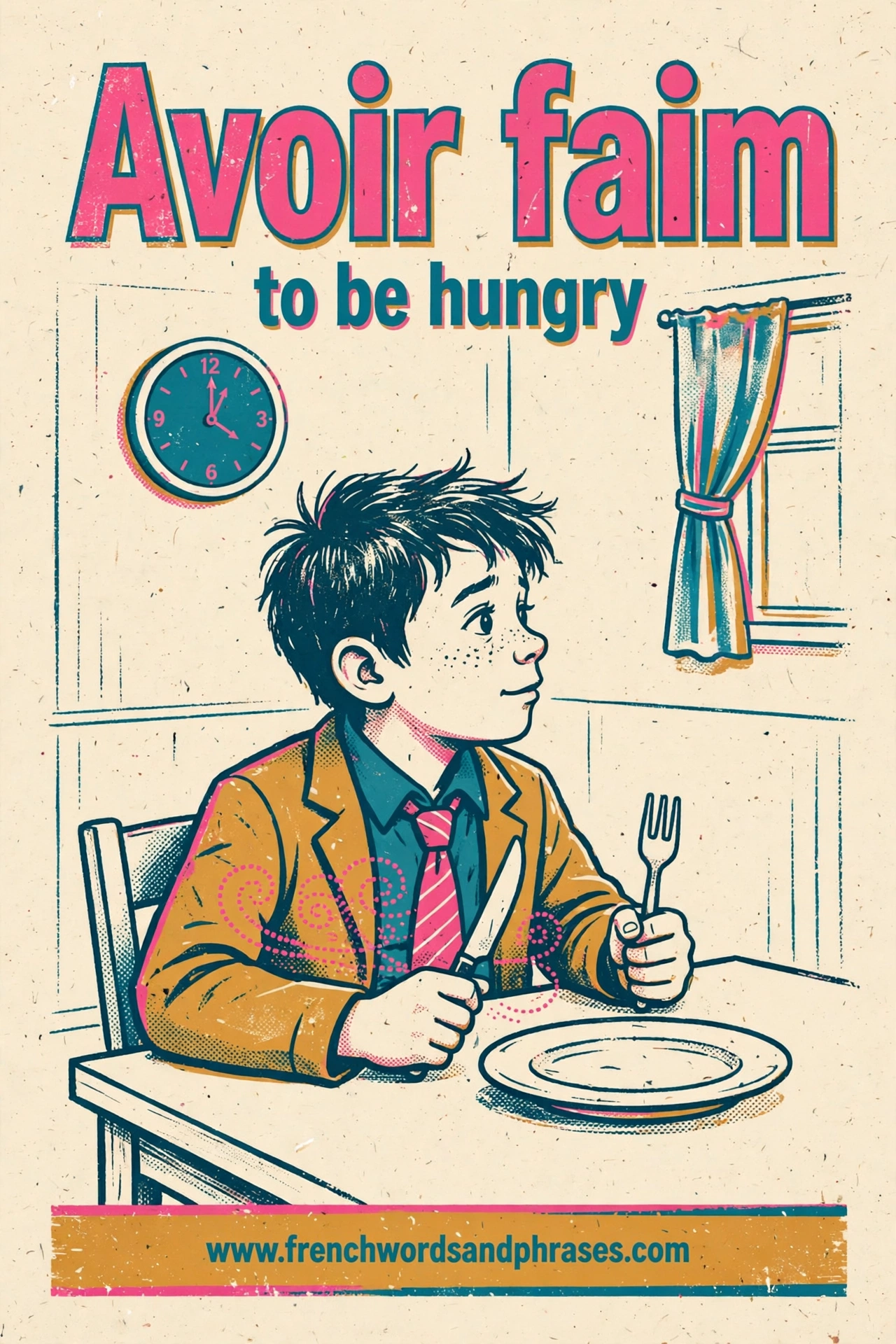
Avoir faim means to be hungry.
Half past twelve in a primary school in Lille, and thirty stomachs are keeping time better than the clock. The teacher looks at the minute hand, smiles, and asks the question everyone is waiting for: « Vous avez faim ? » Every hand in the room goes up.
Let’s explore how avoir faim works in French, beginning with the whole phrase on one card.
Understanding the French Phrase Avoir faim
Avoir faim is a French expression built from avoir (to have) and la faim (hunger) — with the article dropped in the set phrase. Where English makes hunger an adjective you are, French makes it a thing you have: hunger is a possession you carry until the next meal.
It means to be hungry. French belongs to the avoir family for body states: avoir faim (hungry), avoir soif (thirsty), avoir chaud (hot), avoir froid (cold). The logic is consistent and, once seen, unforgettable — the feeling is something that has hold of you, so you have it, the way you have a coat or a cold.
Type: Expression — body state (avoir + faim, no article)
Answers the need: Saying you are hungry — at any level, from peckish to starving
Register: Neutral — the only everyday way to say it, safe everywhere
Strength: Adjustable — un peu (a little) to très (very) to une faim de loup (a wolf’s hunger)
One important usage detail: there is no article in the phrase — avoir faim, never avoir la faim (la faim returns when hunger becomes a topic: la faim dans le monde, hunger in the world). And the great beginner’s trap: je suis faim does not exist. For hunger you always say j’ai faim, with avoir.
Experience the Word
Avoir faim is the most honest sentence in French childhood — said at noon, at four o’clock, and ideally within sight of a bakery.
Imagine the train crossing France at lunchtime, sandwiches still in the bag, and a small voice from the window seat asking the question that will repeat all afternoon: on mange quand ? Hunger in French is a possession, and like all possessions, children show it to everyone.
French hunger has good manners built in. You do not declare yourself hungry like a state of war; you simply have a faim, and it can be fed.
How to Use Avoir faim in French: Complete Guide
Let’s explore how avoir faim works in French, beginning with the whole phrase on one card.
Avoir faim at a Glance
The Whole Phrase on One Card
Real meaning, literal picture, English twin and register — avoir faim in five lines.
| Point | Avoir faim |
|---|---|
| What it really means | to be hungry |
| Word for word | to have hunger |
| English equivalent | to be hungry / to feel peckish (a little) |
| Register | neutral — the standard phrase, safe everywhere |
| Use it for | before meals, at tables, in every kitchen negotiation |
Example
J’ai faim, on mange bientôt ?
I’m hungry — are we eating soon?
Word by Word: Building the Hunger
Two small pieces — take them one by one and lunchtime builds itself.
| Word | Literal meaning | Its job in the phrase |
|---|---|---|
| avoir | to have | the verb of possession — French body states are things you have |
| faim | hunger | a feminine noun, la faim — but in the set phrase the article drops away |
Example
Les enfants ont faim dès midi.
The children are hungry from midday onwards.
Quick Quiz 1
Is it je suis faim or j’ai faim?
Reveal the answer
J’ai faim — French has hunger; it does not be it. Avoir carries the whole family: faim, soif, chaud, froid.
J’ai faim et j’ai soif, vivement le déjeuner !
I’m hungry and I’m thirsty — roll on lunch!
When You Say It: The Hungry Moments
Avoir faim fires at moments like these — the stomach speaks, in kitchens, classrooms and trains.
| Situation | Example |
|---|---|
| Before a meal | j’ai faim, le dîner est prêt ? — I’m hungry, is dinner ready? |
| A child at four o’clock | maman, j’ai faim, je peux avoir un goûter ? — Mum, I’m hungry, can I have a snack? |
| After sport | après le match, nous avions tous très faim — after the match, we were all very hungry |
| Only a little | j’ai un peu faim, juste de quoi grignoter — I’m a little hungry, just enough for a nibble |
| Wolf-hungry | j’ai une faim de loup ce soir — I’m ravenous tonight, hungry as a wolf |
Example
Après la randonnée, ils avaient une faim de loup.
After the hike, they were hungry as wolves.
Make It Yours: Hunger in Every Degree
The phrase measures hunger precisely — a little, a lot, or a wolf’s worth.
| Form | French | In English |
|---|---|---|
| I’m hungry | j’ai faim | I am hungry |
| A little hungry | j’ai un peu faim | I’m a bit peckish |
| Very hungry | j’ai très faim | I’m very hungry |
| Ravenous | j’ai une faim de loup | I’m hungry as a wolf, starving |
| Not hungry | je n’ai pas faim | I’m not hungry |
| Question | tu as faim ? | are you hungry? |
Example
Tu as faim ? Il reste de la soupe.
Are you hungry? There’s some soup left.
Quick Quiz 2
What animal gives French its hungriest hunger — une faim de…?
Reveal the answer
Le loup, the wolf — une faim de loup is hunger at maximum, the appetite of the wolf in the forest tales.
Rentré à sept heures, il avait une faim de loup.
Home at seven, he was hungry as a wolf.
Everyday Expressions: Building on the Hunger
Avoir faim slots into these everyday frames — each one ready to use as it stands.
| Frame | In English |
|---|---|
| avoir faim | to be hungry |
| avoir très faim | to be very hungry |
| avoir une faim de loup | to be ravenous, hungry as a wolf |
| avoir un petit creux | to feel a little peckish (a small hollow) |
| mourir de faim | to be starving (informal exaggeration — dying of hunger) |
Example
J’ai un petit creux, je prendrais bien une pomme.
I feel a bit peckish — I’d happily have an apple.
Close Cousins: The Other Body States
Avoir faim belongs to a whole family — French body states are had, not been; meet the relatives.
| Expression | The difference |
|---|---|
| avoir faim | to be hungry — the food member of the family |
| avoir soif | to be thirsty — the drink member, same construction |
| avoir chaud | to feel hot (a person) — temperature, your own skin |
| avoir froid | to feel cold (a person) — the cold twin of chaud |
| avoir sommeil | to be sleepy — the tired member of the family |
Example
Après la plage, les enfants ont faim, soif et sommeil.
After the beach, the children are hungry, thirsty and sleepy.
Quick Quiz 3
Which cousin means you are thirsty — avoir soif or avoir sommeil?
Reveal the answer
Avoir soif — soif is thirst. Sommeil is sleepiness: avoir sommeil, to be sleepy.
J’ai soif, je boirais bien un grand verre d’eau.
I’m thirsty, I’d love a big glass of water.
Avoir faim and Its Neighbours
The table shelf around the phrase — from the first rumble to the satisfied sigh.
| French | In English |
|---|---|
| l’appétit | the appetite — bon appétit ! |
| un goûter | an afternoon snack (for children, sacred) |
| grignoter | to nibble, to snack |
| se régaler | to feast, to really enjoy your food |
| être rassasié | to be full, satisfied — hunger’s happy ending |
| avoir l’estomac dans les talons | to be famished (informal — your stomach in your heels) |
Example
Bon appétit ! Après, plus personne n’aura faim.
Enjoy your meal! Afterwards, nobody will be hungry any more.
Watch Out: The Traps Around Avoir faim
The traps: an adjective that does not exist, an article that must stay home, and hunger confused with its ending.
| Trap | The truth |
|---|---|
| je suis faim | faim is a noun, not an adjective — French says j’ai faim, with avoir, always |
| the wandering article | avoir faim has no article; la faim appears only when hunger is a subject in itself: la faim dans le monde |
| faim vs fin | la faim (hunger) and la fin (the end) are close cousins in sound — j’ai faim is hungry, c’est la fin is the end; keep the m and the n apart |
| too strong for a nibble | mourir de faim is starving to death — for a small hunger, un petit creux keeps the proportions honest |
Example
Ce n’est pas la fin du monde, c’est juste la faim : mange quelque chose.
It’s not the end of the world, it’s just hunger: eat something.
Quick Quiz 4
True or false: avoir la faim is the correct everyday phrase.
Reveal the answer
False — the set phrase drops the article: avoir faim. La faim is for hunger as a topic: la faim dans le monde.
Elle a faim, donne-lui le goûter.
She’s hungry, give her the snack.
Avoir faim in Everyday French: Real-Life Examples
Now that you know the word, let’s see how avoir faim appears in everyday French.
Example 1 — At the school gate
Vous avez faim, les enfants ? Le goûter est prêt.
Are you hungry, children? The snack is ready.
Example 2 — On the train
J’ai faim, on sort les sandwichs ?
I’m hungry — shall we get the sandwiches out?
Example 3 — A small hunger
J’ai un peu faim, mais je peux attendre le dîner.
I’m a little hungry, but I can wait for dinner.
Example 4 — After the match
Après deux heures de foot, ils avaient très faim.
After two hours of football, they were very hungry.
Example 5 — The polite refusal
Non merci, je n’ai pas faim, j’ai déjà mangé.
No thanks, I’m not hungry, I’ve already eaten.
Example 6 — Wolf hunger
Rentrez vite, vous devez avoir une faim de loup !
Come in quickly — you must be hungry as wolves!
Beyond Translation: The Meaning of Avoir faim
English is hungry — the feeling becomes your identity for an hour. French has hunger, the way you have a guest: it arrives, it is fed, it leaves. There is a whole philosophy in the grammar — your states are possessions, not definitions, and possessions can be put down.
To avoir faim is to host your hunger, not to be it.
And when the meal is done, French dismisses it just as cleanly: je n’ai plus faim — the guest has gone.
How to Remember the French Phrase Avoir faim
Remember it this way: Avoir faim is hunger as a possession — you have it like a bag on your shoulder, and a good meal sets it down.
- You never say je suis faim — body states in French are had: j’ai faim, j’ai soif, j’ai sommeil.
- You drop the article — avoir faim, plain; la faim belongs to hunger as a world topic.
- You feed it by degrees — un peu faim, très faim, and at the top, une faim de loup.
The key idea is avoir faim means to be hungry — hunger you have, with avoir and no article.
Test Your Knowledge of Avoir faim
Let’s see how much you’ve learned. Try answering these questions before revealing the answers.
Question 1
What does avoir faim mean?
Reveal the answer
To be hungry — literally, to have hunger.
Question 2
Why j’ai faim and never je suis faim?
Reveal the answer
Because faim is a noun, not an adjective — French has its body states with avoir.
Question 3
How do you say ‘I’m a little hungry’?
Reveal the answer
J’ai un peu faim — or, for a small hollow, j’ai un petit creux.
Question 4
What does une faim de loup mean?
Reveal the answer
A wolf’s hunger — to be ravenous, as hungry as a wolf.
Question 5
Complete the sentence:
Les enfants ______ faim après l’école. (The children are hungry after school.)
Reveal the answer
ont
Les enfants ont faim après l’école.
The children are hungry after school.
Your Final Challenge
Can You Use It?
How would you say this in French?
“I am hungry — is lunch ready?”
Reveal the answer
J’ai faim — le déjeuner est prêt ?
I am hungry — is lunch ready?
A little French. A little curiosity. A richer everyday life.
LEARN FRENCH ONE WORD AT A TIME