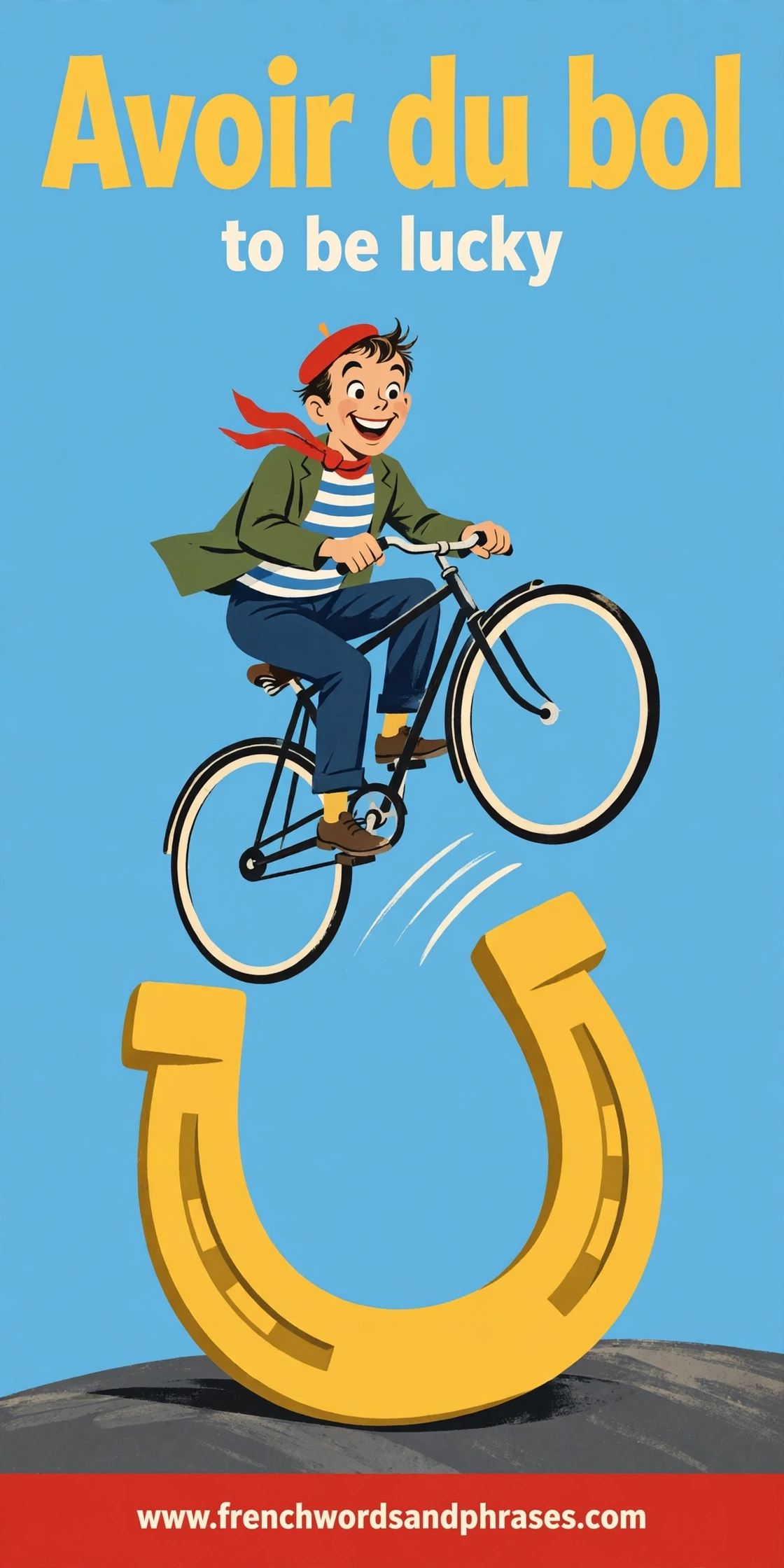
A French Word to Live By
Translate Avoir du bol to English
/a.vwaʁ dy bɔl/
Avoir du bol means to be lucky — to have luck on your side.
The platform is packed, the rain is horizontal, and the loudspeaker has just announced that the last train home is ‘exceptionally’ full. Your friend squeezes through the doors a second before they close, turns, and waves at you through the glass — dry, seated, and holding the coffee she somehow had time to buy. There is only one possible verdict, and the whole platform thinks it at once: « Elle a du bol ! »
Let’s explore how avoir du bol works in French, beginning with the whole phrase on one card.
Understanding the French Phrase Avoir du bol
Avoir du bol is a French idiomatic expression built from avoir (to have) and un bol (a bowl). In slang, le bol simply is luck — nobody can say for certain whether the bowl began as a beggar’s bowl that fills or a gambler’s bowl of dice, but the modern phrase hands you a bowlful of fortune and wishes you well with it.
It means to be lucky — to have luck on your side, served apparently in a bowl. It is the admiring, slightly envious thing you say to someone whose day keeps going right: tu as du bol ! For your own luck, you say it with a grin of disbelief: j’ai eu du bol. And the phrase flips perfectly: pas de bol ! — what bad luck — is the standard French groan when everything goes wrong.
Type: Idiomatic expression — luck (avoir + du bol)
Answers the need: Saying someone is lucky — or, flipped, that luck has run out
Register: Informal — everyday speech; formal French prefers avoir de la chance
Strength: Warm and admiring — a compliment to fortune, often with a smile of envy
One important usage detail: the phrase lives in the present and the recent past — tu as du bol for the standing condition, j’ai eu du bol for the lucky escape just behind you. Its negative twin is a complete sentence of its own: pas de bol ! For serious, lasting good fortune, French switches to the neutral avoir de la chance, which fits every register.
Experience the Word
Avoir du bol is the admiration you feel at someone else’s weather — their sky keeps clearing just as they step outside.
Imagine the station platform in the rain. Your train is cancelled, your phone is dead, and the stranger beside you finds, at the bottom of his bag, a spare charger and the number of the last taxi in town. You do not call that organisation. You shake your head, half jealous and half delighted, and you say the only possible sentence: tu as du bol.
The bowl makes luck homely — something served, shared, and one day finished. To avoir du bol is to be given a serving; the wisdom of the phrase is knowing the bowl goes back to the kitchen.
How to Use Avoir du bol in French: Complete Guide
Let’s explore how avoir du bol works in French, beginning with the whole phrase on one card.
Avoir du bol at a Glance
The Whole Phrase on One Card
Real meaning, literal picture, English twin and register — avoir du bol in five lines.
| Point | Avoir du bol |
|---|---|
| What it really means | to be lucky — luck is on your side |
| Word for word | to have some bowl — in slang, the bowl is luck itself |
| English equivalent | to be lucky / to have all the luck |
| Register | informal — friends, family, everyday talk |
| Use it for | near misses avoided, lucky breaks, other people’s outrageous fortune |
Example
Tu as du bol, le train avait dix minutes de retard.
You’re lucky, the train was ten minutes late.
Word by Word: Building the Bowl of Luck
Three small pieces — take them one by one and the fortune is served.
| Word | Literal meaning | Its job in the phrase |
|---|---|---|
| avoir | to have | luck as a possession — something you hold, for now |
| du | some | a serving of it, not the whole supply |
| bol | a bowl | in slang, luck itself — the bowl your fortune is served in |
Example
J’ai eu du bol de trouver cette place libre.
I was lucky to find this free seat.
Quick Quiz 1
What is un bol, literally?
Reveal the answer
A bowl — the breakfast bowl; in slang the word has come to mean luck itself.
Un bol de café et un bol de chance, voilà un bon matin.
A bowl of coffee and a bowl of luck — that’s a good morning.
When You Say It: The Lucky-Break Moments
Avoir du bol fires at moments like these — fortune has just been spotted, on you or on someone else.
| Situation | Example |
|---|---|
| The near miss | tu as du bol, la voiture s’est arrêtée à temps — you’re lucky, the car stopped in time |
| The lucky find | j’ai eu du bol, il restait un billet — I was lucky, there was one ticket left |
| The weather escape | vous avez du bol, la pluie a attendu votre départ — you’re lucky, the rain waited until you left |
| The groan, flipped | pas de bol, le magasin venait de fermer — no luck, the shop had just closed |
| Pure envy | il a un bol incroyable, ce garçon — that boy has incredible luck |
Example
Pas de bol : la boulangerie ferme juste devant nous.
No luck: the bakery closes right in front of us.
Make It Yours: The Bowl for Every Person
Present for the condition, past for the escape — and a bigger bowl when the luck is outrageous.
| Form | French | In English |
|---|---|---|
| You are lucky | tu as du bol | you’re lucky |
| I was lucky | j’ai eu du bol | I was lucky (on that occasion) |
| Outrageous luck | il a un bol incroyable | he has incredible luck |
| No luck! | pas de bol ! | what bad luck! |
| Really lucky | avoir un sacré bol | to have one heck of a lot of luck |
| Lucky at the game | avoir du bol au jeu | to be lucky at cards, at games |
Example
Il a eu un sacré bol de gagner ce concours.
He had one heck of a lot of luck winning that competition.
Quick Quiz 2
The train leaves just as you reach the platform. Tu as du bol or pas de bol?
Reveal the answer
Pas de bol ! — the flipped twin is the standard French groan for bad luck.
Le train part sous mon nez : pas de bol !
The train leaves right under my nose: no luck!
Everyday Expressions: Building on the Bowl
Avoir du bol slots into these everyday frames — each one ready to use as it stands.
| Frame | In English |
|---|---|
| avoir du bol | to be lucky |
| tu as du bol ! | you’re lucky! |
| j’ai eu du bol | I was lucky (just now, on that occasion) |
| pas de bol ! | what bad luck! / no luck! |
| avoir un sacré bol | to have one heck of a lot of luck |
Example
Tu as du bol : ton parapluie était dans ton sac.
You’re lucky: your umbrella was in your bag.
Close Cousins: The Other Vessels of Luck
French has a whole shelf of luck phrases — the bowl is the slangy one; its cousins change the vessel or change the register.
| Expression | The difference |
|---|---|
| avoir du bol | to be lucky — the slang bowl, warm and admiring |
| avoir de la chance | to be lucky — the neutral standard, safe in every register |
| avoir du pot | to be lucky — the twin with a pot instead of a bowl, equally informal |
| être veinard | to be a lucky devil — informal, and it names the person, not the luck |
| porter bonheur | to bring luck — said of charms and objects |
Example
Ce veinard a du pot : il trouve toujours une place.
That lucky devil has all the luck: he always finds a parking space.
Quick Quiz 3
Which version is safe in a formal letter — avoir du bol or avoir de la chance?
Reveal the answer
Avoir de la chance — bol and pot belong to conversation; chance is the word for writing.
J’ai eu la chance de recevoir votre lettre.
I was lucky enough to receive your letter.
Avoir du bol and Its Neighbours
The fortune shelf around the phrase — the luck, the charm, and the opposite weather.
| French | In English |
|---|---|
| la chance | luck (the standard word) |
| le hasard | chance, coincidence |
| un veinard | a lucky devil |
| un porte-bonheur | a lucky charm |
| la malchance | bad luck |
| par chance | luckily, fortunately |
Example
Par chance, son porte-bonheur était dans sa poche.
Luckily, his lucky charm was in his pocket.
Watch Out: The Traps Around Avoir du bol
The traps: a breakfast bowl, a twin pot, and a compliment that can sting.
| Trap | The truth |
|---|---|
| the breakfast trap | un bol is also your morning bowl of coffee or cereal — only the verb avoir and a lucky story turn it into fortune |
| the twin pot | avoir du pot means exactly the same — but don’t mix the crockery in one sentence; pick bowl or pot |
| register | du bol is slang — in formal writing, chance is the word; bol in a business letter would raise eyebrows |
| luck, not skill | said about someone’s achievement, tu as du bol can sting — it credits the bowl, not the person; for earned success, say bravo |
Example
Il a travaillé dix ans pour ce poste : ce n’est pas du bol, c’est du mérite.
He worked ten years for this job: that’s not luck, that’s merit.
Quick Quiz 4
True or false: tu as du bol is always a compliment.
Reveal the answer
False — said about an achievement, it can sound like ‘you were just lucky’; tone and context decide.
Tu as du bol, dit-elle avec un sourire jaloux.
You’re lucky, she said with a jealous smile.
Avoir du bol in Everyday French: Real-Life Examples
Now that you know the word, let’s see how avoir du bol appears in everyday French.
Example 1 — The late train
Tu as du bol, ton train avait du retard.
You’re lucky, your train was delayed.
Example 2 — The last ticket
J’ai eu du bol, il restait un seul billet.
I was lucky, there was just one ticket left.
Example 3 — The near miss
Vous avez du bol, la branche est tombée après votre passage.
You were lucky, the branch fell after you’d passed.
Example 4 — The groan
Pas de bol, la pharmacie est fermée le dimanche.
No luck, the pharmacy is closed on Sundays.
Example 5 — The envy
Il a un bol incroyable aux cartes, ce soir.
He’s having incredible luck at cards tonight.
Example 6 — The escape
On a eu du bol avec la météo, pas une goutte de pluie.
We were lucky with the weather, not a drop of rain.
Beyond Translation: The Meaning of Avoir du bol
English luck is weather — it comes, it goes, it rains on the just and the unjust alike. French serves luck in a bowl, like soup: you can be given some, a lot, a sacred amount — and you can watch someone else’s portion arrive steaming while yours stays in the kitchen.
To avoir du bol is to be served fortune by the bowlful — and to know the kitchen can stop serving at any time.
That is why the phrase is always a little envious and always a little grateful: the bowl is never yours to keep.
How to Remember the French Phrase Avoir du bol
Remember it this way: Avoir du bol is luck served like soup — sometimes a bowlful, sometimes, pas de bol, an empty bowl.
- You picture the bowl — in slang, le bol is luck itself, and avoir du bol is holding a full one.
- You flip it for the groan — pas de bol ! is the complete sentence of French bad luck.
- You keep chance for formal dress — avoir de la chance is the same luck in a suit.
The key idea is avoir du bol means to be lucky — to be holding a bowlful of luck.
Test Your Knowledge of Avoir du bol
Let’s see how much you’ve learned. Try answering these questions before revealing the answers.
Question 1
What does avoir du bol mean?
Reveal the answer
To be lucky — in slang, the bowl is luck itself.
Question 2
How do you say ‘what bad luck!’?
Reveal the answer
Pas de bol ! — the flipped twin, the standard French groan.
Question 3
What is the formal equivalent?
Reveal the answer
Avoir de la chance — the neutral phrase for every register.
Question 4
What is avoir du pot?
Reveal the answer
The same luck in a different vessel — a pot instead of a bowl, equally informal.
Question 5
Complete the sentence:
Tu ______ du bol, le dernier train était en retard. (You’re lucky, the last train was delayed.)
Reveal the answer
as
Tu as du bol, le dernier train était en retard.
You’re lucky, the last train was delayed.
Your Final Challenge
Can You Use It?
How would you say this in French?
“You’re lucky — there was one seat left.”
Reveal the answer
Tu as du bol — il restait une place.
You’re lucky — there was one seat left.
A little French. A little curiosity. A richer everyday life.
LEARN FRENCH ONE WORD AT A TIME