A French Word to Live By
Translate Avoir des affaires par-dessus la tête to English
/a.vwaʁ de a.fɛʁ paʁ də.sy la tɛt/
Avoir des affaires par-dessus la tête means to be up to one’s ears in business — snowed under with matters to deal with.
The accountant’s office, the last week of March. Files climb the desk in towers, the telephone rings before the last call has ended, and two clients are waiting in the corridor with folders under their arms. His colleague sticks her head round the door, takes one look, and retreats: « Il a des affaires par-dessus la tête. »
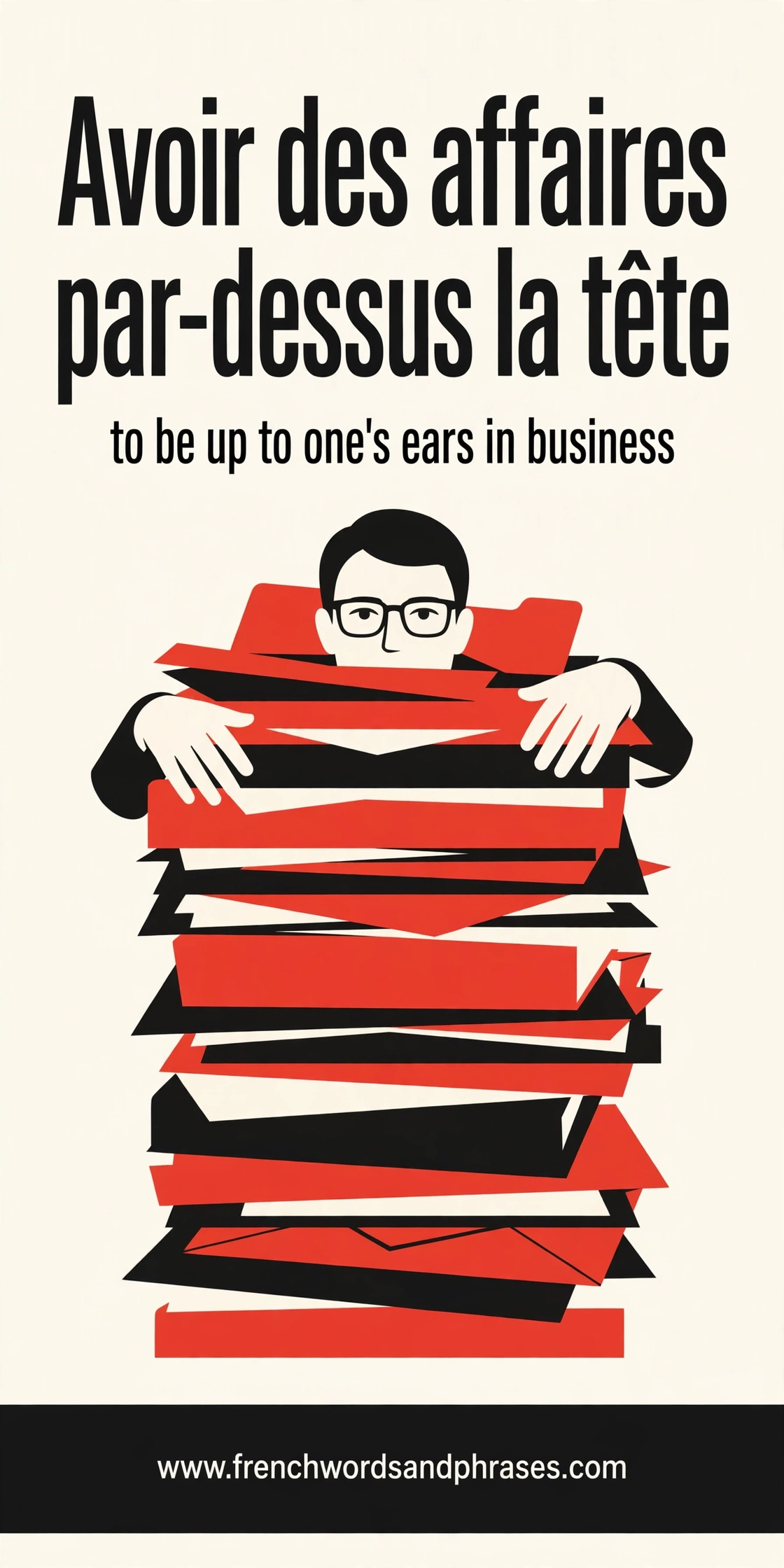
Let’s explore how avoir des affaires par-dessus la tête works in French, beginning with the whole phrase on one card.
Understanding the French Phrase Avoir des affaires par-dessus la tête
Avoir des affaires par-dessus la tête is a French idiomatic expression built from avoir (to have), des affaires (business matters, things to deal with) and par-dessus la tête (over one’s head — above head height). It belongs to a whole family built on par-dessus la tête: what rises over your head is what is submerging you.
It means to be up to your ears in business — to have more matters, files, deals and duties than you can comfortably handle. The picture is water rising: the affaires are up to your chin, over your head, and you are keeping your nose in the air by effort. The same frame works with work itself — avoir du travail par-dessus la tête, to be snowed under with work — and the family extends to en avoir par-dessus la tête, to have had more than enough of something.
Type: Idiomatic expression — overload (avoir + noun + par-dessus la tête)
Answers the need: Saying someone is submerged by business and work
Register: Neutral to informal — everyday speech, vivid but polite
Strength: Strong — not merely busy: submerged, above head height
One important usage detail: par-dessus la tête is a productive frame. Swap the noun and the flood changes its contents — du travail par-dessus la tête (work), des soucis par-dessus la tête (worries), des dettes par-dessus la tête (debts). And the short cousin en avoir par-dessus la tête means to be thoroughly fed up — same water, stronger feeling.
Experience the Word
Avoir des affaires par-dessus la tête is busyness measured like a flood — not in hours, but in centimetres above the crown of your head.
Imagine the notary in December, signatures stacked to the ceiling, every appointment double-booked, eating a sandwich over a deed of sale. He is not complaining, exactly — the flood is also prosperity. But when his sister telephones to suggest one more little matter, his laugh says the water is at his chin.
French measures overload by depth, and the image is honest. Work you can carry is in your arms; work that carries you is over your head.
How to Use Avoir des affaires par-dessus la tête in French: Complete Guide
Let’s explore how avoir des affaires par-dessus la tête works in French, beginning with the whole phrase on one card.
Avoir des affaires par-dessus la tête at a Glance
The Whole Phrase on One Card
Real meaning, literal picture, English twin and register — avoir des affaires par-dessus la tête in five lines.
| Point | Avoir des affaires par-dessus la tête |
|---|---|
| What it really means | to be up to your ears in business — more matters than you can handle calmly |
| Word for word | to have business matters over your head — the flood above head height |
| English equivalent | to be up to one’s ears in business / to be snowed under |
| Register | neutral to informal — vivid everyday speech |
| Use it for | tax season, December shops, any desk where the files form towers |
Example
En mars, le comptable a des affaires par-dessus la tête.
In March, the accountant is up to his ears in business.
Word by Word: Building the Flood
Three small pieces — take them one by one and the water starts to rise.
| Word | Literal meaning | Its job in the phrase |
|---|---|---|
| avoir | to have | the possession verb — the flood belongs to you, unfortunately |
| des affaires | business matters, things to deal with | the water itself: files, deals, duties, all plural, all rising |
| par-dessus la tête | over the head | the depth marker — above head height means submerged, not just busy |
Example
Elle a des affaires par-dessus la tête et elle sourit quand même.
She is up to her ears in business and she still smiles.
Quick Quiz 1
What does par-dessus la tête add that plain beaucoup d’affaires does not?
Reveal the answer
The depth — the matters are not just numerous, they are above head height: you are submerged, keeping your nose in the air.
Des affaires par-dessus la tête, et le téléphone qui sonne encore.
Up to his ears in business, and the phone ringing again.
When You Say It: The Snowed-Under Moments
Avoir des affaires par-dessus la tête fires at moments like these — the pile has passed head height.
| Situation | Example |
|---|---|
| Tax season | en avril, il a des affaires par-dessus la tête — in April, he is up to his ears in business |
| Explaining a refusal | je ne peux pas, j’ai des affaires par-dessus la tête — I can’t, I am snowed under |
| About a shop in December | ils ont des affaires par-dessus la tête avant Noël — they are snowed under before Christmas |
| The family version | elle a des soucis par-dessus la tête — she is up to her ears in worries |
| The work version | nous avons du travail par-dessus la tête — we are snowed under with work |
Example
Ne lui demande rien cette semaine : des affaires par-dessus la tête.
Don’t ask him for anything this week: up to his ears in business.
Make It Yours: The Flood for Every Content
The frame is a mould — affaires, travail, soucis and dettes all pour into it.
| Form | French | In English |
|---|---|---|
| Business | avoir des affaires par-dessus la tête | to be up to your ears in business |
| Work | avoir du travail par-dessus la tête | to be snowed under with work |
| Worries | avoir des soucis par-dessus la tête | to be up to your ears in worries |
| Debts | avoir des dettes par-dessus la tête | to be up to your ears in debt |
| I am snowed under | j’ai des affaires par-dessus la tête | I am up to my ears in business |
| Fed up (cousin) | en avoir par-dessus la tête | to have had it up to here, to be thoroughly fed up |
Example
Des dettes par-dessus la tête, il a fini par tout vendre.
Up to his ears in debt, he ended up selling everything.
Quick Quiz 2
Which version is about work itself — des affaires or du travail par-dessus la tête?
Reveal the answer
Du travail — avoir du travail par-dessus la tête is to be snowed under with work; des affaires aims at business matters and dealings.
Du travail par-dessus la tête jusqu’à Noël.
Snowed under with work until Christmas.
Everyday Expressions: Building on the Flood
Avoir des affaires par-dessus la tête slots into these everyday frames — each one ready to use as it stands.
| Frame | In English |
|---|---|
| avoir des affaires par-dessus la tête | to be up to your ears in business |
| avoir du travail par-dessus la tête | to be snowed under with work |
| en avoir par-dessus la tête | to have had more than enough — to be fed up |
| être débordé | to be overwhelmed, snowed under — the plain modern word |
| crouler sous le travail | to be collapsing under the work — stronger still |
Example
Elle croule sous le travail depuis le départ de sa collègue.
She has been collapsing under the work since her colleague left.
Close Cousins: The Other Overloads
French has a whole shelf of too-much phrases — par-dessus la tête measures the depth; its cousins weigh, bury or exasperate.
| Expression | The difference |
|---|---|
| avoir des affaires par-dessus la tête | up to your ears in business — the flood above head height |
| être débordé | to be overwhelmed — the standard modern word, no picture attached |
| crouler sous les dossiers | to collapse under the files — the weight version, dramatic |
| ne pas savoir où donner de la tête | not to know which way to turn — overload as dizziness, demands from every side |
| en avoir par-dessus la tête | to be fed up — the same water, but the feeling has turned to exasperation |
Example
Débordé, croulant sous les dossiers, il ne sait plus où donner de la tête.
Overwhelmed, collapsing under the files, he no longer knows which way to turn.
Quick Quiz 3
Which cousin means not knowing which way to turn — être débordé or ne pas savoir où donner de la tête?
Reveal the answer
Ne pas savoir où donner de la tête — too many demands from every direction at once; être débordé is simply being overwhelmed.
Entre les clients et les appels, elle ne sait plus où donner de la tête.
Between the clients and the calls, she no longer knows which way to turn.
Avoir des affaires par-dessus la tête and Its Neighbours
The overload shelf around the phrase — the water, the weight and the rescue.
| French | In English |
|---|---|
| la tête | the head — the flood’s measuring stick |
| un dossier | a file, a case — one unit of the flood |
| débordé | overwhelmed, snowed under |
| une urgence | an emergency, an urgent matter |
| s’en sortir | to cope, to get through it |
| prendre un jour de repos | to take a day off — the lifeboat |
Example
Après ce mois débordé, un jour de repos pour s’en sortir.
After this overwhelming month, a day off to get through it.
Watch Out: The Traps Around Avoir des affaires par-dessus la tête
The traps: things thrown over heads, a fed-up cousin with a shorter shape, and belongings in the flood.
| Trap | The truth |
|---|---|
| nothing is thrown | par-dessus la tête measures depth, not throwing — no affaires fly over anyone’s head |
| the fed-up cousin is shorter | en avoir par-dessus la tête drops the noun: the water is understood, and the meaning is ‘fed up’, not just busy |
| affaires here are matters | the flood is made of business matters and duties — for literal belongings, French would say être débordé de choses à ranger |
| busier than busy | for ordinary busy, très occupé suffices — par-dessus la tête claims submersion; save it for the real floods |
Example
Occupé, oui ; des affaires par-dessus la tête, pas encore.
Busy, yes; up to his ears in business, not yet.
Quick Quiz 4
True or false: en avoir par-dessus la tête simply means to be very busy.
Reveal the answer
False — it means to be thoroughly fed up, to have had more than enough. The busy version keeps its noun: des affaires, du travail par-dessus la tête.
Des réunions, encore des réunions — j’en ai par-dessus la tête !
Meetings, more meetings — I have had it up to here!
Avoir des affaires par-dessus la tête in Everyday French: Real-Life Examples
Now that you know the word, let’s see how avoir des affaires par-dessus la tête appears in everyday French.
Example 1 — Tax season
En avril, le comptable a des affaires par-dessus la tête.
In April, the accountant is up to his ears in business.
Example 2 — The refusal
Impossible cette semaine, j’ai des affaires par-dessus la tête.
Impossible this week — I am snowed under.
Example 3 — The December shop
Avant Noël, ils ont des affaires par-dessus la tête.
Before Christmas, they are snowed under.
Example 4 — The work version
Nous avons du travail par-dessus la tête jusqu’à vendredi.
We are snowed under with work until Friday.
Example 5 — Worries
Elle a des soucis par-dessus la tête en ce moment.
She is up to her ears in worries at the moment.
Example 6 — The fed-up cousin
Des dossiers, toujours des dossiers — j’en ai par-dessus la tête !
Files, always files — I have had it up to here!
Beyond Translation: The Meaning of Avoir des affaires par-dessus la tête
English and French agree on the geography of too much: up to your ears, over your head, snowed under. The body is the ruler — work is bearable at waist height, dangerous at the chin. French adds a family likeness: the same par-dessus la tête that floods you with affaires can flood you with soucis, dettes, travail — and, shortened, becomes the cry of the fed up.
To have des affaires par-dessus la tête is to be measured against your own height — and found, briefly, shorter than your week.
The good news is inside the image too: floods go down. Heads, given a day or two, come back above water.
How to Remember the French Phrase Avoir des affaires par-dessus la tête
Remember it this way: Avoir des affaires par-dessus la tête is a flood report — the water of business has risen above head height.
- You measure with your own head — par-dessus la tête means the pile has passed the top of you.
- You swap the water — travail, soucis, dettes all pour into the same frame.
- You shorten for fed up — j’en ai par-dessus la tête drops the noun and means you have had enough.
The key idea is avoir des affaires par-dessus la tête means to be up to your ears in business — submerged by matters to deal with.
Test Your Knowledge of Avoir des affaires par-dessus la tête
Let’s see how much you’ve learned. Try answering these questions before revealing the answers.
Question 1
What does avoir des affaires par-dessus la tête mean?
Reveal the answer
To be up to your ears in business — to have more matters and duties than you can handle calmly.
Question 2
What picture does par-dessus la tête give?
Reveal the answer
A flood above head height — the matters have risen over your head; you are submerged, not just busy.
Question 3
How do you say ‘to be snowed under with work’?
Reveal the answer
Avoir du travail par-dessus la tête — the same frame with travail poured in.
Question 4
What does j’en ai par-dessus la tête mean?
Reveal the answer
I have had it up to here — I am thoroughly fed up. The noun is dropped and understood.
Question 5
Complete the sentence:
En décembre, ils ont des affaires par-dessus la ______. (In December, they are up to their ears in business.)
Reveal the answer
tête
En décembre, ils ont des affaires par-dessus la tête.
In December, they are up to their ears in business.
Your Final Challenge
Can You Use It?
How would you say this in French?
“In April, the accountant is up to his ears in business.”
Reveal the answer
En avril, le comptable a des affaires par-dessus la tête.
In April, the accountant is up to his ears in business.
A little French. A little curiosity. A richer everyday life.
LEARN FRENCH ONE WORD AT A TIME