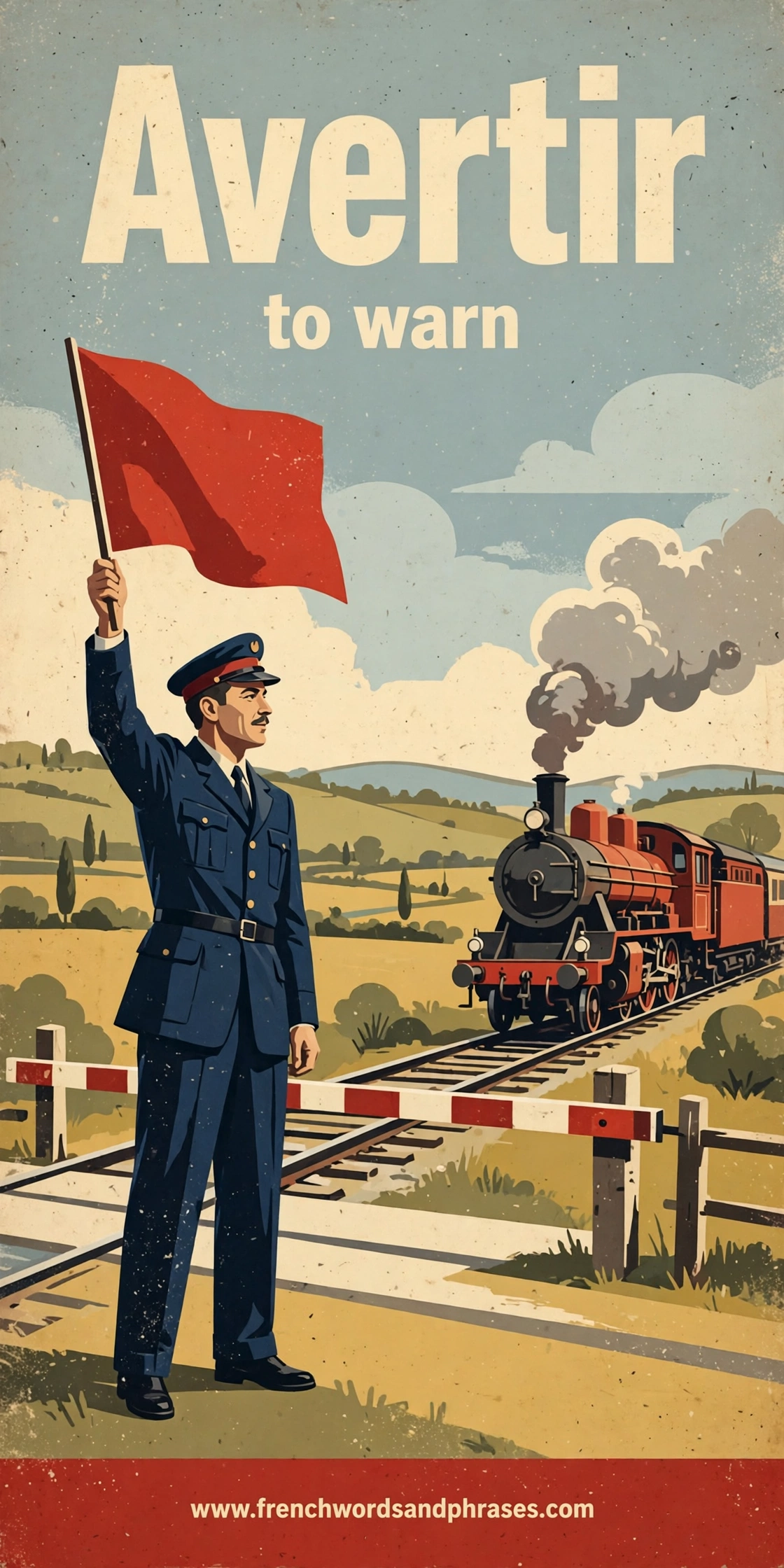
A French Word to Live By
How to Conjugate Avertir in French
/a.vɛʁ.tiʁ/
Avertir means to warn or to notify.
A friend who tells you the bridge is closed, a sign that announces the bend, a phone call that saves your evening — avertir is the verb of the timely warning, the word that arrives before the trouble does.
In this guide, you’ll learn how to conjugate avertir in all the major French tenses and moods. Explore complete conjugation tables, French examples, English translations, and practice quizzes.
Understanding the French Verb Avertir
Avertir is a regular French verb belonging to the second group of verbs, those ending in -ir.
It means to warn, to notify. It is commonly used for warning about dangers and delays, notifying people of decisions and changes, and in the firm little sentence je t’avertis ! — I’m warning you! — friendly or serious, depending on the smile that goes with it.
Verb classification: Second group (-ir)
Auxiliary verb: Avoir
Past participle: averti
Present participle: avertissant
English equivalents: To warn, to notify, to let someone know, to inform.
One important detail: avertir warns a PERSON — you warn someone about something: avertir quelqu’un de quelque chose, or avertir quelqu’un que… — je t’avertis que le train est en retard. Its close cousin prévenir also warns in advance, but prévenir doubles as to prevent; avertir is the plain act of telling someone in time.
Experience the Word
Avertir is the verb of the friend who phones ahead — the small kindness of knowing before, not after.
Imagine a mountain road in the rain. A driver coming the other way flashes his lights: a fallen tree around the bend. He has warned you without a word, and your brakes thank him.
Nothing bad has happened. Someone warned you — and that was enough.
How to Conjugate Avertir: Complete French Conjugation Guide
Let’s explore every major conjugation of avertir, beginning with the indicative mood.
How to Conjugate Avertir in the Indicative Mood
The indicative mood is used to express facts, observations, actions, and events.
How to Conjugate Avertir in the Present Tense (Présent)
Used for actions happening now, habitual actions, and general truths.
| Subject | Conjugation |
|---|---|
| je | avertis |
| tu | avertis |
| il / elle | avertit |
| nous | avertissons |
| vous | avertissez |
| ils / elles | avertissent |
Example
Je t’avertis que le magasin ferme à midi.
I am warning you that the shop closes at noon.
Quick Quiz 1
Complete the sentence:
Nous ______ les voisins du bruit.
Reveal the answer
avertissons
Nous avertissons les voisins du bruit.
We are warning the neighbours about the noise.
How to Conjugate Avertir in the Passé Composé
Used for completed actions in the past. Avertir takes the auxiliary verb avoir.
| Subject | Conjugation |
|---|---|
| j’ | ai averti |
| tu | as averti |
| il / elle | a averti |
| nous | avons averti |
| vous | avez averti |
| ils / elles | ont averti |
Example
Elle a averti ses voisins du bruit.
She warned her neighbours about the noise.
How to Conjugate Avertir in the Imparfait (Imperfect Tense)
Used for habitual past actions, descriptions, and ongoing situations in the past.
| Subject | Conjugation |
|---|---|
| je | avertissais |
| tu | avertissais |
| il / elle | avertissait |
| nous | avertissions |
| vous | avertissiez |
| ils / elles | avertissaient |
Example
Le panneau avertissait les conducteurs du danger.
The sign used to warn drivers of the danger.
Quick Quiz 2
Choose the correct form:
He warned the swimmers.
Il ______ les baigneurs. (a averti / est averti)
Reveal the answer
a averti
Il a averti les baigneurs.
Avertir takes avoir.
How to Conjugate Avertir in the Plus-que-parfait
Used to describe an action that had already been completed before another past event.
| Subject | Conjugation |
|---|---|
| j’ | avais averti |
| tu | avais averti |
| il / elle | avait averti |
| nous | avions averti |
| vous | aviez averti |
| ils / elles | avaient averti |
Example
Nous avions averti la mairie de la fuite.
We had notified the town hall about the leak.
How to Conjugate Avertir in the Passé Simple
Primarily used in formal writing, literature, and historical narratives. It is rarely used in everyday conversation.
| Subject | Conjugation |
|---|---|
| je | avertis |
| tu | avertis |
| il / elle | avertit |
| nous | avertîmes |
| vous | avertîtes |
| ils / elles | avertirent |
Example
Le gardien avertit les baigneurs de la tempête.
The lifeguard warned the swimmers about the storm.
How to Conjugate Avertir in the Passé Antérieur
A literary tense used to express an action completed immediately before another past action, generally in the passé simple.
| Subject | Conjugation |
|---|---|
| j’ | eus averti |
| tu | eus averti |
| il / elle | eut averti |
| nous | eûmes averti |
| vous | eûtes averti |
| ils / elles | eurent averti |
Example
Dès qu’il eut averti la police, il se calma.
As soon as he had notified the police, he calmed down.
How to Conjugate Avertir in the Future Tense (Futur Simple)
Used to describe actions that will take place in the future.
| Subject | Conjugation |
|---|---|
| je | avertirai |
| tu | avertiras |
| il / elle | avertira |
| nous | avertirons |
| vous | avertirez |
| ils / elles | avertiront |
Example
On vous avertira en cas de changement.
You will be notified if anything changes.
How to Conjugate Avertir in the Futur Antérieur (Future Perfect)
Used for an action that will have been completed before a particular point in the future.
| Subject | Conjugation |
|---|---|
| j’ | aurai averti |
| tu | auras averti |
| il / elle | aura averti |
| nous | aurons averti |
| vous | aurez averti |
| ils / elles | auront averti |
Example
À ton arrivée, je les aurai déjà avertis.
By the time you arrive, I will already have warned them.
How to Conjugate Avertir in the Near Future (Futur Proche)
Used to describe something that is going to happen soon. Formed with aller + infinitive.
| Subject | Conjugation |
|---|---|
| je | vais avertir |
| tu | vas avertir |
| il / elle | va avertir |
| nous | allons avertir |
| vous | allez avertir |
| ils / elles | vont avertir |
Example
Attention, je vais t’avertir une dernière fois.
Careful, I am going to warn you one last time.
How to Conjugate Avertir in the Conditional Mood
The conditional mood expresses what would happen under certain circumstances. It is also frequently used to make polite requests or express wishes.
How to Conjugate Avertir in the Present Conditional
| Subject | Conjugation |
|---|---|
| je | avertirais |
| tu | avertirais |
| il / elle | avertirait |
| nous | avertirions |
| vous | avertiriez |
| ils / elles | avertiraient |
Example
Sans ton message, personne ne nous avertirait.
Without your message, nobody would warn us.
How to Conjugate Avertir in the Past Conditional
| Subject | Conjugation |
|---|---|
| j’ | aurais averti |
| tu | aurais averti |
| il / elle | aurait averti |
| nous | aurions averti |
| vous | auriez averti |
| ils / elles | auraient averti |
Example
Elle aurait averti les invités si elle avait su.
She would have warned the guests if she had known.
Avertir in the Literary Past Conditional Form
This less common literary form uses the imperfect subjunctive of avoir.
| Subject | Conjugation |
|---|---|
| j’ | eusse averti |
| tu | eusses averti |
| il / elle | eût averti |
| nous | eussions averti |
| vous | eussiez averti |
| ils / elles | eussent averti |
Example
Il eût averti le village avant l’orage.
He would have warned the village before the storm.
How to Conjugate Avertir in the Subjunctive Mood
The subjunctive is used to express wishes, emotions, doubts, necessity, and uncertainty. It frequently follows expressions such as il faut que (it is necessary that) or bien que (although).
How to Conjugate Avertir in the Present Subjunctive
| Subject | Conjugation |
|---|---|
| que je | avertisse |
| que tu | avertisses |
| qu’il / qu’elle | avertisse |
| que nous | avertissions |
| que vous | avertissiez |
| qu’ils / qu’elles | avertissent |
Example
Il faut que tu avertisses le directeur ce matin.
You must notify the manager this morning.
Quick Quiz 3
Complete the sentence using the subjunctive:
Il faut que vous ______ la mairie.
Reveal the answer
avertissiez
Il faut que vous avertissiez la mairie.
You must notify the town hall.
How to Conjugate Avertir in the Imperfect Subjunctive
A literary tense, rarely encountered in modern spoken French.
| Subject | Conjugation |
|---|---|
| que je | avertisse |
| que tu | avertisses |
| qu’il / qu’elle | avertît |
| que nous | avertissions |
| que vous | avertissiez |
| qu’ils / qu’elles | avertissent |
Example
Je craignais qu’elle avertît les voisins trop tard.
I feared she might warn the neighbours too late.
How to Conjugate Avertir in the Pluperfect Subjunctive
A literary construction used to express an action completed before another past action.
| Subject | Conjugation |
|---|---|
| que j’ | eusse averti |
| que tu | eusses averti |
| qu’il / qu’elle | eût averti |
| que nous | eussions averti |
| que vous | eussiez averti |
| qu’ils / qu’elles | eussent averti |
Example
Il regrettait que nous eussions averti la presse.
He regretted that we had informed the press.
How to Conjugate Avertir in the Past Subjunctive
| Subject | Conjugation |
|---|---|
| que j’ | aie averti |
| que tu | aies averti |
| qu’il / qu’elle | ait averti |
| que nous | ayons averti |
| que vous | ayez averti |
| qu’ils / qu’elles | aient averti |
Example
Je suis content que tu aies averti les voisins.
I am glad you warned the neighbours.
How to Conjugate Avertir in the Imperative
The imperative is used to give commands, instructions, invitations, or suggestions. Subject pronouns are omitted.
How to Conjugate Avertir in the Present Imperative
| Person | Conjugation |
|---|---|
| (tu) | avertis |
| (nous) | avertissons |
| (vous) | avertissez |
Example
Avertis-moi quand tu pars !
Let me know when you leave!
Quick Quiz 4
How would you say Warn me (tu form)?
Reveal the answer
Avertis-moi !
French Participles of Avertir
Participles are verb forms that can be used in compound tenses and other grammatical constructions.
Present Participle of Avertir
avertissant
En avertissant les secours tôt, ils ont évité le pire.
By alerting the emergency services early, they avoided the worst.
Past Participle of Avertir
averti
Averti à temps, le village a fermé les volets.
Warned in time, the village closed its shutters.
Avertir in Everyday French: Real-Life Examples
Now that you know the conjugations, let’s see how avertir appears in everyday French.
Example 1 — Present
Je vous avertis, la route est glissante.
I warn you, the road is slippery.
Example 2 — Passé composé
Elle nous a avertis du changement d’horaire.
She let us know about the timetable change.
Example 3 — Imparfait
Le facteur avertissait tout le village des nouvelles.
The postman used to inform the whole village of the news.
Example 4 — Future
Je t’avertirai dès que je saurai.
I will let you know as soon as I know.
Example 5 — Conditional
À ta place, j’avertirais la police.
In your place, I would notify the police.
Example 6 — Imperative
Avertissez les voisins avant les travaux !
Warn the neighbours before the work starts!
Beyond Translation: The Meaning of Avertir
English warn sounds like danger only; French avertir covers the gentle let me know too — the same verb tells you the bridge is closed and that dinner is at eight.
Its noun runs the country.
Un avertissement is a warning — on road signs, in letters from the bank, and in football, where un avertissement is the referee’s caution, the word before the card.
How to Remember the French Verb Avertir
Remember it this way: Avertir is about the timely warning — avertir quelqu’un de.
- You warn a person — avertir quelqu’un de quelque chose, or avertir quelqu’un que…
- Regular -ir: j’avertis, nous avertissons, past participle averti.
- Je t’avertis ! — I’m warning you! Friendly or serious, context decides.
The key idea is the timely warning — avertir quelqu’un de.
Test Your Knowledge of Avertir
Let’s see how much you’ve learned. Try answering these questions before revealing the answers.
Question 1
Which preposition links avertir to the thing you warn about?
Reveal the answer
De — avertir quelqu’un de quelque chose: je l’ai averti du danger.
Question 2
How do you say Let me know when you leave in French?
Reveal the answer
Avertis-moi quand tu pars.
Question 3
Translate: She warned us about the timetable change.
Reveal the answer
Elle nous a avertis du changement d’horaire.
Question 4
What is the past participle of avertir?
Reveal the answer
Averti.
Question 5
Complete the sentence:
Il faut que tu ______ le directeur ce matin.
Reveal the answer
avertisses
Il faut que tu avertisses le directeur ce matin.
You must notify the manager this morning.
Your Final Challenge
Can You Use It?
How would you say this in French?
Let me know before you leave, and I will put the coffee on.
Reveal the answer
Avertis-moi avant de partir, et je mettrai le café en route.
Let me know before you leave, and I will put the coffee on.
A little French. A little curiosity. A richer everyday life.
LEARN FRENCH ONE WORD AT A TIME