A French Word to Live By
Translate Avant-bras to English
/a.vɑ̃.bʁa/
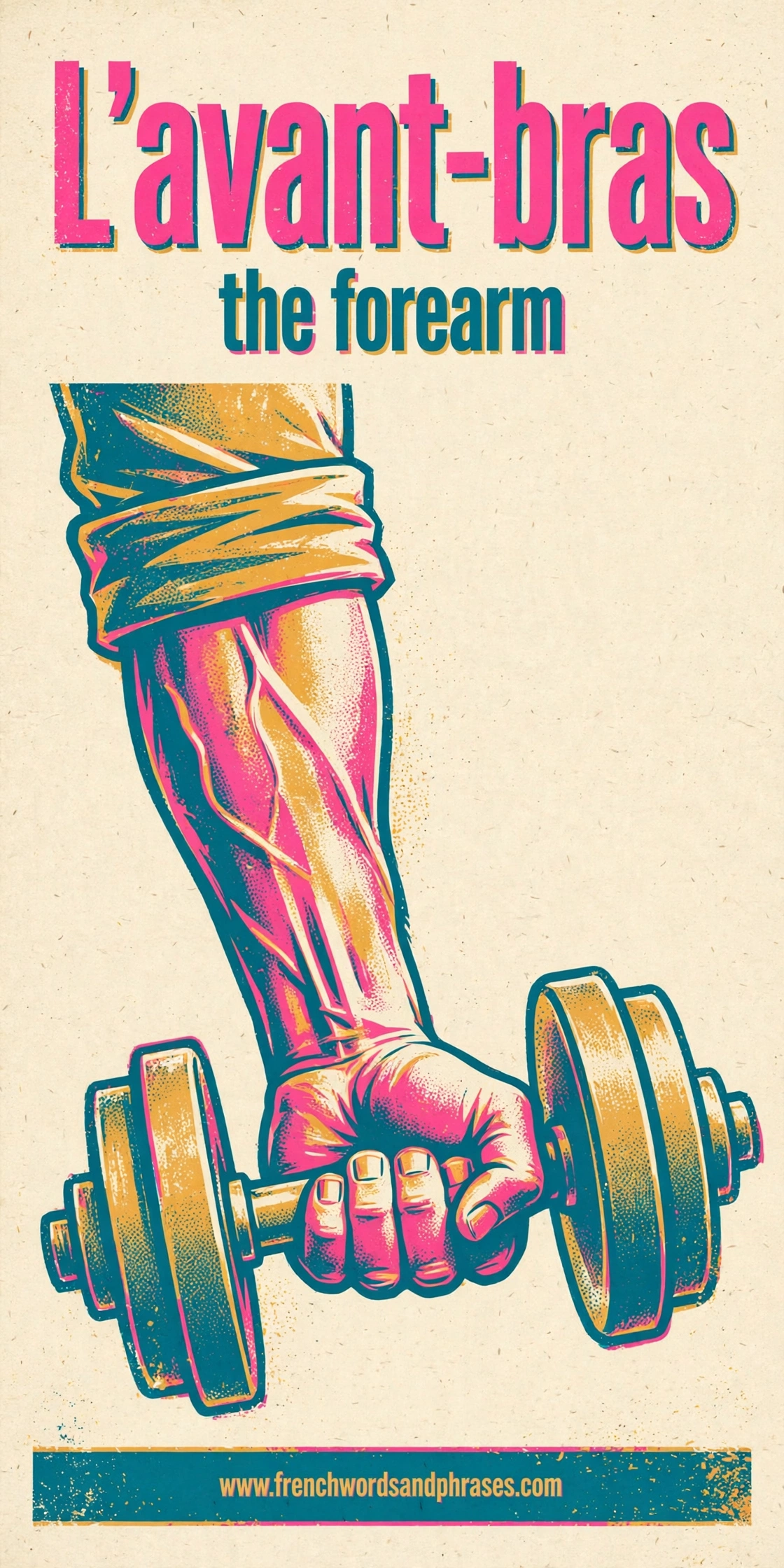
L’avant-bras means the forearm.
The tennis coach taps the inside of her own arm, between elbow and wrist: « C’est là, dans l’avant-bras, que le coup droit prend sa force. » — l’avant-bras, the hardest-working part of the arm.
In this guide, you’ll learn what avant-bras means in English, how to use it with its articles, how to form its plural, and how it appears in everyday French. Explore French examples, English translations, and practice quizzes.
Understanding the French Noun Avant-bras
Avant-bras is a masculine French compound noun. Because it begins with a vowel, the article shrinks: l’avant-bras, un avant-bras. It joins avant (front, before) and bras (the arm): literally, the « front of the arm » — the part between the elbow and the wrist.
It means the forearm — the lower half of the arm, from le coude (the elbow) to le poignet (the wrist). The avant-bras carries, grips, pushes and protects: you lean on it, you roll up your sleeves over it, and a goalkeeper throws it in front of his face. Its two bones have names too: le radius and le cubitus.
Gender: Masculine
Definite article: l’ — l’avant-bras (the forearm), because it starts with a vowel
Indefinite article: un — un avant-bras (a forearm)
Plural: les avant-bras — completely invariable: des avant-bras, because bras already ends in -s
Built from: avant (front) + le bras (the arm)
English equivalents: The forearm.
One important usage detail: bras ends in an -s even in the singular — un bras, one arm — so the plural of avant-bras changes nothing at all: des avant-bras. The same silent -s lives in le repas and le mois: you hear the plural only in the article.
Experience the Word
Avant-bras is more than an anatomy word. It is where strength shows quietly — the rolled sleeve, the carried suitcase, the arm offered to help someone up.
Imagine the fisherman hauling his nets at dawn, avant-bras burning, or the baker sliding tray after tray into the oven, his avant-bras dusted white with flour.
You have not just named a body part. You have found where the arm does its work.
How to Use Avant-bras in French: Complete Guide
Let’s explore how avant-bras works in French, beginning with its articles — and see why its plural is perfectly invariable.
Avant-bras with the Definite Article (L’, Les)
Avant-bras begins with a vowel, so le shrinks to l’ — l’avant-bras, the forearm.
| Form | French |
|---|---|
| Masculine singular | l’avant-bras |
| Plural | les avant-bras |
Example
L’avant-bras du joueur est couvert de terre après le match.
The player’s forearm is covered in mud after the match.
Avant-bras with the Indefinite Article (Un, Des)
Used for a forearm in general — un avant-bras, any forearm.
| Form | French |
|---|---|
| Masculine singular | un avant-bras |
| Plural | des avant-bras |
Example
Il s’est fait un tatouage sur un avant-bras.
He got a tattoo on one forearm.
The Arm, Piece by Piece: Words around Avant-bras
Elbows, wrists and hands — the vocabulary of the avant-bras’ neighbourhood.
| French | In English |
|---|---|
| le bras | the arm |
| le coude | the elbow |
| le poignet | the wrist |
| la main | the hand |
| l’épaule | the shoulder |
| le muscle | the muscle |
Example
L’avant-bras relie le coude au poignet.
The forearm connects the elbow to the wrist.
Quick Quiz 1
Complete the sentence:
Elle s’est brûlé ______ avant-bras en sortant le plat du four.
Reveal the answer
l’
Elle s’est brûlé l’avant-bras en sortant le plat du four.
She burnt her forearm taking the dish out of the oven — l’, because avant-bras starts with a vowel.
The Plural of Avant-bras
Avant-bras is invariable: bras ends in -s already, so the plural is identical — des avant-bras.
| Number | French |
|---|---|
| Singular | l’avant-bras |
| Plural | les avant-bras |
Example
Le gymnaste a des avant-bras très musclés.
The gymnast has very muscular forearms.
Avant-bras with Possessive Adjectives (Mon, Ton, Son…)
Avant-bras begins with a vowel, so it takes mon, ton, son — mon avant-bras.
| Owner | French |
|---|---|
| my | mon avant-bras |
| your (tu) | ton avant-bras |
| his / her | son avant-bras |
| our | notre avant-bras |
| your (vous) | votre avant-bras |
| their | leur avant-bras |
Example
Mon avant-bras me fait mal après l’entraînement.
My forearm hurts after training.
Quick Quiz 2
Complete the sentence:
Le gardien a arrêté le ballon avec ______ avant-bras. (his)
Reveal the answer
son
Le gardien a arrêté le ballon avec son avant-bras.
The goalkeeper stopped the ball with his forearm.
Avant-bras with Demonstrative Adjectives (Cet, Ces)
Used to point: cet avant-bras — cet, not ce, because of the opening vowel.
| Form | French |
|---|---|
| Masculine singular | cet avant-bras |
| Plural | ces avant-bras |
Example
Cet avant-bras est gonflé, il faut voir un médecin.
This forearm is swollen; you need to see a doctor.
Avant-bras with Adjectives
The noun never changes, but adjectives agree with it (masculine): un avant-bras musclé, un avant-bras cassé.
| Adjective | With Avant-bras |
|---|---|
| musclé (muscular) | un avant-bras musclé |
| cassé (broken) | un avant-bras cassé |
| long (long) | un long avant-bras |
| tatoué (tattooed) | un avant-bras tatoué |
| fort (strong) | un avant-bras fort |
Example
Après sa chute, il a un avant-bras cassé et un plâtre.
After his fall, he has a broken forearm and a plaster cast.
Quick Quiz 3
True or false: the plural of avant-bras is « des avant-brass ».
Reveal the answer
False — avant-bras is invariable: des avant-bras, since bras already ends in -s.
Elle croise les avant-bras et attend.
Everyday Expressions with Avant-bras
Sleeves, casts and strength — the avant-bras phrases of daily life.
| Expression | In English |
|---|---|
| remonter ses manches | to roll up your sleeves |
| croiser les avant-bras | to fold your forearms |
| se casser l’avant-bras | to break your forearm |
| un avant-bras en plâtre | a forearm in plaster |
| montrer ses avant-bras | to bare your forearms |
Example
Il remonte ses manches jusqu’au-dessus des avant-bras et commence à travailler.
He rolls his sleeves up above his forearms and starts work.
Words from the Same Family as Avant-bras
Arms, bodies and movement — the words that travel with avant-bras.
| French | In English |
|---|---|
| le bras | the arm |
| avant | before, in front |
| la manche | the sleeve |
| le corps | the body |
| le squelette | the skeleton |
| le plâtre | the plaster cast |
Example
La manche de sa chemise couvre tout l’avant-bras.
His shirt sleeve covers his whole forearm.
Quick Quiz 4
Between which two joints does l’avant-bras run?
Reveal the answer
Between the elbow and the wrist — le coude et le poignet.
L’avant-bras va du coude au poignet.
The forearm runs from the elbow to the wrist.
Avant-bras in Everyday French: Real-Life Examples
Now that you know the word, let’s see how avant-bras appears in everyday French.
Example 1 — Sport
Les avant-bras du rameur sont très musclés.
The rower’s forearms are very muscular.
Example 2 — An accident
Elle est tombée et s’est fait mal à l’avant-bras.
She fell and hurt her forearm.
Example 3 — At work
Le boulanger a les avant-bras couverts de farine.
The baker’s forearms are covered in flour.
Example 4 — Summer
Il porte des chemises qui laissent les avant-bras libres.
He wears shirts that leave his forearms bare.
Example 5 — At the doctor’s
Le médecin examine l’avant-bras gonflé de l’enfant.
The doctor examines the child’s swollen forearm.
Example 6 — A tattoo
Un petit oiseau est tatoué sur son avant-bras gauche.
A little bird is tattooed on her left forearm.
Beyond Translation: The Meaning of Avant-bras
French body words often build themselves like maps: avant-bras, the front of the arm, tells you exactly where to look. The avant-bras has its quiet glory in French life — it is the part of the arm the baker, the fisherman and the tennis player all train without thinking, and the part you offer, instinctively, to shield your face or carry a child.
To say avant-bras is to point to where strength becomes useful.
It evokes rolled sleeves and plaster casts, oars and oven trays — the working half of the arm, honoured with a name of its own.
How to Remember the French Noun Avant-bras
Remember it this way: Avant-bras is the forearm — avant (front) plus bras (arm) — and it is invariable, because bras already ends in -s.
- You picture it — l’avant du bras, the front of the arm.
- You write the plural — des avant-bras, nothing changes.
- You locate it — du coude au poignet, from elbow to wrist.
The key idea is avant-bras — the front of the arm.
Test Your Knowledge of Avant-bras
Let’s see how much you’ve learned. Try answering these questions before revealing the answers.
Question 1
Is avant-bras masculine or feminine?
Reveal the answer
Masculine — l’avant-bras, un avant-bras.
Question 2
What is the plural of avant-bras?
Reveal the answer
Des avant-bras — invariable, because bras already ends in -s.
Question 3
Translate: My forearm hurts.
Reveal the answer
Mon avant-bras me fait mal.
Question 4
What is le coude?
Reveal the answer
The elbow — the joint at the top of the avant-bras; le poignet, the wrist, is at the other end.
Question 5
Complete the sentence:
______ avant-bras est tatoué. (This)
Reveal the answer
Cet
Cet avant-bras est tatoué.
This forearm is tattooed — cet, because avant-bras begins with a vowel.
Your Final Challenge
Can You Use It?
How would you say this in French?
“The gymnast has very strong forearms.”
Reveal the answer
Le gymnaste a des avant-bras très forts.
The gymnast has very strong forearms.
A little French. A little curiosity. A richer everyday life.
LEARN FRENCH ONE WORD AT A TIME