
A French Word to Live By
Translate Aujourd’hui to English
/o.ʒuʁ.dɥi/
Aujourd’hui means today.
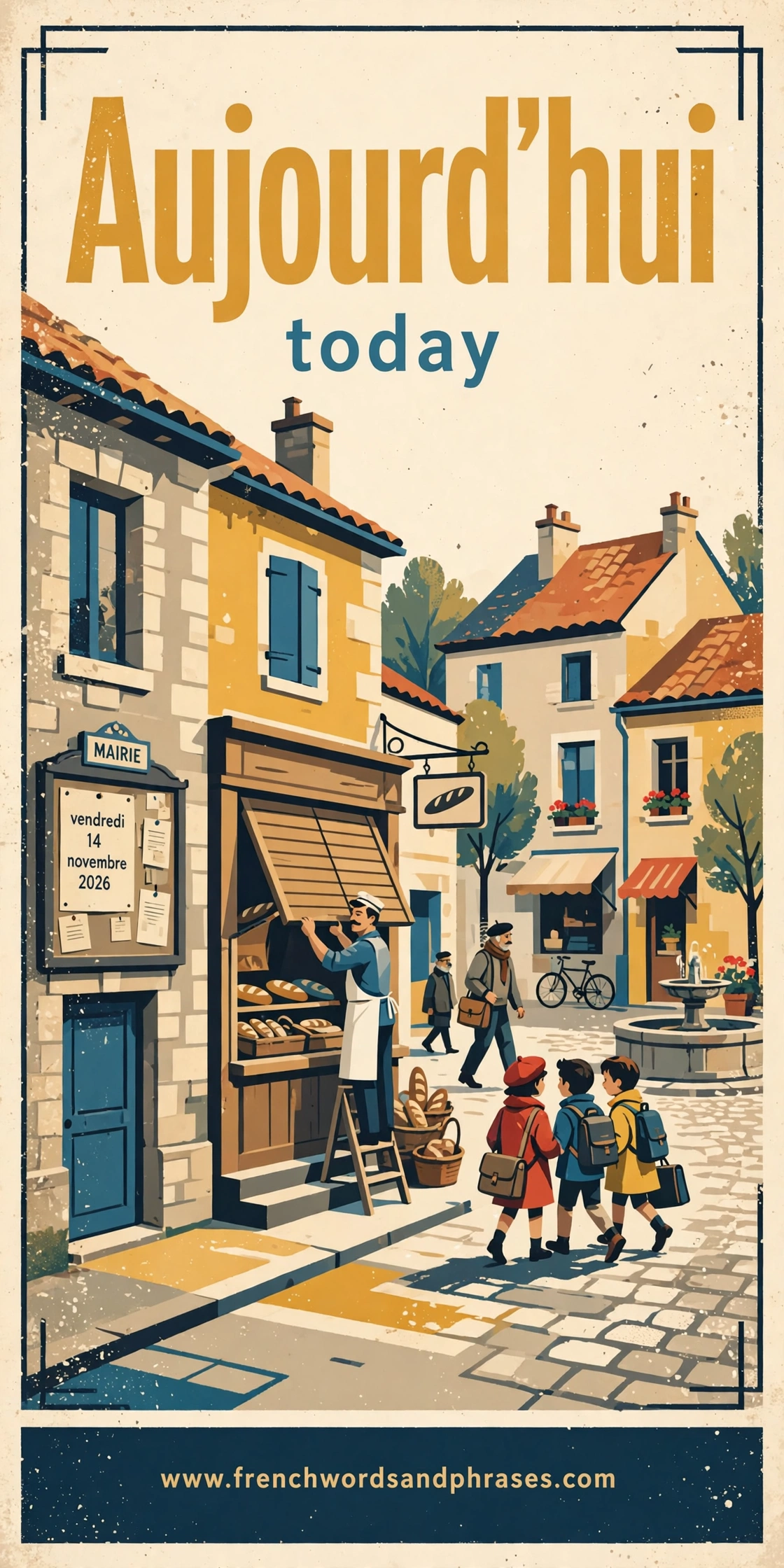
The market wakes under a clean blue sky: shutters rattling up, crates of peaches catching the light, the first coffee of the day steaming on the zinc counter. Everything is beginning again, and it is all happening aujourd’hui.
In this guide, you’ll learn what aujourd’hui means in English, why it carries two apostrophes, where it stands in the sentence, and how the French arrange the days around it. Explore French examples, English translations, and practice quizzes.
Understanding the French Adverb Aujourd’hui
Aujourd’hui is a French adverb of time. It is one of the longest everyday adverbs in the language — a whole little sentence folded into one word: au jour d’hui, on the day of today.
It means today — this day, the day we are living through now. It can point at the morning already gone, the afternoon still to come, or the whole day taken as one block of time. Put it at the head of a sentence and the day opens like a door: Aujourd’hui, tout est possible.
Type: Adverb of time — the present day
Answers the question: When? — this day
Changes form: Never — aujourd’hui is invariable
English equivalents: Today; this day.
One important usage detail: mind the two apostrophes — aujourd’hui. The word is a sandwich of older words, and both apostrophes survive in the spelling. And for the parts of the day, French prefers smaller words: this morning is ce matin and this evening is ce soir — never « aujourd’hui matin ».
Experience the Word
Aujourd’hui is the hinge of the French calendar. Behind it stands hier, yesterday, already told like a story; ahead of it, demain, tomorrow, still only a promise.
Imagine the village on market morning: lists in pockets, baskets on arms, the whole day planned over the first coffee — « Aujourd’hui, on achète pour toute la semaine ! »
You have not just named a date. You have opened the day like a door.
How to Use Aujourd’hui in French: Complete Guide
Let’s explore how aujourd’hui works in French, beginning with the whole word on one card.
Aujourd’hui at a Glance
Before the details, here is the whole word on one card.
The Whole Word on One Card
Meaning, type, position and form — aujourd’hui in four lines.
| Point | Aujourd’hui |
|---|---|
| Meaning | today |
| Type | adverb of time — the present day |
| Usual position | at the head of the sentence, or at the end |
| Form | invariable — never changes |
Example
Aujourd’hui, nous visitons le marché.
Today, we are visiting the market.
Where Aujourd’hui Goes in the Sentence
Aujourd’hui is a traveller: it opens sentences like a headline, and it closes them like a full stop. Both homes are natural.
| Situation | Pattern |
|---|---|
| Head of the sentence (most common) | Aujourd’hui, + sentence — Aujourd’hui, je reste à la maison |
| End of the sentence | sentence + aujourd’hui — Je reste à la maison aujourd’hui |
| In a question | Que fais-tu aujourd’hui ? |
| After a contrast | D’habitude non, mais aujourd’hui oui |
Example
Je reste à la maison aujourd’hui.
I am staying at home today.
Quick Quiz 1
True or false: « aujourd’hui matin » is the French for this morning.
Reveal the answer
False
This morning is ce matin.
Ce matin, je me suis levé tôt. — This morning, I got up early.
The Days Around Aujourd’hui
Aujourd’hui never travels alone. Learn the whole row of days and you can plan a week in French.
| French | In English |
|---|---|
| avant-hier | the day before yesterday |
| hier | yesterday |
| aujourd’hui | today |
| demain | tomorrow |
| après-demain | the day after tomorrow |
| ce matin / ce soir | this morning / this evening |
Example
Hier il pleuvait, aujourd’hui il fait beau, et demain on verra.
Yesterday it rained, today the weather is fine, and tomorrow we shall see.
Aujourd’hui with Different Tenses
One day, three directions: aujourd’hui stretches from the morning already finished to the evening still to come, and the tense follows it.
| Moment | Example |
|---|---|
| Earlier today (passé composé) | J’ai déjà acheté le pain aujourd’hui. |
| Right now (present) | Aujourd’hui, elle est en vacances. |
| Later today (future) | Aujourd’hui, je finirai ce travail. |
| Habit against today | D’habitude je prends le bus, mais aujourd’hui je marche. |
Example
D’habitude, il prend le train, mais aujourd’hui il prend la voiture.
Usually he takes the train, but today he is taking the car.
Quick Quiz 2
Complete the sentence:
______, nous visitons le marché. (Today)
Reveal the answer
Aujourd’hui
Aujourd’hui, nous visitons le marché.
Today, we are visiting the market.
Everyday Expressions with Aujourd’hui
Small phrases built on aujourd’hui turn up in conversations, letters and plans every single day.
| Expression | In English |
|---|---|
| aujourd’hui même | this very day |
| dès aujourd’hui | from today, starting today |
| jusqu’à aujourd’hui | until today, so far |
| le journal d’aujourd’hui | today’s newspaper |
| aujourd’hui en huit | a week today |
Example
Le journal d’aujourd’hui est sur la table.
Today’s newspaper is on the table.
Aujourd’hui or De Nos Jours?
Both can be translated as a kind of today in English, but French keeps them apart: one is a day, the other is an era.
| Aspect | The Difference |
|---|---|
| aujourd’hui | this single day — the one on today’s calendar |
| de nos jours | nowadays — the times we live in, years wide |
| Test sentence | Aujourd’hui, il pleut. / De nos jours, tout va vite. |
| How long it lasts | aujourd’hui lasts one day; de nos jours lasts years |
Example
De nos jours, les enfants grandissent avec les écrans ; aujourd’hui, le mien joue dehors.
Nowadays, children grow up with screens; today, mine is playing outside.
Quick Quiz 3
What does aujourd’hui en huit mean?
Reveal the answer
A week today
On se voit aujourd’hui en huit !
See you a week today!
Inside the Word: Au Jour d’Hui
Aujourd’hui is a fossil you can still take apart. Each piece tells a piece of the story.
| Piece | Story |
|---|---|
| au | on the, at the |
| jour | day |
| hui | today — from the Latin hodie |
| au jour d’aujourd’hui | the joke form — « on the day of today »: today said twice, a famous redundancy |
Example
Les élèves rient quand le professeur dit « au jour d’aujourd’hui ».
The pupils laugh when the teacher says « on the day of today ».
Watch Out: Traps with Aujourd’hui
Two small traps catch learners again and again — one of spelling, one of habit.
| Mistake | Correct French |
|---|---|
| « aujourd’hui matin » for this morning | ce matin |
| « aujourdhui » written without apostrophes (texting only) | aujourd’hui — with its two apostrophes |
| « aujourd’hui soir » for this evening | ce soir |
| « aujourd’hui après-midi » for this afternoon | cet après-midi |
Example
Ce soir, nous dînons chez des amis.
This evening, we are having dinner at friends’ house.
Quick Quiz 4
How many apostrophes does aujourd’hui have: one or two?
Reveal the answer
Two
aujourd’hui — one after jour (d’) and one inside (d’hui). Write both, every time.
Aujourd’hui in Everyday French: Real-Life Examples
Now that you know the word, let’s see how aujourd’hui appears in everyday French.
Example 1 — At the market
Aujourd’hui, nous achetons des légumes pour toute la semaine.
Today, we are buying vegetables for the whole week.
Example 2 — At work
Aujourd’hui, la réunion commence à dix heures.
Today, the meeting starts at ten o’clock.
Example 3 — Weather
Aujourd’hui, il fait un temps magnifique.
Today, the weather is magnificent.
Example 4 — Family plans
Aujourd’hui, nous déjeunons chez mes parents.
Today, we are having lunch at my parents’ house.
Example 5 — At school
Aujourd’hui, les enfants ont un cours de musique.
Today, the children have a music lesson.
Example 6 — A phone call
Je t’appelle aujourd’hui, sans faute.
I will call you today, without fail.
Beyond Translation: The Meaning of Aujourd’hui
Few French words carry their history so openly: aujourd’hui is a tiny sentence — au jour d’hui, on the day of today — worn smooth by a thousand years of mornings.
To say aujourd’hui is to stand in the middle of the day and look both ways.
Behind it, hier, already a story; ahead, demain, still a promise. It is the hinge word of the calendar, the one the market, the news and the family all reach for before breakfast.
How to Remember the French Adverb Aujourd’hui
Remember it this way: Aujourd’hui is today — one word built from a whole phrase, au jour d’hui, with two apostrophes.
- You take the word apart — au jour d’hui, on the day of today.
- You open the day with it — Aujourd’hui, nous visitons le marché.
- You shrink it for the day’s edges — ce matin, ce soir, never « aujourd’hui matin ».
The key idea is today — au jour d’hui, two apostrophes, and ce matin / ce soir for the edges.
Test Your Knowledge of Aujourd’hui
Let’s see how much you’ve learned. Try answering these questions before revealing the answers.
Question 1
What does aujourd’hui mean?
Reveal the answer
Today — this day, the day we are in.
Question 2
How do you say this morning and this evening in French?
Reveal the answer
Ce matin and ce soir.
Question 3
Translate: Today’s newspaper is on the table.
Reveal the answer
Le journal d’aujourd’hui est sur la table.
Question 4
What does aujourd’hui en huit mean?
Reveal the answer
A week today — the same day next week.
Question 5
Complete the sentence:
______, je reste à la maison. (Today)
Reveal the answer
Aujourd’hui
Aujourd’hui, je reste à la maison.
Today, I am staying at home.
Your Final Challenge
Can You Use It?
How would you say this in French?
“Today, we are visiting the market.”
Reveal the answer
Aujourd’hui, nous visitons le marché.
Today, we are visiting the market.
A little French. A little curiosity. A richer everyday life.
LEARN FRENCH ONE WORD AT A TIME




