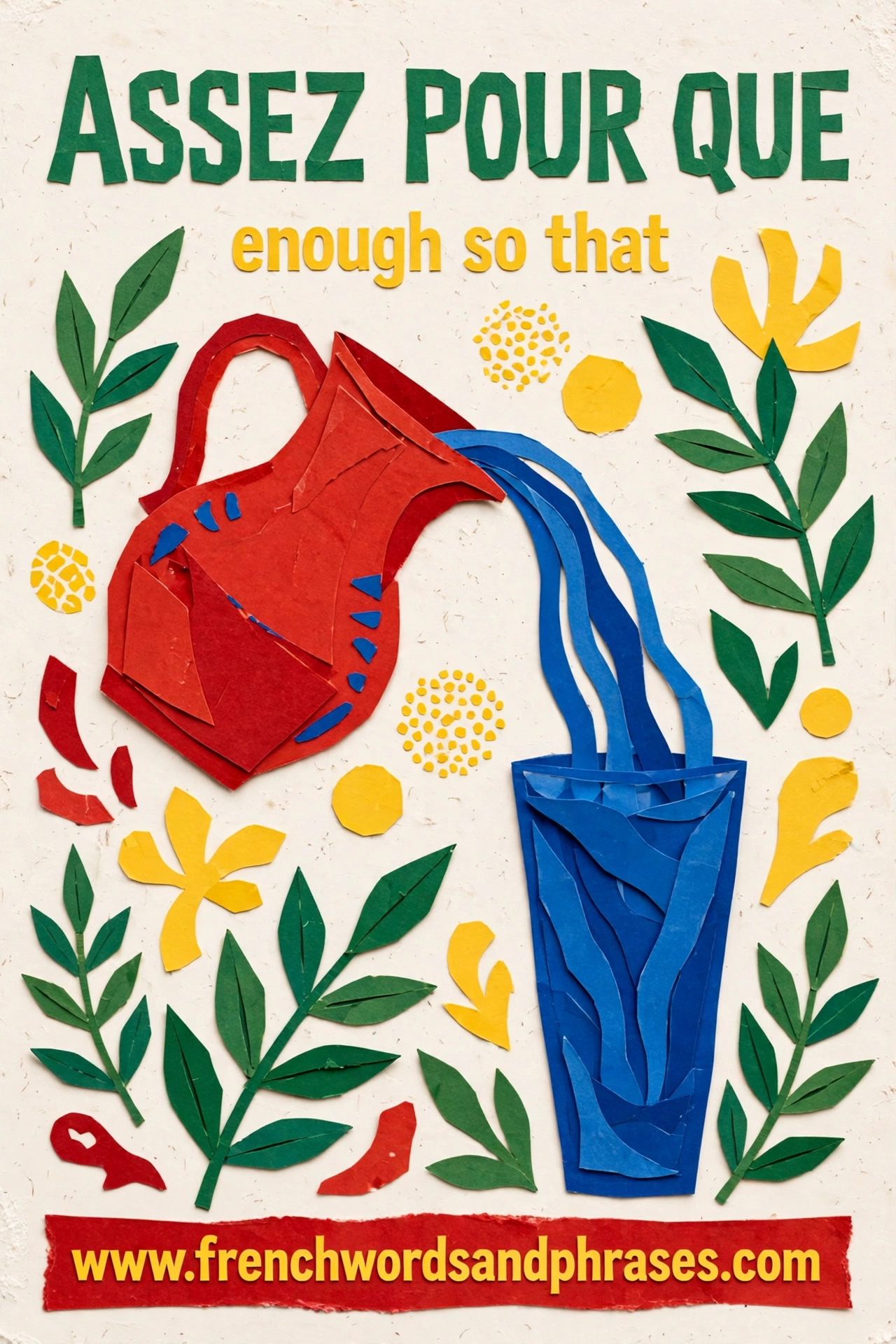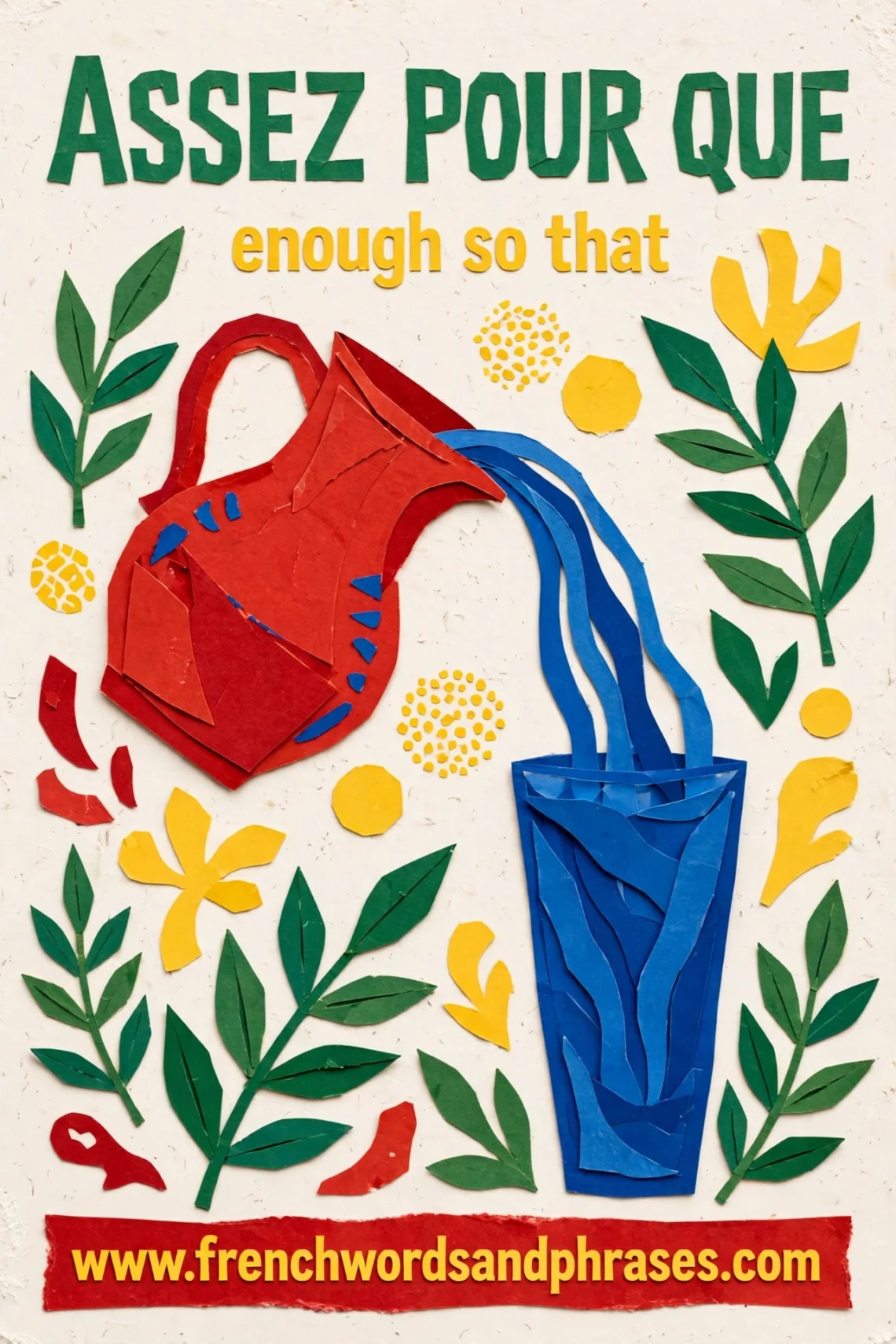
A French Word to Live By
Translate Assez pour que to English
/ase puʁ kə/
Assez pour que means enough so that.
The soup is almost right — one pinch more and it will be salty enough for everyone to ask for seconds. Assez pour que lives at exactly that threshold: the moment a quality grows big enough to produce a consequence in someone else’s clause.
In this guide, you’ll learn what assez pour que means in English, how it says ‘enough for something to happen’, why the verb after it is in the subjunctive, and when French prefers assez pour + infinitive instead. Explore French examples, English translations, and practice quizzes.
Understanding the French Conjunction Assez pour que
Assez pour que is a French subordinating conjunction of consequence, built on assez (enough). It measures a quality or quantity in one clause and announces that it is sufficient to trigger a result in another — and the result, being potential rather than accomplished, takes the subjunctive.
It means enough so that — enough for it to happen that. The subjects are usually different: il est assez grand pour que tu le voies de loin — he is tall enough for you to see him from far away. Assez sets the level; pour que opens the consequence.
Type: Subordinating conjunction — consequence (sufficiency)
Pattern: assez + adjective/adverb/noun + pour que + clause
What follows it: A full clause, usually with a different subject
Mood after it: Subjunctive — always
One important usage detail: when the subject stays the same, French drops que and uses the infinitive — il est assez grand pour voir par-dessus la foule (he is tall enough to see over the crowd). Assez pour que is for when the consequence belongs to someone else.
Experience the Word
Assez pour que is the conjunction of the threshold — the exact point where ‘enough’ tips over into ‘and so it happens’.
Imagine a child on tiptoe at the bakery window, nose just above the counter: she is grande — assez grande pour que la vendeuse la voie, and smile.
You have not just measured a quality. You have watched it reach the line where it changes what others can do.
How to Use Assez pour que in French: Complete Guide
Let’s explore how assez pour que works in French, beginning with the whole pattern on one card.
Assez pour que at a Glance
Before the details, here is the whole word on one card.
The Whole Pattern on One Card
Meaning, job, pattern and mood — assez pour que in four lines.
| Point | Assez pour que |
|---|---|
| Meaning | enough so that — enough for… to |
| Job | a quality reaches the level where a consequence follows |
| Pattern | assez + adjective + pour que + clause |
| Mood | subjunctive |
Example
La musique est assez douce pour que le bébé dorme.
The music is soft enough for the baby to sleep.
How Assez pour que Links: A Level, Then a Result
Assez pour que links a measurement to a consequence in another clause. The first clause sets the level with assez; pour que introduces the result that level makes possible.
| Pattern | Example |
|---|---|
| adjective + pour que | il fait assez chaud pour que nous nagions — it’s warm enough for us to swim |
| noun + pour que | il y a assez de pain pour que tout le monde mange — there is enough bread for everyone to eat |
| adverb + pour que | elle parle assez fort pour que je l’entende — she speaks loudly enough for me to hear her |
| different subjects — the point of the pattern | tu es assez clair pour que les enfants comprennent — you are clear enough for the children to understand |
Example
La lampe est assez forte pour que je lise sans fatigue.
The lamp is bright enough for me to read without strain.
Quick Quiz 1
In ‘elle chante assez bien pour que le public applaudisse’, whose action is in the pour que clause?
Reveal the answer
Someone else’s — the public’s. Assez pour que hands the consequence to a different subject.
Elle chante assez bien pour que le public applaudisse.
She sings well enough for the audience to applaud.
The Mood Question: Subjunctive, Because the Result Is Potential
The consequence after pour que is aimed at, not yet accomplished — so the verb goes into the subjunctive. Practise the key forms: être, avoir, pouvoir, faire.
| Verb | Subjunctive after assez pour que |
|---|---|
| être | assez grand pour qu’elle soit vue — tall enough for her to be seen (soit) |
| avoir | assez riche pour qu’ils aient une maison — rich enough for them to have a house (aient) |
| pouvoir | assez fort pour que tu puisses soulever la boîte — strong enough for you to lift the box (puisses) |
| faire | assez beau pour qu’on fasse une promenade — nice enough for us to go for a walk (fasse) |
Example
Il est assez patient pour que les élèves osent poser des questions.
He is patient enough for the pupils to dare to ask questions.
Where Assez pour que Goes: Assez Early, pour que Before the Result
Assez hugs the adjective, adverb or noun it measures; pour que stands right before the consequence clause. Que elides to qu’ before a vowel.
| Position | Example |
|---|---|
| assez + adjective | assez chaud pour que… — assez directly before the adjective |
| assez de + noun | assez de temps pour que… — enough time for… (de is part of the pattern) |
| pour que before the result clause | …pour que les voisins entendent — so that the neighbours hear |
| Elision | pour qu’il / pour qu’elle — que becomes qu’ before a vowel |
Example
Il y a assez de chaises pour que tout le monde s’asseye.
There are enough chairs for everyone to sit down.
Quick Quiz 2
Why the subjunctive after assez pour que?
Reveal the answer
Because the result is potential, not yet real — the level makes it possible; the subjunctive keeps it in the realm of the aimed-at.
Assez calme pour que je dorme.
Calm enough for me to sleep.
Everyday Expressions with Assez pour que
The pattern has a small family — its negative twin, its stronger form, and its infinitive shortcut.
| Expression | In English |
|---|---|
| assez… pour que + subjunctive | enough… for… to / so that |
| pas assez… pour que | not enough… for… to (the negative twin) |
| bien assez… pour que | quite enough… for… to |
| assez pour + infinitive | enough to… (same subject — the infinitive shortcut) |
Example
Il n’y a pas assez de lumière pour que je voie les touches.
There isn’t enough light for me to see the keys.
Close Cousins: Assez pour que, Trop pour que, Tellement que, Pour que
Consequence has a family: enough, too much, so much, and plain purpose. Each measures differently.
| Word | The difference |
|---|---|
| assez pour que | enough — the level is sufficient for the result (+ subjunctive) |
| trop pour que | too much — the level blocks the result: trop petit pour qu’on le voie, too small to be seen (+ subjunctive) |
| tellement… que | so… that — an accomplished result, indicative: tellement fatigué qu’il dort |
| pour que (alone) | purpose — ‘so that, in order that’: je parle lentement pour que tu comprennes |
Example
Il parle tellement vite qu’on ne comprend rien.
He speaks so fast that we understand nothing.
Quick Quiz 3
Which cousin states a result that actually happened: tellement que, or assez pour que?
Reveal the answer
tellement… que — with the indicative, because the result is real. Assez pour que keeps its result potential, in the subjunctive.
Il est tellement tard que les magasins sont fermés.
It’s so late that the shops are closed.
Assez pour que and Its Neighbours
Sufficiency and its neighbours — the formal synonym, the excess twin, and the result words.
| French | In English |
|---|---|
| suffisamment pour que | sufficiently so that (formal synonym) |
| trop pour que | too… for… to (the excess twin) |
| pour que | so that (purpose) |
| tellement que | so much that (real result) |
| de sorte que | so that (result, often indicative) |
Example
Il a travaillé de sorte que tout est prêt.
He worked so that everything is ready.
Watch Out: The Traps Around Assez pour que
The traps: choosing the clause when the infinitive is wanted, and letting the indicative sneak into the consequence.
| Trap | The truth |
|---|---|
| same subject? use the infinitive | il est assez grand pour passer — when he himself passes, drop que and use pour + infinitive |
| indicative after pour que | never: ‘pour que tu comprends’ is wrong — pour que tu comprennes |
| forgetting de with nouns | assez de pain, assez de temps — the de is part of the measure |
| assez word order | assez comes BEFORE the adjective: assez grand — never after it |
Example
Elle est assez rapide pour gagner la course.
She is fast enough to win the race.
Quick Quiz 4
Fix it: ‘Nous avons assez d’argent pour que nous achetons le pain.’ (the same people are buying)
Reveal the answer
Same subject — use the infinitive, and no que.
Nous avons assez d’argent pour acheter le pain.
We have enough money to buy the bread.
Assez pour que in Everyday French: Real-Life Examples
Now that you know the word, let’s see how assez pour que appears in everyday French.
Example 1 — At home
La soupe est assez chaude pour que les enfants la mangent.
The soup is warm enough for the children to eat it.
Example 2 — Weather
Il fait assez beau pour que nous déjeunions dehors.
The weather is nice enough for us to have lunch outside.
Example 3 — At work
Le rapport est assez clair pour que le directeur le signe.
The report is clear enough for the director to sign it.
Example 4 — Music
Elle joue assez doucement pour que le bébé ne se réveille pas.
She plays softly enough for the baby not to wake up.
Example 5 — Enough room
La table est assez grande pour que dix personnes s’asseyent.
The table is big enough for ten people to sit down.
Example 6 — A compliment
Tu expliques assez bien pour que même moi, je comprenne.
You explain well enough for even me to understand.
Beyond Translation: The Meaning of Assez pour que
English says enough so that for assez pour que — and the French pattern is a small lesson in fairness: one clause holds the measure, the other holds the consequence, and the subjunctive stands between them like a door not yet opened.
Assez pour que is where quantity becomes possibility — the grammar of ‘just enough’.
French cooks, builders and grandmothers all live by assez: enough salt, enough light, enough patience. This conjunction is that wisdom, conjugated.
How to Remember the French Conjunction Assez pour que
Remember it this way: Assez pour que is a measuring jug: fill to the assez line, and someone else’s action pours out.
- You measure with assez — adjective, adverb, or assez de + noun.
- You hand the consequence to another subject with pour que.
- You put that consequence in the subjunctive — possible, not yet done.
The key idea is assez pour que: level reached, consequence possible, verb subjunctive.
Test Your Knowledge of Assez pour que
Let’s see how much you’ve learned. Try answering these questions before revealing the answers.
Question 1
What does assez pour que mean?
Reveal the answer
Enough so that — enough for something to happen.
Question 2
Which mood follows assez pour que?
Reveal the answer
The subjunctive — the consequence is potential, not accomplished.
Question 3
Translate: The room is big enough for us to dance.
Reveal the answer
La salle est assez grande pour que nous dansions.
Question 4
Same subject — what replaces assez pour que?
Reveal the answer
assez pour + infinitive — il est assez fort pour soulever la table, he is strong enough to lift the table.
Question 5
Complete with the right form:
Il fait assez froid pour que l’eau ______ (geler, in the subjunctive).
Reveal the answer
gèle
Il fait assez froid pour que l’eau gèle.
It’s cold enough for the water to freeze.
Your Final Challenge
Can You Use It?
How would you say this in French?
“The light is strong enough for me to read.”
Reveal the answer
La lumière est assez forte pour que je lise.
The light is strong enough for me to read.
A little French. A little curiosity. A richer everyday life.
LEARN FRENCH ONE WORD AT A TIME