A French Word to Live By
How to Conjugate Arrêter in French
/a.ʁe.te/
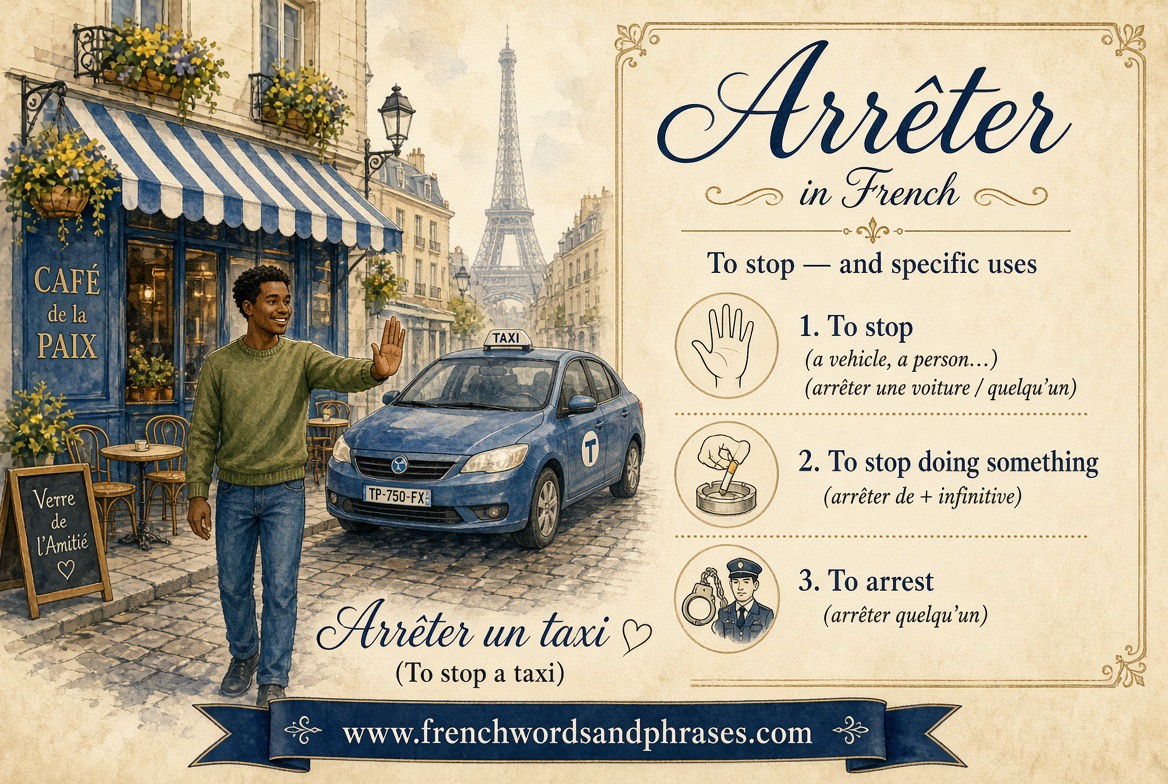
Arrêter means to stop, or to give up.
Sometimes the bravest thing is to stop. You stop a car at a red light, you stop a habit that no longer serves you, or you simply pause and catch your breath — that is arrêter.
In this guide, you’ll learn how to conjugate arrêter in all the major French tenses and moods. Explore complete conjugation tables, French examples, English translations, and practice quizzes.
Understanding the French Verb Arrêter
Arrêter is a regular French verb belonging to the first group of verbs, those ending in -er.
It means to stop, or to give up. It is commonly used to talk about stopping an action, stopping a vehicle or a machine, and — with de + infinitive — about giving something up. In a legal sense, it also means to arrest someone.
Verb classification: First group (-er)
Auxiliary verb: Avoir
Past participle: arrêté
Present participle: arrêtant
English equivalents: To stop, to give up, to arrest.
One important spelling detail: the accent circonflexe on the ê in arrêter remains in most forms — j’arrête, nous arrêtons — but the future and conditional stems use arrêter-, as in j’arrêterai.
Experience the Word
Arrêter is more than coming to a halt. It is a decision — to pause, to end something, or to draw a line and start again.
Imagine driving through the countryside at sunset. You stop the car, step out, and stand still for a moment, listening to nothing but the wind.
You have not just paused. You have stopped — and chosen to.
How to Conjugate Arrêter: Complete French Conjugation Guide
Let’s explore every major conjugation of arrêter, beginning with the indicative mood.
How to Conjugate Arrêter in the Indicative Mood
The indicative mood is used to express facts, observations, actions, and events.
How to Conjugate Arrêter in the Present Tense (Présent)
Used for actions happening now, habitual actions, and general truths.
| Subject | Conjugation |
|---|---|
| je | arrête |
| tu | arrêtes |
| il / elle | arrête |
| nous | arrêtons |
| vous | arrêtez |
| ils / elles | arrêtent |
Example
J’arrête de travailler à six heures.
I stop working at six o’clock.
Quick Quiz 1
Complete the sentence:
Nous ______ de travailler à six heures.
Reveal the answer
arrêtons
Nous arrêtons de travailler à six heures.
We stop working at six o’clock.
How to Conjugate Arrêter in the Passé Composé
Used for completed actions in the past. Arrêter takes the auxiliary verb avoir.
| Subject | Conjugation |
|---|---|
| j’ | ai arrêté |
| tu | as arrêté |
| il / elle | a arrêté |
| nous | avons arrêté |
| vous | avez arrêté |
| ils / elles | ont arrêté |
Example
Il a arrêté la voiture devant la maison.
He stopped the car in front of the house.
How to Conjugate Arrêter in the Imparfait (Imperfect Tense)
Used for habitual past actions, descriptions, and ongoing situations in the past.
| Subject | Conjugation |
|---|---|
| je | arrêtais |
| tu | arrêtais |
| il / elle | arrêtait |
| nous | arrêtions |
| vous | arrêtiez |
| ils / elles | arrêtaient |
Example
Quand il pleuvait, nous arrêtions la promenade.
When it rained, we stopped the walk.
Quick Quiz 2
Choose the correct form:
When we were children, we used to stop at the bakery every day.
Quand nous étions enfants, nous ______ à la boulangerie tous les jours.
Reveal the answer
arrêtions
Quand nous étions enfants, nous arrêtions à la boulangerie tous les jours.
How to Conjugate Arrêter in the Plus-que-parfait
Used to describe an action that had already been completed before another past event.
| Subject | Conjugation |
|---|---|
| j’ | avais arrêté |
| tu | avais arrêté |
| il / elle | avait arrêté |
| nous | avions arrêté |
| vous | aviez arrêté |
| ils / elles | avaient arrêté |
Example
J’avais déjà arrêté de fumer avant l’été.
I had already stopped smoking before the summer.
How to Conjugate Arrêter in the Passé Simple
Primarily used in formal writing, literature, and historical narratives. It is rarely used in everyday conversation.
| Subject | Conjugation |
|---|---|
| je | arrêtai |
| tu | arrêtas |
| il / elle | arrêta |
| nous | arrêtâmes |
| vous | arrêtâtes |
| ils / elles | arrêtèrent |
Example
Il arrêta la machine d’un geste rapide.
He stopped the machine with a swift gesture.
How to Conjugate Arrêter in the Passé Antérieur
A literary tense used to express an action completed immediately before another past action, generally in the passé simple.
| Subject | Conjugation |
|---|---|
| j’ | eus arrêté |
| tu | eus arrêté |
| il / elle | eut arrêté |
| nous | eûmes arrêté |
| vous | eûtes arrêté |
| ils / elles | eurent arrêté |
Example
Dès qu’il eut arrêté le moteur, le silence revint.
As soon as he had stopped the engine, silence returned.
How to Conjugate Arrêter in the Future Tense (Futur Simple)
Used to describe actions that will take place in the future.
| Subject | Conjugation |
|---|---|
| je | arrêterai |
| tu | arrêteras |
| il / elle | arrêtera |
| nous | arrêterons |
| vous | arrêterez |
| ils / elles | arrêteront |
Example
Demain, nous arrêterons le projet si cela ne marche pas.
Tomorrow, we will stop the project if it does not work.
How to Conjugate Arrêter in the Futur Antérieur (Future Perfect)
Used for an action that will have been completed before a particular point in the future.
| Subject | Conjugation |
|---|---|
| j’ | aurai arrêté |
| tu | auras arrêté |
| il / elle | aura arrêté |
| nous | aurons arrêté |
| vous | aurez arrêté |
| ils / elles | auront arrêté |
Example
À huit heures, tu auras déjà arrêté de travailler.
By eight o’clock, you will already have stopped working.
How to Conjugate Arrêter in the Near Future (Futur Proche)
Used to describe something that is going to happen soon. Formed with aller + infinitive.
| Subject | Conjugation |
|---|---|
| je | vais arrêter |
| tu | vas arrêter |
| il / elle | va arrêter |
| nous | allons arrêter |
| vous | allez arrêter |
| ils / elles | vont arrêter |
Example
Je vais arrêter de manger des bonbons.
I am going to stop eating sweets.
How to Conjugate Arrêter in the Conditional Mood
The conditional mood expresses what would happen under certain circumstances. It is also frequently used to make polite requests or express wishes.
How to Conjugate Arrêter in the Present Conditional
| Subject | Conjugation |
|---|---|
| je | arrêterais |
| tu | arrêterais |
| il / elle | arrêterait |
| nous | arrêterions |
| vous | arrêteriez |
| ils / elles | arrêteraient |
Example
J’arrêterais volontiers si j’avais le choix.
I would gladly stop if I had the choice.
How to Conjugate Arrêter in the Past Conditional
| Subject | Conjugation |
|---|---|
| j’ | aurais arrêté |
| tu | aurais arrêté |
| il / elle | aurait arrêté |
| nous | aurions arrêté |
| vous | auriez arrêté |
| ils / elles | auraient arrêté |
Example
J’aurais arrêté plus tôt si j’avais su.
I would have stopped earlier if I had known.
Arrêter in the Literary Past Conditional Form
This less common literary form uses the imperfect subjunctive of avoir.
| Subject | Conjugation |
|---|---|
| j’ | eusse arrêté |
| tu | eusses arrêté |
| il / elle | eût arrêté |
| nous | eussions arrêté |
| vous | eussiez arrêté |
| ils / elles | eussent arrêté |
Example
Il eût arrêté le travail s’il avait pu.
He would have stopped the work if he had been able to.
How to Conjugate Arrêter in the Subjunctive Mood
The subjunctive is used to express wishes, emotions, doubts, necessity, and uncertainty. It frequently follows expressions such as il faut que (it is necessary that) or bien que (although).
How to Conjugate Arrêter in the Present Subjunctive
| Subject | Conjugation |
|---|---|
| que je | arrête |
| que tu | arrêtes |
| qu’il / qu’elle | arrête |
| que nous | arrêtions |
| que vous | arrêtiez |
| qu’ils / qu’elles | arrêtent |
Example
Il faut que j’arrête de perdre du temps.
I need to stop wasting time.
Quick Quiz 3
Complete the sentence using the subjunctive:
Il faut que nous ______ de perdre du temps.
Reveal the answer
arrêtions
Il faut que nous arrêtions de perdre du temps.
We need to stop wasting time.
How to Conjugate Arrêter in the Imperfect Subjunctive
A literary tense, rarely encountered in modern spoken French.
| Subject | Conjugation |
|---|---|
| que je | arrêtasse |
| que tu | arrêtasses |
| qu’il / qu’elle | arrêtât |
| que nous | arrêtassions |
| que vous | arrêtassiez |
| qu’ils / qu’elles | arrêtassent |
Example
Il souhaitait qu’elle arrêtât de fumer.
He wished that she would stop smoking.
How to Conjugate Arrêter in the Pluperfect Subjunctive
A literary construction used to express an action completed before another past action.
| Subject | Conjugation |
|---|---|
| que j’ | eusse arrêté |
| que tu | eusses arrêté |
| qu’il / qu’elle | eût arrêté |
| que nous | eussions arrêté |
| que vous | eussiez arrêté |
| qu’ils / qu’elles | eussent arrêté |
Example
Il regrettait que nous eussions arrêté si tard.
He regretted that we had stopped so late.
How to Conjugate Arrêter in the Past Subjunctive
| Subject | Conjugation |
|---|---|
| que j’ | aie arrêté |
| que tu | aies arrêté |
| qu’il / qu’elle | ait arrêté |
| que nous | ayons arrêté |
| que vous | ayez arrêté |
| qu’ils / qu’elles | aient arrêté |
Example
Je suis heureux que tu aies arrêté cette habitude.
I am happy that you stopped this habit.
How to Conjugate Arrêter in the Imperative
The imperative is used to give commands, instructions, invitations, or suggestions. Subject pronouns are omitted.
How to Conjugate Arrêter in the Present Imperative
| Person | Conjugation |
|---|---|
| (tu) | arrête |
| (nous) | arrêtons |
| (vous) | arrêtez |
Example
Arrête de parler, s’il te plaît !
Stop talking, please!
Quick Quiz 4
How would you say Stop! (tu form)?
Reveal the answer
Arrête !
French Participles of Arrêter
Participles are verb forms that can be used in compound tenses and other grammatical constructions.
Present Participle of Arrêter
arrêtant
En arrêtant la voiture, il a vu le panneau.
While stopping the car, he saw the sign.
Past Participle of Arrêter
arrêté
Nous avons arrêté la réunion à midi.
We stopped the meeting at noon.
Arrêter in Everyday French: Real-Life Examples
Now that you know the conjugations, let’s see how arrêter appears in everyday French.
Example 1 — Present
Le bus arrête devant la gare.
The bus stops in front of the station.
Example 2 — Passé composé
Elle a arrêté de boire du café.
She stopped drinking coffee.
Example 3 — Imparfait
Il arrêtait toujours son vélo devant la boulangerie.
He always stopped his bike in front of the bakery.
Example 4 — Future
Nous arrêterons la voiture pour déjeuner.
We will stop the car for lunch.
Example 5 — Conditional
J’arrêterais ce bruit si je pouvais.
I would stop this noise if I could.
Example 6 — Subjunctive
Bien que nous arrêtions tôt, nous finissons à temps.
Although we stop early, we finish on time.
Beyond Translation: The Meaning of Arrêter
English has words such as stop, quit, and give up. Each captures part of the meaning of arrêter, but the French word also covers arresting someone and deciding to end something.
Stopping is a choice.
To arrêter is to bring something to an end — a movement, a habit, a noise. It evokes a pause, a decision, and sometimes a fresh start.
How to Remember the French Verb Arrêter
Remember it this way: Arrêter is about bringing something to an end, by choice.
- You reach a red light and press the brake — tu arrêtes la voiture.
- You decide to give up smoking for good — tu arrêtes de fumer.
- You tell a noisy room to be quiet — arrêtez de parler !
The key idea is bringing something to an end, by choice.
Test Your Knowledge of Arrêter
Let’s see how much you’ve learned. Try answering these questions before revealing the answers.
Question 1
What auxiliary verb is used with arrêter in compound tenses?
Reveal the answer
Avoir
Question 2
How do you say I will stop in French?
Reveal the answer
J’arrêterai.
Question 3
Translate: We stopped the meeting at noon.
Reveal the answer
Nous avons arrêté la réunion à midi.
Question 4
What is the present participle of arrêter?
Reveal the answer
Arrêtant.
Question 5
Complete the sentence:
Si j’avais su, j’______ plus tôt.
Reveal the answer
aurais arrêté
Si j’avais su, j’aurais arrêté plus tôt.
If I had known, I would have stopped earlier.
Your Final Challenge
Can You Use It?
How would you say this in French?
“Tomorrow, I want to stop wasting time.”
Reveal the answer
Demain, je veux arrêter de perdre du temps.
Tomorrow, I want to stop wasting time.
A little French. A little curiosity. A richer everyday life.
LEARN FRENCH ONE WORD AT A TIME