
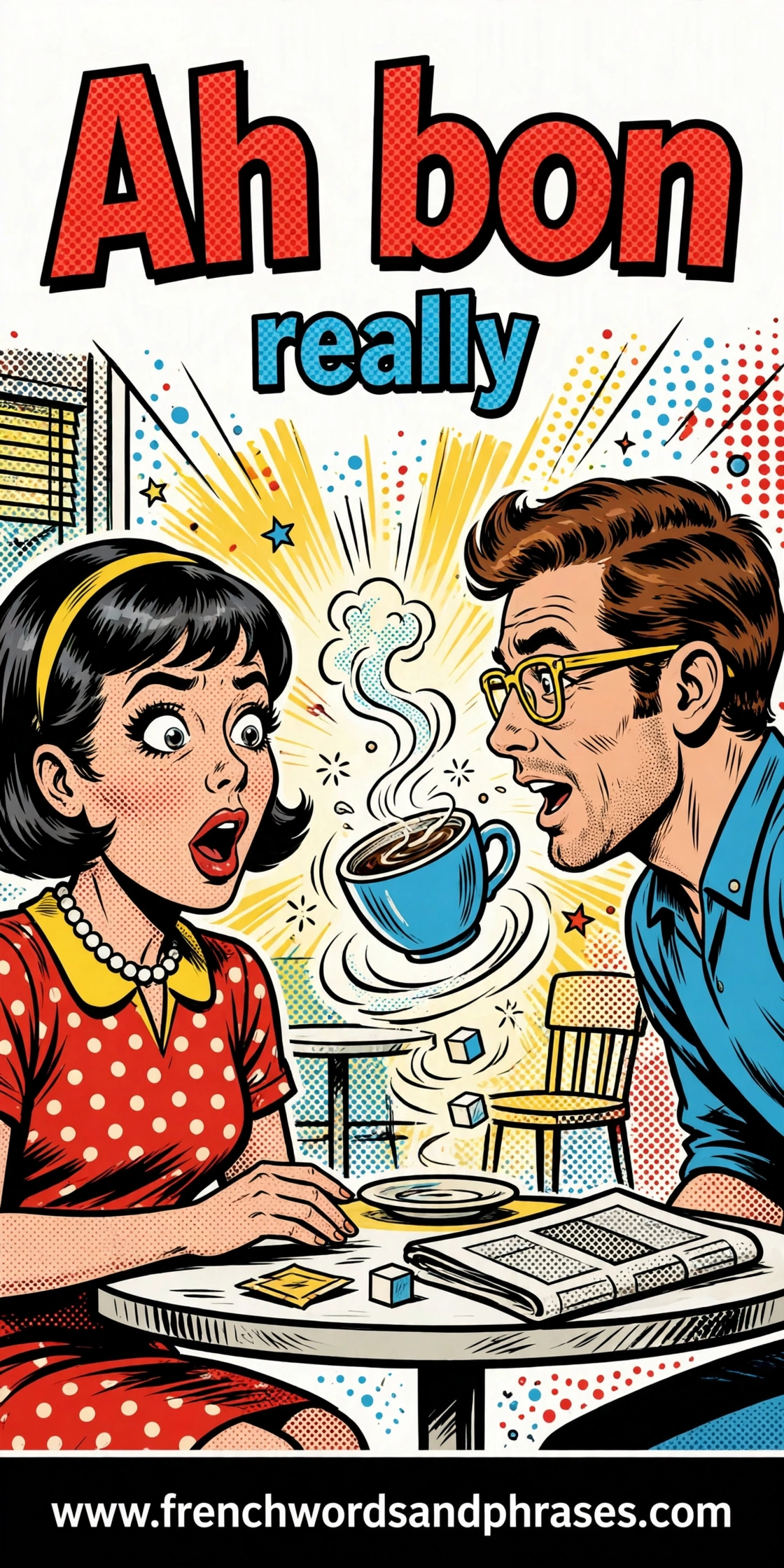
A French Word to Live By
Translate Ah bon to English
/a bɔ̃/
Ah bon means really?.
Two neighbours meet by the bakery door, and one announces that the old cinema is reopening next month. The other raises her eyebrows: « Ah bon ? Je ne savais pas ! » Really? I did not know! Ah bon is the small, polite gasp of French conversation — the sound of new information landing. Said with a rising voice, it asks for more; said flatly, it can quietly doubt what it just heard.
Let’s explore how ah bon works in French, beginning with the whole reaction on one card.
Understanding the French Interjection Ah bon
Ah bon is a French interjection built from ah + bon (good) — a two-word reaction, not an adjective phrase here. Its job is conversational: it marks surprise at news, invites the speaker to continue, and keeps the exchange flowing without interrupting.
It means really? — but its range is wide. With warm, rising intonation it is genuine surprise and interest: oh really, tell me more. Flattened and slowed down, it becomes sceptical: oh, is that so? The words are a question, but the real message is written by the voice.
Type: Interjection — reaction (surprise / interest)
Answers the need: Reacting to news — showing surprise, interest, or polite doubt
Register: Neutral and polite — safe in every conversation
Strength: Gentle — the softest surprise on the shelf
One important usage detail: ah bon rarely stands as the whole conversation. It is a stepping stone — it begs a follow-up, and a French speaker who hears « ah bon ? » will almost always add details. Dropping it after someone’s big news and saying nothing more can feel strangely cold.
Experience the Word
Ah bon is the hinge of French small talk — two small words that keep a story moving.
Imagine a grandfather hearing that his granddaughter has been picked for the school play: « Ah bon ? C’est merveilleux ! » His surprise is real, but so is the invitation: tell me everything.
You have not added any information at all. You have told the speaker: I am listening, go on.
How to Use Ah bon in French: Complete Guide
Let’s explore how ah bon works in French, beginning with the whole reaction on one card.
Ah bon at a Glance
The Whole Reaction on One Card
Meaning, job, register and strength — ah bon in four lines.
| Point | Ah bon |
|---|---|
| Meaning | really? / oh, I see — set by tone |
| Job | reacts to news and invites the speaker to continue |
| Register | neutral and polite — welcome everywhere |
| Strength | gentle: mild surprise, never shock |
Example
Ah bon ? Tu pars demain ?
Really? You are leaving tomorrow?
When You Say It: The Trigger Moments
Ah bon fires whenever information arrives — a fact, a plan, a piece of gossip.
| Situation | Example |
|---|---|
| Hearing news | ah bon ? je ne savais pas — really? I did not know |
| A surprising fact | ah bon, il a démissionné ? — oh really, he resigned? |
| Polite interest | ah bon ? et ensuite ? — really? and then what? |
| Gentle doubt | ah bon… c’est bizarre — oh… that is odd |
| Learning something small | ah bon, le magasin ferme à sept heures — oh, the shop closes at seven |
Example
Ah bon ? Elle a gagné le concours ?
Really? She won the competition?
Quick Quiz 1
What does a French speaker usually do right after hearing ah bon ?
Reveal the answer
They add details — ah bon is an invitation to continue, not a full stop.
Ah bon ? Raconte-moi !
Really? Tell me everything!
The Reaction Question: A Rising Voice or a Flat One
Ah bon is written with a question mark for a reason — the delivery turns it from interest into doubt.
| Delivery | What it does |
|---|---|
| Rising voice + ? | genuine surprise and interest — ‘really? tell me more’ |
| Warm and quick | friendly encouragement to keep talking |
| Flat and slow | scepticism — ‘oh, is that so?’ |
| Repeated: ah bon, ah bon | taking the news in, nodding along |
| Followed by silence | the coldest version — polite but unconvinced |
Example
Ah bon… tu es sûr de ça ?
Oh really… are you sure about that?
Where It Goes: Mid-Conversation, Never Alone for Long
Ah bon lives inside conversations — it opens a door and waits for the other person to walk through.
| Position / pattern | Example |
|---|---|
| Answering news | — Je déménage en juin. — Ah bon ? — I am moving in June. — Really? |
| Before a question | ah bon ? et pourquoi ? — really? and why? |
| With a follow-up phrase | ah bon, je ne savais pas — oh, I did not know |
| Doubled for warmth | ah bon, ah bon, d’accord — oh I see, I see, okay |
Example
Ah bon ? Depuis quand ?
Really? Since when?
Quick Quiz 2
How does a flat, slow ah bon… differ from a bright, rising one?
Reveal the answer
The flat one doubts — it means ‘oh, is that so?’ rather than ‘tell me more’.
Ah bon… moi, je n’y crois pas trop.
Oh really… me, I do not quite believe it.
Everyday Expressions with Ah bon
Ah bon pairs with these short follow-ups — together they make the classic sound of French conversation.
| Expression | In English |
|---|---|
| ah bon ? je ne savais pas | really? I did not know |
| ah bon, d’accord | oh, okay then |
| ah bon ? et alors ? | really? and so? |
| ah bon, c’est intéressant | oh, that is interesting |
| ah bon ? vraiment ? | really? honestly? |
Example
Ah bon ? Vraiment ? C’est une super nouvelle !
Really? Honestly? That is great news!
Close Cousins: The Other Listening Reactions
French listeners have a whole toolkit of small reactions — ah bon is the surprised one.
| Word | The difference |
|---|---|
| ah bon ? | surprise at news — ‘really?’ |
| ah oui ? | softer, warmer — ‘oh yes?’ often pure politeness |
| vraiment ? | ‘honestly?’ — stronger surprise, asks for confirmation |
| c’est vrai ? | ‘is that true?’ — checks the fact itself |
| ah bon | also just ‘oh, I see’ — understanding, no surprise |
Example
Vraiment ? Tu as parlé au directeur ?
Honestly? You spoke to the manager?
Quick Quiz 3
Which cousin asks whether the fact itself is true — ah bon or c’est vrai ?
Reveal the answer
c’est vrai ? — it questions the fact, while ah bon reacts to it.
C’est vrai ? Il neige déjà ?
Is that true? It is already snowing?
Ah bon and Its Neighbours
The listening shelf: from simple acknowledgement to real astonishment.
| French | In English |
|---|---|
| d’accord | okay (agreement, no surprise) |
| ah oui | oh yes (warm acknowledgement) |
| ah bon | really? (surprise, interest) |
| vraiment ? | honestly? (stronger surprise) |
| oh là là | wow / oh dear (full emotion) |
Example
Ah bon ? Oh là là, quelle histoire !
Really? Oh wow, what a story!
Watch Out: The Traps Around Ah bon
The traps: reading it word by word, and using the flat version by accident.
| Trap | The truth |
|---|---|
| translating as ‘ah good’ | bon adds nothing literal here — the pair means ‘really?’ |
| a flat tone by accident | a slow, flat ah bon sounds doubtful — keep it rising for warmth |
| answering it with ‘oui’ and stopping | ah bon begs for details — add a sentence or two |
| using it at grave news | at sad news, oh là là or je suis désolé carries more heart |
Example
Ah bon ? Je suis content pour toi !
Really? I am happy for you!
Quick Quiz 4
True or false: ah bon is a complete reply that ends a conversation.
Reveal the answer
False — it is a stepping stone that invites the speaker to say more.
Ah bon ? Et comment ça s’est passé ?
Really? And how did it go?
Ah bon in Everyday French: Real-Life Examples
Now that you know the word, let’s see how ah bon appears in everyday French.
Example Example 1 — News
Ah bon ? Le musée est gratuit le dimanche ?
Really? The museum is free on Sundays?
Example Example 2 — A move
Ah bon, tu déménages à Lyon ?
Oh really, you are moving to Lyon?
Example Example 3 — Small talk
Ah bon ? Et ton frère, il va bien ?
Really? And your brother, is he well?
Example Example 4 — Doubt
Ah bon… moi, je trouve ça étrange.
Oh… me, I find that strange.
Example Example 5 — At work
Ah bon ? La réunion est annulée ?
Really? The meeting is cancelled?
Example Example 6 — Learning
Ah bon, ce mot veut dire ‘lentement’ ?
Oh, this word means ‘slowly’?
Beyond Translation: The Meaning of Ah bon
Every language needs a word that means keep talking, I am with you — and in French that word is ah bon. It costs the listener almost nothing, yet it does real work: it applauds the storyteller, asks for the next chapter, and turns a monologue into a conversation.
To say ah bon is to hold the door open for someone else’s sentence.
That is why its tone matters so much. The same two words can be a warm invitation or a raised eyebrow — French conversation is played on these tiny instruments.
How to Remember the French Interjection Ah bon
Remember it this way: Remember it this way: Ah bon is the polite gasp — surprise with good manners, and always an invitation to continue.
- You keep the voice rising — ah bon ? warm and curious, never flat unless you mean doubt.
- You follow it with interest — a question, a reaction, a raconte-moi.
- You hear bon as padding, not meaning — the pair together simply says really?
The key idea is ah bon means really?, its rising tone shows interest, and it always invites the speaker to say more.
Test Your Knowledge of Ah bon
Let’s see how much you’ve learned. Try answering these questions before revealing the answers.
Question 1
What does ah bon mean?
Reveal the answer
Really? — surprise and interest at news, or ‘oh, I see’.
Question 2
What does a flat, slow ah bon suggest?
Reveal the answer
Doubt — ‘oh, is that so?’ rather than warm interest.
Question 3
Translate: Really? I did not know!
Reveal the answer
Ah bon ? Je ne savais pas !
Question 4
What should you do after someone says ah bon to your news?
Reveal the answer
Add details — ah bon is an invitation to continue, not a full stop.
Question 5
Complete the sentence:
— Je pars en vacances demain. — ______ ? Quelle chance ! (Really? How lucky!)
Reveal the answer
Ah bon
Ah bon ? Quelle chance !
Really? How lucky!
Your Final Challenge
Can You Use It?
How would you say this in French?
“How would you say this in French?”
Reveal the answer
Ah bon ? Je ne savais pas !
Really? I did not know!
A little French. A little curiosity. A richer everyday life.
LEARN FRENCH ONE WORD AT A TIME




