A French Word to Live By
How to Conjugate Affermir in French
/a.fɛʁ.miʁ/
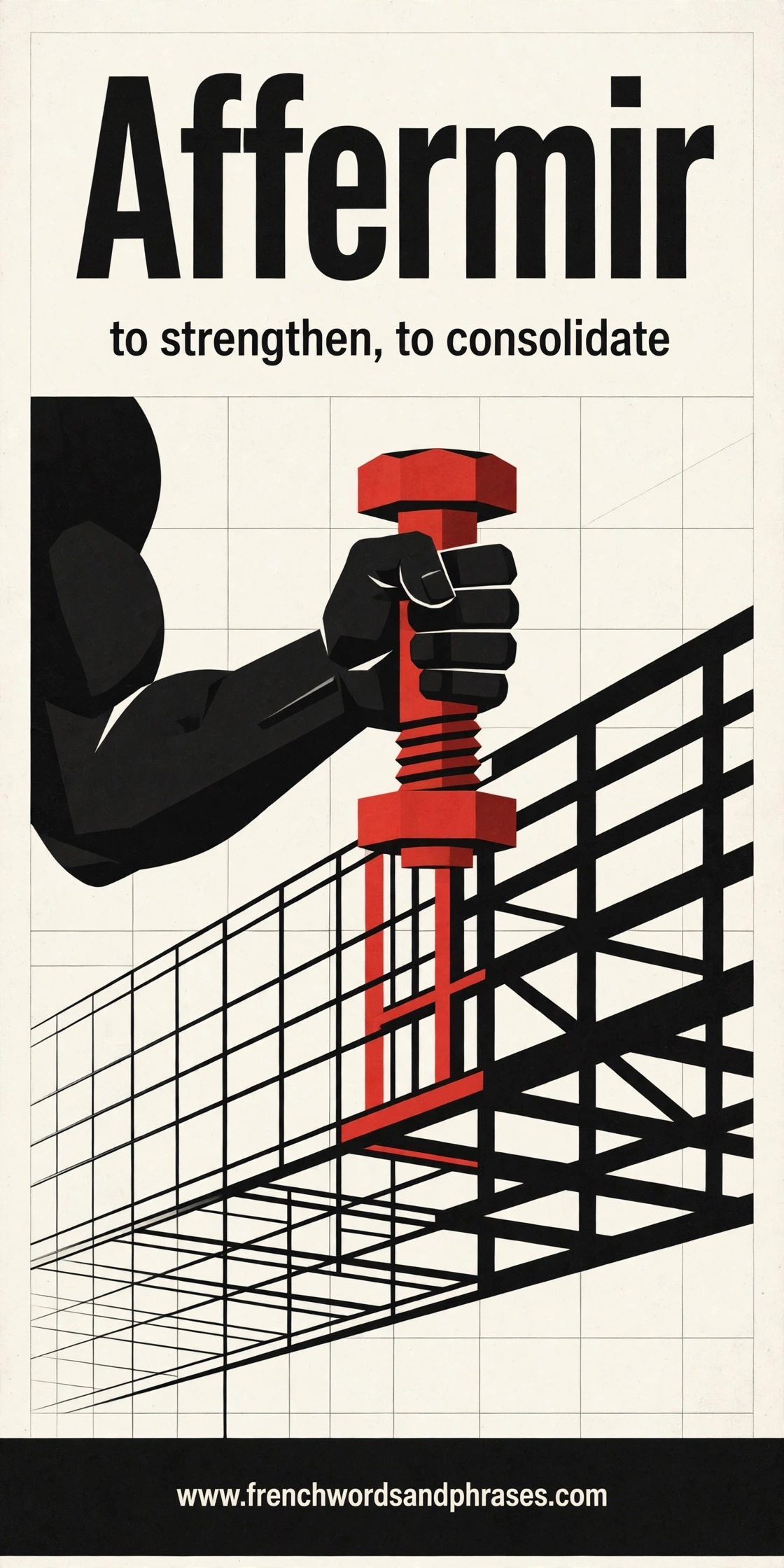
Affermir means to strengthen, to consolidate — to make something firm: a wall, a muscle, a currency, or a king’s hold on power.
A mason wedging props against a cracked wall, a gymnast’s hand gripping the bar without a tremor, a new king securing his throne — affermir is the verb of making firm, in stone, in flesh and in politics alike.
In this guide, you’ll learn how to conjugate affermir in all the major French tenses and moods. Explore complete conjugation tables, French examples, English translations, and practice quizzes.
Understanding the French Verb Affermir
Affermir is a regular French verb belonging to the second group of verbs, those ending in -ir.
It means to strengthen, to consolidate. It works at every scale: builders affermissent walls and dykes, exercise affermit muscles and skin, victories affermissent a leader’s authority, and sound policy affermit a currency. Wherever something shaky becomes solid, affermir is the verb French reaches for.
Verb classification: Second group (-ir)
Auxiliary verb: Avoir
Past participle: affermi
Present participle: affermissant
English equivalents: To strengthen, to consolidate, to firm up; affermir un mur — to strengthen a wall; affermir son autorité — to consolidate one’s authority; affermir les muscles — to firm up the muscles; affermir sa position — to strengthen one’s position.
One important detail: affermir is a regular second-group verb in -ir, like finir: j’affermis, nous affermissons, ils affermissent, past participle affermi. Its heart is the adjective ferme, firm — affermir is simply to make firm. Keep it apart from affermer (to lease out a farm): affermir strengthens the wall of the farmhouse, affermer rents out its fields.
Experience the Word
Affermir is the verb of firmness won — nothing here is born solid; everything is made solid, by work, by training or by time.
Imagine a young gymnast at her first competition. A year ago her arms shook on the bar; a winter of training a affermi her grip, her shoulders, her nerve. Today the hand that takes the bar does not tremble at all.
Nothing about her was firm by nature. It has been strengthened — affermi, rep by rep, all winter long.
How to Conjugate Affermir: Complete French Conjugation Guide
Let’s explore every major conjugation of affermir, beginning with the indicative mood.
How to Conjugate Affermir in the Indicative Mood
The indicative mood is used to express facts, observations, actions, and events.
How to Conjugate Affermir in the Present Tense (Présent)
Used for actions happening now, habitual actions, and general truths.
| Subject | Conjugation |
|---|---|
| je | affermis |
| tu | affermis |
| il / elle | affermit |
| nous | affermissons |
| vous | affermissez |
| ils / elles | affermissent |
L’exercice affermit les muscles du dos.
Exercise strengthens the back muscles.
Quick Quiz 1
Complete the sentence:
Nous ______ la digue avant la tempête.
Reveal the answer
affermissons
Nous affermissons la digue avant la tempête.
We are strengthening the dyke before the storm.
How to Conjugate Affermir in the Passé Composé
Used for completed actions in the past. Affermir takes the auxiliary verb avoir.
| Subject | Conjugation |
|---|---|
| j’ | ai affermi |
| tu | as affermi |
| il / elle | a affermi |
| nous | avons affermi |
| vous | avez affermi |
| ils / elles | ont affermi |
Example
Cette victoire a affermi son autorité.
This victory consolidated his authority.
How to Conjugate Affermir in the Imparfait (Imperfect Tense)
Used for habitual past actions, descriptions, and ongoing situations in the past.
| Subject | Conjugation |
|---|---|
| je | affermissais |
| tu | affermissais |
| il / elle | affermissait |
| nous | affermissions |
| vous | affermissiez |
| ils / elles | affermissaient |
Example
Le maçon affermissait le mur avec des étais.
The mason used to shore up the wall with props.
Quick Quiz 2
Choose the correct form:
This victory consolidated his authority.
Cette victoire ______ son autorité. (a affermi / est affermi)
Reveal the answer
a affermi
Cette victoire a affermi son autorité.
Affermir takes avoir.
How to Conjugate Affermir in the Plus-que-parfait
Used to describe an action that had already been completed before another past event.
| Subject | Conjugation |
|---|---|
| j’ | avais affermi |
| tu | avais affermi |
| il / elle | avait affermi |
| nous | avions affermi |
| vous | aviez affermi |
| ils / elles | avaient affermi |
Example
Ils avaient affermi la digue avant la tempête.
They had strengthened the dyke before the storm.
How to Conjugate Affermir in the Passé Simple
Primarily used in formal writing, literature, and historical narratives. It is rarely used in everyday conversation.
| Subject | Conjugation |
|---|---|
| je | affermis |
| tu | affermis |
| il / elle | affermit |
| nous | affermîmes |
| vous | affermîtes |
| ils / elles | affermirent |
Example
Le nouveau roi affermit son pouvoir en dix ans.
The new king consolidated his power in ten years.
How to Conjugate Affermir in the Passé Antérieur
A literary tense used to express an action completed immediately before another past action, generally in the passé simple.
| Subject | Conjugation |
|---|---|
| j’ | eus affermi |
| tu | eus affermi |
| il / elle | eut affermi |
| nous | eûmes affermi |
| vous | eûtes affermi |
| ils / elles | eurent affermi |
Example
Quand il eut affermi sa position, il annonça la réforme.
When he had strengthened his position, he announced the reform.
How to Conjugate Affermir in the Future Tense (Futur Simple)
Used to describe actions that will take place in the future.
| Subject | Conjugation |
|---|---|
| je | affermirai |
| tu | affermiras |
| il / elle | affermira |
| nous | affermirons |
| vous | affermirez |
| ils / elles | affermiront |
Example
Ces mesures affermiront la monnaie.
These measures will strengthen the currency.
How to Conjugate Affermir in the Futur Antérieur (Future Perfect)
Used for an action that will have been completed before a particular point in the future.
| Subject | Conjugation |
|---|---|
| j’ | aurai affermi |
| tu | auras affermi |
| il / elle | aura affermi |
| nous | aurons affermi |
| vous | aurez affermi |
| ils / elles | auront affermi |
Example
À la fin du chantier, on aura affermi toutes les fondations.
By the end of the works, all the foundations will have been strengthened.
How to Conjugate Affermir in the Near Future (Futur Proche)
Used to describe something that is going to happen soon. Formed with aller + infinitive.
| Subject | Conjugation |
|---|---|
| je | vais affermir |
| tu | vas affermir |
| il / elle | va affermir |
| nous | allons affermir |
| vous | allez affermir |
| ils / elles | vont affermir |
Example
Ce traitement va affermir ta peau.
This treatment is going to firm up your skin.
How to Conjugate Affermir in the Conditional Mood
The conditional mood expresses what would happen under certain circumstances. It is also frequently used to make polite requests or express wishes.
How to Conjugate Affermir in the Present Conditional
| Subject | Conjugation |
|---|---|
| je | affermirais |
| tu | affermirais |
| il / elle | affermirait |
| nous | affermirions |
| vous | affermiriez |
| ils / elles | affermiraient |
Example
Plus de sport affermirait ton corps.
More sport would firm up your body.
How to Conjugate Affermir in the Past Conditional
| Subject | Conjugation |
|---|---|
| j’ | aurais affermi |
| tu | aurais affermi |
| il / elle | aurait affermi |
| nous | aurions affermi |
| vous | auriez affermi |
| ils / elles | auraient affermi |
Example
Sans ces travaux, rien n’aurait affermi la falaise.
Without these works, nothing would have strengthened the cliff.
Affermir in the Literary Past Conditional Form
This less common literary form uses the imperfect subjunctive of avoir.
| Subject | Conjugation |
|---|---|
| j’ | eusse affermi |
| tu | eusses affermi |
| il / elle | eût affermi |
| nous | eussions affermi |
| vous | eussiez affermi |
| ils / elles | eussent affermi |
Example
Il eût affermi son trône par des alliances.
He would have consolidated his throne through alliances.
How to Conjugate Affermir in the Subjunctive Mood
The subjunctive is used to express wishes, emotions, doubts, necessity, and uncertainty. It frequently follows expressions such as il faut que (it is necessary that) or bien que (although).
How to Conjugate Affermir in the Present Subjunctive
| Subject | Conjugation |
|---|---|
| que je | affermisse |
| que tu | affermisses |
| qu’il / qu’elle | affermisse |
| que nous | affermissions |
| que vous | affermissiez |
| qu’ils / qu’elles | affermissent |
Example
Il faut que tu affermisses ta prise avant de grimper.
You must firm up your grip before climbing.
Quick Quiz 3
Complete the sentence using the subjunctive:
Il faut que vous ______ les fondations.
Reveal the answer
affermissiez
Il faut que vous affermissiez les fondations.
You must strengthen the foundations.
How to Conjugate Affermir in the Imperfect Subjunctive
A literary tense, rarely encountered in modern spoken French.
| Subject | Conjugation |
|---|---|
| que je | affermisse |
| que tu | affermisses |
| qu’il / qu’elle | affermît |
| que nous | affermissions |
| que vous | affermissiez |
| qu’ils / qu’elles | affermissent |
Example
On voulait que le ciment affermît le mur.
They wanted the cement to strengthen the wall.
How to Conjugate Affermir in the Pluperfect Subjunctive
A literary construction used to express an action completed before another past action.
| Subject | Conjugation |
|---|---|
| que j’ | eusse affermi |
| que tu | eusses affermi |
| qu’il / qu’elle | eût affermi |
| que nous | eussions affermi |
| que vous | eussiez affermi |
| qu’ils / qu’elles | eussent affermi |
Example
On admirait qu’il eût affermi si vite son autorité.
People admired that he had consolidated his authority so quickly.
How to Conjugate Affermir in the Past Subjunctive
| Subject | Conjugation |
|---|---|
| que j’ | aie affermi |
| que tu | aies affermi |
| qu’il / qu’elle | ait affermi |
| que nous | ayons affermi |
| que vous | ayez affermi |
| qu’ils / qu’elles | aient affermi |
Example
Je suis ravi que ce séjour ait affermi votre santé.
I am delighted that this stay strengthened your health.
How to Conjugate Affermir in the Imperative
The imperative is used to give commands, instructions, invitations, or suggestions. Subject pronouns are omitted.
How to Conjugate Affermir in the Present Imperative
| Person | Conjugation |
|---|---|
| (tu) | affermis |
| (nous) | affermissons |
| (vous) | affermissez |
Example
Affermis ton dos, tiens-toi droit !
Firm up your back, stand up straight!
Quick Quiz 4
How would you say Firm up your back (tu form)?
Reveal the answer
Affermis ton dos !
French Participles of Affermir
Participles are verb forms that can be used in compound tenses and other grammatical constructions.
Present Participle of Affermir
affermissant
En affermissant la digue, les ouvriers ont évité l’inondation.
By strengthening the dyke, the workers prevented the flood.
Past Participle of Affermir
affermi
Affermie par l’exercice, sa main ne tremble plus.
Strengthened by exercise, her hand no longer trembles.
Affermir in Everyday French: Real-Life Examples
Now that you know the conjugations, let’s see how affermir appears in everyday French.
Example 1 — Present
L’exercice affermit les muscles.
Exercise strengthens the muscles.
Example 2 — Passé composé
Cette victoire a affermi son autorité.
This victory consolidated his authority.
Example 3 — Imparfait
Le maçon affermissait le mur avec des étais.
The mason used to shore up the wall with props.
Example 4 — Future
Ces mesures affermiront la monnaie.
These measures will strengthen the currency.
Example 5 — Conditional
Plus de sport affermirait ton corps.
More sport would firm up your body.
Example 6 — Imperative
Affermis ton dos, tiens-toi droit !
Firm up your back, stand up straight!
Beyond Translation: The Meaning of Affermir
English to firm up is the exact twin — and shares the root: affermir is built on ferme, firm, the same Latin firmus that gives English its firm and its confirm.
Firmness, in French, is an achievement.
Walls, muscles, currencies and kings are not born firm; they are affermis — by props, by training, by victories — and the verb honours the work.
How to Remember the French Verb Affermir
Remember it this way: Affermir is about the gymnast’s hand on the bar, no longer trembling.
- Built on ferme (firm): affermir is to make firm — a wall, a muscle, an authority.
- Regular -ir like finir: j’affermis, nous affermissons, past participle affermi.
- Not affermer: affermir strengthens the wall, affermer leases the farm.
The key idea is the gymnast’s hand on the bar, no longer trembling.
Test Your Knowledge of Affermir
Let’s see how much you’ve learned. Try answering these questions before revealing the answers.
Question 1
What adjective lives inside affermir?
Reveal the answer
Ferme — firm: affermir is to make firm, whether a wall, a muscle or a throne.
Question 2
How do you say This victory consolidated his authority in French?
Reveal the answer
Cette victoire a affermi son autorité.
Question 3
Translate: Exercise strengthens the back muscles.
Reveal the answer
L’exercice affermit les muscles du dos.
Question 4
What is the past participle of affermir?
Reveal the answer
Affermi.
Question 5
Complete the sentence:
Il faut que tu ______ ta prise avant de grimper.
Reveal the answer
affermisses
Il faut que tu affermisses ta prise avant de grimper.
You must firm up your grip before climbing.
Your Final Challenge
Can You Use It?
How would you say this in French?
Every morning of training strengthened her grip, and on the day of the competition, her hand did not tremble.
Reveal the answer
Chaque matin d’entraînement affermit sa prise, et le jour du concours, sa main n’a pas tremblé.
Every morning of training strengthened her grip, and on the day of the competition, her hand did not tremble.
A little French. A little curiosity. A richer everyday life.
LEARN FRENCH ONE WORD AT A TIME