A French Word to Live By
Translate Adresse to English
/a.dʁɛs/
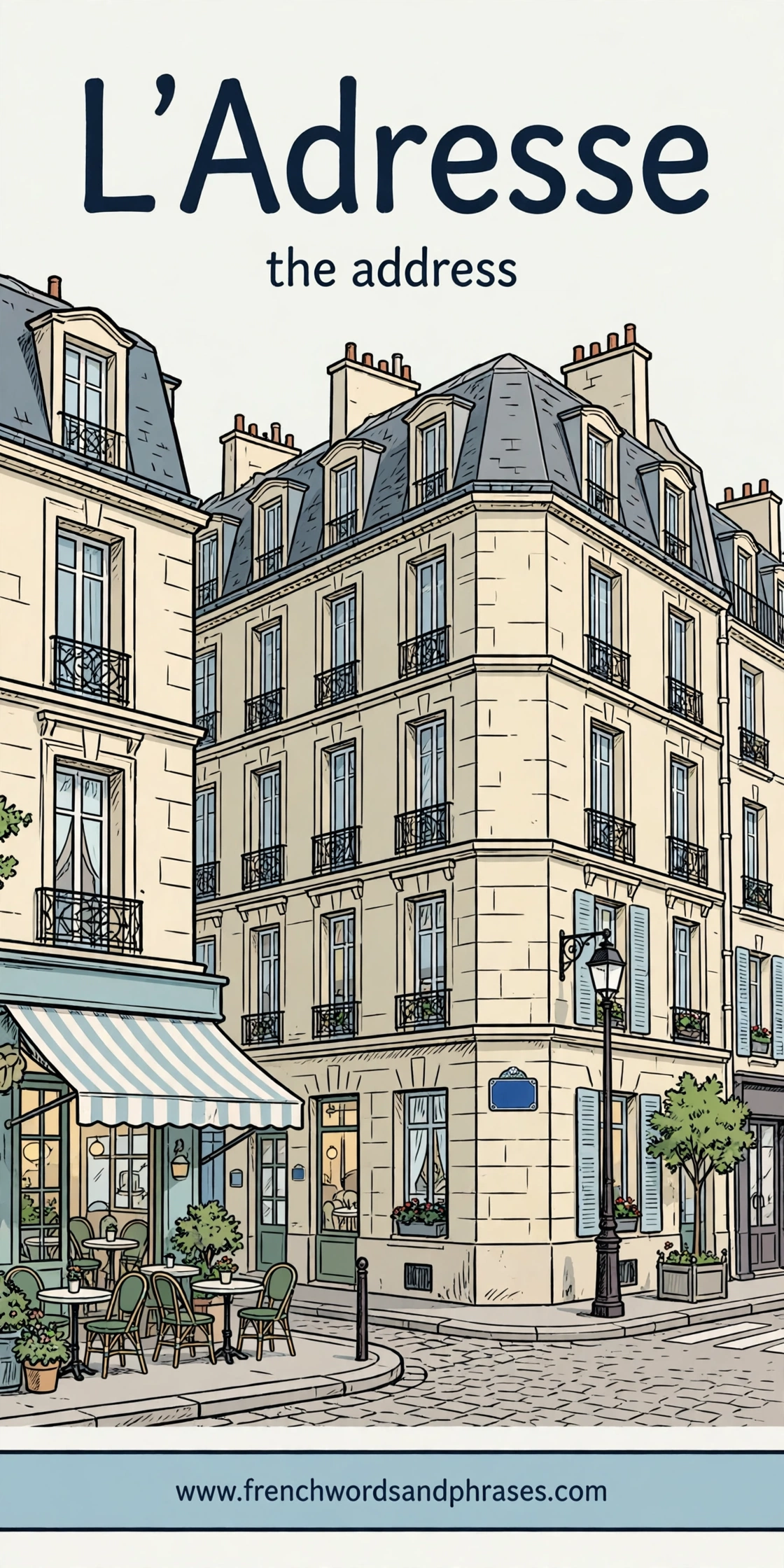
L’Adresse means the address.
The taxi driver leans towards the window and asks the question every journey in France begins with: « L’adresse, s’il vous plaît ! » Before the letter can travel, before the taxi can move, one thing is needed — l’adresse.
In this guide, you’ll learn what adresse means in English, how to use it with its articles, how to form its plural, and how it appears in everyday French. Explore French examples, English translations, and practice quizzes.
Understanding the French Noun Adresse
Adresse is a feminine French noun. It is learned together with its article: l’adresse, une adresse — because it begins with a vowel, la shrinks to l’, and you never hear the two vowels collide.
It means the address — the name, number, street and town that tell the world where a person lives or where a letter must go. In modern life it is just as often virtual: l’adresse e-mail, also called l’adresse électronique. And the word has a second, surprising life: l’adresse is also skill, dexterity — the sureness of a well-aimed hand.
Gender: Feminine
Definite article: l’ — l’adresse (the address)
Indefinite article: une — une adresse (an address)
Plural: les adresses
Vowel start: la becomes l’ — and possessives follow: mon adresse, never « ma adresse »
Second sense: adresse also means skill, dexterity — faire preuve d’adresse, to show skill
English equivalents: The address; an email address.
One expression every visitor to France should steal: une bonne adresse — literally « a good address », it means a good tip, a restaurant or shop worth knowing, the kind of place locals pass on like a secret. When a French friend whispers « je te donne une bonne adresse », treasure it.
Experience the Word
Adresse is more than lines on an envelope. It is the thread that ties a person to a place — the few words that let a letter cross a whole country and knock on exactly the right door.
Imagine the concierge’s lodge in an old Paris building, the facteur sorting the morning post, each envelope carrying its little map: a name, a number, a staircase, a town.
You have not just located a house. You have found your way to someone — the adresse did its quiet work.
How to Use Adresse in French: Complete Guide
Let’s explore how adresse works in French, beginning with its articles — and watch what the opening vowel does to la, ma and cette.
Adresse with the Definite Article (L’, Les)
Adresse begins with a vowel, so la becomes l’ — l’adresse, the address everyone is talking about.
| Form | French |
|---|---|
| Feminine singular | l’adresse |
| Plural | les adresses |
Example
L’adresse sur l’enveloppe est illisible.
The address on the envelope is unreadable.
Adresse with the Indefinite Article (Une, Des)
Used for an address in general — une adresse, an address you are looking for or giving.
| Form | French |
|---|---|
| Feminine singular | une adresse |
| Plural | des adresses |
Example
Elle cherche une adresse dans son carnet.
She is looking for an address in her notebook.
Adresse with Quantities and Parts
Adresse is countable, so French counts and qualifies it — the full address, the wrong address, a brand-new one.
| Form | French |
|---|---|
| One address | une adresse |
| The full address | l’adresse complète |
| A new address | une nouvelle adresse |
| The wrong address | la mauvaise adresse |
| Several addresses | plusieurs adresses |
| An email address | une adresse e-mail |
Example
Donne-moi ton adresse e-mail, je t’envoie les photos.
Give me your email address, I’ll send you the photos.
Quick Quiz 1
Complete the sentence:
______ adresse est écrite sur le papier. (The)
Reveal the answer
L’
L’adresse est écrite sur le papier.
The address is written on the paper — la becomes l’ before a vowel.
The Plural of Adresse
Adresse adds an -s in the plural — les adresses, the addresses in a notebook or a phone.
| Number | French |
|---|---|
| Singular | l’adresse / une adresse |
| Plural | les adresses / des adresses |
Example
Il note toutes les adresses dans un petit carnet.
He writes all the addresses in a little notebook.
Adresse with Possessive Adjectives (Mon, Ton, Son…)
The famous vowel rule: adresse is feminine, but because it starts with a vowel it takes mon, ton, son — never « ma adresse ».
| Owner | French |
|---|---|
| my | mon adresse |
| your (tu) | ton adresse |
| his / her | son adresse |
| our | notre adresse |
| your (vous) | votre adresse |
| their | leur adresse |
Example
Mon adresse e-mail a changé le mois dernier.
My email address changed last month.
Quick Quiz 2
Complete the sentence:
______ adresse est à Lyon. (My)
Reveal the answer
Mon
Mon adresse est à Lyon.
My address is in Lyon — mon, not ma, because adresse begins with a vowel.
Adresse with Demonstrative Adjectives (Cette, Ces)
Used to point at one address in particular — cette adresse, this address.
| Form | French |
|---|---|
| Feminine singular | cette adresse |
| Plural | ces adresses |
Example
Cette adresse n’existe plus, la rue a changé de nom.
This address no longer exists, the street has changed its name.
Adresse with Adjectives
Adjectives agree with adresse — feminine: nouvelle, ancienne, bonne, mauvaise.
| Adjective | With Adresse |
|---|---|
| nouvelle (new) | une nouvelle adresse |
| ancienne (old, former) | une ancienne adresse |
| bonne (good) | une bonne adresse |
| mauvaise (wrong, bad) | une mauvaise adresse |
| complète (full, complete) | l’adresse complète |
| exacte (exact) | l’adresse exacte |
Example
C’est une bonne adresse, ce petit restaurant près de la gare.
It’s a good tip, that little restaurant near the station.
Quick Quiz 3
What does « une bonne adresse » mean in everyday French?
Reveal the answer
A good tip — a place worth knowing: a restaurant, a bakery, a shop that locals recommend.
Je te donne une bonne adresse pour le dîner.
I’ll give you a good tip for dinner.
Everyday Expressions with Adresse
Moving house, emails and good tips — the adresse phrases of daily life.
| Expression | In English |
|---|---|
| changer d’adresse | to change address, to move |
| une bonne adresse | a good tip, a place worth knowing |
| l’adresse e-mail | the email address |
| laisser son adresse | to leave one’s address |
| se tromper d’adresse | to get the wrong address |
| le carnet d’adresses | the address book |
Example
Nous avons changé d’adresse au printemps.
We changed address in the spring.
Words from the Same Family as Adresse
Sending, speaking and receiving — the words that travel with adresse.
| French | In English |
|---|---|
| adresser | to send, to address (a letter, a remark) |
| s’adresser à | to speak to, to apply to |
| le carnet d’adresses | the address book |
| l’adresse électronique | the email address (formal) |
| le destinataire | the recipient |
| l’expéditeur | the sender |
Example
Elle adresse la lettre à sa grand-mère.
She is addressing the letter to her grandmother.
Quick Quiz 4
How do you say « to change address » in French?
Reveal the answer
Changer d’adresse
Ils changent d’adresse le mois prochain.
They are changing address next month.
Adresse in Everyday French: Real-Life Examples
Now that you know the word, let’s see how adresse appears in everyday French.
Example 1 — On the envelope
L’adresse est écrite en haut de la lettre.
The address is written at the top of the letter.
Example 2 — In the taxi
Le chauffeur demande l’adresse au passager.
The driver asks the passenger for the address.
Example 3 — By email
Je t’envoie mon adresse e-mail par message.
I’ll send you my email address by message.
Example 4 — Moving house
Ils ont changé d’adresse et habitent à Nantes.
They have changed address and live in Nantes.
Example 5 — A good tip
Ce café est une bonne adresse, garde-la pour toi.
This café is a good tip, keep it to yourself.
Example 6 — Wrong door
Pardon, je me suis trompé d’adresse.
Sorry, I have got the wrong address.
Beyond Translation: The Meaning of Adresse
Adresse is built on a beautiful idea: directing something towards its target. A letter is directed to a house, words are directed to a listener — s’adresser à quelqu’un — and a skilful hand directs its gesture exactly where it should land, which is why adresse also means dexterity. One word for the map, the message and the steady hand.
To say adresse is to point something — a letter, a word, a gesture — exactly where it should go.
It evokes the handwritten envelope and the concierge’s lodge, the whispered bonne adresse passed between friends, and the modern string of letters and symbols that finds you anywhere on earth in a second.
How to Remember the French Noun Adresse
Remember it this way: Adresse is the address — feminine, and it begins with a vowel, so la steps aside and becomes l’adresse.
- You write it — l’adresse, en haut de l’enveloppe.
- You say my — mon adresse, jamais ma adresse, à cause de la voyelle.
- You hear a tip — une bonne adresse, un restaurant à garder pour soi.
The key idea is l’adresse, mon adresse — the vowel runs the show.
Test Your Knowledge of Adresse
Let’s see how much you’ve learned. Try answering these questions before revealing the answers.
Question 1
Why do we say l’adresse and not la adresse?
Reveal the answer
Because adresse begins with a vowel — la becomes l’ so the two vowels never collide.
Question 2
Is adresse masculine or feminine?
Reveal the answer
Feminine — une adresse, la bonne adresse.
Question 3
Translate: My address has changed.
Reveal the answer
Mon adresse a changé.
Question 4
What is un carnet d’adresses?
Reveal the answer
An address book — the notebook (or phone list) where all the adresses live.
Question 5
Complete the sentence:
Elle laisse ______ adresse à la réception. (her)
Reveal the answer
son
Elle laisse son adresse à la réception.
She is leaving her address at reception — son, because adresse starts with a vowel.
Your Final Challenge
Can You Use It?
How would you say this in French?
“The address is written on the envelope.”
Reveal the answer
L’adresse est écrite sur l’enveloppe.
The address is written on the envelope.
A little French. A little curiosity. A richer everyday life.
LEARN FRENCH ONE WORD AT A TIME