A French Word to Live By
How to Conjugate Aciérer in French
/a.sje.ʁe/
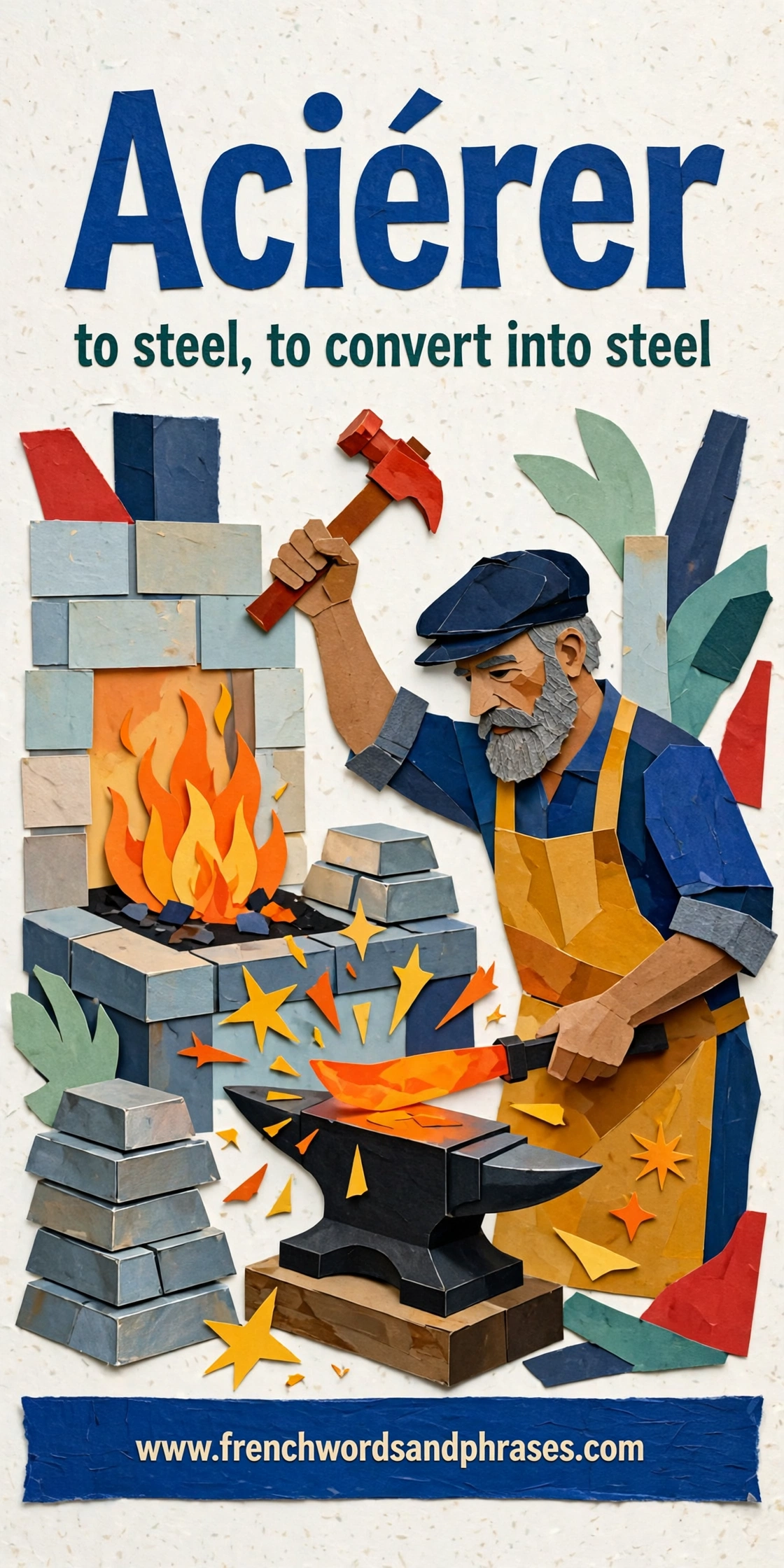
Aciérer means to steel, to convert into steel — to give iron the hardness and edge of steel.
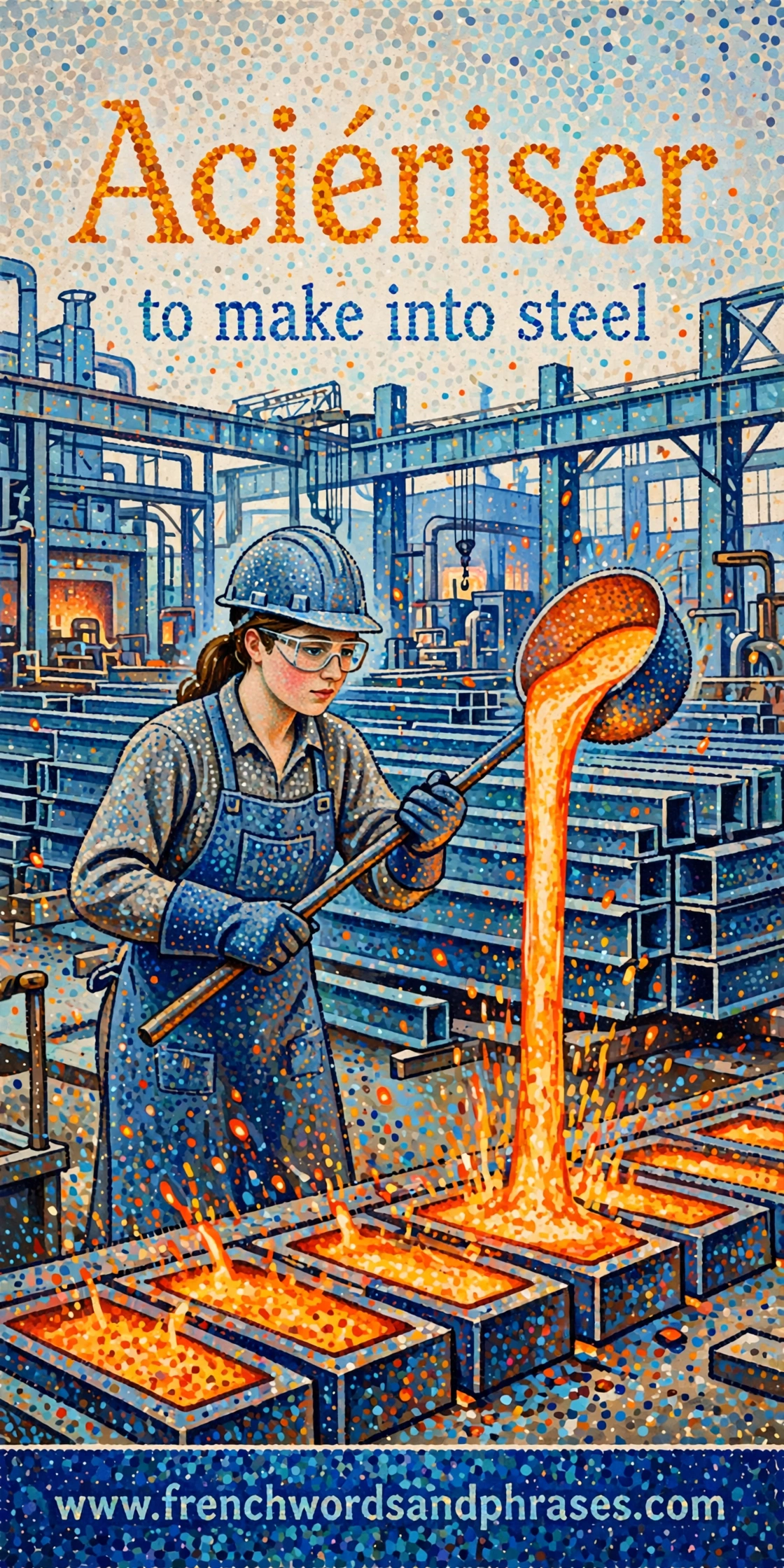
In the forge and the steelworks, iron alone is too soft for a blade that must hold its edge. Aciérer is the craftsman’s verb for turning iron into steel, or facing a tool with steel — a rare, technical word from the hot, exact world of metalwork.
In this guide, you’ll learn how to conjugate aciérer in all the major French tenses and moods. Explore complete conjugation tables, French examples, English translations, and practice quizzes.
Understanding the French Verb Aciérer
Aciérer is a regular French verb belonging to the first group of verbs, those ending in-er.
It means to steel, to convert into steel. Aciérer is a technical verb of metalwork: it means converting iron into steel, and, in the older craftsman’s sense, welding or facing a steel edge onto an iron tool so that the cutting part is steel while the body stays iron. Its near-twin aciériser covers the same industrial ground; aciérer is the older, forge-side word.
Verb classification: First group (-er)
Auxiliary verb: Avoir
Past participle: aciéré
Present participle: aciérant
English equivalents: To steel, to convert into steel, to face with steel; aciérer le fer — to convert iron into steel; aciérer un outil — to steel the edge of a tool; un fer aciéré — steel-faced iron; l’acier — steel, the noun the whole family serves.
One important detail: aciérer is a céder-type verb — the é of the stem opens to è wherever the next syllable is mute: j’acière, tu acières, il acière, ils acièrent, and through the future and conditional: j’acièrerai, j’acièrerais. The é survives where the ending is sounded: nous aciérons, vous aciérez, j’aciérais, and in the infinitive and participle, aciérer, aciéré. The subjunctive splits the same way: que j’acière, but que nous aciérions. The verb belongs to the forge: its object is iron, a blade or a tool.
Experience the Word
Aciérer is the verb of the moment iron grows up — heated, worked and hardened into the metal that cuts.
Imagine a forge in a mountain village a century ago. The smith holds a ploughshare in the coals until it glows, works the steel edge into the iron — il acière le fer — and plunges it hissing into the water trough. What comes out is no longer soft iron: it will bite the earth all spring.
Same shape, new nature. The iron has been steeled — aciéré — and it will hold its edge.
How to Conjugate Aciérer: Complete French Conjugation Guide
Let’s explore every major conjugation of aciérer, beginning with the indicative mood.
How to Conjugate Aciérer in the Indicative Mood
The indicative mood is used to express facts, observations, actions, and events.
How to Conjugate Aciérer in the Present Tense (Présent)
Used for actions happening now, habitual actions, and general truths.
| Subject | Conjugation |
|---|---|
| je | acière |
| tu | acières |
| il / elle | acière |
| nous | aciérons |
| vous | aciérez |
| ils / elles | acièrent |
Example
Le forgeron acière le fer avant de forger la lame.
The blacksmith converts the iron into steel before forging the blade.
Quick Quiz 1
Complete the sentence:
Nous ______ le fer avant de le tremper.
Reveal the answer
aciérons
Nous aciérons le fer avant de le tremper.
We convert the iron into steel before quenching it.
How to Conjugate Aciérer in the Passé Composé
Used for completed actions in the past. Aciérer takes the auxiliary verb avoir.
| Subject | Conjugation |
|---|---|
| j’ | ai aciéré |
| tu | as aciéré |
| il / elle | a aciéré |
| nous | avons aciéré |
| vous | avez aciéré |
| ils / elles | ont aciéré |
Example
L’atelier a aciéré les outils pour la nouvelle saison.
The workshop steeled the tools for the new season.
How to Conjugate Aciérer in the Imparfait (Imperfect Tense)
Used for habitual past actions, descriptions, and ongoing situations in the past.
| Subject | Conjugation |
|---|---|
| je | aciérais |
| tu | aciérais |
| il / elle | aciérait |
| nous | aciérions |
| vous | aciériez |
| ils / elles | aciéraient |
Example
Autrefois, on aciérait les socs de charrue à la forge du village.
In the old days, ploughshares were steeled at the village forge.
Quick Quiz 2
Choose the correct form:
The smith steeled the axe.
Le forgeron ______ la hache. (a aciéré / est aciéré)
Reveal the answer
a aciéré
Le forgeron a aciéré la hache.
Aciérer takes avoir.
How to Conjugate Aciérer in the Plus-que-parfait
Used to describe an action that had already been completed before another past event.
| Subject | Conjugation |
|---|---|
| j’ | avais aciéré |
| tu | avais aciéré |
| il / elle | avait aciéré |
| nous | avions aciéré |
| vous | aviez aciéré |
| ils / elles | avaient aciéré |
Example
Le forgeron avait aciéré la hache avant l’hiver.
The smith had steeled the axe before winter.
How to Conjugate Aciérer in the Passé Simple
Primarily used in formal writing, literature, and historical narratives. It is rarely used in everyday conversation.
| Subject | Conjugation |
|---|---|
| je | aciérai |
| tu | aciéras |
| il / elle | aciéra |
| nous | aciérâmes |
| vous | aciérâtes |
| ils / elles | aciérèrent |
Example
Le maître aciéra le fer dans un feu de charbon de bois.
The master converted the iron into steel over a charcoal fire.
How to Conjugate Aciérer in the Passé Antérieur
A literary tense used to express an action completed immediately before another past action, generally in the passé simple.
| Subject | Conjugation |
|---|---|
| j’ | eus aciéré |
| tu | eus aciéré |
| il / elle | eut aciéré |
| nous | eûmes aciéré |
| vous | eûtes aciéré |
| ils / elles | eurent aciéré |
Example
Quand il eut aciéré le tranchant, il trempa la pièce dans l’eau.
When he had steeled the cutting edge, he quenched the piece in water.
How to Conjugate Aciérer in the Future Tense (Futur Simple)
Used to describe actions that will take place in the future.
| Subject | Conjugation |
|---|---|
| je | acièrerai |
| tu | acièreras |
| il / elle | acièrera |
| nous | acièrerons |
| vous | acièrerez |
| ils / elles | acièreront |
Example
Demain, l’ouvrier acièrera les burins de l’atelier.
Tomorrow, the worker will steel the workshop’s chisels.
How to Conjugate Aciérer in the Futur Antérieur (Future Perfect)
Used for an action that will have been completed before a particular point in the future.
| Subject | Conjugation |
|---|---|
| j’ | aurai aciéré |
| tu | auras aciéré |
| il / elle | aura aciéré |
| nous | aurons aciéré |
| vous | aurez aciéré |
| ils / elles | auront aciéré |
Example
À midi, le forgeron aura aciéré les trois lames commandées.
By noon, the blacksmith will have steeled the three ordered blades.
How to Conjugate Aciérer in the Near Future (Futur Proche)
Used to describe something that is going to happen soon. Formed with aller + infinitive.
| Subject | Conjugation |
|---|---|
| je | vais aciérer |
| tu | vas aciérer |
| il / elle | va aciérer |
| nous | allons aciérer |
| vous | allez aciérer |
| ils / elles | vont aciérer |
Example
Le forgeron va aciérer ce fer pour en faire un couteau.
The blacksmith is going to convert this iron into steel to make a knife of it.
How to Conjugate Aciérer in the Conditional Mood
The conditional mood expresses what would happen under certain circumstances. It is also frequently used to make polite requests or express wishes.
How to Conjugate Aciérer in the Present Conditional
| Subject | Conjugation |
|---|---|
| je | acièrerais |
| tu | acièrerais |
| il / elle | acièrerait |
| nous | acièrerions |
| vous | acièreriez |
| ils / elles | acièreraient |
Example
Avec un meilleur charbon, il acièrerait le fer plus vite.
With better coal, he would steel the iron faster.
How to Conjugate Aciérer in the Past Conditional
| Subject | Conjugation |
|---|---|
| j’ | aurais aciéré |
| tu | aurais aciéré |
| il / elle | aurait aciéré |
| nous | aurions aciéré |
| vous | auriez aciéré |
| ils / elles | auraient aciéré |
Example
Elle aurait aciéré la lame si la forge avait été chaude.
She would have steeled the blade if the forge had been hot.
Aciérer in the Literary Past Conditional Form
This less common literary form uses the imperfect subjunctive of avoir.
| Subject | Conjugation |
|---|---|
| j’ | eusse aciéré |
| tu | eusses aciéré |
| il / elle | eût aciéré |
| nous | eussions aciéré |
| vous | eussiez aciéré |
| ils / elles | eussent aciéré |
Example
Le forgeron eût aciéré le soc avant les labours sans la panne.
The blacksmith would have steeled the ploughshare before the ploughing without the breakdown.
How to Conjugate Aciérer in the Subjunctive Mood
The subjunctive is used to express wishes, emotions, doubts, necessity, and uncertainty. It frequently follows expressions such as il faut que (it is necessary that) or bien que (although).
How to Conjugate Aciérer in the Present Subjunctive
| Subject | Conjugation |
|---|---|
| que je | acière |
| que tu | acières |
| qu’il / qu’elle | acière |
| que nous | aciérions |
| que vous | aciériez |
| qu’ils / qu’elles | acièrent |
Example
Il faut que l’apprenti acière le fer sous l’œil du maître.
The apprentice must convert the iron into steel under the master’s eye.
Quick Quiz 3
Complete the sentence using the subjunctive:
Il faut que tu ______ ce fer avant midi.
Reveal the answer
acières
Il faut que tu acières ce fer avant midi.
You must convert this iron into steel before noon.
How to Conjugate Aciérer in the Imperfect Subjunctive
A literary tense, rarely encountered in modern spoken French.
| Subject | Conjugation |
|---|---|
| que je | aciérasse |
| que tu | aciérasses |
| qu’il / qu’elle | aciérât |
| que nous | aciérassions |
| que vous | aciérassiez |
| qu’ils / qu’elles | aciérassent |
Example
Le maître exigeait que l’ouvrier aciérât le tranchant deux fois.
The master required the worker to steel the edge twice.
How to Conjugate Aciérer in the Pluperfect Subjunctive
A literary construction used to express an action completed before another past action.
| Subject | Conjugation |
|---|---|
| que j’ | eusse aciéré |
| que tu | eusses aciéré |
| qu’il / qu’elle | eût aciéré |
| que nous | eussions aciéré |
| que vous | eussiez aciéré |
| qu’ils / qu’elles | eussent aciéré |
Example
On racontait qu’il eût aciéré les épées de tout le comté.
People said he had steeled the swords of the whole county.
How to Conjugate Aciérer in the Past Subjunctive
| Subject | Conjugation |
|---|---|
| que j’ | aie aciéré |
| que tu | aies aciéré |
| qu’il / qu’elle | ait aciéré |
| que nous | ayons aciéré |
| que vous | ayez aciéré |
| qu’ils / qu’elles | aient aciéré |
Example
Je suis content que le forgeron ait aciéré ma hache.
I am glad the blacksmith steeled my axe.
How to Conjugate Aciérer in the Imperative
The imperative is used to give commands, instructions, invitations, or suggestions. Subject pronouns are omitted.
How to Conjugate Aciérer in the Present Imperative
| Person | Conjugation |
|---|---|
| (tu) | acière |
| (nous) | aciérons |
| (vous) | aciérez |
Example
Acière ce fer, puis trempe-le aussitôt !
Steel this iron, then quench it at once!
Quick Quiz 4
How would you say Steel this iron (tu form)?
Reveal the answer
Acière ce fer !
French Participles of Aciérer
Participles are verb forms that can be used in compound tenses and other grammatical constructions.
Present Participle of Aciérer
aciérant
En aciérant le fer, le forgeron lui donne son tranchant.
By converting iron into steel, the blacksmith gives it its edge.
Past Participle of Aciérer
aciéré
Aciéré à la forge, le soc labourera dix printemps.
Steeled at the forge, the ploughshare will plough for ten springs.
Aciérer in Everyday French: Real-Life Examples
Now that you know the conjugations, let’s see how aciérer appears in everyday French.
Example 1 — Present
Le forgeron acière le fer à la forge.
The blacksmith converts iron into steel at the forge.
Example 2 — Passé composé
Il a aciéré les outils de l’atelier.
He steeled the workshop tools.
Example 3 — Imparfait
On aciérait les lames avant l’hiver.
Blades used to be steeled before winter.
Example 4 — Future
L’ouvrier acièrera les burins demain.
The worker will steel the chisels tomorrow.
Example 5 — Conditional
Avec un feu plus vif, elle acièrerait plus vite.
With a livelier fire, she would steel faster.
Example 6 — Imperative
Aciérez le tranchant, puis trempez la pièce !
Steel the edge, then quench the piece!
Beyond Translation: The Meaning of Aciérer
French aciérer is built on acier, steel — itself from Latin acies, the edge or point of a weapon.
The verb that gives iron its edge.
English to steel works the same way as a noun turned verb, and even keeps the figurative path — to steel oneself. French keeps aciérer at the forge, sober and technical, and does its steeling of hearts with other words.
How to Remember the French Verb Aciérer
Remember it this way: Aciérer is about the smith at the forge — iron going in, steel coming out.
- Céder-type spelling: j’acière with è, but nous aciérons with é — and j’acièrerai through the future.
- Built on acier, steel: aciérer is what the forge does to iron.
- Technical and sober: its objects are le fer, une lame, un outil — iron, blades and tools.
The key idea is the smith at the forge — iron going in, steel coming out.
Test Your Knowledge of Aciérer
Let’s see how much you’ve learned. Try answering these questions before revealing the answers.
Question 1
Why does j’acière have a grave accent but nous aciérons an acute one?
Reveal the answer
The céder-type rule — é becomes è before a mute syllable (j’acière), and stays é where the ending is sounded (nous aciérons).
Question 2
How do you say The blacksmith converts the iron into steel in French?
Reveal the answer
Le forgeron acière le fer.
Question 3
Translate: He steeled the workshop tools.
Reveal the answer
Il a aciéré les outils de l’atelier.
Question 4
What is the past participle of aciérer?
Reveal the answer
Aciéré.
Question 5
Complete the sentence:
Il faut que l’apprenti ______ le fer sous l’œil du maître.
Reveal the answer
acière
Il faut que l’apprenti acière le fer sous l’œil du maître.
The apprentice must convert the iron into steel under the master’s eye.
Your Final Challenge
Can You Use It?
How would you say this in French?
At the village forge, the iron glows red, then the master steels it for the ploughing season.
Reveal the answer
À la forge du village, le fer rougit, puis le maître l’acière pour la saison des labours.
At the village forge, the iron glows red, then the master steels it for the ploughing season.
A little French. A little curiosity. A richer everyday life.
LEARN FRENCH ONE WORD AT A TIME