A French Word to Live By
How to Conjugate Acheter in French
/aʃ.te/
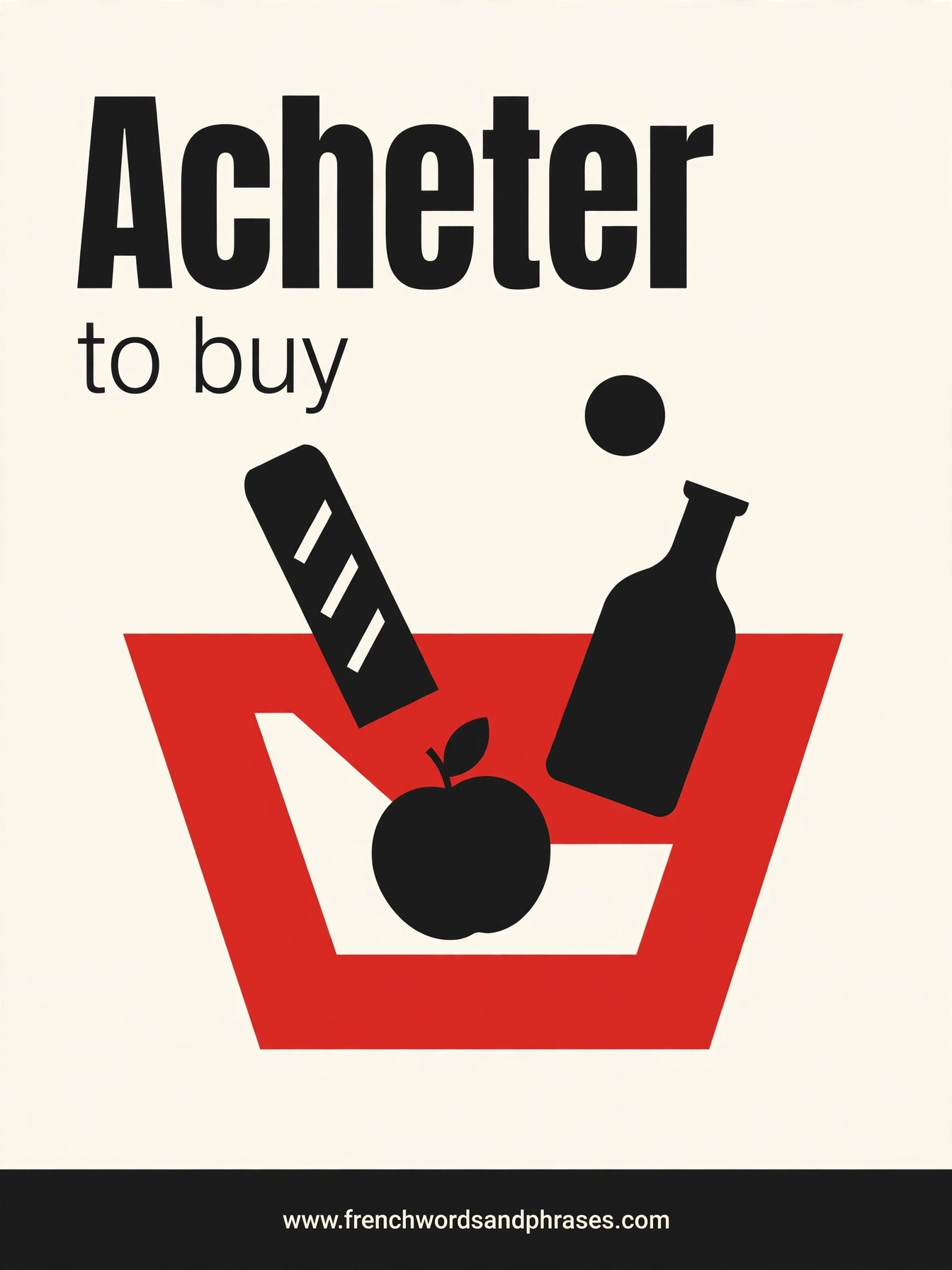
Acheter means to buy — the everyday verb of markets, bakeries and bookshops, of everything that changes hands for money.
A woman choosing peaches at a market stall, a boy counting his coins outside a bakery, a couple signing for a house they have dreamed about for years — acheter is the verb of buying in all its forms: the daily loaf and the once-in-a-lifetime purchase alike.
In this guide, you’ll learn how to conjugate acheter in all the major French tenses and moods. Explore complete conjugation tables, French examples, English translations, and practice quizzes.
Understanding the French Verb Acheter
Acheter is a regular French verb belonging to the first group of verbs, those ending in-er.
It means to buy. It is the standard verb of every transaction, from acheter du pain to acheter une entreprise, and it works at every register — the market stall and the boardroom alike. Its natural partner is vendre, to sell: every acheteur needs a vendeur, and the two verbs frame the whole of French shopping.
Verb classification: First group (-er)
Auxiliary verb: Avoir
Past participle: acheté
Present participle: achetant
English equivalents: To buy, to purchase; acheter quelque chose à quelqu’un — to buy something for someone (or from someone); acheter en ligne — to buy online; acheter comptant — to pay cash; un acheteur — a buyer.
One important detail: acheter changes its stem vowel where the ending goes quiet. The é of the infinitive opens to è in the present singular and third plural — j’achète, tu achètes, il achète, ils achètent — and through the whole future and conditional: j’achèterai, j’achèterais. Where the ending is sounded, é stays: nous achetons, vous achetez, j’achetais, en achetant. The subjunctive splits the same way: que j’achète, but que nous achetions. Watch the à as well: acheter quelque chose à quelqu’un usually means buying it for that person — il achète des fleurs à sa mère, he buys flowers for his mother.
Experience the Word
Acheter is the verb of the exchanged coin — desire on one side, money on the other, and something carried home.
Imagine a Saturday market in a small French town. Madame Fabre tastes a sliver of cheese, nods once, and the decision is made: elle achète — a quarter of this, a dozen of those — performing the small ceremony that French markets have repeated, stall by stall, for a thousand years.
The bag is full, the coins are gone. She has bought — acheté, chosen, carried home.
How to Conjugate Acheter: Complete French Conjugation Guide
Let’s explore every major conjugation of acheter, beginning with the indicative mood.
How to Conjugate Acheter in the Indicative Mood
The indicative mood is used to express facts, observations, actions, and events.
How to Conjugate Acheter in the Present Tense (Présent)
Used for actions happening now, habitual actions, and general truths.
| Subject | Conjugation |
|---|---|
| je | achète |
| tu | achètes |
| il / elle | achète |
| nous | achetons |
| vous | achetez |
| ils / elles | achètent |
Example
J’achète du pain frais tous les matins.
I buy fresh bread every morning.
Quick Quiz 1
Complete the sentence:
Nous ______ nos légumes au marché.
Reveal the answer
achetons
Nous achetons nos légumes au marché.
We buy our vegetables at the market.
How to Conjugate Acheter in the Passé Composé
Used for completed actions in the past. Acheter takes the auxiliary verb avoir.
| Subject | Conjugation |
|---|---|
| j’ | ai acheté |
| tu | as acheté |
| il / elle | a acheté |
| nous | avons acheté |
| vous | avez acheté |
| ils / elles | ont acheté |
Example
Elle a acheté une robe rouge pour la fête.
She bought a red dress for the party.
How to Conjugate Acheter in the Imparfait (Imperfect Tense)
Used for habitual past actions, descriptions, and ongoing situations in the past.
| Subject | Conjugation |
|---|---|
| je | achetais |
| tu | achetais |
| il / elle | achetait |
| nous | achetions |
| vous | achetiez |
| ils / elles | achetaient |
Example
Nous achetions nos légumes au marché du village.
We used to buy our vegetables at the village market.
Quick Quiz 2
Choose the correct form:
He bought the tickets in advance.
Il ______ les billets à l’avance. (a acheté / est acheté)
Reveal the answer
a acheté
Il a acheté les billets à l’avance.
Acheter takes avoir.
How to Conjugate Acheter in the Plus-que-parfait
Used to describe an action that had already been completed before another past event.
| Subject | Conjugation |
|---|---|
| j’ | avais acheté |
| tu | avais acheté |
| il / elle | avait acheté |
| nous | avions acheté |
| vous | aviez acheté |
| ils / elles | avaient acheté |
Example
Il avait acheté les billets à l’avance.
He had bought the tickets in advance.
How to Conjugate Acheter in the Passé Simple
Primarily used in formal writing, literature, and historical narratives. It is rarely used in everyday conversation.
| Subject | Conjugation |
|---|---|
| je | achetai |
| tu | achetas |
| il / elle | acheta |
| nous | achetâmes |
| vous | achetâtes |
| ils / elles | achetèrent |
Example
Le roi acheta ce château pour sa fille.
The king bought this castle for his daughter.
How to Conjugate Acheter in the Passé Antérieur
A literary tense used to express an action completed immediately before another past action, generally in the passé simple.
| Subject | Conjugation |
|---|---|
| j’ | eus acheté |
| tu | eus acheté |
| il / elle | eut acheté |
| nous | eûmes acheté |
| vous | eûtes acheté |
| ils / elles | eurent acheté |
Example
Quand elle eut acheté la maison, elle commença les travaux.
When she had bought the house, she began the work on it.
How to Conjugate Acheter in the Future Tense (Futur Simple)
Used to describe actions that will take place in the future.
| Subject | Conjugation |
|---|---|
| je | achèterai |
| tu | achèteras |
| il / elle | achètera |
| nous | achèterons |
| vous | achèterez |
| ils / elles | achèteront |
Example
J’achèterai une voiture l’année prochaine.
I will buy a car next year.
How to Conjugate Acheter in the Futur Antérieur (Future Perfect)
Used for an action that will have been completed before a particular point in the future.
| Subject | Conjugation |
|---|---|
| j’ | aurai acheté |
| tu | auras acheté |
| il / elle | aura acheté |
| nous | aurons acheté |
| vous | aurez acheté |
| ils / elles | auront acheté |
Example
À Noël, nous aurons acheté tous les cadeaux.
By Christmas, we will have bought all the presents.
How to Conjugate Acheter in the Near Future (Futur Proche)
Used to describe something that is going to happen soon. Formed with aller + infinitive.
| Subject | Conjugation |
|---|---|
| je | vais acheter |
| tu | vas acheter |
| il / elle | va acheter |
| nous | allons acheter |
| vous | allez acheter |
| ils / elles | vont acheter |
Example
Tu vas acheter quoi, au marché ?
What are you going to buy at the market?
How to Conjugate Acheter in the Conditional Mood
The conditional mood expresses what would happen under certain circumstances. It is also frequently used to make polite requests or express wishes.
How to Conjugate Acheter in the Present Conditional
| Subject | Conjugation |
|---|---|
| je | achèterais |
| tu | achèterais |
| il / elle | achèterait |
| nous | achèterions |
| vous | achèteriez |
| ils / elles | achèteraient |
Example
J’achèterais cette maison si j’avais l’argent.
I would buy this house if I had the money.
How to Conjugate Acheter in the Past Conditional
| Subject | Conjugation |
|---|---|
| j’ | aurais acheté |
| tu | aurais acheté |
| il / elle | aurait acheté |
| nous | aurions acheté |
| vous | auriez acheté |
| ils / elles | auraient acheté |
Example
Elle aurait acheté le tableau s’il avait été moins cher.
She would have bought the painting if it had been cheaper.
Acheter in the Literary Past Conditional Form
This less common literary form uses the imperfect subjunctive of avoir.
| Subject | Conjugation |
|---|---|
| j’ | eusse acheté |
| tu | eusses acheté |
| il / elle | eût acheté |
| nous | eussions acheté |
| vous | eussiez acheté |
| ils / elles | eussent acheté |
Example
Il eût acheté le domaine entier sans la crise.
He would have bought the whole estate without the crisis.
How to Conjugate Acheter in the Subjunctive Mood
The subjunctive is used to express wishes, emotions, doubts, necessity, and uncertainty. It frequently follows expressions such as il faut que (it is necessary that) or bien que (although).
How to Conjugate Acheter in the Present Subjunctive
| Subject | Conjugation |
|---|---|
| que je | achète |
| que tu | achètes |
| qu’il / qu’elle | achète |
| que nous | achetions |
| que vous | achetiez |
| qu’ils / qu’elles | achètent |
Example
Il faut que tu achètes des fleurs pour ta mère.
You must buy some flowers for your mother.
Quick Quiz 3
Complete the sentence using the subjunctive:
Il faut que vous ______ cette maison avant l’hiver.
Reveal the answer
achetiez
Il faut que vous achetiez cette maison avant l’hiver.
You must buy this house before winter.
How to Conjugate Acheter in the Imperfect Subjunctive
A literary tense, rarely encountered in modern spoken French.
| Subject | Conjugation |
|---|---|
| que je | achetasse |
| que tu | achetasses |
| qu’il / qu’elle | achetât |
| que nous | achetassions |
| que vous | achetassiez |
| qu’ils / qu’elles | achetassent |
Example
Je voulais qu’il achetât la voiture bleue.
I wanted him to buy the blue car.
How to Conjugate Acheter in the Pluperfect Subjunctive
A literary construction used to express an action completed before another past action.
| Subject | Conjugation |
|---|---|
| que j’ | eusse acheté |
| que tu | eusses acheté |
| qu’il / qu’elle | eût acheté |
| que nous | eussions acheté |
| que vous | eussiez acheté |
| qu’ils / qu’elles | eussent acheté |
Example
On racontait qu’elle eût acheté le château en secret.
People said she had bought the castle in secret.
How to Conjugate Acheter in the Past Subjunctive
| Subject | Conjugation |
|---|---|
| que j’ | aie acheté |
| que tu | aies acheté |
| qu’il / qu’elle | ait acheté |
| que nous | ayons acheté |
| que vous | ayez acheté |
| qu’ils / qu’elles | aient acheté |
Example
Je suis content que vous ayez acheté cette maison.
I am glad you bought this house.
How to Conjugate Acheter in the Imperative
The imperative is used to give commands, instructions, invitations, or suggestions. Subject pronouns are omitted.
How to Conjugate Acheter in the Present Imperative
| Person | Conjugation |
|---|---|
| (tu) | achète |
| (nous) | achetons |
| (vous) | achetez |
Example
Achète du lait en rentrant, s’il te plaît !
Buy some milk on your way home, please!
Quick Quiz 4
How would you say Buy some milk (tu form)?
Reveal the answer
Achète du lait !
French Participles of Acheter
Participles are verb forms that can be used in compound tenses and other grammatical constructions.
Present Participle of Acheter
achetant
En achetant local, vous aidez les petits producteurs.
By buying local, you help small producers.
Past Participle of Acheter
acheté
Acheté la veille, le pain était déjà rassis.
Bought the day before, the bread was already stale.
Acheter in Everyday French: Real-Life Examples
Now that you know the conjugations, let’s see how acheter appears in everyday French.
Example 1 — Present
J’achète du pain tous les matins.
I buy bread every morning.
Example 2 — Passé composé
Elle a acheté une robe rouge.
She bought a red dress.
Example 3 — Imparfait
Nous achetions nos légumes au marché.
We used to buy our vegetables at the market.
Example 4 — Future
J’achèterai une voiture l’année prochaine.
I will buy a car next year.
Example 5 — Conditional
J’achèterais cette maison avec plus d’argent.
I would buy this house with more money.
Example 6 — Imperative
Achète des fleurs pour ta mère !
Buy some flowers for your mother!
Beyond Translation: The Meaning of Acheter
English buy is blunt and Germanic; French acheter descends from Latin and keeps a hint of the marketplace in it — the same root gives un achat, a purchase, and un acheteur, a buyer.
Its opposite, vendre, completes the picture.
Between acheter and vendre, the whole of French commerce takes place: stalls and shops, farms and factories, a loaf in the morning and a château once in a lifetime.
How to Remember the French Verb Acheter
Remember it this way: Acheter is about the market stall on Saturday — coins out, bag full, bread carried home.
- The stem vowel opens where the ending is quiet: j’achète, ils achètent, j’achèterai — but nous achetons, j’achetais.
- Acheter quelque chose à quelqu’un usually means buying it FOR that person: il achète des fleurs à sa mère.
- Otherwise regular -er with avoir: j’ai acheté, past participle acheté; opposite: vendre.
The key idea is the market stall on Saturday — coins out, bag full, bread carried home.
Test Your Knowledge of Acheter
Let’s see how much you’ve learned. Try answering these questions before revealing the answers.
Question 1
Why is it j’achète but nous achetons?
Reveal the answer
The stem vowel rule — é opens to è where the ending is mute (j’achète, ils achètent), and stays é where the ending is sounded (nous achetons).
Question 2
How do you say I buy fresh bread every morning in French?
Reveal the answer
J’achète du pain frais tous les matins.
Question 3
Translate: She bought a red dress.
Reveal the answer
Elle a acheté une robe rouge.
Question 4
What is the past participle of acheter?
Reveal the answer
Acheté.
Question 5
Complete the sentence:
Il faut que tu ______ des fleurs pour ta mère.
Reveal the answer
achètes
Il faut que tu achètes des fleurs pour ta mère.
You must buy some flowers for your mother.
Your Final Challenge
Can You Use It?
How would you say this in French?
She has always bought her bread from the same baker, for twenty years.
Reveal the answer
Elle achète toujours son pain chez le même boulanger, depuis vingt ans.
She has always bought her bread from the same baker, for twenty years.
A little French. A little curiosity. A richer everyday life.
LEARN FRENCH ONE WORD AT A TIME