A French Word to Live By
How to Conjugate Accroire in French
/a.kʁwaʁ/
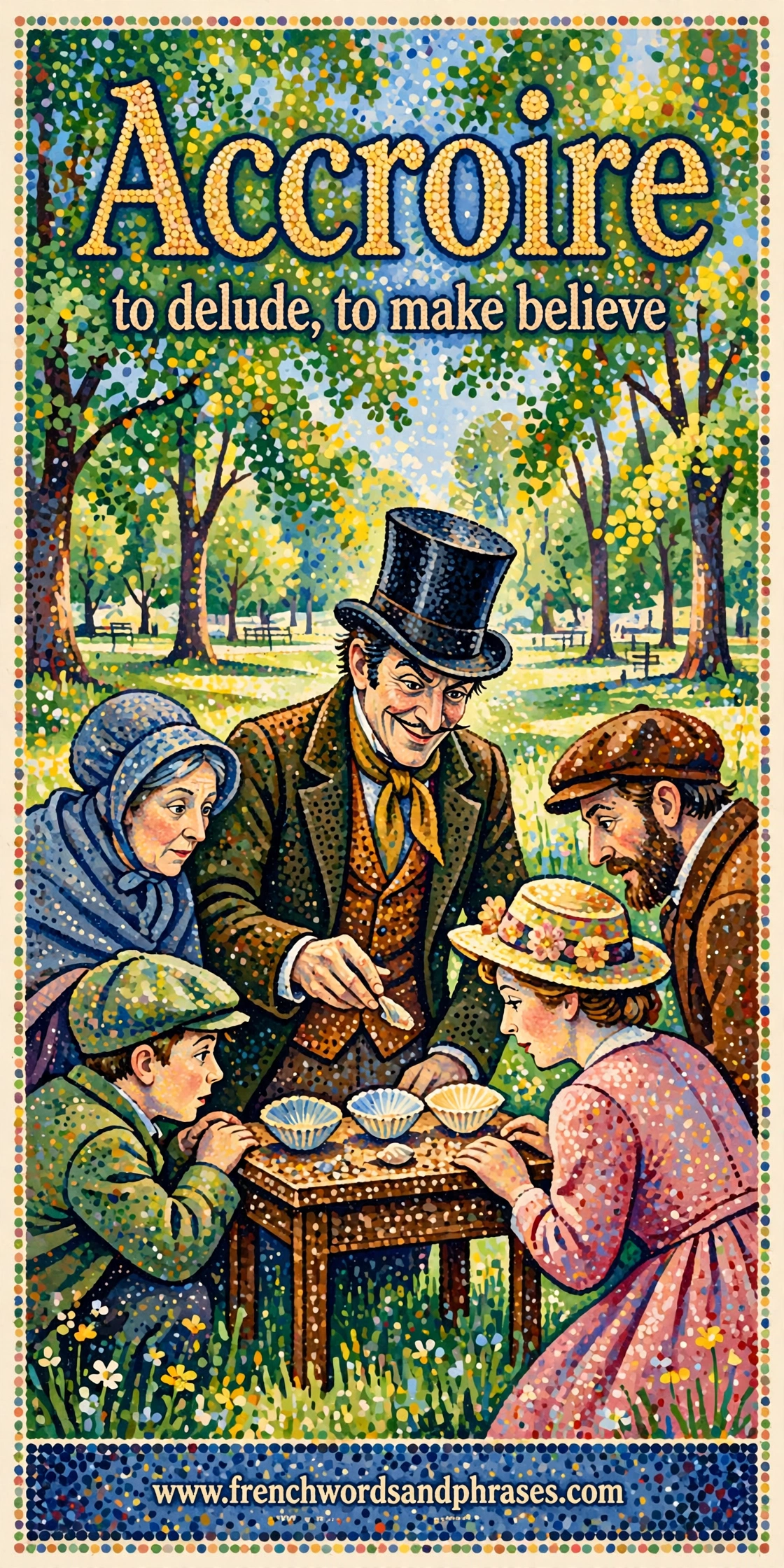
Accroire means to delude, to make believe — to plant a fine, false story in someone’s head and watch them swallow it whole.
A travelling charlatan at a fair, a smooth talker with a miracle cure, a storyteller whose dragons grow with every telling — accroire is the verb of the planted illusion: it lives today almost entirely inside one famous phrase, faire accroire, to make someone believe a tall tale.
In this guide, you’ll learn how to conjugate accroire in all the major French tenses and moods. Explore complete conjugation tables, French examples, English translations, and practice quizzes.
Understanding the French Verb Accroire
Accroire is an irregular French verb ending in -oire, conjugated like croire and heard today almost only inside the phrase faire accroire — to make someone believe a tall tale.
It means to delude, to make believe. The deception is always verbal: no force, no forgery, just a story well told. Faire accroire implies an audience that wants to believe — children, the credulous, the hopeful — and a teller who knows it. The tone ranges from playful (a grandfather’s tall tales) to damning (a fraudster’s promises).
Verb classification: Irregular (-oire, like croire)
Auxiliary verb: Avoir
Past participle: accru
Present participle: accroyant
English equivalents: To delude, to make believe; faire accroire quelque chose à quelqu’un — to make someone believe something (untrue); en faire accroire à quelqu’un — to take someone in, to spin someone a yarn; faire accroire des merveilles — to promise wonders, to tell marvellous lies; il veut nous faire accroire que… — he wants us to believe that…
One important detail: accroire is a prisoner of its phrase — modern French uses it almost exclusively after faire: faire accroire quelque chose à quelqu’un, to make someone believe something false, and en faire accroire à quelqu’un, to take someone in completely. Bare, conjugated accroire belongs to older French and to dictionaries; the tables here show its full croire-shaped paradigm because the phrase is unintelligible without it. Like croire, it swings between two stems: accroi- in the singular (je accrois, il accroit — no circumflex, unlike accroître) and accroy- before a vowel ending (nous accroyons, en accroyant), with past participle accru.
Experience the Word
Accroire is the verb of the swallowed story — the moment a listener nods, and a lie becomes, for them, the truth.
Imagine a fairground in 1890. A man in a velvet jacket holds up a brown bottle and explains, gravely, that it cures everything from rheumatism to heartbreak. The crowd presses closer; coins change hands — il leur a fait accroire, and the bottle is only coloured water.
Nothing in the bottle had changed. Only the story — accrue, believed, bought.
How to Conjugate Accroire: Complete French Conjugation Guide
Let’s explore every major conjugation of accroire, beginning with the indicative mood.
How to Conjugate Accroire in the Indicative Mood
The indicative mood is used to express facts, observations, actions, and events.
How to Conjugate Accroire in the Present Tense (Présent)
Used for actions happening now, habitual actions, and general truths.
| Subject | Conjugation |
|---|---|
| je | accrois |
| tu | accrois |
| il / elle | accroit |
| nous | accroyons |
| vous | accroyez |
| ils / elles | accroient |
Example
Ce conteur accroit aux enfants des histoires de dragons et de trésors.
This storyteller makes the children believe tales of dragons and treasure.
Quick Quiz 1
Complete the sentence:
Nous ______ des merveilles aux enfants, le soir de la fête.
Reveal the answer
accroyons
Nous accroyons des merveilles aux enfants, le soir de la fête.
We make the children believe in wonders on the night of the fair.
How to Conjugate Accroire in the Passé Composé
Used for completed actions in the past. Accroire takes the auxiliary verb avoir.
| Subject | Conjugation |
|---|---|
| j’ | ai accru |
| tu | as accru |
| il / elle | a accru |
| nous | avons accru |
| vous | avez accru |
| ils / elles | ont accru |
Example
Il a fait accroire à tout le village qu’il avait vu un loup.
He made the whole village believe he had seen a wolf.
How to Conjugate Accroire in the Imparfait (Imperfect Tense)
Used for habitual past actions, descriptions, and ongoing situations in the past.
| Subject | Conjugation |
|---|---|
| je | accroyais |
| tu | accroyais |
| il / elle | accroyait |
| nous | accroyions |
| vous | accroyiez |
| ils / elles | accroyaient |
Example
Autrefois, on accroyait aux paysans que la rivière cachait de l’or.
In the old days, people made the peasants believe the river hid gold.
Quick Quiz 2
Choose the correct form:
He made the village believe his story.
Il ______ son histoire au village. (a fait accroire / est fait accroire)
Reveal the answer
a fait accroire
Il a fait accroire son histoire au village.
Accroire works through faire and takes avoir.
How to Conjugate Accroire in the Plus-que-parfait
Used to describe an action that had already been completed before another past event.
| Subject | Conjugation |
|---|---|
| j’ | avais accru |
| tu | avais accru |
| il / elle | avait accru |
| nous | avions accru |
| vous | aviez accru |
| ils / elles | avaient accru |
Example
Il leur avait fait accroire qu’il reviendrait riche.
He had made them believe he would come back rich.
How to Conjugate Accroire in the Passé Simple
Primarily used in formal writing, literature, and historical narratives. It is rarely used in everyday conversation.
| Subject | Conjugation |
|---|---|
| je | accrus |
| tu | accrus |
| il / elle | accrut |
| nous | accrûmes |
| vous | accrûtes |
| ils / elles | accrurent |
Example
Le charlatan accrut mille merveilles aux badauds de la foire.
The charlatan made the fair’s onlookers believe a thousand wonders.
How to Conjugate Accroire in the Passé Antérieur
A literary tense used to express an action completed immediately before another past action, generally in the passé simple.
| Subject | Conjugation |
|---|---|
| j’ | eus accru |
| tu | eus accru |
| il / elle | eut accru |
| nous | eûmes accru |
| vous | eûtes accru |
| ils / elles | eurent accru |
Example
Quand il eut fait accroire son histoire aux voisins, ils lui prêtèrent de l’argent.
When he had made the neighbours believe his story, they lent him money.
How to Conjugate Accroire in the Future Tense (Futur Simple)
Used to describe actions that will take place in the future.
| Subject | Conjugation |
|---|---|
| je | accroirai |
| tu | accroiras |
| il / elle | accroira |
| nous | accroirons |
| vous | accroirez |
| ils / elles | accroiront |
Example
Ce menteur accroira des prodiges à tous les naïfs de la ville.
That liar will make all the town’s gullible folk believe in marvels.
How to Conjugate Accroire in the Futur Antérieur (Future Perfect)
Used for an action that will have been completed before a particular point in the future.
| Subject | Conjugation |
|---|---|
| j’ | aurai accru |
| tu | auras accru |
| il / elle | aura accru |
| nous | aurons accru |
| vous | aurez accru |
| ils / elles | auront accru |
Example
À la fin de la foire, il aura fait accroire ses fables à cent personnes.
By the end of the fair, he will have made a hundred people believe his tales.
How to Conjugate Accroire in the Near Future (Futur Proche)
Used to describe something that is going to happen soon. Formed with aller + infinitive.
| Subject | Conjugation |
|---|---|
| je | vais accroire |
| tu | vas accroire |
| il / elle | va accroire |
| nous | allons accroire |
| vous | allez accroire |
| ils / elles | vont accroire |
Example
Attention, il va encore faire accroire des sornettes aux nouveaux.
Careful, he is going to make the newcomers believe more nonsense.
How to Conjugate Accroire in the Conditional Mood
The conditional mood expresses what would happen under certain circumstances. It is also frequently used to make polite requests or express wishes.
How to Conjugate Accroire in the Present Conditional
| Subject | Conjugation |
|---|---|
| je | accroirais |
| tu | accroirais |
| il / elle | accroirait |
| nous | accroirions |
| vous | accroiriez |
| ils / elles | accroiraient |
Example
Il accroirait n’importe quelle fable aux enfants du village.
He would make the village children believe any tale at all.
How to Conjugate Accroire in the Past Conditional
| Subject | Conjugation |
|---|---|
| j’ | aurais accru |
| tu | aurais accru |
| il / elle | aurait accru |
| nous | aurions accru |
| vous | auriez accru |
| ils / elles | auraient accru |
Example
Sans les témoins, il aurait fait accroire son mensonge à tout le monde.
Without the witnesses, he would have made everyone believe his lie.
Accroire in the Literary Past Conditional Form
This less common literary form uses the imperfect subjunctive of avoir.
| Subject | Conjugation |
|---|---|
| j’ | eusse accru |
| tu | eusses accru |
| il / elle | eût accru |
| nous | eussions accru |
| vous | eussiez accru |
| ils / elles | eussent accru |
Example
Il eût accru ses fables à la cour entière.
He would have made the whole court believe his tales.
How to Conjugate Accroire in the Subjunctive Mood
The subjunctive is used to express wishes, emotions, doubts, necessity, and uncertainty. It frequently follows expressions such as il faut que (it is necessary that) or bien que (although).
How to Conjugate Accroire in the Present Subjunctive
| Subject | Conjugation |
|---|---|
| que je | accroie |
| que tu | accroies |
| qu’il / qu’elle | accroie |
| que nous | accroyions |
| que vous | accroyiez |
| qu’ils / qu’elles | accroient |
Example
Il est incroyable qu’il accroie de telles fables aux enfants.
It is incredible that he makes the children believe such tales.
Quick Quiz 3
Complete the sentence using the subjunctive:
Il est incroyable que tu ______ ces fables aux enfants.
Reveal the answer
accroies
Il est incroyable que tu accroies ces fables aux enfants.
It is incredible that you make the children believe these tales.
How to Conjugate Accroire in the Imperfect Subjunctive
A literary tense, rarely encountered in modern spoken French.
| Subject | Conjugation |
|---|---|
| que je | accrusse |
| que tu | accrusses |
| qu’il / qu’elle | accrût |
| que nous | accrussions |
| que vous | accrussiez |
| qu’ils / qu’elles | accrussent |
Example
Je ne pensais pas qu’il accrût ses histoires aux voisins.
I did not think he made the neighbours believe his stories.
How to Conjugate Accroire in the Pluperfect Subjunctive
A literary construction used to express an action completed before another past action.
| Subject | Conjugation |
|---|---|
| que j’ | eusse accru |
| que tu | eusses accru |
| qu’il / qu’elle | eût accru |
| que nous | eussions accru |
| que vous | eussiez accru |
| qu’ils / qu’elles | eussent accru |
Example
On racontait qu’il eût fait accroire des prodiges au village entier.
People said he had made the whole village believe in marvels.
How to Conjugate Accroire in the Past Subjunctive
| Subject | Conjugation |
|---|---|
| que j’ | aie accru |
| que tu | aies accru |
| qu’il / qu’elle | ait accru |
| que nous | ayons accru |
| que vous | ayez accru |
| qu’ils / qu’elles | aient accru |
Example
Je suis étonné qu’il ait fait accroire cela à sa propre sœur.
I am amazed he made his own sister believe that.
How to Conjugate Accroire in the Imperative
The imperative is used to give commands, instructions, invitations, or suggestions. Subject pronouns are omitted.
How to Conjugate Accroire in the Present Imperative
| Person | Conjugation |
|---|---|
| (tu) | accrois |
| (nous) | accroyons |
| (vous) | accroyez |
Example
N’accrois pas de fables aux enfants !
Do not make the children believe tales!
Quick Quiz 4
How would you say Do not make the children believe tales (tu form)?
Reveal the answer
N’accrois pas de fables aux enfants !
French Participles of Accroire
Participles are verb forms that can be used in compound tenses and other grammatical constructions.
Present Participle of Accroire
accroyant
En accroyant ses mensonges aux clients, il a bâti sa fortune.
By making his customers believe his lies, he built his fortune.
Past Participle of Accroire
accru
Accrues aux enfants par le conteur, ces fables sont devenues des légendes.
Made believable to the children by the storyteller, these tales became legends.
Accroire in Everyday French: Real-Life Examples
Now that you know the conjugations, let’s see how accroire appears in everyday French.
Example 1 — Present
Il fait accroire n’importe quoi aux gens.
He makes people believe anything at all.
Example 2 — Passé composé
Il a fait accroire au village qu’il avait vu un loup.
He made the village believe he had seen a wolf.
Example 3 — Imparfait
On accroyait aux paysans que la rivière cachait de l’or.
People made the peasants believe the river hid gold.
Example 4 — Future
Il te fera accroire ce qu’il voudra.
He will make you believe whatever he likes.
Example 5 — Conditional
Il ferait accroire que la lune est verte.
He would make people believe the moon is green.
Example 6 — Imperative
N’accrois pas de fables aux enfants !
Do not make the children believe tales!
Beyond Translation: The Meaning of Accroire
English has to build the idea out of parts — to make someone believe, to take someone in — where French keeps one compact old verb.
Accroire is croire with a victim.
Croire is to believe; accroire is to cause the believing, deliberately, in someone else, for your own purposes. It survives because the phrase faire accroire names something no other French verb names quite so neatly: the successful planting of a beautiful lie.
How to Remember the French Verb Accroire
Remember it this way: Accroire is about the charlatan at the fair, planting a beautiful lie in a willing crowd.
- It lives inside faire accroire: faire accroire quelque chose à quelqu’un — to make someone believe something untrue.
- Conjugated like croire: je accrois, nous accroyons, ils accroient, past participle accru.
- No circumflex in the present (il accroit) — that roof belongs to its neighbour accroître.
The key idea is the charlatan at the fair, planting a beautiful lie in a willing crowd.
Test Your Knowledge of Accroire
Let’s see how much you’ve learned. Try answering these questions before revealing the answers.
Question 1
Inside which famous phrase does accroire live in modern French?
Reveal the answer
Faire accroire — faire accroire quelque chose à quelqu’un, to make someone believe something untrue.
Question 2
How do you say He made the whole village believe he had seen a wolf in French?
Reveal the answer
Il a fait accroire à tout le village qu’il avait vu un loup.
Question 3
Translate: He would make people believe the moon is green.
Reveal the answer
Il ferait accroire que la lune est verte.
Question 4
What is the past participle of accroire?
Reveal the answer
Accru — the same shape as croire’s family, without any circumflex in the present tense.
Question 5
Complete the sentence:
Il est incroyable qu’il ______ de telles fables aux enfants.
Reveal the answer
accroie
Il est incroyable qu’il accroie de telles fables aux enfants.
It is incredible that he makes the children believe such tales.
Your Final Challenge
Can You Use It?
How would you say this in French?
He made them believe the moon was made of cheese, and the children still dream about it.
Reveal the answer
Il leur a fait accroire que la lune était en fromage, et les enfants en rêvent encore.
He made them believe the moon was made of cheese, and the children still dream about it.
A little French. A little curiosity. A richer everyday life.
LEARN FRENCH ONE WORD AT A TIME