
A French Word to Live By
Translate Accordéon to English
/akɔʁdeɔ̃/
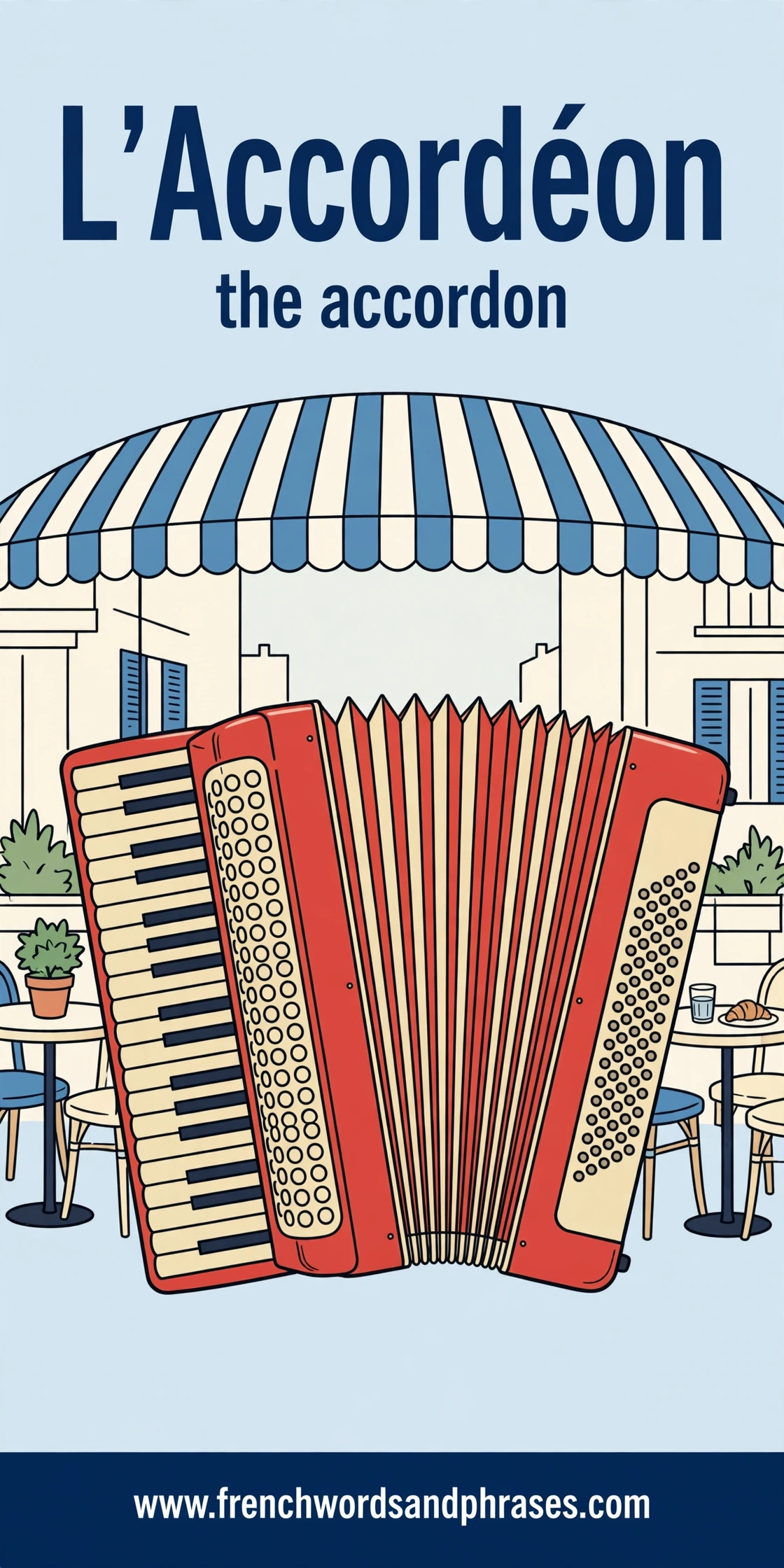
L’Accordéon means the accordion.
On the village square, the old man straps on the bellows, squeezes, and the whole square starts to waltz: l’accordéon, the accordion, the portable orchestra of French cafés, weddings and country dances.
In this guide, you’ll learn what accordéon means in English, how to use it with its articles, how to form its plural, and how it appears in everyday French. Explore French examples, English translations, and practice quizzes.
Understanding the French Noun Accordéon
Accordéon is a masculine French noun, learned with its article: l’accordéon, un accordéon. It is named after the accords, the chords it produces — the instrument was patented in the 1820s, and within a generation it had become the sound of popular France: the bal musette, the café-concert, the wedding in the village hall.
It means the accordion — the box-shaped instrument played by working the bellows (le soufflet) while pressing keys or buttons, forcing air across metal reeds. French distinguishes two great families: l’accordéon-piano, the piano accordion with a keyboard, and the button accordions, l’accordéon diatonique and l’accordéon chromatique à boutons. No instrument is more French in the world’s imagination: the musette waltz, the songs of Piaf’s Paris, the village fête — all of them breathe through an accordéon.
Gender: Masculine — l’accordéon
Definite article: l’ — l’accordéon (the accordion), melted before the vowel
Indefinite article: un — un accordéon (an accordion)
Plural: les accordéons — the accordions
The parts: le soufflet (the bellows), les touches (the keys), les boutons (the buttons)
The player: un accordéoniste / une accordéoniste — the accordion player
English equivalents: The accordion.
Instruments take de: jouer de l’accordéon, to play the accordion — never jouer l’accordéon in careful French. The word also describes a shape: plié en accordéon means folded in pleats, like the bellows — concertina-folded paper, a pleated skirt, the bending middle of an articulated bus (un bus en accordéon).
Experience the Word
Accordéon is a lung made of wood, leather and mother-of-pearl: it breathes in, it breathes out, and a whole dance floor moves with its breathing.
Imagine the bal du 14 juillet in a small town: strings of lights, a smell of crêpes, and at the corner of the square l’accordéon starting the first waltz, while three generations take to the floor at once.
You have not just named an instrument. You have named the soundtrack of popular France — l’accordéon, a whole orchestra in one pair of arms.
How to Use Accordéon in French: Complete Guide
Let’s explore how accordéon works in French, beginning with its articles — l’accordéon, un accordéon, jouer de l’accordéon.
Accordéon with the Definite Article (L’, Les)
Used for a specific accordion — the one on the chair, the one in the family since 1950.
| Form | French |
|---|---|
| Masculine singular | l’accordéon |
| Plural | les accordéons |
Example
L’accordéon de mon grand-père date de 1952.
My grandfather’s accordion dates from 1952.
Accordéon with the Indefinite Article (Un, Des)
Used for an accordion in general — one in a shop window, one at a flea market.
| Form | French |
|---|---|
| Masculine singular | un accordéon |
| Plural | des accordéons |
Example
Il a trouvé un accordéon ancien au marché aux puces.
He found an old accordion at the flea market.
Accordéon with the Partitive and Quantities (Jouer de l’accordéon…)
Accordéon is played, carried and folded — de for the playing, en for the folding.
| Quantity | French |
|---|---|
| to play the accordion | jouer de l’accordéon |
| a diatonic accordion | un accordéon diatonique |
| folded in pleats | plié en accordéon |
| without an accordion | sans accordéon |
| the accordion’s bellows | le soufflet de l’accordéon |
Example
Elle joue de l’accordéon depuis l’âge de sept ans.
She has been playing the accordion since she was seven.
Quick Quiz 1
Complete the sentence:
______ accordéon sonne dès les premières notes. (the)
Reveal the answer
L’
L’accordéon sonne dès les premières notes.
The accordion sounds from the very first notes — le melts into l’ before the vowel.
The Plural of Accordéon
Accordéon adds a simple -s — one is a soloist, several are a shop window.
| Number | French |
|---|---|
| Singular | l’accordéon |
| Plural | les accordéons |
Example
La vitrine du magasin expose des accordéons de toutes les couleurs.
The shop window displays accordions of every colour.
Accordéon with Possessive Adjectives (Mon, Ton, Son…)
Accordéon is masculine, so mon, ton, son in the singular.
| Owner | French |
|---|---|
| my | mon accordéon |
| your (tu) | ton accordéon |
| his / her | son accordéon |
| our | notre accordéon |
| your (vous) | votre accordéon |
| their | leur accordéon |
Example
Son accordéon ne le quitte jamais en tournée.
His accordion never leaves him on tour.
Quick Quiz 2
Complete the sentence:
Elle joue ______ l’accordéon au bal. (of/from — the instrument preposition)
Reveal the answer
de
Elle joue de l’accordéon au bal.
She plays the accordion at the dance — instruments take jouer de.
Accordéon with Demonstrative Adjectives (Cet, Ces)
Used to point: cet accordéon, this accordion — masculine before a vowel takes cet, not ce.
| Form | French |
|---|---|
| Masculine singular | cet accordéon |
| Plural | ces accordéons |
Example
Cet accordéon rouge attire tous les regards.
This red accordion catches everyone’s eye.
Accordéon with Adjectives
Adjectives agree with accordéon — masculine singular: un accordéon diatonique, un vieil accordéon.
| Adjective | With Accordéon |
|---|---|
| diatonique (diatonic) | un accordéon diatonique |
| chromatique (chromatic) | un accordéon chromatique |
| ancien (old) | un accordéon ancien |
| un accordéon électrique | |
| lourd (heavy) | un accordéon lourd |
Example
Un accordéon chromatique permet de jouer dans toutes les tonalités.
A chromatic accordion lets you play in every key.
Quick Quiz 3
Complete the sentence:
C’est un accordéon très ______. (heavy)
Reveal the answer
lourd
C’est un accordéon très lourd.
It is a very heavy accordion — lourd, masculine, to agree with accordéon.
Everyday Expressions with Accordéon
Bals, buskers and bellows — the accordéon phrases of daily life.
| Expression | In English |
|---|---|
| jouer de l’accordéon | to play the accordion |
| un accordéon-piano | a piano accordion |
| plié en accordéon | folded in pleats, concertina-folded |
| le bal à l’accordéon | the dance with accordion music |
| le soufflet de l’accordéon | the accordion’s bellows |
Example
Le papier est plié en accordéon pour former un éventail.
The paper is concertina-folded to form a fan.
Words from the Same Family as Accordéon
Chords, bellows and dances — the words that travel with accordéon.
| French | In English |
|---|---|
| l’accordéoniste | the accordion player |
| l’accordéon-piano | the piano accordion |
| l’accord | the chord; the agreement |
| le soufflet | the bellows |
| le bal musette | the musette dance, the popular dance hall |
Example
L’accordéoniste ouvre le bal musette avec une valse.
The accordionist opens the musette dance with a waltz.
Quick Quiz 4
What does plié en accordéon mean?
Reveal the answer
Folded in pleats — concertina-folded, like the bellows.
La carte est pliée en accordéon.
The map is concertina-folded.
Accordéon in Everyday French: Real-Life Examples
Now that you know the word, let’s see how accordéon appears in everyday French.
Example 1 — The village fête
L’accordéon anime la fête du village toute la soirée.
The accordion livens up the village fête all evening.
Example 2 — The café concert
Au café-concert, l’accordéon accompagne les chansons anciennes.
At the café-concert, the accordion accompanies the old songs.
Example 3 — The street musician
Un accordéon résonne sous les arcades de la place.
An accordion echoes under the arcades of the square.
Example 4 — The music shop
Elle essaie un accordéon neuf au magasin de musique.
She tries out a new accordion at the music shop.
Example 5 — The dance
Sans accordéon, pas de bal dans ce village.
Without an accordion, no dance in this village.
Example 6 — The busker
Dans le métro, l’accordéon fait sourire les voyageurs pressés.
In the metro, the accordion makes the hurrying travellers smile.
Beyond Translation: The Meaning of Accordéon
No instrument carries France around the world like the accordéon. Invented in Vienna’s orbit in the 1820s and named for its chords, it was cheap, loud and portable — a whole dance band in one box — and popular France adopted it as its own: the bal musette of Paris, the wedding orchestras of the countryside, the chansons of the café-concert. Yvette Horner made it glamorous, Piaf’s streets made it immortal, and every French village fête still reserves it the place of honour. To the rest of the world, three seconds of accordéon say Paris more surely than a photograph of the Eiffel Tower.
To say accordéon is to start the waltz.
It evokes strings of lights, wooden dance floors and grandfathers’ Sunday suits — the breathing heart of popular celebration.
How to Remember the French Noun Accordéon
Remember it this way: Accordéon is the accordion — named for its chords (accords): l’accordéon, jouer de l’accordéon, plié en accordéon.
- Always masculine — l’accordéon, un accordéon, cet accordéon.
- The playing phrase — jouer de l’accordéon, instruments take de.
- The shape — plié en accordéon, folded in pleats like the bellows.
The key idea is l’accordéon — the accordion, masculine; jouer de l’accordéon = to play the accordion.
Test Your Knowledge of Accordéon
Let’s see how much you’ve learned. Try answering these questions before revealing the answers.
Question 1
Is accordéon masculine or feminine?
Reveal the answer
Masculine — l’accordéon, un accordéon.
Question 2
How do you say to play the accordion?
Reveal the answer
Jouer de l’accordéon — instruments take de.
Question 3
Translate: He plays the accordion at the village dance.
Reveal the answer
Il joue de l’accordéon au bal du village.
Question 4
What is le soufflet of an accordion?
Reveal the answer
The bellows — the folding part that pushes the air across the reeds.
Question 5
Complete the sentence:
______ accordéon est très ancien. (this)
Reveal the answer
Cet
Cet accordéon est très ancien.
This accordion is very old — cet before a vowel.
Your Final Challenge
Can You Use It?
How would you say this in French?
“He plays the accordion at the village dance.”
Reveal the answer
Il joue de l’accordéon au bal du village.
He plays the accordion at the village dance.
A little French. A little curiosity. A richer everyday life.
LEARN FRENCH ONE WORD AT A TIME




