
A French Word to Live By
Translate Accord to English
/akɔʁ/
L’accord means the agreement.
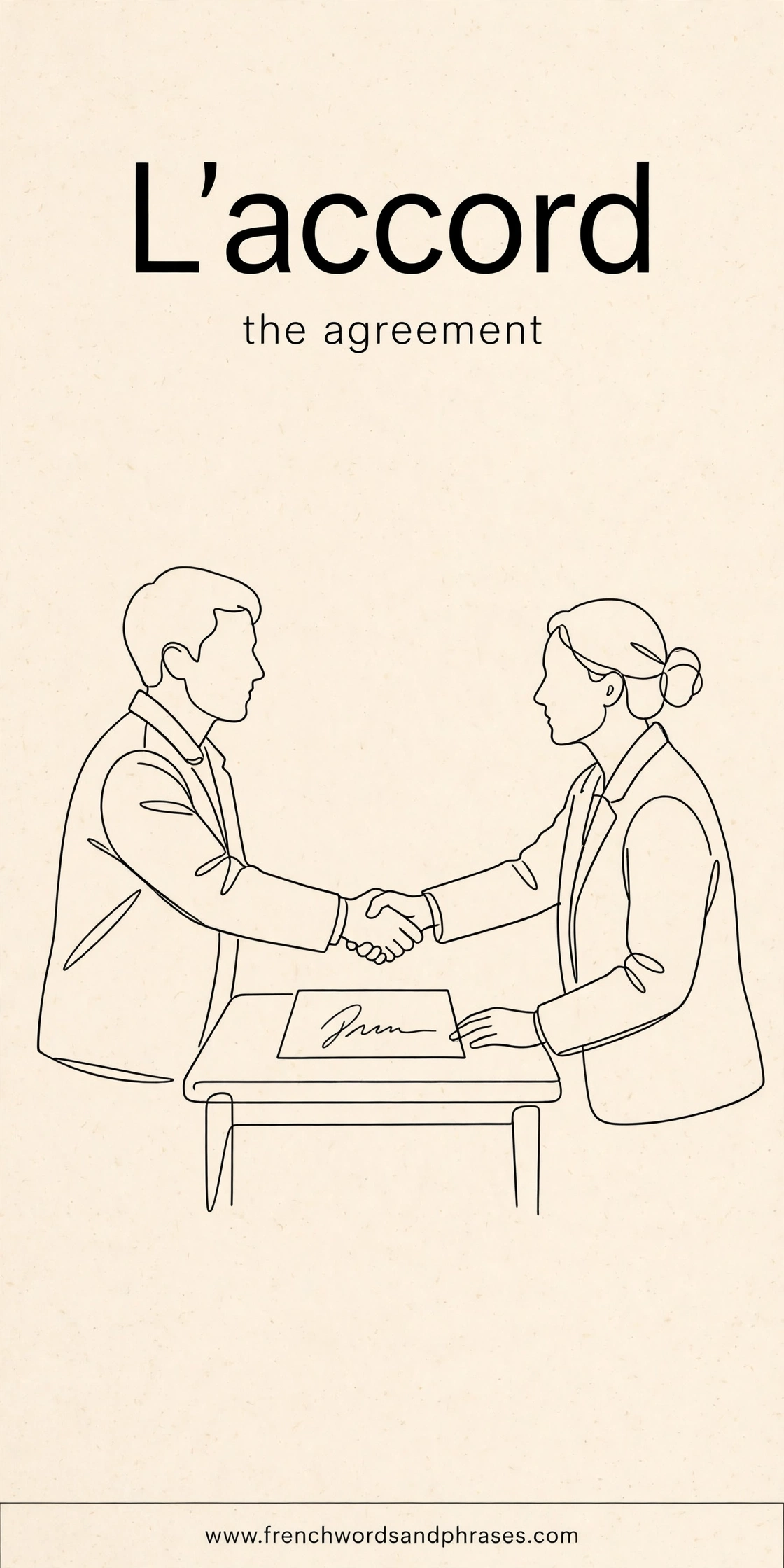
After three days of arguments around the long table, the two directors finally lean over the same page and shake hands: l’accord, the agreement — the moment two wills stop pulling in opposite directions.
In this guide, you’ll learn what accord means in English, how to use it with its articles, how to form its plural, and how it appears in everyday French. Explore French examples, English translations, and practice quizzes.
Understanding the French Noun Accord
Accord is a masculine French noun, learned with its article: l’accord, un accord. Short, old and everywhere, it is the noun of the verb accorder, to grant and to tune — and like the verb, it lives three lives at once: the agreement, the grammatical agreement, and the musical chord.
Its first life is agreement and consent: parvenir à un accord, to reach an agreement; signer un accord, to sign an agreement; un accord de paix, a peace agreement. From it comes the most useful phrase in spoken French: être d’accord, to agree, and its everyday short form d’accord ! — agreed, OK! Its second life is grammar: l’accord du participe passé, the agreement of the past participle. Its third life is music: un accord is a chord — un accord de sol majeur, a chord of G major.
Gender: Masculine — l’accord
Definite article: l’ — l’accord (the agreement), melted before the vowel
Indefinite article: un — un accord (an agreement; also a chord)
Plural: les accords — the agreements; the chords
Three lives: agreement and consent; grammar agreement; a chord in music
Key phrases: d’accord ! (OK, agreed) ; être d’accord (to agree)
English equivalents: The agreement.
Two constructions rule daily life: être d’accord avec quelqu’un, to agree with someone, and être d’accord sur quelque chose, to agree on something. The bare d’accord is the French OK — acceptances, arrangements and truces are all sealed with it. In the classroom, faire l’accord means to make the adjective or participle agree; at the piano, plaquer un accord is to strike a chord.
Experience the Word
Accord is the handshake inside the language: two parties, two notes, two words in a sentence — different things, suddenly in tune.
Imagine the flatmates around the kitchen table at midnight, the chore rota finally settled, four voices at once: « D’accord ! » — l’accord, small and total, and the argument is over.
You have not just named a contract. You have named harmony between people — l’accord, the sound of things fitting together.
How to Use Accord in French: Complete Guide
Let’s explore how accord works in French, beginning with its articles — l’accord, un accord, and the golden phrase d’accord.
Accord with the Definite Article (L’, Les)
Used for a specific agreement — the one on the table, the one in the treaty.
| Form | French |
|---|---|
| Masculine singular | l’accord |
| Plural | les accords |
Example
L’accord a été signé hier soir à minuit.
The agreement was signed last night at midnight.
Accord with the Indefinite Article (Un, Des)
Used for an agreement in general — one reached, one hoped for, one chord among many.
| Form | French |
|---|---|
| Masculine singular | un accord |
| Plural | des accords |
Example
Les deux pays cherchent un accord durable.
The two countries are looking for a lasting agreement.
Accord with the Partitive and Quantities (D’accord !…)
Accord is measured in handshakes and signatures — and in the shortest useful phrase in French: d’accord.
| Quantity | French |
|---|---|
| agreed, OK | d’accord |
| to agree (with someone) | être d’accord |
| to reach an agreement | parvenir à un accord |
| a peace agreement | un accord de paix |
| without agreement | sans accord |
Example
Après des heures de discussion, ils sont enfin parvenus à un accord.
After hours of discussion, they finally reached an agreement.
Quick Quiz 1
Complete the sentence:
______ accord entre les deux entreprises est officiel. (the)
Reveal the answer
L’
L’accord entre les deux entreprises est officiel.
The agreement between the two companies is official — le melts into l’ before the vowel.
The Plural of Accord
Accord adds a simple -s — treaties multiply, and so do chords.
| Number | French |
|---|---|
| Singular | l’accord |
| Plural | les accords |
Example
Elle joue les trois accords sans regarder ses mains.
She plays the three chords without looking at her hands.
Accord with Possessive Adjectives (Mon, Ton, Son…)
Accord is masculine, so mon, ton, son in the singular.
| Owner | French |
|---|---|
| my | mon accord |
| your (tu) | ton accord |
| his / her | son accord |
| our | notre accord |
| your (vous) | votre accord |
| their | leur accord |
Example
Tu as mon accord pour le projet.
You have my agreement for the project.
Quick Quiz 2
Complete the sentence:
Je suis ______ avec toi sur ce point. (in agreement)
Reveal the answer
d’accord
Je suis d’accord avec toi sur ce point.
I agree with you on this point — être d’accord avec quelqu’un.
Accord with Demonstrative Adjectives (Cet, Ces)
Used to point: cet accord, this agreement — masculine before a vowel takes cet, not ce.
| Form | French |
|---|---|
| Masculine singular | cet accord |
| Plural | ces accords |
Example
Cet accord change la situation de toute la région.
This agreement changes the situation of the whole region.
Accord with Adjectives
Adjectives agree with accord — masculine singular: un accord écrit, un accord parfait.
| Adjective | With Accord |
|---|---|
| écrit (written) | un accord écrit |
| verbal (verbal, oral) | un accord verbal |
| parfait (perfect — also a perfect chord) | un accord parfait |
| international (international) | un accord international |
| définitif (final, definitive) | un accord définitif |
Example
Un accord verbal ne suffit pas, il faut un écrit.
A verbal agreement is not enough, we need it in writing.
Quick Quiz 3
Complete the sentence:
Ils ont signé un accord ______. (international)
Reveal the answer
international
Ils ont signé un accord international.
They signed an international agreement — international, masculine, to agree with accord.
Everyday Expressions with Accord
Handshakes, classrooms and keyboards — the accord phrases of daily life.
| Expression | In English |
|---|---|
| d’accord ! | agreed! OK! |
| être d’accord avec quelqu’un | to agree with someone |
| parvenir à un accord | to reach an agreement |
| signer un accord | to sign an agreement |
| un accord de paix | a peace agreement |
| mettre tout le monde d’accord | to get everyone to agree |
Example
Son idée simple a mis tout le monde d’accord.
His simple idea got everyone to agree.
Words from the Same Family as Accord
Tuning, granting and fitting together — the words that travel with accord.
| French | In English |
|---|---|
| accorder | to grant, to tune, to agree (grammar) |
| l’accordance | the accordance, the harmony (rare) |
| le désaccord | the disagreement |
| accordéon | the accordion — the instrument of chords |
| la concorde | the concord, harmony between people |
Example
Un désaccord profond sépare les deux associés.
A deep disagreement divides the two partners.
Quick Quiz 4
What does d’accord mean on its own?
Reveal the answer
Agreed! OK! — the everyday French word of consent.
On se retrouve à huit heures ? — D’accord !
Shall we meet at eight? — Agreed!
Accord in Everyday French: Real-Life Examples
Now that you know the word, let’s see how accord appears in everyday French.
Example 1 — Making plans
On se retrouve devant la gare, d’accord ?
We’ll meet in front of the station, OK?
Example 2 — In the news
Les deux pays ont signé un accord de paix.
The two countries have signed a peace agreement.
Example 3 — At the guitar
Ce morceau ne contient que trois accords.
This piece contains only three chords.
Example 4 — Grammar class
N’oublie pas l’accord du participe passé.
Don’t forget the agreement of the past participle.
Example 5 — Flatmates
Nous sommes tombés d’accord sur les tâches ménagères.
We reached an agreement about the household chores.
Example 6 — The contract
Elle a donné son accord par écrit.
She gave her agreement in writing.
Beyond Translation: The Meaning of Accord
Accord may be the hardest-working short word in French. It seals peace treaties and settles who washes the dishes; it is the OK of a thousand daily arrangements and the chord under a thousand songs; and every schoolchild meets it in the grammar lesson, where words themselves must be brought into accord. The idea underneath never changes: separate things — nations, notes, nouns and verbs — brought into tune. It is no accident that the instrument of the French street and the village dance, the accordéon, is named after it: a box full of accords, harmony you can carry on your back.
To say accord is to hear the click of things fitting together.
It evokes the signed page, the struck chord and the classroom rule — one word for every kind of harmony French knows.
How to Remember the French Noun Accord
Remember it this way: Accord is the agreement — and a chord, and the grammar rule: l’accord, parvenir à un accord, and above all d’accord !
- Always masculine — l’accord, un accord, cet accord.
- The golden phrase — d’accord !, agreed, OK; être d’accord, to agree.
- The three lives — agreement, grammar agreement, and a chord in music.
The key idea is l’accord — the agreement, masculine; d’accord = OK, agreed.
Test Your Knowledge of Accord
Let’s see how much you’ve learned. Try answering these questions before revealing the answers.
Question 1
Is accord masculine or feminine?
Reveal the answer
Masculine — l’accord, un accord.
Question 2
How do you say to agree with someone?
Reveal the answer
Être d’accord avec quelqu’un.
Question 3
Translate: They signed a peace agreement.
Reveal the answer
Ils ont signé un accord de paix.
Question 4
What is un accord at the piano?
Reveal the answer
A chord — un accord de sol majeur is a G major chord.
Question 5
Complete the sentence:
______ accord a été signé hier. (this)
Reveal the answer
Cet
Cet accord a été signé hier.
This agreement was signed yesterday — cet before a vowel.
Your Final Challenge
Can You Use It?
How would you say this in French?
“We finally reached an agreement.”
Reveal the answer
Nous sommes enfin parvenus à un accord.
We finally reached an agreement.
A little French. A little curiosity. A richer everyday life.
LEARN FRENCH ONE WORD AT A TIME




