
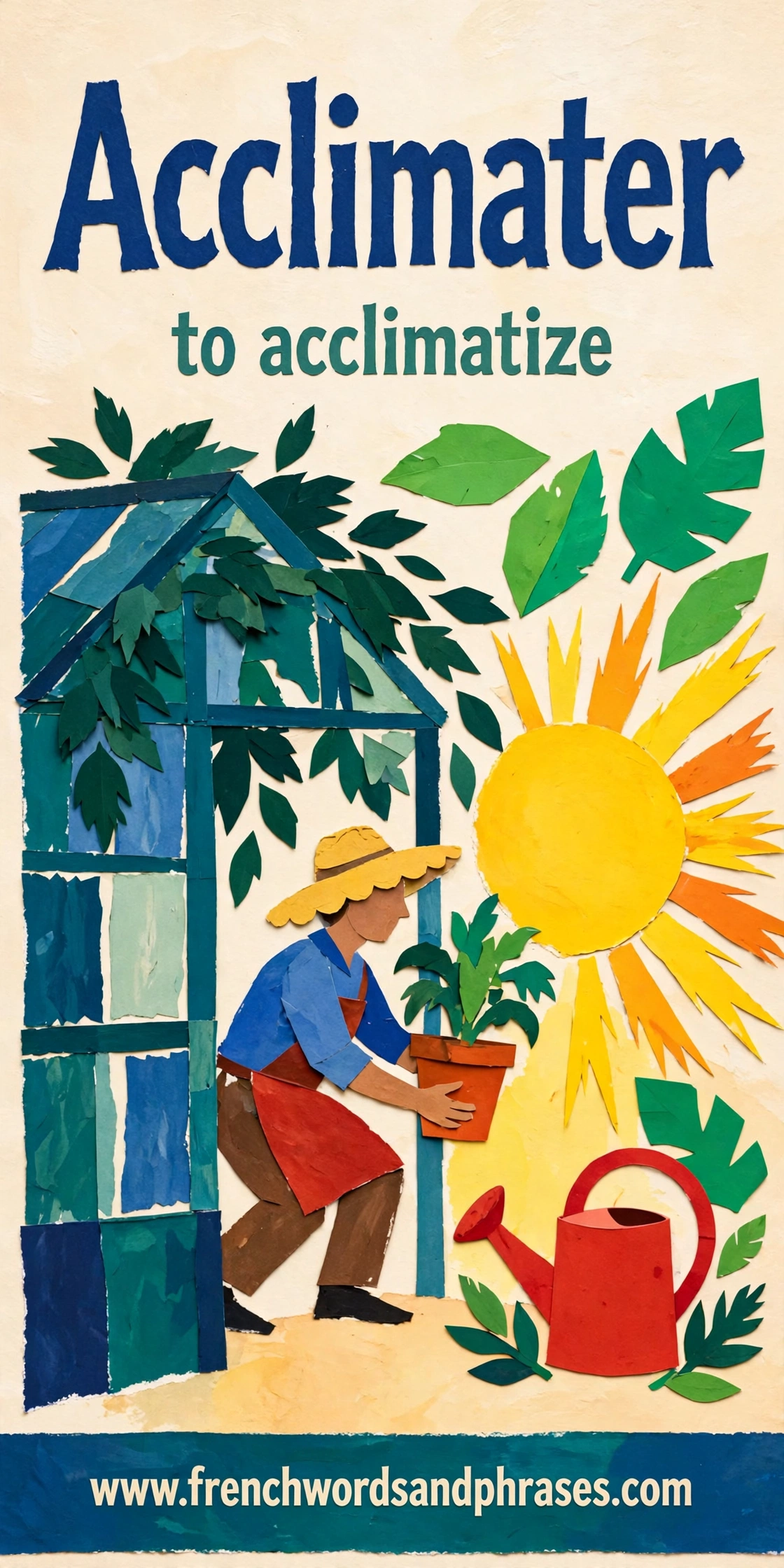
A French Word to Live By
How to Conjugate Acclimater in French
/a.kli.ma.te/
Acclimater means to acclimatize — to get a plant, an animal or yourself used to a new climate, a new altitude, a new world.
Coffee plants carried from Arabia to a Caribbean hillside, a climber sleeping one night at each camp on the way up Everest, a northerner wilting through her first Provençal August — acclimater is the verb of slow adjustment: bodies and plants learning a new sky.
In this guide, you’ll learn how to conjugate acclimater in all the major French tenses and moods. Explore complete conjugation tables, French examples, English translations, and practice quizzes.
Understanding the French Verb Acclimater
Acclimater is a regular French verb belonging to the first group of verbs, those ending in-er.
It means to acclimatize. Botanists and zoologists acclimatent species — much of the modern world map of coffee, tea, vines and garden flowers is the story of plants acclimatées to new continents. For people, s’acclimater covers altitude and heat first, then, by extension, any new environment: a school, a job, a country.
Verb classification: First group (-er)
Auxiliary verb: Avoir
Past participle: acclimaté
Present participle: acclimatant
English equivalents: To acclimatize, to get used to a climate; acclimater une plante à un climat — to acclimatize a plant to a climate; s’acclimater à — to get used to (a climate, an altitude, a new life); s’acclimater à la chaleur — to get used to the heat; un animal acclimaté — an acclimatized animal.
One important detail: acclimater lives two lives. The plain verb is transitive and belongs to gardeners and zoos: acclimater une espèce à un pays, on a acclimaté le caféier aux Antilles. But the form French people use about themselves is the pronominal s’acclimater (à) — je me suis acclimaté à l’altitude, elle s’acclimate à sa nouvelle ville — with être in compound tenses and the participle agreeing: acclimaté, acclimatée, acclimatés. The two lives share one idea: adjustment takes time, and the à names what you are adjusting to. The verb is regular: j’acclimate, nous acclimatons, past participle acclimaté.
Experience the Word
Acclimater is the verb of the slow yes — the body or the plant agreeing, day by day, to a place it did not come from.
Imagine a Breton fisherman’s daughter arriving in Marseille in July. The first week, the heat flattens her by noon; the second, she learns the siesta; by September she is buying tomatoes at the market at midday like a native. Elle s’est acclimatée — her whole rhythm has quietly changed sky.
She has not merely survived the heat. She has acclimatized — acclimatée — and the new climate has become hers.
How to Conjugate Acclimater: Complete French Conjugation Guide
Let’s explore every major conjugation of acclimater, beginning with the indicative mood.
How to Conjugate Acclimater in the Indicative Mood
The indicative mood is used to express facts, observations, actions, and events.
How to Conjugate Acclimater in the Present Tense (Présent)
Used for actions happening now, habitual actions, and general truths.
| Subject | Conjugation |
|---|---|
| je | acclimate |
| tu | acclimates |
| il / elle | acclimate |
| nous | acclimatons |
| vous | acclimatez |
| ils / elles | acclimatent |
Example
Le jardinier acclimate peu à peu les plantes au froid.
The gardener gradually acclimatizes the plants to the cold.
Quick Quiz 1
Complete the sentence:
Nous ______ les jeunes plants au froid.
Reveal the answer
acclimatons
Nous acclimatons les jeunes plants au froid.
We acclimatize the young plants to the cold.
How to Conjugate Acclimater in the Passé Composé
Used for completed actions in the past. Acclimater takes the auxiliary verb avoir.
| Subject | Conjugation |
|---|---|
| j’ | ai acclimaté |
| tu | as acclimaté |
| il / elle | a acclimaté |
| nous | avons acclimaté |
| vous | avez acclimaté |
| ils / elles | ont acclimaté |
Example
On a acclimaté ces vignes au climat du Nord.
These vines have been acclimatized to the northern climate.
How to Conjugate Acclimater in the Imparfait (Imperfect Tense)
Used for habitual past actions, descriptions, and ongoing situations in the past.
| Subject | Conjugation |
|---|---|
| je | acclimatais |
| tu | acclimatais |
| il / elle | acclimatait |
| nous | acclimations |
| vous | acclimatiez |
| ils / elles | acclimataient |
Example
Les colons acclimataient les espèces nouvelles avec patience.
The settlers patiently acclimatized the new species.
Quick Quiz 2
Choose the correct form:
She got used to the heat.
Elle ______ à la chaleur. (s’est acclimatée / a acclimatée)
Reveal the answer
s’est acclimatée
Elle s’est acclimatée à la chaleur.
About people, s’acclimater is pronominal and takes être.
How to Conjugate Acclimater in the Plus-que-parfait
Used to describe an action that had already been completed before another past event.
| Subject | Conjugation |
|---|---|
| j’ | avais acclimaté |
| tu | avais acclimaté |
| il / elle | avait acclimaté |
| nous | avions acclimaté |
| vous | aviez acclimaté |
| ils / elles | avaient acclimaté |
Example
Elle s’était acclimatée à l’altitude en une semaine.
She had got used to the altitude in a week.
How to Conjugate Acclimater in the Passé Simple
Primarily used in formal writing, literature, and historical narratives. It is rarely used in everyday conversation.
| Subject | Conjugation |
|---|---|
| je | acclimatai |
| tu | acclimatas |
| il / elle | acclimata |
| nous | acclimatâmes |
| vous | acclimatâtes |
| ils / elles | acclimatèrent |
Example
Le botaniste acclimata le caféier sous ces latitudes.
The botanist acclimatized the coffee plant in these latitudes.
How to Conjugate Acclimater in the Passé Antérieur
A literary tense used to express an action completed immediately before another past action, generally in the passé simple.
| Subject | Conjugation |
|---|---|
| j’ | eus acclimaté |
| tu | eus acclimaté |
| il / elle | eut acclimaté |
| nous | eûmes acclimaté |
| vous | eûtes acclimaté |
| ils / elles | eurent acclimaté |
Example
Quand les plantes se furent acclimatées, on les mit en pleine terre.
When the plants had acclimatized, they were put out in the open ground.
How to Conjugate Acclimater in the Future Tense (Futur Simple)
Used to describe actions that will take place in the future.
| Subject | Conjugation |
|---|---|
| je | acclimaterai |
| tu | acclimateras |
| il / elle | acclimatera |
| nous | acclimaterons |
| vous | acclimaterez |
| ils / elles | acclimateront |
Example
Tu t’acclimateras vite à ce nouveau pays.
You will soon get used to this new country.
How to Conjugate Acclimater in the Futur Antérieur (Future Perfect)
Used for an action that will have been completed before a particular point in the future.
| Subject | Conjugation |
|---|---|
| j’ | aurai acclimaté |
| tu | auras acclimaté |
| il / elle | aura acclimaté |
| nous | aurons acclimaté |
| vous | aurez acclimaté |
| ils / elles | auront acclimaté |
Example
Dans un mois, vous vous serez acclimatés à la chaleur.
In a month, you will have got used to the heat.
How to Conjugate Acclimater in the Near Future (Futur Proche)
Used to describe something that is going to happen soon. Formed with aller + infinitive.
| Subject | Conjugation |
|---|---|
| je | vais acclimater |
| tu | vas acclimater |
| il / elle | va acclimater |
| nous | allons acclimater |
| vous | allez acclimater |
| ils / elles | vont acclimater |
Example
Ces jeunes plants vont s’acclimater au jardin.
These young plants are going to acclimatize to the garden.
How to Conjugate Acclimater in the Conditional Mood
The conditional mood expresses what would happen under certain circumstances. It is also frequently used to make polite requests or express wishes.
How to Conjugate Acclimater in the Present Conditional
| Subject | Conjugation |
|---|---|
| je | acclimaterais |
| tu | acclimaterais |
| il / elle | acclimaterait |
| nous | acclimaterions |
| vous | acclimateriez |
| ils / elles | acclimateraient |
Example
Sans serre, ces plantes ne s’acclimateraient jamais ici.
Without a greenhouse, these plants would never acclimatize here.
How to Conjugate Acclimater in the Past Conditional
| Subject | Conjugation |
|---|---|
| j’ | aurais acclimaté |
| tu | aurais acclimaté |
| il / elle | aurait acclimaté |
| nous | aurions acclimaté |
Example
Il se serait acclimaté plus vite avec des amis sur place.
He would have settled in faster with friends on the spot.
Acclimater in the Literary Past Conditional Form
This less common literary form uses the imperfect subjunctive of avoir.
| Subject | Conjugation |
|---|---|
| j’ | eusse acclimaté |
| tu | eusses acclimaté |
| il / elle | eût acclimaté |
| nous | eussions acclimaté |
| vous | eussiez acclimaté |
| ils / elles | eussent acclimaté |
Example
Elle se fût acclimatée au désert sans cette maladie.
She would have acclimatized to the desert without that illness.
How to Conjugate Acclimater in the Subjunctive Mood
The subjunctive is used to express wishes, emotions, doubts, necessity, and uncertainty. It frequently follows expressions such as il faut que (it is necessary that) or bien que (although).
How to Conjugate Acclimater in the Present Subjunctive
| Subject | Conjugation |
|---|---|
| que je | acclimate |
| que tu | acclimates |
| qu’il / qu’elle | acclimate |
| que nous | acclimations |
| que vous | acclimatiez |
| qu’ils / qu’elles | acclimatent |
Example
Il faut que le corps s’acclimate avant l’ascension.
The body must acclimatize before the ascent.
Quick Quiz 3
Complete the sentence using the subjunctive:
Il faut que tu ______ à l’altitude avant de monter.
Reveal the answer
t’acclimates
Il faut que tu t’acclimates à l’altitude avant de monter.
You must acclimatize to the altitude before climbing.
How to Conjugate Acclimater in the Imperfect Subjunctive
A literary tense, rarely encountered in modern spoken French.
| Subject | Conjugation |
|---|---|
| que je | acclimatasse |
| que tu | acclimatasses |
| qu’il / qu’elle | acclimatât |
| que nous | acclimatassions |
| que vous | acclimatassiez |
| qu’ils / qu’elles | acclimatassent |
Example
Le médecin voulait qu’on acclimatât les enfants en douceur.
The doctor wanted the children to be acclimatized gently.
How to Conjugate Acclimater in the Pluperfect Subjunctive
A literary construction used to express an action completed before another past action.
| Subject | Conjugation |
|---|---|
| que j’ | eusse acclimaté |
| que tu | eusses acclimaté |
| qu’il / qu’elle | eût acclimaté |
| que nous | eussions acclimaté |
| que vous | eussiez acclimaté |
| qu’ils / qu’elles | eussent acclimaté |
Example
On espérait que les plants se fussent acclimatés avant l’hiver.
People hoped the plants had acclimatized before the winter.
How to Conjugate Acclimater in the Past Subjunctive
| Subject | Conjugation |
|---|---|
| que j’ | aie acclimaté |
| que tu | aies acclimaté |
| qu’il / qu’elle | ait acclimaté |
| que nous | ayons acclimaté |
| que vous | ayez acclimaté |
| qu’ils / qu’elles | aient acclimaté |
Example
Je suis content que tu te sois acclimaté si vite.
I am glad you settled in so quickly.
How to Conjugate Acclimater in the Imperative
The imperative is used to give commands, instructions, invitations, or suggestions. Subject pronouns are omitted.
How to Conjugate Acclimater in the Present Imperative
| Person | Conjugation |
|---|---|
| (tu) | acclimate |
| (nous) | acclimatons |
| (vous) | acclimatez |
Example
Acclimate-toi doucement à cette chaleur !
Get used to this heat gently!
Quick Quiz 4
How would you say Get used to this heat gently (tu form)?
Reveal the answer
Acclimate-toi doucement à cette chaleur !
French Participles of Acclimater
Participles are verb forms that can be used in compound tenses and other grammatical constructions.
Present Participle of Acclimater
acclimatant
En s’acclimatant à la montagne, elle respirait mieux chaque jour.
By acclimatizing to the mountains, she breathed better every day.
Past Participle of Acclimater
acclimaté
Une fois acclimatées, les plantes ont fleuri.
Once acclimatized, the plants flowered.
Acclimater in Everyday French: Real-Life Examples
Now that you know the conjugations, let’s see how acclimater appears in everyday French.
Example 1 — Present
Le jardinier acclimate les plantes au froid.
The gardener acclimatizes the plants to the cold.
Example 2 — Passé composé
Elle s’est acclimatée à l’altitude.
She got used to the altitude.
Example 3 — Imparfait
Les colons acclimataient les espèces nouvelles.
The settlers used to acclimatize the new species.
Example 4 — Future
Tu t’acclimateras vite à ce pays.
You will soon get used to this country.
Example 5 — Conditional
Sans serre, ces plantes ne s’acclimateraient jamais.
Without a greenhouse, these plants would never acclimatize.
Example 6 — Imperative
Acclimate-toi en douceur !
Settle in gently!
Beyond Translation: The Meaning of Acclimater
English acclimatize stays mostly in the laboratory and the travel guide; French acclimater has a whole imperial garden behind it.
France once ran gardens for exactly this.
The great jardins d’acclimatation received coffee, tea, rubber and exotic animals from every colony and taught them to live under new skies. The verb keeps that patient, practical flavour — and French people borrow it happily for themselves: a new city, a new job, a new climate, on s’acclimate.
How to Remember the French Verb Acclimater
Remember it this way: Acclimater is about the coffee plant learning a new continent — and the traveller learning the heat.
- Two lives: acclimater une plante (transitive) and s’acclimater à (for people, with être and agreement).
- The à names the new world: s’acclimater à la chaleur, à l’altitude, à un pays.
- Regular -er: j’acclimate, nous acclimatons, past participle acclimaté.
The key idea is the coffee plant learning a new continent — and the traveller learning the heat.
Test Your Knowledge of Acclimater
Let’s see how much you’ve learned. Try answering these questions before revealing the answers.
Question 1
Which form do French people use about themselves: acclimater or s’acclimater?
Reveal the answer
S’acclimater (à) — je me suis acclimaté à l’altitude; the plain verb is for gardeners acclimatizing plants and animals.
Question 2
How do you say She got used to the altitude in French?
Reveal the answer
Elle s’est acclimatée à l’altitude.
Question 3
Translate: The gardener acclimatizes the plants to the cold.
Reveal the answer
Le jardinier acclimate les plantes au froid.
Question 4
What is the past participle of acclimater?
Reveal the answer
Acclimaté — agreeing in the pronominal form: acclimatée, acclimatés.
Question 5
Complete the sentence:
Il faut que le corps ______ avant l’ascension.
Reveal the answer
s’acclimate
Il faut que le corps s’acclimate avant l’ascension.
The body must acclimatize before the ascent.
Your Final Challenge
Can You Use It?
How would you say this in French?
She acclimatizes to the mountains day after day, and soon the thin air becomes her everyday air.
Reveal the answer
Elle s’acclimate à la montagne jour après jour, et bientôt l’air rare devient son air de tous les jours.
She acclimatizes to the mountains day after day, and soon the thin air becomes her everyday air.
A little French. A little curiosity. A richer everyday life.
LEARN FRENCH ONE WORD AT A TIME




