
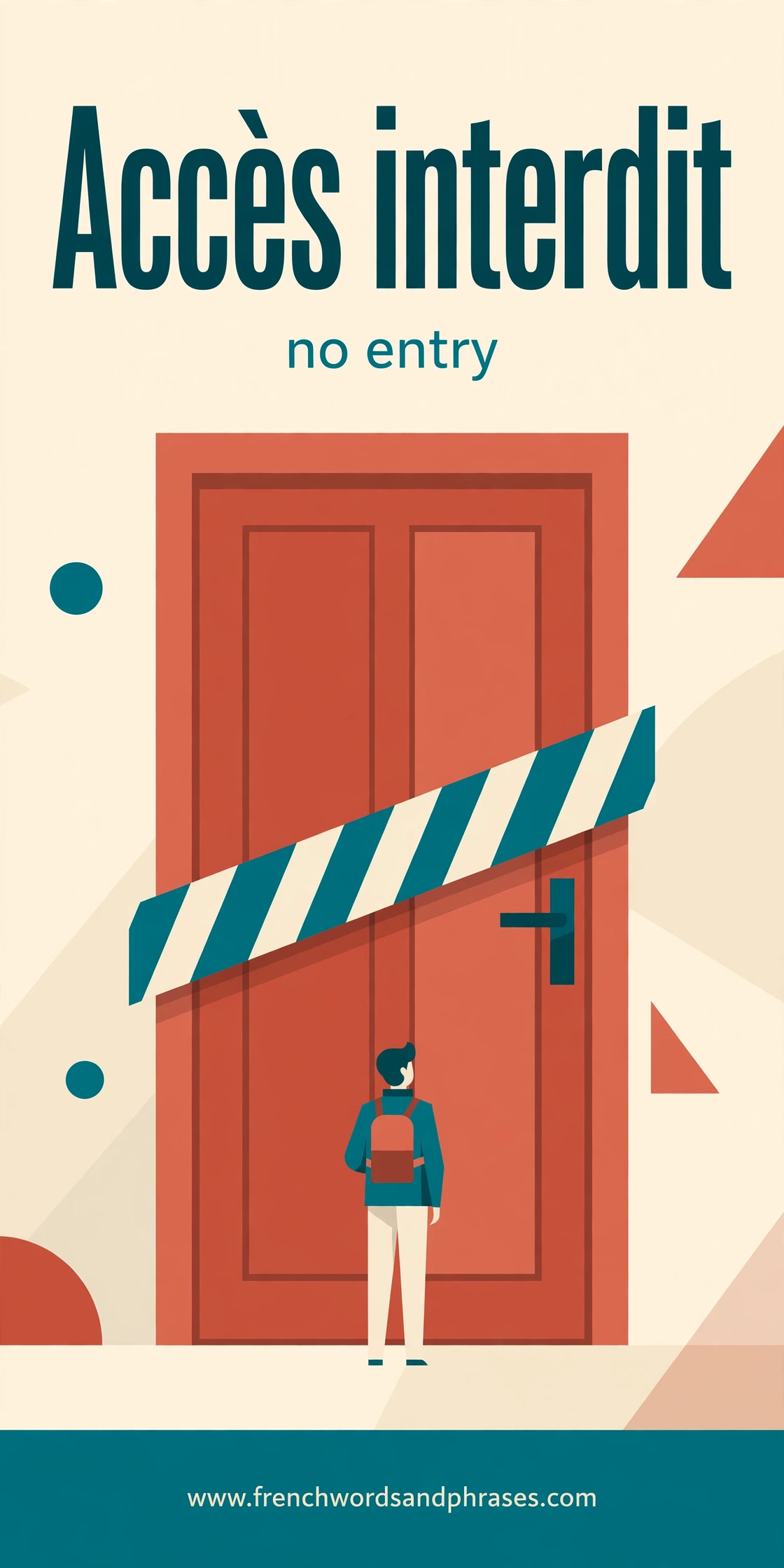
A French Word to Live By
Translate Accès interdit to English
/ak.sɛ ɛ̃.tɛʁ.di/
Accès interdit means no entry — the sign that forbids entering a place.
At the end of the corridor, past the last office, a door carries two words in red capitals under a crossed-out figure: ACCÈS INTERDIT. You do not need a dictionary. You turn around — which is exactly what the sign was written to make you do.
Let’s explore how accès interdit works in French, beginning with the whole sign on one card.
Understanding the French Phrase Accès interdit
Accès interdit is a French sign formula built from accès (access, entry — a masculine noun, un accès) and interdit (forbidden — the past participle of interdire, to forbid, working as an adjective). Word for word: access forbidden. It is not quite a sentence — it is a label, the language of doors, fences and barriers, written to be read in half a second.
It means no entry — nobody may go in. You will meet it on building sites, staff doors, military ground, private land and the back rooms of every shop and station in France. It is the official, impersonal way to close a space: no please, no explanation, no exceptions — and its close family (défense d’entrer, entrée interdite, interdit au public) covers the same ground with slightly different uniforms.
Type: Sign formula — prohibition (accès + interdit)
Answers the need: Closing a place to everyone who is not authorised
Register: Official and impersonal — the language of notices and regulations
Strength: Absolute — no exceptions are written, so none are offered
One important usage detail: interdit agrees with the noun it closes — accès is masculine, so accès interdit; but entrée is feminine, so the sister sign reads entrée interdite, with an e. The participle comes from interdire, and the family is everywhere in French public life: stationnement interdit (no parking), interdit aux chiens (no dogs), formellement interdit (strictly forbidden).
Experience the Word
Accès interdit is probably the first French you ever obeyed — read at a glance, in a corridor, at a fence, understood before it was translated.
Imagine the small harbour at dawn, the fishermen’s quay empty, a chain across the steps and a weathered board: ACCÈS INTERDIT. The gulls ignore it. You, being neither gull nor fisherman, photograph the boats from behind the chain like everyone else.
English writes NO ENTRY in the same red shout. French builds the same wall out of grammar: a noun for the door, and a participle for the lock.
How to Use Accès interdit in French: Complete Guide
Let’s explore how accès interdit works in French, beginning with the whole sign on one card.
Accès interdit at a Glance
The Whole Sign on One Card
Real meaning, literal picture, English twin and register — accès interdit in five lines.
| Point | Accès interdit |
|---|---|
| What it really means | no entry — nobody may go in |
| Word for word | access forbidden — accès (entry) + interdit (forbidden) |
| English equivalent | no entry / no admittance / keep out |
| Register | official and impersonal — signs, fences, regulations |
| Use it for | staff areas, building sites, private land, danger zones |
Example
Sur la porte, on lit : « Accès interdit ».
On the door, it reads: “No entry”.
Word by Word: Building the Wall
Two pieces — take them one by one and the barrier assembles itself.
| Word | Literal meaning | Its job in the sign |
|---|---|---|
| accès | access, entry | the thing being closed — a masculine noun: un accès |
| interdit | forbidden | the lock — past participle of interdire, agreeing with accès |
Example
L’accès à la cour est interdit aux visiteurs.
Access to the yard is forbidden to visitors.
Quick Quiz 1
Why does the sister sign say entrée interdite with an extra e?
Reveal the answer
Because entrée is feminine — interdit agrees with its noun: accès interdit (masculine), entrée interdite (feminine).
Accès interdit, entrée interdite : même porte, même message.
No entry, no entrance: same door, same message.
Where You Meet It: The Sign in Its World
Accès interdit turns up in places like these — wherever a space changes from public to forbidden.
| Situation | Example |
|---|---|
| A building site | chantier : accès interdit — building site: no entry |
| A staff door | accès interdit, réservé au personnel — no entry, staff only |
| Private land | propriété privée, accès interdit — private property, no entry |
| A danger zone | danger : accès interdit — danger: keep out |
| A closed path | sentier fermé, accès interdit — path closed, no entry |
Example
Le chantier est entouré de panneaux « Accès interdit ».
The building site is surrounded by “No entry” signs.
Make It Yours: The Sign in Sentences
On the sign the formula is frozen — in sentences, accès and interdire unfold into full grammar.
| Form | French | In English |
|---|---|---|
| The sign | accès interdit | no entry |
| A full sentence | l’accès est interdit | entry is forbidden |
| Forbidden to someone | accès interdit au public | no entry for the public |
| Staff only | accès interdit sauf au personnel | no entry except for staff |
| The verb form | il est interdit d’entrer | it is forbidden to enter |
Example
L’accès est interdit au public pendant les travaux.
Entry is forbidden to the public during the works.
Quick Quiz 2
Complete it: L’entrée est ______. (forbidden, feminine)
Reveal the answer
interdite — entrée is feminine, so interdit takes an e.
L’entrée est interdite aux visiteurs.
Entrance is forbidden to visitors.
Everyday Expressions: The Sign Family
Accès interdit belongs to a whole family of public prohibitions — learn one, read them all.
| Frame | In English |
|---|---|
| défense d’entrer | no entry — literally, forbidden to enter (older, sterner) |
| entrée interdite | no entrance — the feminine twin |
| interdit au public | closed to the public |
| stationnement interdit | no parking |
| interdit aux chiens | no dogs allowed |
Example
« Défense d’entrer » annonce la vieille pancarte, encore plus sévère.
“No entry” says the old sign, sterner still.
Close Cousins: The Other Ways to Close a Door
French closes spaces at several temperatures — accès interdit is the official one; its cousins warn, reserve or explain.
| Expression | The difference |
|---|---|
| accès interdit | no entry — official, absolute, for everyone unauthorised |
| réservé au personnel | staff only — closes the door by saying who may open it |
| propriété privée | private property — closes by ownership, not by rule |
| passage interdit | no thoroughfare — closes a way through, not a room |
| ne pas entrer | do not enter — the plain instruction, almost a request |
Example
Réservé au personnel ou accès interdit : la porte reste fermée.
Staff only or no entry: the door stays shut.
Quick Quiz 3
A door says réservé au personnel. Can a visitor enter — and what does the sign literally say?
Reveal the answer
No — the sign says reserved for staff: it closes the door by naming the only people allowed through it.
Cette porte est réservée au personnel, les visiteurs attendent ici.
This door is for staff only, visitors wait here.
Accès interdit and Its Neighbours
The public-notice shelf around the sign — doors, bans and barriers.
| French | In English |
|---|---|
| un panneau | a sign, a notice board |
| une barrière | a barrier, a fence |
| interdire | to forbid, to ban |
| le personnel | the staff |
| un chantier | a building site |
Example
Un panneau et une barrière suffisent : accès interdit.
A sign and a barrier are enough: no entry.
Watch Out: The Traps Around Accès interdit
The traps: the agreeing participle, and a cousin that means something medical.
| Trap | The truth |
|---|---|
| « entrée interdit » | entrée is feminine: entrée interdite — the participle always agrees |
| accès read as “success” | un accès is an entry or an access point here — and, in another life, a sudden fit (un accès de fièvre) |
| interdit as a noun | un interdit is a ban or a taboo — the sign uses the participle, not the noun |
| expecting a please | official French does not soften its bans: the absence of politeness is part of the message |
Example
Pas de « s’il vous plaît » sur le panneau : accès interdit, point.
No “please” on the sign: no entry, full stop.
Quick Quiz 4
True or false: accès interdit is a complete sentence with a verb.
Reveal the answer
False — it is a label: a noun plus a participle, with the verb (est) understood. Signs drop verbs to be read in half a second.
Sur un panneau, pas de verbe : accès interdit suffit.
On a sign, no verb: no entry is enough.
Accès interdit in Everyday French: Real-Life Examples
Now that you know the word, let’s see how accès interdit appears in everyday French.
Example 1 — On a door
La porte du fond porte l’inscription « Accès interdit ».
The door at the back bears the words “No entry”.
Example 2 — A building site
Accès interdit : le chantier est dangereux.
No entry: the building site is dangerous.
Example 3 — At the station
Cette zone est en accès interdit pour les voyageurs.
This area is no entry for passengers.
Example 4 — Private land
Propriété privée, accès interdit, dit la pancarte.
Private property, no entry, says the sign.
Example 5 — Obeying
Il a vu le panneau « Accès interdit » et a fait demi-tour.
He saw the “No entry” sign and turned back.
Example 6 — Staff only
Accès interdit sauf au personnel de service.
No entry except for staff on duty.
Beyond Translation: The Meaning of Accès interdit
Every language keeps a special voice for its walls, and French’s is pure grammar: a noun and a participle, no verb, no person, no please. Accès interdit does not address you — it simply describes the door, and leaves you to draw the conclusion.
That impersonality is the authority: nobody is forbidding you, the place itself is forbidden.
Learn to read this one sign and the whole family unlocks — stationnement interdit, entrée interdite, interdit aux chiens — the small red grammar of French public life.
How to Remember the French Phrase Accès interdit
Remember it this way: Accès interdit means no entry — access forbidden: accès, the entry, plus interdit, forbidden, agreeing with its noun.
- You read it as a label — accès the door, interdit the lock, no verb needed.
- You agree the lock — accès interdit (masculine), entrée interdite (feminine).
- You know the family — défense d’entrer, interdit au public, stationnement interdit.
The key idea is accès interdit = no entry — accès (m.) + interdit; feminine twin: entrée interdite.
Test Your Knowledge of Accès interdit
Let’s see how much you’ve learned. Try answering these questions before revealing the answers.
Question 1
What does accès interdit mean?
Reveal the answer
No entry — access forbidden, nobody may go in.
Question 2
Which two words build the sign?
Reveal the answer
Accès (access, entry) and interdit (forbidden, from interdire).
Question 3
Translate: Entry is forbidden to the public.
Reveal the answer
L’accès est interdit au public.
Question 4
How does the sign change for entrée?
Reveal the answer
Entrée interdite — entrée is feminine, so interdit takes an e.
Question 5
Complete the sentence:
Sur la porte du chantier : « Accès ______ ». (forbidden)
Reveal the answer
interdit
Accès interdit.
No entry — interdit agrees with accès, masculine.
Your Final Challenge
Can You Use It?
How would you say this in French?
“He saw the “no entry” sign and turned back.”
Reveal the answer
Il a vu le panneau « Accès interdit » et a fait demi-tour.
He saw the “no entry” sign and turned back.
A little French. A little curiosity. A richer everyday life.
LEARN FRENCH ONE WORD AT A TIME




