
A French Word to Live By
Translate Acajou to English
/a.ka.ʒu/
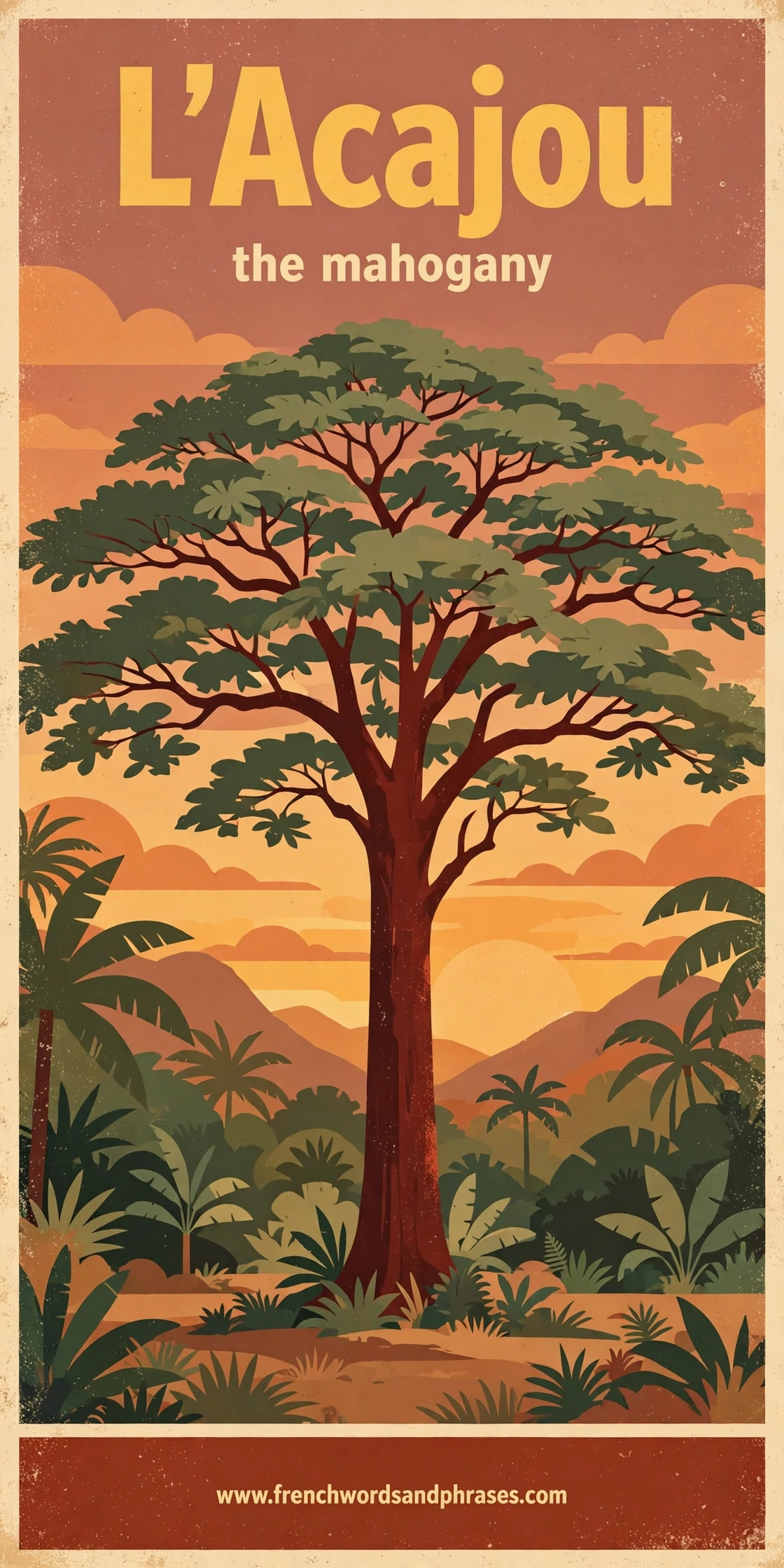
L’Acajou means the mahogany.
The cabinetmaker opens the workshop door and the warm red-brown glow of the wood meets him before the smell does: l’acajou, mahogany, the noble timber of empire furniture, guitars and grand pianos.
In this guide, you’ll learn what acajou means in English, how to use it with its articles, how to form its plural, and how it appears in everyday French. Explore French examples, English translations, and practice quizzes.
Understanding the French Noun Acajou
Acajou is a masculine French noun, learned with its article: l’acajou, un acajou. It begins with a vowel, so the article melts into it: l’acajou, never le acajou in speech. The word travelled from a Caribbean language through Portuguese and Spanish before reaching French, carrying the tree across the Atlantic in its name.
It means mahogany — first the tropical tree, then the precious reddish-brown wood cut from it, prized for furniture, boats and instruments because it resists rot and takes a deep polish. By extension, French uses acajou as a colour word: des cheveux acajou, mahogany hair, a rich auburn. The wood of the dining table, the colour of the hair — one word covers both.
Gender: Masculine — l’acajou
Definite article: l’ — l’acajou (the mahogany), melted before the vowel
Indefinite article: un — un acajou (a mahogany)
Plural: les acajous — regular, with a simple -s
Spelling note: from a Caribbean word, via Portuguese and Spanish — the tree named the wood
Two lives: the wood itself, and a reddish-brown colour (cheveux acajou)
English equivalents: The mahogany.
For the wood as a material, French usually leaves acajou bare after en: une table en acajou, a mahogany table. As a colour adjective it is invariable: une robe acajou, des reflets acajou — no agreement, no plural -s, like marron and orange.
Experience the Word
Acajou is the colour of polished wood in a sunlit room — the red-brown that deepens with age instead of fading.
Imagine the old desk in a notary’s study, darkened by a century of hands, its surface glowing like embers under the lamp: that glow is acajou, and carpenters cross oceans for it.
You have not just named a tree. You have named the wood of heirlooms — l’acajou, mahogany, the timber that outlives its makers.
How to Use Acajou in French: Complete Guide
Let’s explore how acajou works in French, beginning with its articles — l’acajou, un acajou, en acajou.
Acajou with the Definite Article (L’, Les)
Used for a specific mahogany — this tree, this wood. The vowel opening makes le melt into l’.
| Form | French |
|---|---|
| Masculine singular | l’acajou |
| Plural | les acajous |
Example
L’acajou de cette table vient du Honduras.
The mahogany of this table comes from Honduras.
Acajou with the Indefinite Article (Un, Des)
Used for mahogany in general — a tree in the forest, a plank in the yard.
| Form | French |
|---|---|
| Masculine singular | un acajou |
| Plural | des acajous |
Example
Un acajou centenaire domine la clairière.
A hundred-year-old mahogany towers over the clearing.
Acajou with the Partitive and Quantities (En acajou…)
As a material, acajou is named with en and measured in planks, not in articles.
| Quantity | French |
|---|---|
| made of mahogany | en acajou |
| a mahogany table | une table en acajou |
| a plank of mahogany | une planche d’acajou |
| solid mahogany | en acajou massif |
| mahogany-coloured | couleur acajou |
Example
Elle a acheté un bureau en acajou massif.
She bought a desk in solid mahogany.
Quick Quiz 1
Complete the sentence:
______ acajou est un bois précieux. (the)
Reveal the answer
L’
L’acajou est un bois précieux.
Mahogany is a precious wood — le melts into l’ before the vowel.
The Plural of Acajou
Acajou takes a regular plural in -s, whether you mean the trees or the woods.
| Number | French |
|---|---|
| Singular | l’acajou |
| Plural | les acajous |
Example
Les acajous sont protégés dans plusieurs pays.
Mahoganies are protected in several countries.
Acajou with Possessive Adjectives (Mon, Ton, Son…)
Possessives agree with the noun: acajou is masculine, so mon, ton, son in the singular.
| Owner | French |
|---|---|
| my | mon acajou |
| your (tu) | ton acajou |
| his / her | son acajou |
| our | notre acajou |
| your (vous) | votre acajou |
| their | leur acajou |
Example
Son acajou préféré sert à fabriquer des guitares.
His favourite mahogany is used to make guitars.
Quick Quiz 2
Complete the sentence:
Il polit ______ acajou avec un chiffon doux. (his)
Reveal the answer
son
Il polit son acajou avec un chiffon doux.
He polishes his mahogany with a soft cloth — son, because acajou is masculine.
Acajou with Demonstrative Adjectives (Cet, Ces)
Used to point: cet acajou, this mahogany — cet, because the noun begins with a vowel.
| Form | French |
|---|---|
| Masculine singular | cet acajou |
| Plural | ces acajous |
Example
Cet acajou fera une magnifique commode.
This mahogany will make a magnificent chest of drawers.
Acajou with Adjectives
Adjectives agree with acajou — masculine singular — except acajou itself as a colour, which never changes.
| Adjective | With Acajou |
|---|---|
| massif (solid) | un acajou massif |
| précieux (precious) | un acajou précieux |
| ancien (old) | un acajou ancien |
| poli (polished) | un acajou poli |
| acajou (mahogany-coloured, invariable) | des cheveux acajou |
Example
Ses cheveux acajou brillent au soleil.
Her mahogany hair shines in the sun.
Quick Quiz 3
Complete the sentence:
Elle a choisi une armoire en acajou ______. (solid)
Reveal the answer
massif
Elle a choisi une armoire en acajou massif.
She chose a wardrobe in solid mahogany — massif, masculine, to agree with acajou.
Everyday Expressions with Acajou
Workshops, forests and hair salons — the acajou phrases of daily life.
| Expression | In English |
|---|---|
| en acajou | in mahogany, made of mahogany |
| en acajou massif | in solid mahogany |
| une planche d’acajou | a plank of mahogany |
| des cheveux acajou | mahogany hair |
| la couleur acajou | the mahogany colour |
Example
Le salon expose une table basse en acajou.
The showroom displays a coffee table in mahogany.
Words from the Same Family as Acajou
Precious woods and warm colours — the words that travel with acajou.
| French | In English |
|---|---|
| le bois | the wood |
| l’ébène | the ebony |
| le chêne | the oak |
| le noyer | the walnut (tree and wood) |
| l’ébéniste | the cabinetmaker |
Example
L’ébéniste préfère l’acajou pour les meubles fins.
The cabinetmaker prefers mahogany for fine furniture.
Quick Quiz 4
What does en acajou massif mean?
Reveal the answer
In solid mahogany — made of solid mahogany wood, not veneer.
Ce bureau est en acajou massif.
This desk is in solid mahogany.
Acajou in Everyday French: Real-Life Examples
Now that you know the word, let’s see how acajou appears in everyday French.
Example 1 — The workshop
L’ébéniste travaille l’acajou avec patience.
The cabinetmaker works the mahogany with patience.
Example 2 — The forest
L’acajou pousse dans les forêts tropicales.
Mahogany grows in tropical forests.
Example 3 — Furniture
Cette commode en acajou date du XIXe siècle.
This chest of drawers in mahogany dates from the 19th century.
Example 4 — Hair colour
Elle a teint ses cheveux en acajou.
She dyed her hair mahogany.
Example 5 — Music
Le corps de la guitare est en acajou.
The body of the guitar is made of mahogany.
Example 6 — Protection
L’acajou est une espèce protégée.
Mahogany is a protected species.
Beyond Translation: The Meaning of Acajou
Acajou crossed the Atlantic twice: first as a tree name in a Caribbean language, then as the wood itself in the holds of ships. For two centuries it was the timber of luxury — the wood of ship captains’ cabins, of Parisian commodes and of the first grand pianos — until over-cutting made it rare and protected. French keeps the word warm: it names both the wood and the glowing auburn colour borrowed from it.
To say acajou is to see the red-brown glow of polished wood.
It evokes the cabinetmaker’s workshop and the forest canopy at once — the tree and the heirloom in a single word.
How to Remember the French Noun Acajou
Remember it this way: Acajou is mahogany — the precious red-brown wood, and the colour named after it: l’acajou, un meuble en acajou.
- Always masculine — l’acajou, un acajou, cet acajou.
- The material phrase — en acajou, made of mahogany; en acajou massif, solid mahogany.
- The colour — des cheveux acajou, mahogany hair, and as a colour the word never changes.
The key idea is l’acajou — the mahogany, masculine; the precious wood and its auburn colour.
Test Your Knowledge of Acajou
Let’s see how much you’ve learned. Try answering these questions before revealing the answers.
Question 1
Is acajou masculine or feminine?
Reveal the answer
Masculine — l’acajou, un acajou (the article melts before the vowel).
Question 2
How do you say a mahogany table?
Reveal the answer
Une table en acajou.
Question 3
Translate: Her hair is mahogany.
Reveal the answer
Ses cheveux sont acajou.
Question 4
Does the colour word acajou agree with its noun?
Reveal the answer
No — as a colour it is invariable: des robes acajou, never acajous.
Question 5
Complete the sentence:
______ acajous de la réserve sont centenaires. (the)
Reveal the answer
Les
Les acajous de la réserve sont centenaires.
The mahoganies of the reserve are a hundred years old.
Your Final Challenge
Can You Use It?
How would you say this in French?
“This desk is made of solid mahogany.”
Reveal the answer
Ce bureau est en acajou massif.
This desk is made of solid mahogany.
A little French. A little curiosity. A richer everyday life.
LEARN FRENCH ONE WORD AT A TIME




