A French Word to Live By
Translate Acacia to English
/a.ka.sja/
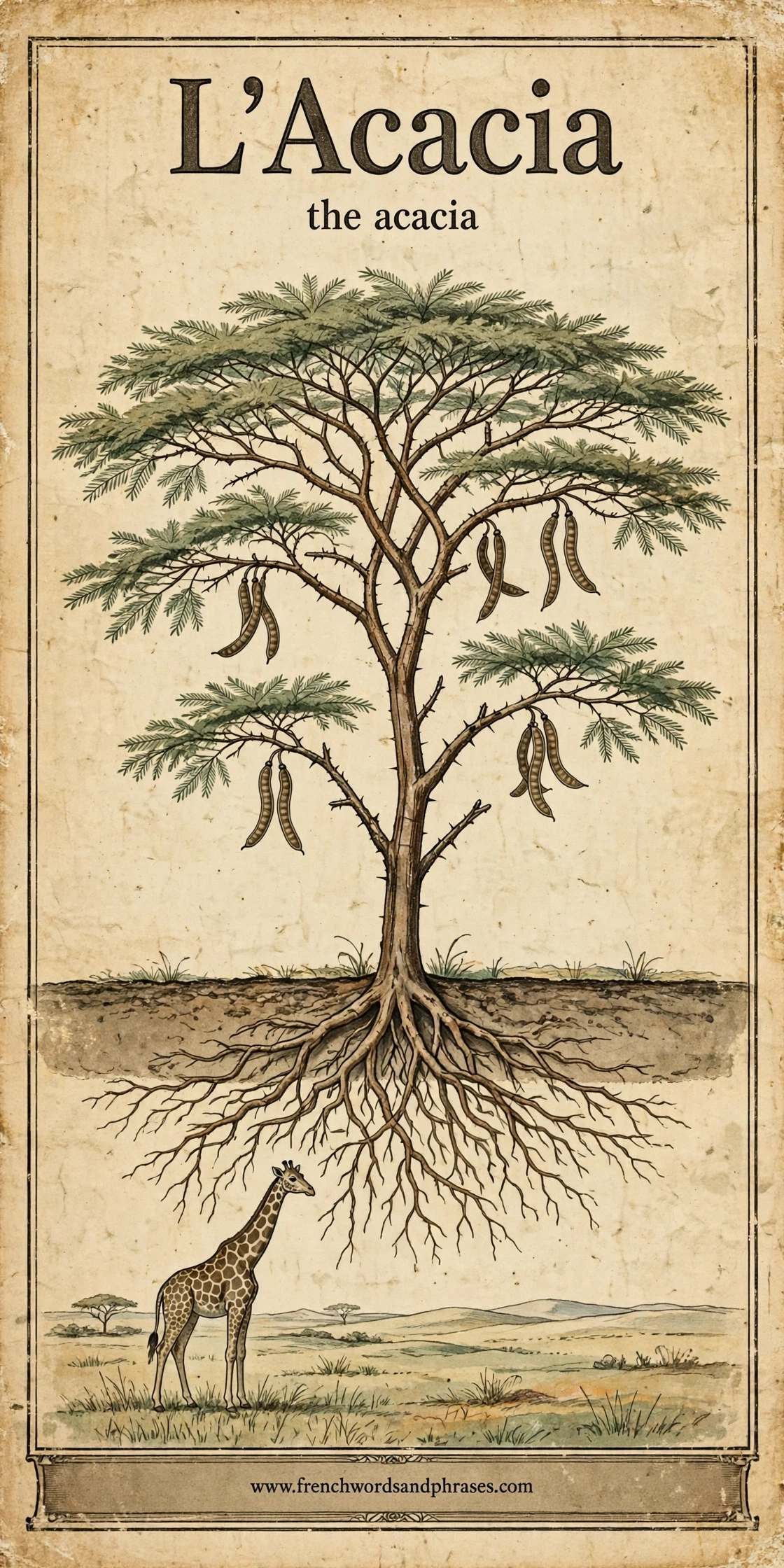
L’Acacia means the acacia.
Late spring in a village garden: a small tree opens clouds of golden flowers, the bees arrive by the hundred, and the air turns sweet. Under its light shade, a beekeeper smiles — the honey this year will be pale and delicate. The tree is l’acacia.
In this guide, you’ll learn what acacia means in English, how to use it with its articles, how to form its plural, and how it appears in everyday French. Explore French examples, English translations, and practice quizzes.
Understanding the French Noun Acacia
Acacia is a masculine French noun — and that surprises many learners, who expect a feminine word. It is learned with its article: l’acacia, un acacia — it begins with a vowel, so le shrinks to l’, hiding the gender completely.
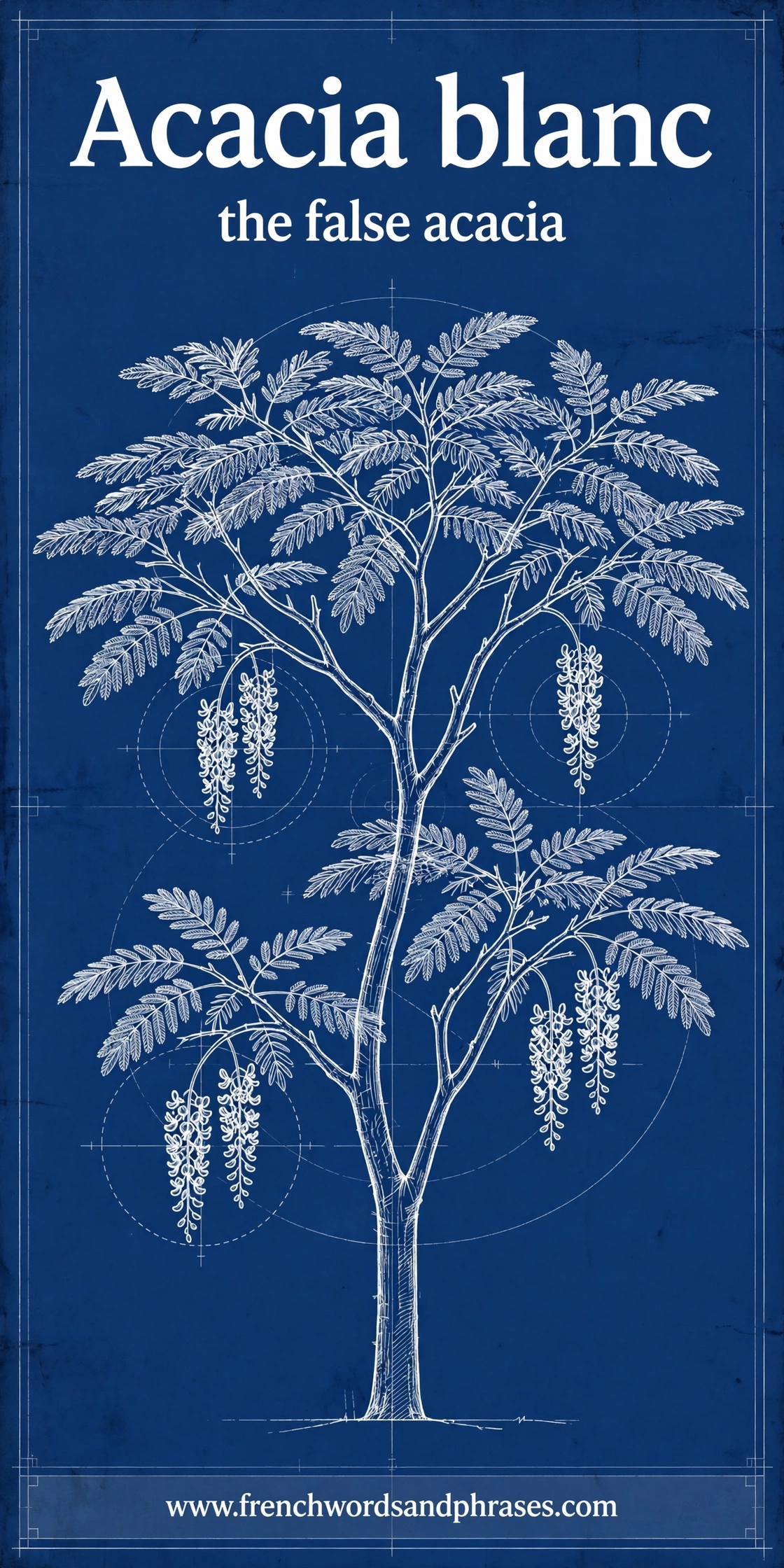
It means the acacia — the thorny tree of warm countries, famous in the African savanna for its flat crown, and loved in France for its fragrant flowers and its honey: le miel d’acacia, acacia honey, the clearest and mildest of honeys, which never crystallises. Be careful with one neighbour: the tree commonly planted along French roads and called faux acacia is really le robinier — a cousin, not the true acacia.
Gender: Masculine — l’acacia, un acacia (a famous trap: not feminine)
Definite article: l’ — l’acacia (the acacia)
Indefinite article: un — un acacia (an acacia)
Plural: les acacias
Not to confuse: le robinier — the false acacia (faux acacia), the roadside tree with white flowers
English equivalents: The acacia.
One important usage detail: because l’ hides the gender, the truth appears only when an adjective or a pronoun points at the tree: l’acacia est fleuri, the acacia is in flower — fleuri, masculine. Learn the gender with the word, since the article will never tell you.
Experience the Word
Acacia is more than a tree. It is the umbrella of the savanna in every schoolbook picture, the shade where the lions rest at noon — and, closer to home, the golden week of spring when the garden smells of honey before the honey exists.
Imagine the beekeeper among his hives at dawn, watching the first bees rise toward the flowering branches: in a fortnight, those visits will become jars of the palest gold.
You have not just named a tree. You have tasted spring in advance — le printemps en avance.
How to Use Acacia in French: Complete Guide
Let’s explore how acacia works in French, beginning with its articles — and with the trap of its hidden masculine gender.
Acacia with the Definite Article (L’, Les)
Acacia begins with a vowel, so le shrinks to l’ — l’acacia, the tree everyone in the garden knows.
| Form | French |
|---|---|
| Singular | l’acacia |
| Plural | les acacias |
Example
L’acacia du jardin fleurit au mois de mai.
The acacia in the garden flowers in May.
Acacia with the Indefinite Article (Un, Des)
Used for an acacia in general — and un reveals the secret: the word is masculine.
| Form | French |
|---|---|
| Masculine singular | un acacia |
| Plural | des acacias |
Example
Il a planté un acacia près de la terrasse.
He planted an acacia near the terrace.
Under the Acacia: Flowers, Bees and Honey
Thorns, golden flowers and pale honey — the vocabulary that surrounds l’acacia.
| French | In English |
|---|---|
| les fleurs jaunes | the yellow flowers |
| les épines | the thorns |
| le miel d’acacia | acacia honey |
| l’ombre | the shade |
| les abeilles | the bees |
| la savane | the savanna |
Example
Les abeilles couvrent l’acacia dès le matin.
The bees cover the acacia from the morning on.
Quick Quiz 1
Complete the sentence — and watch the trap:
______ acacia est fleuri cette année.
Reveal the answer
L’
L’acacia est fleuri cette année.
The acacia is in flower this year — and fleuri, in the masculine, proves the word is masculine.
The Plural of Acacia
Acacia adds an -s in the plural — les acacias, the flat crowns of the savanna.
| Number | French |
|---|---|
| Singular | l’acacia |
| Plural | les acacias |
Example
Les acacias donnent leur ombre aux animaux de la savane.
The acacias give their shade to the animals of the savanna.
Acacia with Possessive Adjectives (Mon, Ton, Son…)
Possessives agree with the noun — and acacia is masculine, so it takes mon, ton, son.
| Owner | French |
|---|---|
| my | mon acacia |
| your (tu) | ton acacia |
| his / her | son acacia |
| our | notre acacia |
| your (vous) | votre acacia |
| their | leur acacia |
Example
Mon acacia attire toutes les abeilles du quartier.
My acacia attracts all the bees of the neighbourhood.
Quick Quiz 2
Complete the sentence:
______ acacia a doublé de taille en trois ans. (Our)
Reveal the answer
Notre
Notre acacia a doublé de taille en trois ans.
Our acacia has doubled in size in three years.
Acacia with Demonstrative Adjectives (Cet, Ces)
Used to point: cet acacia, with cet because the word begins with a vowel.
| Form | French |
|---|---|
| Masculine singular | cet acacia |
| Plural | ces acacias |
Example
Cet acacia parfume tout le jardin au printemps.
This acacia perfumes the whole garden in spring.
Acacia with Adjectives
Adjectives reveal the masculine gender at last: fleuri, parfumé, épineux.
| Adjective | With Acacia |
|---|---|
| fleuri (in flower) | un acacia fleuri |
| parfumé (fragrant) | un acacia parfumé |
| épineux (thorny) | un acacia épineux |
| jeune (young) | un jeune acacia |
| africain (African) | un acacia africain |
Example
Un acacia fleuri attire des centaines d’abeilles.
An acacia in flower attracts hundreds of bees.
Quick Quiz 3
Complete the sentence:
L’acacia est ______ cette année. (in flower)
Reveal the answer
fleuri
L’acacia est fleuri cette année.
The acacia is in flower this year — fleuri, masculine, not fleurie.
Everyday Expressions with Acacia
Honey, shade and spring — the acacia phrases of daily life.
| Expression | In English |
|---|---|
| le miel d’acacia | acacia honey |
| à l’ombre d’un acacia | in the shade of an acacia |
| les fleurs d’acacia | acacia flowers |
| un acacia en fleurs | an acacia in flower |
| planter un acacia | to plant an acacia |
| le bois d’acacia | acacia wood |
Example
Le miel d’acacia reste liquide très longtemps.
Acacia honey stays liquid for a very long time.
Words from the Same Family as Acacia
Trees, cousins and honey — the words that travel with acacia.
| French | In English |
|---|---|
| le robinier | the false acacia, the black locust |
| le mimosa | the mimosa (a close cousin) |
| le miel | honey |
| une abeille | a bee |
| fleurir | to flower |
| un arbre | a tree |
Example
Le robinier ressemble à l’acacia, mais ce n’est pas le même arbre.
The false acacia resembles the acacia, but it is not the same tree.
Quick Quiz 4
What is le miel d’acacia famous for?
Reveal the answer
Staying liquid and mild — acacia honey is the clearest of honeys and almost never crystallises.
Le miel d’acacia ne cristallise presque jamais.
Acacia honey almost never crystallises.
Acacia in Everyday French: Real-Life Examples
Now that you know the word, let’s see how acacia appears in everyday French.
Example 1 — In the garden
L’acacia du jardin est couvert de fleurs jaunes.
The acacia in the garden is covered with yellow flowers.
Example 2 — At the market
Elle achète un pot de miel d’acacia au marché.
She buys a jar of acacia honey at the market.
Example 3 — In the savanna
Les girafes mangent les feuilles des acacias.
The giraffes eat the leaves of the acacias.
Example 4 — Planting
Nous avons planté un acacia près de la maison.
We planted an acacia near the house.
Example 5 — A bee lesson
Les abeilles adorent les fleurs de l’acacia.
The bees love the flowers of the acacia.
Example 6 — Seeking shade
À midi, tout le village se repose à l’ombre d’un acacia.
At midday, the whole village rests in the shade of an acacia.
Beyond Translation: The Meaning of Acacia
The acacia carries two worlds in one word: the flat-topped giant of the African savanna, drawn in every child’s book of animals, and the modest garden tree whose flowers feed the bees of France for one golden fortnight. Its honey is a small miracle of patience — the only common honey that refuses to crystallise, staying clear as glass in the jar.
To say acacia is to name the tree that turns sunlight into honey.
It evokes the giraffe at the thorny branches, the beekeeper at dawn, the jar of pale gold on the breakfast table — and a gender trap that has caught generations of learners, hidden behind its innocent l’.
How to Remember the French Noun Acacia
Remember it this way: Acacia is the acacia — a masculine tree hiding behind l’: un acacia, l’acacia est fleuri.
- You learn the trap — un acacia, masculin, pas féminin.
- You taste the honey — le miel d’acacia, clair et liquide.
- You watch the adjective — l’acacia est fleuri, avec un i, pas un e.
The key idea is l’acacia — masculine, whatever l’ suggests.
Test Your Knowledge of Acacia
Let’s see how much you’ve learned. Try answering these questions before revealing the answers.
Question 1
Is acacia masculine or feminine?
Reveal the answer
Masculine — l’acacia, un acacia. The elided article hides it, so learn it with the word.
Question 2
What reveals the gender of acacia in a sentence?
Reveal the answer
The adjective — l’acacia est fleuri, with the masculine fleuri.
Question 3
Translate: The bees love the flowers of the acacia.
Reveal the answer
Les abeilles adorent les fleurs de l’acacia.
Question 4
What is le robinier?
Reveal the answer
The false acacia — the roadside tree often confused with the true acacia.
Question 5
Complete the sentence:
______ acacia parfume tout le jardin. (This)
Reveal the answer
Cet
Cet acacia parfume tout le jardin.
This acacia perfumes the whole garden — cet, because the word begins with a vowel.
Your Final Challenge
Can You Use It?
How would you say this in French?
“The bees love the flowers of the acacia.”
Reveal the answer
Les abeilles adorent les fleurs de l’acacia.
The bees love the flowers of the acacia.
A little French. A little curiosity. A richer everyday life.
LEARN FRENCH ONE WORD AT A TIME