A French Word to Live By
Translate Abstrus to English
/apstʁy/
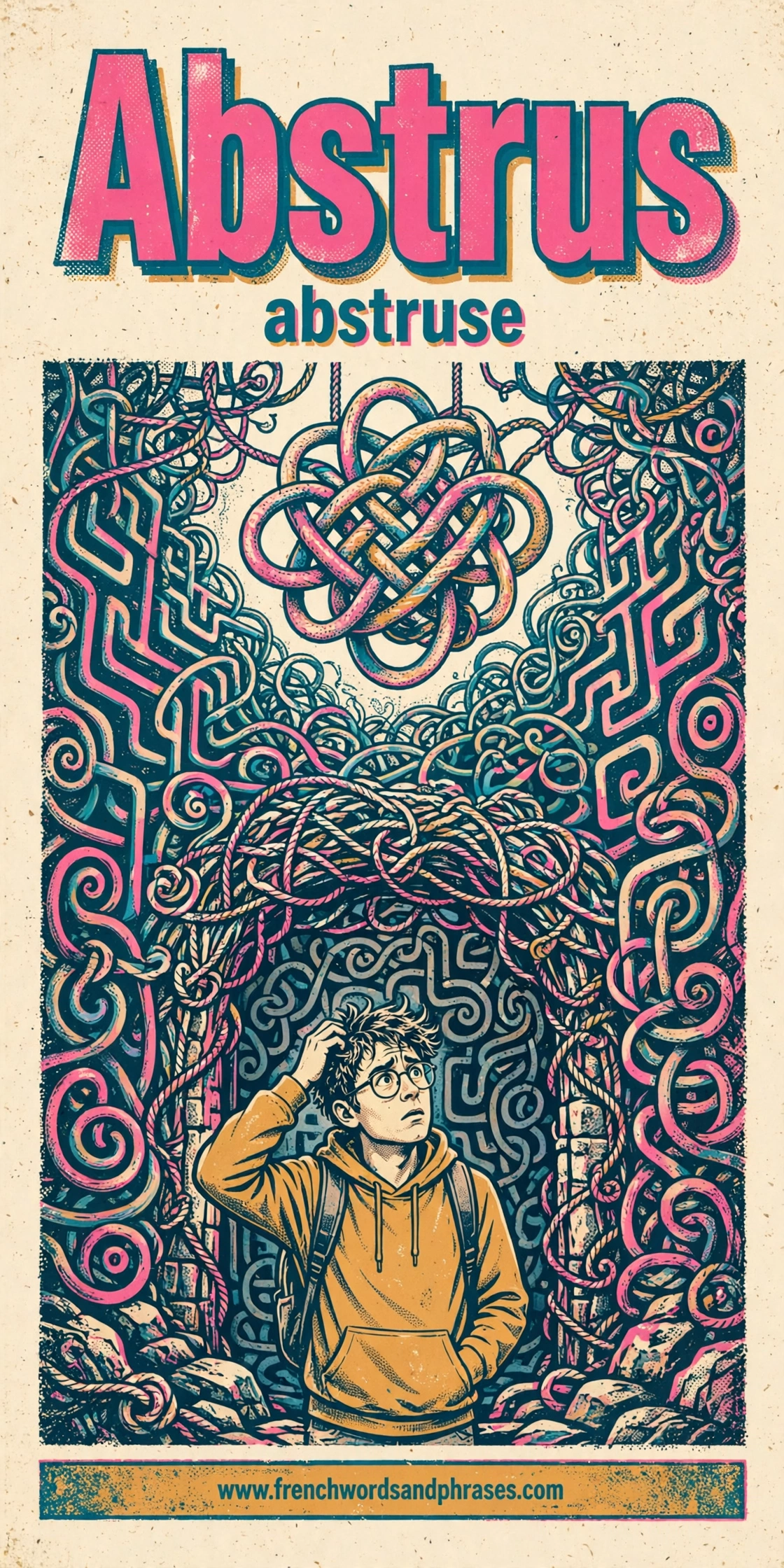
Abstrus means abstruse.
A student closes a heavy book at two in the morning and rubs his eyes. Three pages read, nothing understood — not because the ideas are foolish, but because they hide behind thickets of difficult words. French has a precise, slightly weary adjective for writing like that: abstrus.
In this guide, you’ll learn what abstrus means in English, how its feminine ends in -use, why it must not be confused with abstrait, and where this literary adjective still earns its place. Explore French examples, English translations, and practice quizzes.
Understanding the French Adjective Abstrus
Abstrus is a French literary adjective — it describes what is hard to understand, hidden away from easy comprehension. It agrees in the -us pattern: abstrus, abstruse, abstrus, abstruses. The masculine singular and plural are spelled the same, which suits a word that likes to keep things obscure.
It means abstruse — difficult to comprehend, obscure, deep in the pejorative sense of needlessly hard. It describes reasoning (un raisonnement abstrus), texts (un texte abstrus), theories and questions that resist understanding. Where abstrait simply means abstract, abstrus adds a complaint: this is hard to follow, perhaps harder than it needed to be.
Type: Adjective (literary) — difficulty of understanding
Answers the question: What is it like? — abstruse, hard to follow
Changes form: Yes — abstrus, abstruse, abstrus, abstruses
English equivalents: Abstruse; obscure; recondite.
One important usage detail: abstrus stands AFTER the noun — un raisonnement abstrus — and after être: ce passage est abstrus. It is a written, literary word; in conversation French more often says compliqué or incompréhensible.
Experience the Word
Abstrus is the adjective of the locked door in a text — the paragraph you read three times and salute, unenlightened, as you pass.
Imagine a medieval commentary on a commentary, translated from a translation, in which every sentence hides its verb like a secret. Generations of students have closed that book with the same sigh: abstrus.
You have not just called something difficult. You have accused it of hiding.
How to Use Abstrus in French: Complete Guide
Let’s explore how abstrus works in French, beginning with the whole word on one card.
Abstrus at a Glance
Before the details, here is the whole word on one card.
The Whole Word on One Card
Meaning, type, position and forms — abstrus in four lines.
| Point | Abstrus |
|---|---|
| Meaning | abstruse — difficult to understand |
| Type | literary adjective — obscurity |
| Usual position | after the noun — un texte abstrus |
| Form | abstrus / abstruse / abstrus / abstruses |
Example
Ce chapitre est abstrus, je l’ai lu trois fois.
This chapter is abstruse, I have read it three times.
The Four Forms of Abstrus
Abstrus hides a small trick: the masculine plural is spelled exactly like the singular. Only the feminine shows its endings clearly.
| Form | Abstrus | Example |
|---|---|---|
| Masculine singular | abstrus | un texte abstrus — an abstruse text |
| Feminine singular | abstruse | une théorie abstruse — an abstruse theory |
| Masculine plural | abstrus | des textes abstrus — abstruse texts |
| Feminine plural | abstruses | des théories abstruses — abstruse theories |
Example
Ces questions abstruses ont fatigué toute la classe.
These abstruse questions tired the whole class.
Quick Quiz 1
What is the feminine of abstrus?
Reveal the answer
abstruse
Une théorie abstruse — an abstruse theory.
The feminine ends in -use.
The Feminine of Abstrus: -us Becomes -use
Adjectives in -us build their feminine with -use — confus, confuse; abstrus, abstruse — and the sound changes completely.
| Situation | Example |
|---|---|
| Masculine | un raisonnement abstrus — abstruse reasoning |
| Feminine | une démonstration abstruse — an abstruse demonstration |
| Why | the -us pattern: the feminine ends in -use and is fully sounded |
| The plural | masculine unchanged, feminine adds s — des idées abstruses |
Example
Sa démonstration, abstruse et lente, a perdu l’auditoire.
Her demonstration, abstruse and slow, lost the audience.
Where Abstrus Goes: After the Noun
Abstrus follows the noun it describes, like most French adjectives, and it sits comfortably after être in the language of reviews and examinations.
| Pattern | Example |
|---|---|
| After the noun | un ouvrage abstrus — an abstruse work |
| After être | ce passage est abstrus — this passage is abstruse |
| With an adverb | un style inutilement abstrus — a needlessly abstruse style |
| Before the noun | un abstrus texte — not in everyday French |
Example
Le manuel est abstrus : même le professeur s’y perd.
The manual is abstruse: even the teacher gets lost in it.
Quick Quiz 2
How do you say ‘an abstruse text’ — un abstrus texte or un texte abstrus?
Reveal the answer
un texte abstrus
Abstrus stands after the noun.
An abstruse text.
More Abstruse: Comparing with Abstrus
Abstrus compares the regular way, with plus, moins and aussi — the scale on which students silently rank their textbooks.
| Degree | Example |
|---|---|
| As abstruse as | aussi abstrus que — as abstruse as |
| More abstruse | plus abstrus — more abstruse |
| Less abstruse | moins abstrus — less abstruse |
| The most abstruse (masc.) | le plus abstrus — le plus abstrus des traités |
| The most abstruse (fem.) | la plus abstruse — la plus abstruse des théories |
Example
Le second volume est encore plus abstrus que le premier.
The second volume is even more abstruse than the first.
Everyday Expressions with Abstrus
Everyday is generous again — these are the expressions of students, critics and anyone facing a difficult page.
| Expression | In English |
|---|---|
| un texte abstrus | an abstruse text |
| un raisonnement abstrus | abstruse reasoning |
| une question abstruse | an abstruse question |
| des considérations abstruses | abstruse considerations |
| un style abstrus | an abstruse style |
| trop abstrus pour moi | too abstruse for me |
Example
Ces considérations abstruses dépassent les étudiants de première année.
These abstruse considerations are beyond first-year students.
Quick Quiz 3
What does un raisonnement abstrus mean?
Reveal the answer
Abstruse reasoning
Un raisonnement abstrus est difficile à suivre.
Abstruse reasoning is hard to follow.
Abstrus and Its Neighbours
Abstrus must first be separated from abstrait; around them, French grades every shade of difficulty.
| French | In English |
|---|---|
| abstrait | abstract — of ideas, not necessarily hard to follow |
| obscur | obscure, dark — un passage obscur |
| compliqué | complicated — the everyday word |
| hermétique | hermetic, impenetrable — un style hermétique |
| incompréhensible | incomprehensible — the blunt verdict |
| limpide | crystal-clear — the opposite: un style limpide |
Example
Le même sujet peut être limpide chez un auteur et abstrus chez un autre.
The same subject can be crystal-clear in one author and abstruse in another.
Watch Out: The Traps Around Abstrus
The traps here are the famous false friend abstrait, and a masculine plural that refuses to change.
| Trap | The truth |
|---|---|
| abstrus ≠ abstrait | abstrait = abstract; abstrus = abstruse, hard to understand — a complaint, not a category |
| The masculine plural | des textes abstrus — no extra s, the form is already complete |
| The feminine | une question abstruse — with -use, fully sounded |
| Register | abstrus is literary; at the café, say compliqué or incompréhensible |
Example
Ce n’est pas abstrait, c’est abstrus : je ne comprends rien.
It’s not abstract, it’s abstruse: I understand nothing.
Quick Quiz 4
How do you say ‘an abstruse question’?
Reveal the answer
une question abstruse
Abstrus follows the noun, and its feminine ends in -use.
An abstruse question.
Abstrus in Everyday French: Real-Life Examples
Now that you know the word, let’s see how abstrus appears in everyday French.
Example 1 — Studying
Ce manuel est tellement abstrus que je prends des notes sur mes notes.
This manual is so abstruse that I take notes on my notes.
Example 2 — A review
Le critique juge le roman abstrus et prétentieux.
The critic finds the novel abstruse and pretentious.
Example 3 — Philosophy
Certaines questions abstruses occupent les philosophes depuis des siècles.
Certain abstruse questions have occupied philosophers for centuries.
Example 4 — At work
Ce rapport abstrus devra être réécrit pour le public.
This abstruse report will have to be rewritten for the public.
Example 5 — Honesty
Ton explication est abstruse pour moi, recommence simplement.
Your explanation is abstruse to me, start again simply.
Example 6 — Poetry
J’aime ces poèmes abstrus, je les relis chaque année.
I love these abstruse poems, I reread them every year.
Beyond Translation: The Meaning of Abstrus
English abstruse and French abstrus descend from the same Latin word, abstrusus — thrust away, hidden — and both languages reserve it for learning that hides itself. There is a quiet justice in the word: it sounds a little difficult itself, as if it wanted to demonstrate its meaning.
Abstrus is the reader’s revenge — one word that says the fault is in the text, not in you.
Keep it separate from abstrait and you hold a distinction French examiners love: a thing can be abstract and clear, or concrete and utterly abstrus.
How to Remember the French Adjective Abstrus
Remember it this way: Abstrus is the hard-to-follow adjective — -us becomes -use in the feminine, the masculine plural never changes, and it always carries a small complaint.
- You change the ending — un texte abstrus, une théorie abstruse.
- You leave the masculine plural alone — des textes abstrus.
- You separate the twins — abstrait parle des idées ; abstrus parle de la difficulté.
The key idea is abstrus means hard to understand — obscure by excess of depth or of fog.
Test Your Knowledge of Abstrus
Let’s see how much you’ve learned. Try answering these questions before revealing the answers.
Question 1
What does abstrus mean?
Reveal the answer
Abstruse — difficult to comprehend, obscure.
Question 2
What is the feminine of abstrus?
Reveal the answer
abstruse — une théorie abstruse.
Question 3
Translate: an abstruse text.
Reveal the answer
Un texte abstrus.
Question 4
Complete the sentence:
Cette démonstration est ______ .
Reveal the answer
abstruse
Cette démonstration est abstruse.
This demonstration is abstruse.
Question 5
What is the difference between abstrait and abstrus?
Reveal the answer
Abstrait means abstract (of ideas); abstrus means abstruse — hard to follow.
Your Final Challenge
Can You Use It?
How would you say this in French?
“His reasoning is too abstruse for me.”
Reveal the answer
Son raisonnement est trop abstrus pour moi.
His reasoning is too abstruse for me.
A little French. A little curiosity. A richer everyday life.
LEARN FRENCH ONE WORD AT A TIME