A French Word to Live By
How to Conjugate Abstraire in French
/ap.stʁɛʁ/
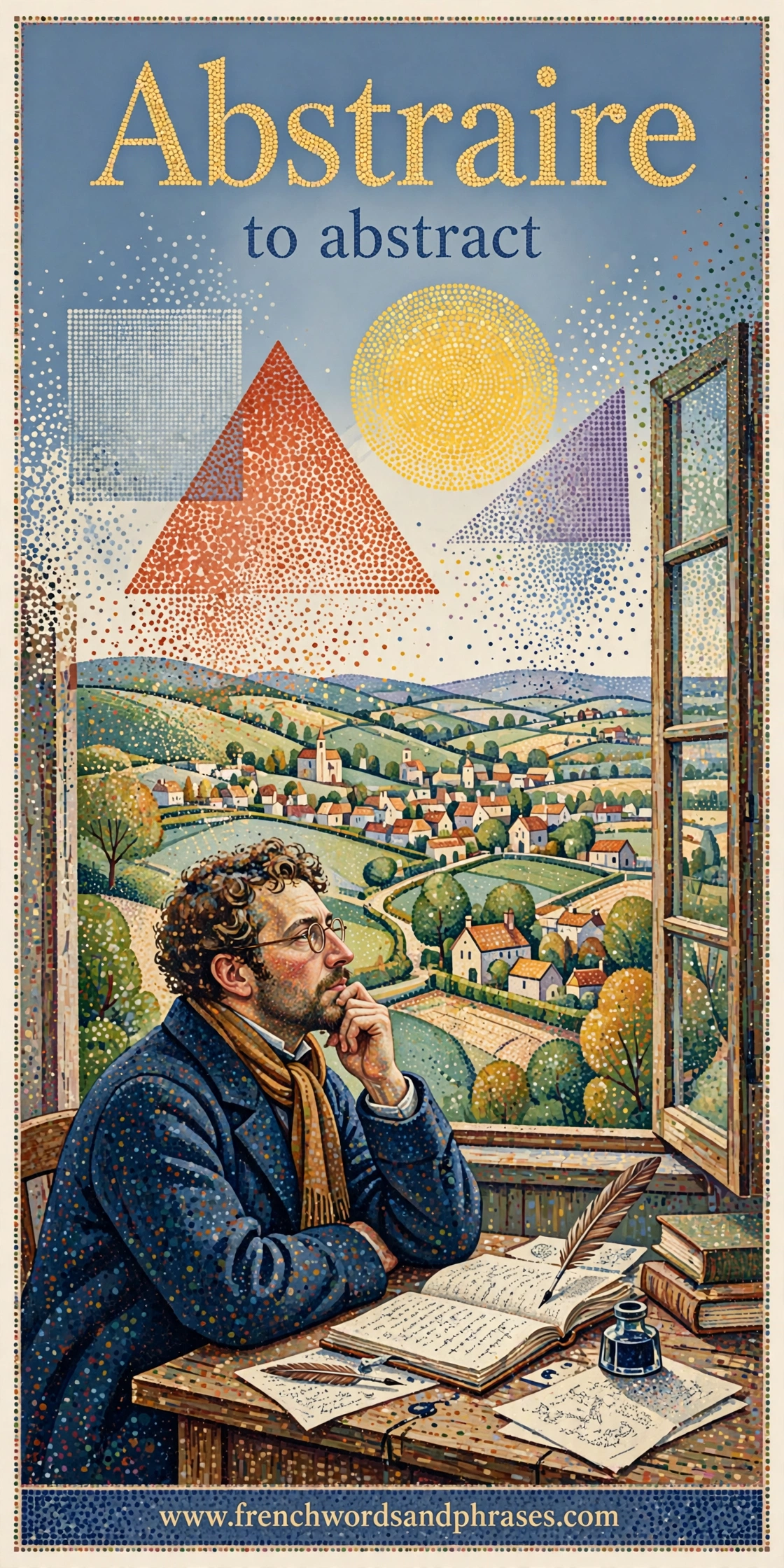
Abstraire means to abstract — to draw the general idea out of the particular thing, and consider it alone.
A painter reducing a landscape to three bands of colour, a mathematician lifting a rule out of a hundred examples, a thinker setting the world aside to keep only the idea — abstraire is the verb of extraction: it pulls the essence out of the example and leaves the example behind.
In this guide, you’ll learn how to conjugate abstraire in all the major French tenses and moods. Explore complete conjugation tables, French examples, English translations, and practice quizzes.
Understanding the French Verb Abstraire
Abstraire is an irregular French verb ending in -ire, conjugated like traire: it has no passé simple and no imperfect subjunctive.
It means to abstract. It is a verb of philosophers, mathematicians and artists: abstraire is what a mind does when it keeps the form and drops the matter — the rule from the examples, the shape from the landscape, the idea from the thing. Outside those worlds it is rare, and its adjective abstrait does the everyday work.
Verb classification: Irregular (-ire)
Auxiliary verb: Avoir
Past participle: abstrait
Present participle: abstrayant
English equivalents: To abstract, to extract (an idea); abstraire une règle d’exemples — to abstract a rule from examples; s’abstraire — to withdraw into thought, to shut out the world; abstrait — abstract (adjective and noun).
One important detail: abstraire belongs to the traire family — its present runs on the stem abstray- (nous abstrayons, en abstrayant), its past participle is the short, familiar abstrait — the very word French uses for ‘abstract’ — and two whole tenses are missing: abstraire has no passé simple and no imperfect subjunctive. Where a story would want them, French reaches for the passé composé instead: elle a abstrait la règle. Note also the reflexive: s’abstraire, to withdraw into your own thoughts, shutting the world out.
Experience the Word
Abstraire is the verb of the mind stepping back — from the hundred examples to the one rule that governs them all.
Imagine a painter before a harbour at dawn. Boats, ropes, gulls, reflections — she looks for a long time, then paints three bands: gold, grey, blue. Elle a abstrait le port — she has abstracted the harbour, kept its truth and let its details go, and the canvas says more about dawn than any photograph.
The harbour is still there, unchanged. Its idea has been abstracted — abstraite — and the idea travels where the harbour cannot.
How to Conjugate Abstraire: Complete French Conjugation Guide
Let’s explore every major conjugation of abstraire, beginning with the indicative mood.
How to Conjugate Abstraire in the Indicative Mood
The indicative mood is used to express facts, observations, actions, and events.
How to Conjugate Abstraire in the Present Tense (Présent)
Used for actions happening now, habitual actions, and general truths.
| Subject | Conjugation |
|---|---|
| je | abstrais |
| tu | abstrais |
| il / elle | abstrait |
| nous | abstrayons |
| vous | abstrayez |
| ils / elles | abstraient |
Example
Le philosophe abstrait la forme de la matière.
The philosopher abstracts form from matter.
Quick Quiz 1
Complete the sentence:
Nous ______ la règle de ces exemples.
Reveal the answer
abstrayons
Nous abstrayons la règle de ces exemples.
We are abstracting the rule from these examples.
How to Conjugate Abstraire in the Passé Composé
Used for completed actions in the past. Abstraire takes the auxiliary verb avoir.
| Subject | Conjugation |
|---|---|
| j’ | ai abstrait |
| tu | as abstrait |
| il / elle | a abstrait |
| nous | avons abstrait |
| vous | avez abstrait |
| ils / elles | ont abstrait |
Example
Elle a abstrait l’idée principale du texte.
She abstracted the main idea from the text.
How to Conjugate Abstraire in the Imparfait (Imperfect Tense)
Used for habitual past actions, descriptions, and ongoing situations in the past.
| Subject | Conjugation |
|---|---|
| je | abstrayais |
| tu | abstrayais |
| il / elle | abstrayait |
| nous | abstrayions |
| vous | abstrayiez |
| ils / elles | abstrayaient |
Example
Il abstrayait des formes géométriques de ses souvenirs.
He used to abstract geometric shapes from his memories.
Quick Quiz 2
Choose the correct form:
She abstracted the idea.
Elle ______ l’idée. (a abstrait / est abstraite)
Reveal the answer
a abstrait
Elle a abstrait l’idée.
Abstraire takes avoir.
How to Conjugate Abstraire in the Plus-que-parfait
Used to describe an action that had already been completed before another past event.
| Subject | Conjugation |
|---|---|
| j’ | avais abstrait |
| tu | avais abstrait |
| il / elle | avait abstrait |
| nous | avions abstrait |
| vous | aviez abstrait |
| ils / elles | avaient abstrait |
Example
L’artiste avait abstrait la lumière de tous ses tableaux.
The artist had abstracted light from all his paintings.
How to Conjugate Abstraire in the Passé Simple
Primarily used in formal writing, literature, and historical narratives. It is rarely used in everyday conversation.
| Subject | Conjugation |
|---|---|
| je | — |
| tu | — |
| il / elle | — |
| nous | — |
| vous | — |
| ils / elles | — |
Example
Abstraire n’a pas de passé simple : on dit « elle a abstrait la règle des exemples ».
Abstraire has no passé simple: you say ‘she abstracted the rule from the examples’ with the passé composé.
How to Conjugate Abstraire in the Passé Antérieur
A literary tense used to express an action completed immediately before another past action, generally in the passé simple.
| Subject | Conjugation |
|---|---|
| j’ | eus abstrait |
| tu | eus abstrait |
| il / elle | eut abstrait |
| nous | eûmes abstrait |
| vous | eûtes abstrait |
| ils / elles | eurent abstrait |
Example
Quand il eut abstrait le principe, il le formula en une phrase.
When he had abstracted the principle, he stated it in one sentence.
How to Conjugate Abstraire in the Future Tense (Futur Simple)
Used to describe actions that will take place in the future.
| Subject | Conjugation |
|---|---|
| je | abstrairai |
| tu | abstrairas |
| il / elle | abstraira |
| nous | abstrairons |
| vous | abstrairez |
| ils / elles | abstrairont |
Example
Demain, nous abstrairons la règle de ces exemples.
Tomorrow, we will abstract the rule from these examples.
How to Conjugate Abstraire in the Futur Antérieur (Future Perfect)
Used for an action that will have been completed before a particular point in the future.
| Subject | Conjugation |
|---|---|
| j’ | aurai abstrait |
| tu | auras abstrait |
| il / elle | aura abstrait |
| nous | aurons abstrait |
| vous | aurez abstrait |
| ils / elles | auront abstrait |
Example
À la fin du cours, vous aurez abstrait la loi générale.
By the end of the lesson, you will have abstracted the general law.
How to Conjugate Abstraire in the Near Future (Futur Proche)
Used to describe something that is going to happen soon. Formed with aller + infinitive.
| Subject | Conjugation |
|---|---|
| je | vais abstraire |
| tu | vas abstraire |
| il / elle | va abstraire |
| nous | allons abstraire |
| vous | allez abstraire |
| ils / elles | vont abstraire |
Example
Le peintre va abstraire les formes de ce paysage.
The painter is going to abstract the shapes from this landscape.
How to Conjugate Abstraire in the Conditional Mood
The conditional mood expresses what would happen under certain circumstances. It is also frequently used to make polite requests or express wishes.
How to Conjugate Abstraire in the Present Conditional
| Subject | Conjugation |
|---|---|
| je | abstrairais |
| tu | abstrairais |
| il / elle | abstrairait |
| nous | abstrairions |
| vous | abstrairiez |
| ils / elles | abstrairaient |
Example
Sans ces exemples, on abstrairait difficilement la règle.
Without these examples, we would abstract the rule with difficulty.
How to Conjugate Abstraire in the Past Conditional
| Subject | Conjugation |
|---|---|
| j’ | aurais abstrait |
| tu | aurais abstrait |
| il / elle | aurait abstrait |
| nous | aurions abstrait |
| vous | auriez abstrait |
| ils / elles | auraient abstrait |
Example
Il aurait abstrait la forme sans le modèle sous les yeux.
He would have abstracted the form without the model before his eyes.
Abstraire in the Literary Past Conditional Form
This less common literary form uses the imperfect subjunctive of avoir.
| Subject | Conjugation |
|---|---|
| j’ | eusse abstrait |
| tu | eusses abstrait |
| il / elle | eût abstrait |
| nous | eussions abstrait |
| vous | eussiez abstrait |
| ils / elles | eussent abstrait |
Example
Le sage eût abstrait l’éternel du passager.
The sage would have abstracted the eternal from the transient.
How to Conjugate Abstraire in the Subjunctive Mood
The subjunctive is used to express wishes, emotions, doubts, necessity, and uncertainty. It frequently follows expressions such as il faut que (it is necessary that) or bien que (although).
How to Conjugate Abstraire in the Present Subjunctive
| Subject | Conjugation |
|---|---|
| que je | abstraie |
| que tu | abstraies |
| qu’il / qu’elle | abstraie |
| que nous | abstrayions |
| que vous | abstrayiez |
| qu’ils / qu’elles | abstraient |
Example
Il faut que tu abstraies l’idée de l’exemple.
You must abstract the idea from the example.
Quick Quiz 3
Complete the sentence using the subjunctive:
Il faut que tu ______ la forme du détail.
Reveal the answer
abstraies
Il faut que tu abstraies la forme du détail.
You must abstract the form from the detail.
How to Conjugate Abstraire in the Imperfect Subjunctive
A literary tense, rarely encountered in modern spoken French.
| Subject | Conjugation |
|---|---|
| que je | — |
| que tu | — |
| qu’il / qu’elle | — |
| que nous | — |
| que vous | — |
| qu’ils / qu’elles | — |
Example
Abstraire n’a pas d’imparfait du subjonctif : la langue moderne tourne la phrase autrement.
Abstraire has no imperfect subjunctive: modern French phrases the sentence another way.
How to Conjugate Abstraire in the Pluperfect Subjunctive
A literary construction used to express an action completed before another past action.
| Subject | Conjugation |
|---|---|
| que j’ | eusse abstrait |
| que tu | eusses abstrait |
| qu’il / qu’elle | eût abstrait |
| que nous | eussions abstrait |
| que vous | eussiez abstrait |
| qu’ils / qu’elles | eussent abstrait |
Example
Je doutais qu’il eût abstrait la règle tout seul.
I doubted he had abstracted the rule on his own.
How to Conjugate Abstraire in the Past Subjunctive
| Subject | Conjugation |
|---|---|
| que j’ | aie abstrait |
| que tu | aies abstrait |
| qu’il / qu’elle | ait abstrait |
| que nous | ayons abstrait |
| que vous | ayez abstrait |
| qu’ils / qu’elles | aient abstrait |
Example
Je suis content que vous ayez abstrait le principe.
I am glad you abstracted the principle.
How to Conjugate Abstraire in the Imperative
The imperative is used to give commands, instructions, invitations, or suggestions. Subject pronouns are omitted.
How to Conjugate Abstraire in the Present Imperative
| Person | Conjugation |
|---|---|
| (tu) | abstrais |
| (nous) | abstrayons |
| (vous) | abstrayez |
Example
Abstrais la forme, oublie le détail !
Abstract the form, forget the detail!
Quick Quiz 4
How would you say Abstract the form (tu form)?
Reveal the answer
Abstrais la forme !
French Participles of Abstraire
Participles are verb forms that can be used in compound tenses and other grammatical constructions.
Present Participle of Abstraire
abstrayant
En abstrayant les formes, le peintre a trouvé son style.
By abstracting the shapes, the painter found his style.
Past Participle of Abstraire
abstrait
Abstraite du contexte, la phrase perd son sens.
Abstracted from its context, the sentence loses its meaning.
Abstraire in Everyday French: Real-Life Examples
Now that you know the conjugations, let’s see how abstraire appears in everyday French.
Example 1 — Present
Le philosophe abstrait la forme de la matière.
The philosopher abstracts form from matter.
Example 2 — Passé composé
Elle a abstrait l’idée principale.
She abstracted the main idea.
Example 3 — Imparfait
Il abstrayait des formes géométriques.
He used to abstract geometric shapes.
Example 4 — Future
Nous abstrairons la règle demain.
We will abstract the rule tomorrow.
Example 5 — Conditional
On abstrairait la règle avec peine.
We would abstract the rule with difficulty.
Example 6 — Imperative
Abstrayons la loi de ces exemples !
Let us abstract the law from these examples!
Beyond Translation: The Meaning of Abstraire
English abstract as a verb is mostly academic; French abstraire is rarer still in speech, but its participle conquered the language: abstrait is the everyday adjective for everything from art to ideas.
A verb that withdrew, leaving its participle in charge.
There is a quiet joke in the family: s’abstraire means to withdraw into thought — and the verb itself has done exactly that, retreating into philosophy while abstrait runs the everyday world.
How to Remember the French Verb Abstraire
Remember it this way: Abstraire is about the harbour reduced to three bands of colour — essence kept, details released.
- The stem is abstray-: nous abstrayons, en abstrayant — but the past participle is short: abstrait.
- Abstraire has no passé simple and no imperfect subjunctive: say elle a abstrait la règle.
- S’abstraire is to withdraw into thought — the scholar shutting the study door.
The key idea is the harbour reduced to three bands of colour — essence kept, details released.
Test Your Knowledge of Abstraire
Let’s see how much you’ve learned. Try answering these questions before revealing the answers.
Question 1
Which two tenses does abstraire not have?
Reveal the answer
The passé simple and the imperfect subjunctive — French uses the passé composé instead.
Question 2
How do you say She abstracted the main idea in French?
Reveal the answer
Elle a abstrait l’idée principale.
Question 3
Translate: The philosopher abstracts form from matter.
Reveal the answer
Le philosophe abstrait la forme de la matière.
Question 4
What is the past participle of abstraire?
Reveal the answer
Abstrait — the same word as the adjective ‘abstract’.
Question 5
Complete the sentence:
Il faut que tu ______ l’idée de l’exemple.
Reveal the answer
abstraies
Il faut que tu abstraies l’idée de l’exemple.
You must abstract the idea from the example.
Your Final Challenge
Can You Use It?
How would you say this in French?
The painter abstracts the harbour into three bands of colour, and the whole dawn fits in the painting.
Reveal the answer
Le peintre abstrait le port en trois bandes de couleur, et l’aube entière tient dans le tableau.
The painter abstracts the harbour into three bands of colour, and the whole dawn fits in the painting.
A little French. A little curiosity. A richer everyday life.
LEARN FRENCH ONE WORD AT A TIME