A French Word to Live By
Translate Abruti to English
/a.bʁy.ti/
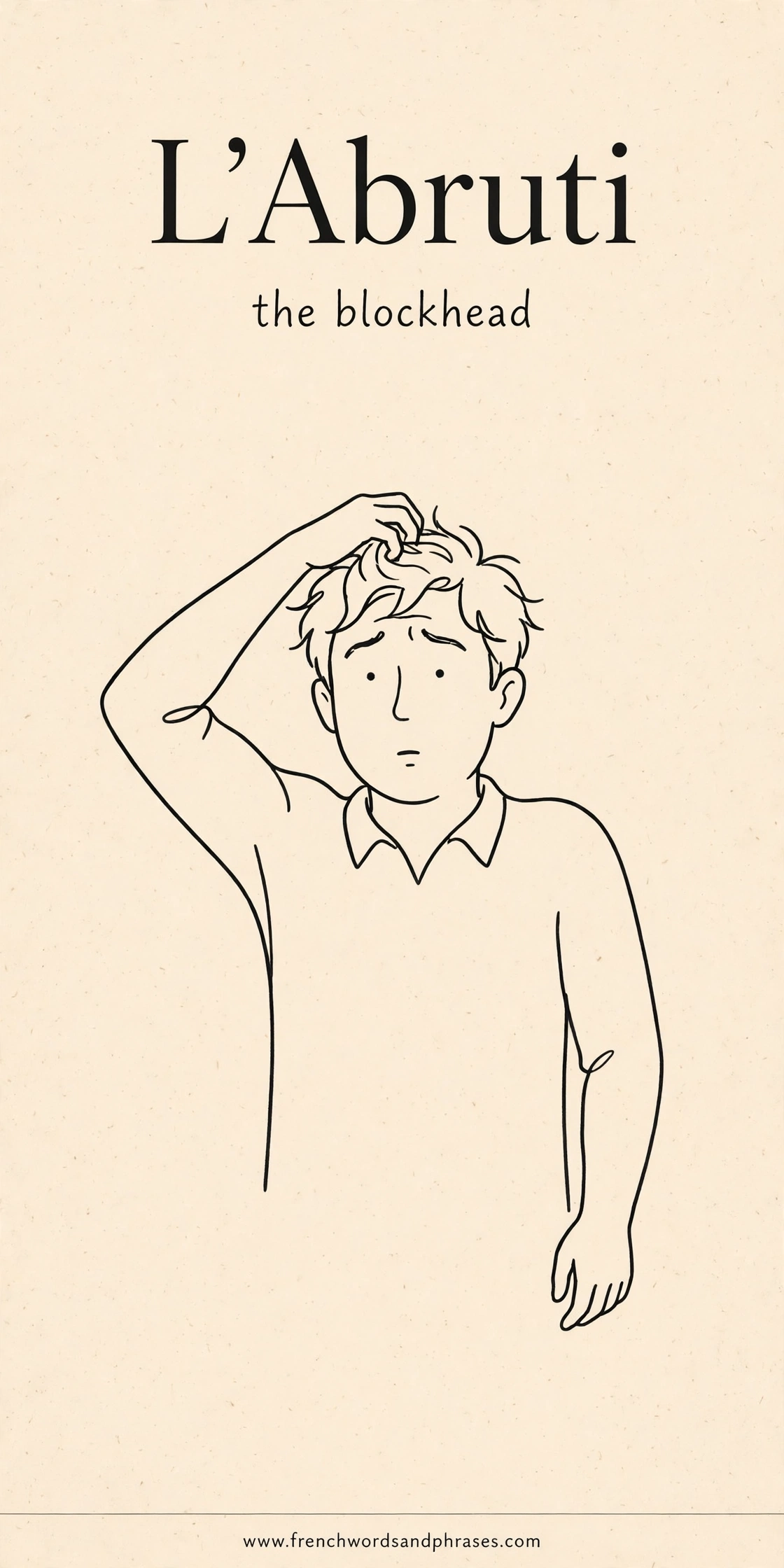
L’Abruti means the blockhead.
The car has been parked across two spaces, the shopping trolley sits abandoned in the middle of the aisle, and someone mutters the word French keeps for moments like this: « Quel abruti ! » For a woman, the word grows an -e: une abrutie.
In this guide, you’ll learn what abruti means in English, how to use it with its articles, how to form its plural, and how it appears in everyday French. Explore French examples, English translations, and practice quizzes.
Understanding the French Noun Abruti
Abruti is a masculine French noun, learned with its article: l’abruti, un abruti — because it begins with a vowel, le shrinks to l’. For a woman, the ending changes in the classic pattern: -i becomes -ie — une abrutie, l’abrutie. It is familiar, mocking French — a word for playgrounds and traffic jams, never for polite company.
It means the blockhead, the idiot, the hopeless incompetent — someone who has done something thoroughly stupid, or who simply never seems to understand. Un abruti is stronger than un maladroit (a clumsy person) and rougher than un étourdi (a scatterbrain): it carries real contempt, softened only when friends use it as a teasing nickname. The word comes from the verb abrutir — the abruti is, literally, someone dulled into stupidity.
Gender: Masculine
Feminine: abrutie — une abrutie, l’abrutie (the blockhead, a woman)
Definite article: l’ — l’abruti (the blockhead); l’ — l’abrutie (the blockhead, a woman)
Indefinite article: un — un abruti (a blockhead); une — une abrutie (a blockhead, a woman)
Plural: les abrutis / les abruties
English equivalents: The blockhead; an idiot, a fool.
One important usage detail: abruti is an insult, so mind where you use it — among friends it can be affectionate teasing (« Espèce d’abruti, tu m’as fait peur ! »), but to a stranger it is fighting talk. The feminine is fully alive: une abrutie follows the regular pattern of words in -i, like un ami, une amie.
Experience the Word
Abruti is more than an insult. It is the pressure valve of French daily life — the word that escapes at the roundabout, at the photocopier, at the self-service checkout that has eaten your card.
Imagine the scene at the market: a van parked across the whole lane, a queue of cars behind it, and twenty drivers thinking exactly the same word at exactly the same moment.
You have not just insulted someone. You have let off steam — à la française, with one well-chosen word.
How to Use Abruti in French: Complete Guide
Let’s explore how abruti works in French, beginning with its articles — and watch the ending change for a woman: abruti becomes abrutie.
Abruti with the Definite Article (L’, Les)
Abruti begins with a vowel, so le and la both shrink to l’ — the ending of the noun itself tells you man or woman.
| Form | French |
|---|---|
| Masculine singular | l’abruti |
| Feminine singular | l’abrutie |
| Plural | les abrutis / les abruties |
Example
L’abruti a encore garé sa voiture devant le portail.
The blockhead has parked his car in front of the gate again.
Abruti with the Indefinite Article (Un, Une, Des)
Used for a blockhead in general — un abruti, une abrutie.
| Form | French |
|---|---|
| Masculine singular | un abruti |
| Feminine singular | une abrutie |
| Plural | des abrutis / des abruties |
Example
Il faut être un abruti pour jeter ses clés comme ça.
You’d have to be a blockhead to throw your keys away like that.
Calling Names: Words Around the Abruti
Insults and teasing — the vocabulary that surrounds the abruti, from mild to strong.
| French | In English |
|---|---|
| un maladroit | a clumsy person (mild) |
| un étourdi | a scatterbrain |
| un abruti | a blockhead, an idiot |
| une abrutie | a blockhead (a woman) |
| un imbécile | an imbecile |
| faire l’abruti | to act the fool |
Example
Ne fais pas l’abruti, écoute-moi sérieusement.
Don’t act the fool, listen to me seriously.
Quick Quiz 1
Your friend Sophie has just locked her keys inside the car. Complete the teasing sentence:
Sophie, tu es vraiment ______ aujourd’hui !
Reveal the answer
une abrutie
Sophie, tu es vraiment une abrutie aujourd’hui !
Sophie, you really are a blockhead today — for a woman, abruti becomes abrutie.
The Plural of Abruti
Both forms add an -s in the plural — les abrutis, les abruties.
| Form | French |
|---|---|
| Masculine | l’abruti → les abrutis |
| Feminine | l’abrutie → les abruties |
Example
Ces abrutis ont bloqué toute la rue avec leur camion.
Those blockheads blocked the whole street with their lorry.
Abruti with Possessive Adjectives (Mon, Ton, Son…)
A useful exception: abruti and abrutie begin with a vowel, so even the feminine takes mon, ton, son — mon abrutie, never « ma abrutie ».
| Owner | French |
|---|---|
| my | mon abruti / mon abrutie |
| your (tu) | ton abruti / ton abrutie |
| his / her | son abruti / son abrutie |
| our | notre abruti / notre abrutie |
| your (vous) | votre abruti / votre abrutie |
| their | leur abruti / leur abrutie |
Example
Mon abruti de frère a encore oublié les billets.
That blockhead brother of mine has forgotten the tickets again.
Quick Quiz 2
Complete the sentence:
______ abrutie de voisine fait du bruit toute la nuit. (His)
Reveal the answer
Son
Son abrutie de voisine fait du bruit toute la nuit.
That blockhead of a neighbour of his makes noise all night — son, not sa, because abrutie begins with a vowel.
Abruti with Demonstrative Adjectives (Cet, Cette, Ces)
Used to point: cet abruti for a man (cet, because of the vowel), cette abrutie for a woman.
| Form | French |
|---|---|
| Masculine singular | cet abruti |
| Feminine singular | cette abrutie |
| Plural | ces abrutis / ces abruties |
Example
Cet abruti ne regarde jamais avant de traverser.
That blockhead never looks before crossing.
Abruti with Adjectives
Adjectives agree with the person: parfait becomes parfaite, vrai stays vrai.
| Adjective | With Abruti |
|---|---|
| parfait (perfect, utter) | un abruti parfait / une abrutie parfaite |
| vrai (real, true) | un vrai abruti / une vraie abrutie |
| pauvre (poor, pathetic) | un pauvre abruti / une pauvre abrutie |
| fini (complete, out-and-out) | un abruti fini / une abrutie finie |
| gentil (kind — ironic) | un gentil abruti / une gentille abrutie |
Example
C’est un abruti fini, il ne comprend jamais rien.
He is a complete blockhead; he never understands anything.
Quick Quiz 3
Complete the sentence:
Elle est une abrutie ______. (complete, out-and-out)
Reveal the answer
finie
Elle est une abrutie finie.
She is an out-and-out blockhead — the adjective takes the feminine -e: finie.
Everyday Expressions with Abruti
Traffic, teasing and exasperation — the abruti phrases of daily life.
| Expression | In English |
|---|---|
| quel abruti ! | what a blockhead! |
| espèce d’abruti ! | you blockhead! (teasing or angry) |
| faire l’abruti | to act the fool |
| un abruti de première | a first-class blockhead |
| bande d’abrutis ! | you bunch of idiots! |
| ne sois pas abruti | don’t be stupid |
Example
Espèce d’abruti, tu as failli me faire tomber !
You blockhead, you nearly knocked me over!
Words from the Same Family as Abruti
Dulling, brutes and stupidity — the words that travel with abruti.
| French | In English |
|---|---|
| abrutir | to dull, to stun, to make brutish |
| l’abrutissement | the dulling, mental lethargy |
| la brute | the brute |
| abruti (adjective) | dulled, stupefied (un regard abruti) |
| bête | stupid, silly (also: a beast) |
| la bêtise | stupidity; a stupid thing |
Example
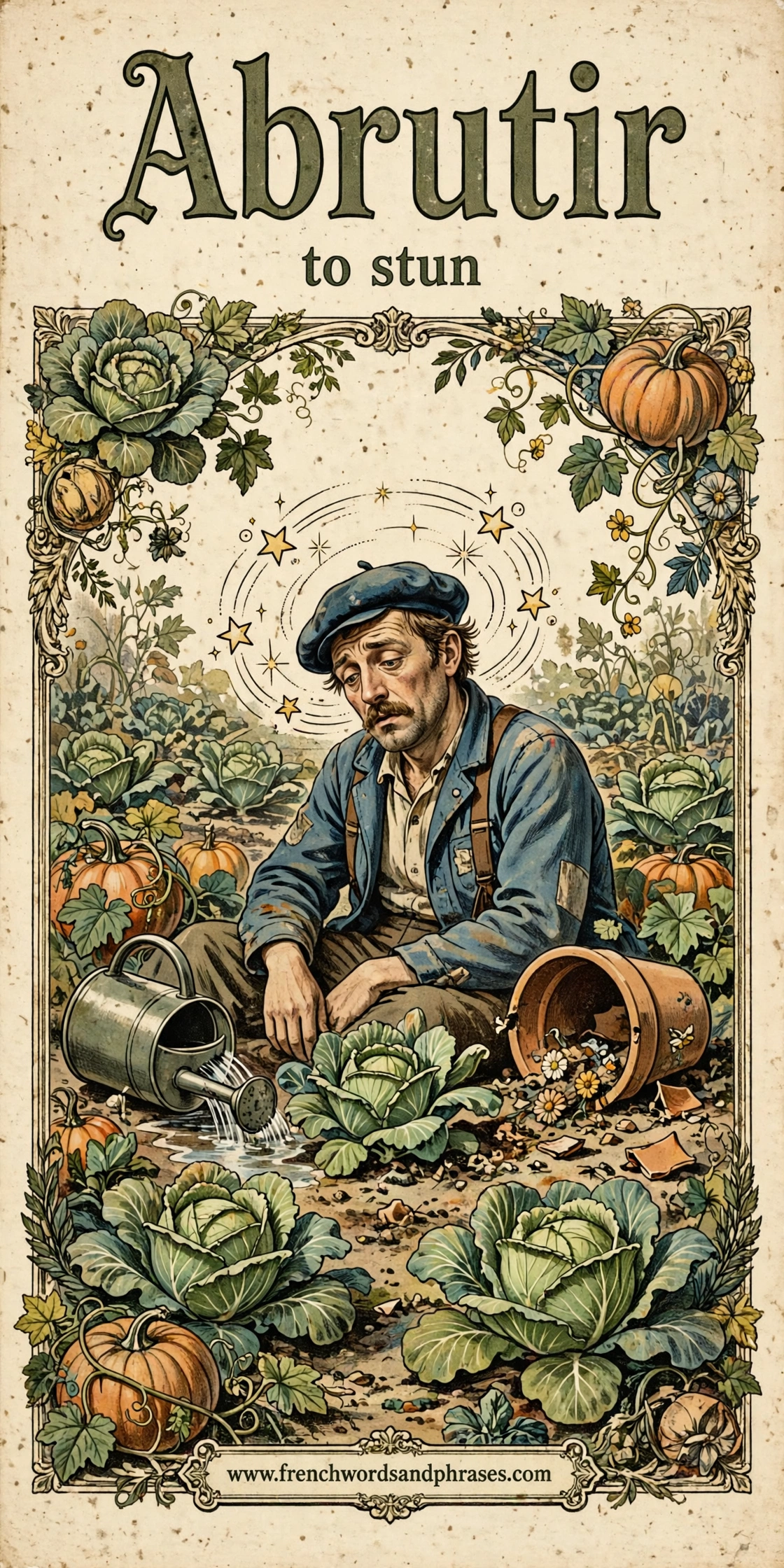
Le bruit constant finit par abrutir tout le monde.
The constant noise ends up dulling everyone’s mind.
Quick Quiz 4
What verb does abruti come from, and what does it suggest?
Reveal the answer
Abrutir — to dull or stun; the abruti is pictured as someone whose mind has been dulled.
Un travail répétitif peut abrutir n’importe qui.
Repetitive work can dull anyone’s mind.
Abruti in Everyday French: Real-Life Examples
Now that you know the word, let’s see how abruti appears in everyday French.
Example 1 — In traffic
Quel abruti, il ne met jamais son clignotant !
What a blockhead, he never uses his indicator!
Example 2 — Teasing a friend
Espèce d’abrutie, tu as oublié ton propre anniversaire !
You blockhead, you forgot your own birthday!
Example 3 — At work
L’abruti du service a effacé tous les fichiers.
The blockhead in the department deleted all the files.
Example 4 — Acting the fool
Arrête de faire l’abruti et aide-moi.
Stop acting the fool and help me.
Example 5 — About a stranger
Un abruti a laissé son chien dans la voiture au soleil.
Some idiot left his dog in the car in the sun.
Example 6 — Softening it
Ce n’est pas un abruti, il est juste distrait.
He’s not a blockhead, he’s just absent-minded.
Beyond Translation: The Meaning of Abruti
Every language keeps a drawer of affectionate insults, and abruti is one of France’s favourites — harsh on paper, often warm in the mouth. Between friends it can mean almost the opposite of its dictionary sense: a way of saying « you exasperate me and I love you anyway ». Context and tone do all the work, which is exactly why learners should handle it with care.
To say abruti is to deliver the most French of reprimands — half anger, half affection.
It evokes the blown horn at the roundabout, the shrugged shoulders, the friend who laughs instead of taking offence — the theatre of everyday exasperation.
How to Remember the French Noun Abruti
Remember it this way: Abruti is the blockhead — masculine in -i, and the ending softens into -ie for a woman: une abrutie.
- You see a man — un abruti, quel abruti !
- You see a woman — une abrutie, espèce d’abrutie !
- You remember the tone — entre amis, c’est une taquinerie ; sinon, une insulte.
The key idea is un abruti, une abrutie — the -ie ending is the feminine.
Test Your Knowledge of Abruti
Let’s see how much you’ve learned. Try answering these questions before revealing the answers.
Question 1
What is the feminine of abruti?
Reveal the answer
Abrutie — the ending -i becomes -ie: une abrutie.
Question 2
Is abruti polite French?
Reveal the answer
No — it is a familiar, mocking insult; affectionate between friends, offensive to strangers.
Question 3
Translate: What a blockhead!
Reveal the answer
Quel abruti ! (For a woman: Quelle abrutie !)
Question 4
Why do we say mon abrutie and not ma abrutie?
Reveal the answer
Because abrutie begins with a vowel sound — feminine nouns starting with a vowel take mon, ton, son.
Question 5
Complete the sentence:
Elle a agi comme ______ toute la journée.
Reveal the answer
une abrutie
Elle a agi comme une abrutie toute la journée.
She acted like a blockhead all day.
Your Final Challenge
Can You Use It?
How would you say this in French?
“That blockhead has forgotten the tickets again.”
Reveal the answer
Cet abruti a encore oublié les billets.
That blockhead has forgotten the tickets again.
A little French. A little curiosity. A richer everyday life.
LEARN FRENCH ONE WORD AT A TIME