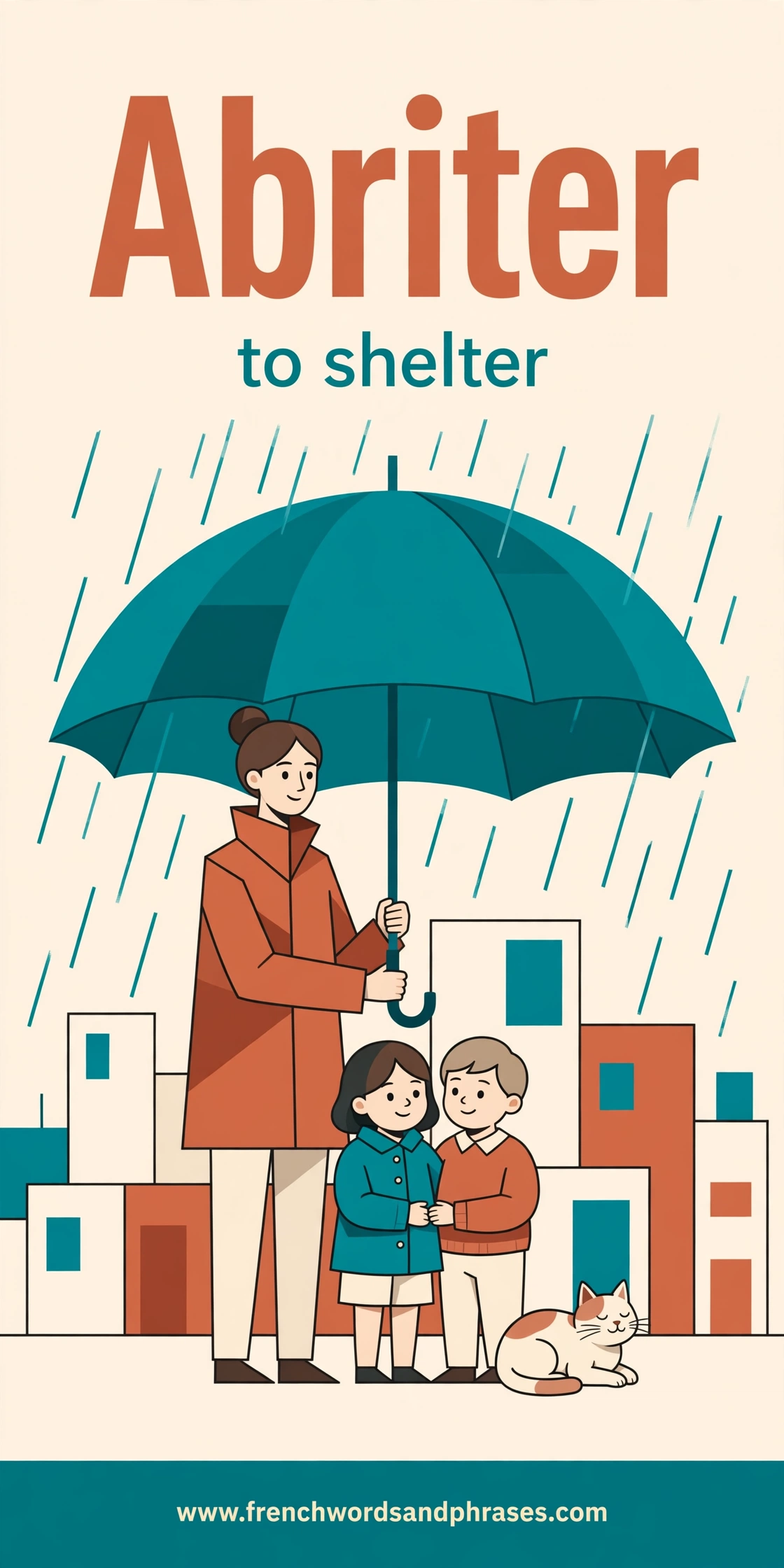
A French Word to Live By
How to Conjugate Abriter in French
/a.bʁi.te/
Abriter means to shelter — to give a roof, a refuge or a home to someone or something.
A barn full of swallows, a café awning in a sudden downpour, a farmhouse that has sheltered four generations — abriter is the verb of the offered roof: whatever gives cover to people, animals or treasures, abrite them.
In this guide, you’ll learn how to conjugate abriter in all the major French tenses and moods. Explore complete conjugation tables, French examples, English translations, and practice quizzes.
Understanding the French Verb Abriter
Abriter is a regular French verb belonging to the first group of verbs, those ending in-er.
It means to shelter. It is commonly used for people sheltering from weather, war or danger, for buildings housing institutions, museums and collections, and for countries or towns that shelter refugees — anywhere a roof, literal or figurative, is offered to someone who needs it.
Verb classification: First group (-er)
Auxiliary verb: Avoir
Past participle: abrité
Present participle: abritant
English equivalents: To shelter, to house, to give shelter to; abriter quelqu’un — to shelter someone; s’abriter — to take shelter; un abri — a shelter; abriter une collection — to house a collection; abriter des réfugiés — to shelter refugees.
One important detail: abriter works in two directions. With an object, it is what roofs and houses do: la grange abrite les hirondelles — the barn shelters the swallows. Reflexive, it is what people do when the rain starts: s’abriter, to take shelter — ils se sont abrités sous un porche, with être and the participle agreeing. The noun of the family is everywhere in French life: un abri, a shelter — un abri de jardin, a garden shed; un abribus, a bus shelter.
Experience the Word
Abriter is the verb of the roof held out to others — cover given, before it is asked for.
Imagine a storm breaking over a village fête. In ninety seconds the square empties: the café awning fills, the church porch fills, and old Madame Fabre, who lives on the corner, opens her barn to a dozen soaked strangers and their bicycles — elle les abrite, towels and hot coffee included, as her grandmother did before her.
The storm lasts twenty minutes. The shelter — l’abri — is remembered for twenty years.
How to Conjugate Abriter: Complete French Conjugation Guide
Let’s explore every major conjugation of abriter, beginning with the indicative mood.
How to Conjugate Abriter in the Indicative Mood
The indicative mood is used to express facts, observations, actions, and events.
How to Conjugate Abriter in the Present Tense (Présent)
Used for actions happening now, habitual actions, and general truths.
| Subject | Conjugation |
|---|---|
| je | abrite |
| tu | abrites |
| il / elle | abrite |
| nous | abritons |
| vous | abritez |
| ils / elles | abritent |
Example
Cette vieille grange abrite les hirondelles chaque printemps.
This old barn shelters the swallows every spring.
Quick Quiz 1
Complete the sentence:
Nous ______ les voyageurs pour la nuit.
Reveal the answer
abritons
Nous abritons les voyageurs pour la nuit.
We are sheltering the travellers for the night.
How to Conjugate Abriter in the Passé Composé
Used for completed actions in the past. Abriter takes the auxiliary verb avoir.
| Subject | Conjugation |
|---|---|
| j’ | ai abrité |
| tu | as abrité |
| il / elle | a abrité |
| nous | avons abrité |
| vous | avez abrité |
| ils / elles | ont abrité |
Example
La mairie a abrité les sinistrés pendant une semaine.
The town hall sheltered the disaster victims for a week.
How to Conjugate Abriter in the Imparfait (Imperfect Tense)
Used for habitual past actions, descriptions, and ongoing situations in the past.
| Subject | Conjugation |
|---|---|
| je | abritais |
| tu | abritais |
| il / elle | abritait |
| nous | abritions |
| vous | abritiez |
| ils / elles | abritaient |
Example
L’auvent abritait les clients quand la pluie tombait.
The awning used to shelter the customers when the rain fell.
Quick Quiz 2
Choose the correct form:
The town hall sheltered the victims.
La mairie ______ les sinistrés. (a abrité / est abritée)
Reveal the answer
a abrité
La mairie a abrité les sinistrés.
Abriter takes avoir.
How to Conjugate Abriter in the Plus-que-parfait
Used to describe an action that had already been completed before another past event.
| Subject | Conjugation |
|---|---|
| j’ | avais abrité |
| tu | avais abrité |
| il / elle | avait abrité |
| nous | avions abrité |
| vous | aviez abrité |
| ils / elles | avaient abrité |
Example
Ils avaient abrité une famille de réfugiés pendant la guerre.
They had sheltered a refugee family during the war.
How to Conjugate Abriter in the Passé Simple
Primarily used in formal writing, literature, and historical narratives. It is rarely used in everyday conversation.
| Subject | Conjugation |
|---|---|
| je | abritai |
| tu | abritas |
| il / elle | abrita |
| nous | abritâmes |
| vous | abritâtes |
| ils / elles | abritèrent |
Example
Le château abrita les archives de la ville pendant le siège.
The castle housed the town archives during the siege.
How to Conjugate Abriter in the Passé Antérieur
A literary tense used to express an action completed immediately before another past action, generally in the passé simple.
| Subject | Conjugation |
|---|---|
| j’ | eus abrité |
| tu | eus abrité |
| il / elle | eut abrité |
| nous | eûmes abrité |
| vous | eûtes abrité |
| ils / elles | eurent abrité |
Example
Quand la maison eut abrité trois générations, on la vendit.
When the house had sheltered three generations, it was sold.
How to Conjugate Abriter in the Future Tense (Futur Simple)
Used to describe actions that will take place in the future.
| Subject | Conjugation |
|---|---|
| je | abriterai |
| tu | abriteras |
| il / elle | abritera |
| nous | abriterons |
| vous | abriterez |
| ils / elles | abriteront |
Example
Ce hangar abritera les bateaux tout l’hiver.
This shed will house the boats all winter.
How to Conjugate Abriter in the Futur Antérieur (Future Perfect)
Used for an action that will have been completed before a particular point in the future.
| Subject | Conjugation |
|---|---|
| j’ | aurai abrité |
| tu | auras abrité |
| il / elle | aura abrité |
| nous | aurons abrité |
| vous | aurez abrité |
| ils / elles | auront abrité |
Example
À la fin des travaux, le centre aura abrité deux cents personnes.
By the end of the works, the centre will have sheltered two hundred people.
How to Conjugate Abriter in the Near Future (Futur Proche)
Used to describe something that is going to happen soon. Formed with aller + infinitive.
| Subject | Conjugation |
|---|---|
| je | vais abriter |
| tu | vas abriter |
| il / elle | va abriter |
| nous | allons abriter |
| vous | allez abriter |
| ils / elles | vont abriter |
Example
Cours, on va s’abriter sous ce porche !
Run, we are going to take shelter under this porch!
How to Conjugate Abriter in the Conditional Mood
The conditional mood expresses what would happen under certain circumstances. It is also frequently used to make polite requests or express wishes.
How to Conjugate Abriter in the Present Conditional
| Subject | Conjugation |
|---|---|
| je | abriterais |
| tu | abriterais |
| il / elle | abriterait |
| nous | abriterions |
| vous | abriteriez |
| ils / elles | abriteraient |
Example
Un toit plus grand abriterait toute la terrasse.
A bigger roof would shelter the whole terrace.
How to Conjugate Abriter in the Past Conditional
| Subject | Conjugation |
|---|---|
| j’ | aurais abrité |
| tu | aurais abrité |
| il / elle | aurait abrité |
| nous | aurions abrité |
| vous | auriez abrité |
| ils / elles | auraient abrité |
Example
Elle aurait abrité ses amis si sa maison avait été plus grande.
She would have sheltered her friends if her house had been bigger.
Abriter in the Literary Past Conditional Form
This less common literary form uses the imperfect subjunctive of avoir.
| Subject | Conjugation |
|---|---|
| j’ | eusse abrité |
| tu | eusses abrité |
| il / elle | eût abrité |
| nous | eussions abrité |
| vous | eussiez abrité |
| ils / elles | eussent abrité |
Example
Il eût abrité les voyageurs sans l’incendie de l’auberge.
He would have sheltered the travellers if the inn had not burned down.
How to Conjugate Abriter in the Subjunctive Mood
The subjunctive is used to express wishes, emotions, doubts, necessity, and uncertainty. It frequently follows expressions such as il faut que (it is necessary that) or bien que (although).
How to Conjugate Abriter in the Present Subjunctive
| Subject | Conjugation |
|---|---|
| que je | abrite |
| que tu | abrites |
| qu’il / qu’elle | abrite |
| que nous | abritions |
| que vous | abritiez |
| qu’ils / qu’elles | abritent |
Example
Il faut que ce toit abrite mieux la cour.
This roof must shelter the courtyard better.
Quick Quiz 3
Complete the sentence using the subjunctive:
Il faut que vous ______ les plantes avant le gel.
Reveal the answer
abritiez
Il faut que vous abritiez les plantes avant le gel.
You must shelter the plants before the frost.
How to Conjugate Abriter in the Imperfect Subjunctive
A literary tense, rarely encountered in modern spoken French.
| Subject | Conjugation |
|---|---|
| que je | abritasse |
| que tu | abritasses |
| qu’il / qu’elle | abritât |
| que nous | abritassions |
| que vous | abritassiez |
| qu’ils / qu’elles | abritassent |
Example
On ne pensait pas que la grotte abritât une source.
Nobody thought the cave sheltered a spring.
How to Conjugate Abriter in the Pluperfect Subjunctive
A literary construction used to express an action completed before another past action.
| Subject | Conjugation |
|---|---|
| que j’ | eusse abrité |
| que tu | eusses abrité |
| qu’il / qu’elle | eût abrité |
| que nous | eussions abrité |
| que vous | eussiez abrité |
| qu’ils / qu’elles | eussent abrité |
Example
On racontait que le monastère eût abrité des manuscrits rares.
People said the monastery had housed rare manuscripts.
How to Conjugate Abriter in the Past Subjunctive
| Subject | Conjugation |
|---|---|
| que j’ | aie abrité |
| que tu | aies abrité |
| qu’il / qu’elle | ait abrité |
| que nous | ayons abrité |
| que vous | ayez abrité |
| qu’ils / qu’elles | aient abrité |
Example
Je suis heureux que le musée ait abrité cette exposition.
I am glad the museum housed this exhibition.
How to Conjugate Abriter in the Imperative
The imperative is used to give commands, instructions, invitations, or suggestions. Subject pronouns are omitted.
How to Conjugate Abriter in the Present Imperative
| Person | Conjugation |
|---|---|
| (tu) | abrite |
| (nous) | abritons |
| (vous) | abritez |
Example
Abrite les plantes, le gel arrive ce soir !
Shelter the plants, the frost is coming tonight!
Quick Quiz 4
How would you say Shelter the plants (tu form)?
Reveal the answer
Abrite les plantes !
French Participles of Abriter
Participles are verb forms that can be used in compound tenses and other grammatical constructions.
Present Participle of Abriter
abritant
En abritant les réfugiés, le village a montré son courage.
By sheltering the refugees, the village showed its courage.
Past Participle of Abriter
abrité
Abritées sous l’auvent, les hirondelles attendaient la fin de l’orage.
Sheltered under the awning, the swallows waited for the storm to end.
Abriter in Everyday French: Real-Life Examples
Now that you know the conjugations, let’s see how abriter appears in everyday French.
Example 1 — Present
La grange abrite les hirondelles.
The barn shelters the swallows.
Example 2 — Passé composé
La mairie a abrité les sinistrés.
The town hall sheltered the disaster victims.
Example 3 — Imparfait
L’auvent abritait les clients de la pluie.
The awning sheltered the customers from the rain.
Example 4 — Future
Ce hangar abritera les bateaux l’hiver.
This shed will house the boats in winter.
Example 5 — Conditional
Elle abriterait ses amis volontiers.
She would gladly shelter her friends.
Example 6 — Imperative
Abrite-toi sous le porche !
Take shelter under the porch!
Beyond Translation: The Meaning of Abriter
English shelter does noun and verb duty in one word; French splits the work — un abri is the shelter itself, and abriter is the sheltering.
And its reflexive is the one you will use most.
Nobody in France abrite very often, but everybody, at least once a summer, court s’abriter — runs for shelter — when the sky opens over a picnic.
How to Remember the French Verb Abriter
Remember it this way: Abriter is about a roof offered to others — and the porch you run to yourself.
- Regular -er: j’abrite, nous abritons, past participle abrité.
- Two directions: abriter quelqu’un (to shelter someone) and s’abriter (to take shelter yourself).
- Its noun is un abri — the shelter itself: un abri de jardin, un abribus.
The key idea is a roof offered to others — and the porch you run to yourself.
Test Your Knowledge of Abriter
Let’s see how much you’ve learned. Try answering these questions before revealing the answers.
Question 1
What is the difference between abriter and s’abriter?
Reveal the answer
Abriter quelqu’un is to shelter someone else; s’abriter is to take shelter yourself.
Question 2
How do you say The barn shelters the swallows in French?
Reveal the answer
La grange abrite les hirondelles.
Question 3
Translate: The town hall sheltered the disaster victims.
Reveal the answer
La mairie a abrité les sinistrés.
Question 4
What is the past participle of abriter?
Reveal the answer
Abrité.
Question 5
Complete the sentence:
Il faut que ce toit ______ mieux la cour.
Reveal the answer
abrite
Il faut que ce toit abrite mieux la cour.
This roof must shelter the courtyard better.
Your Final Challenge
Can You Use It?
How would you say this in French?
The old barn shelters the swallows in spring, and the whole village takes shelter under its roof when the storm breaks.
Reveal the answer
La vieille grange abrite les hirondelles au printemps, et tout le village s’abrite sous son toit quand l’orage éclate.
The old barn shelters the swallows in spring, and the whole village takes shelter under its roof when the storm breaks.
A little French. A little curiosity. A richer everyday life.
LEARN FRENCH ONE WORD AT A TIME