A French Word to Live By
How to Conjugate Abréagir in French
/a.bʁe.a.ʒiʁ/
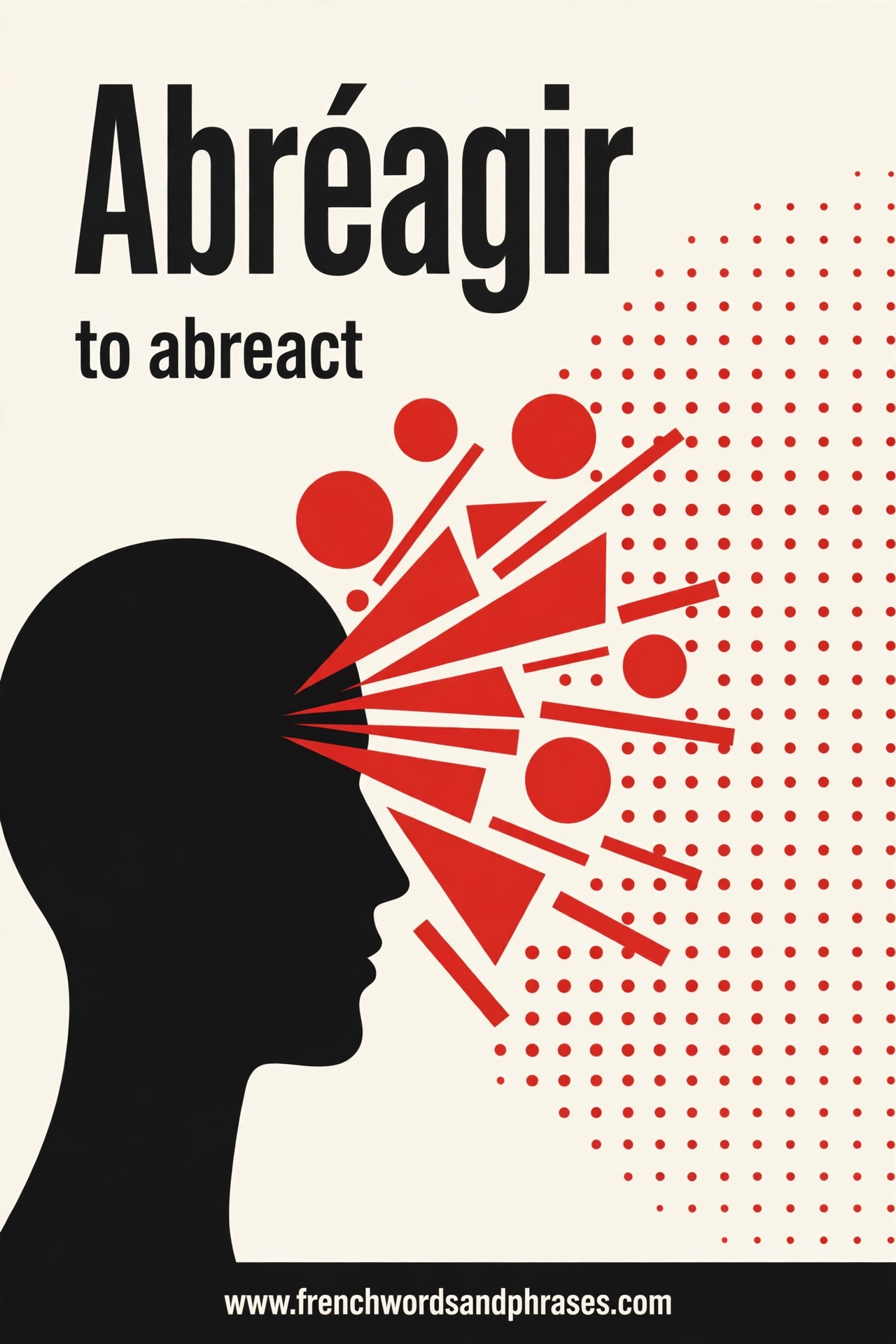
Abréagir means to abreact — in psychoanalysis, to release a repressed emotion by reliving the experience that caused it.
A patient on the analyst’s couch suddenly weeping at a childhood scene, a buried grief finally spoken aloud — abréagir is the technical verb of psychoanalysis for emotion discharged by reliving: the past, replayed, loses its charge.
In this guide, you’ll learn how to conjugate abréagir in all the major French tenses and moods. Explore complete conjugation tables, French examples, English translations, and practice quizzes.
Understanding the French Verb Abréagir
Abréagir is a regular French verb belonging to the second group of verbs, those ending in -ir.
It means to abreact. It is a term of art from Freud’s early work: the patient abréagit when the memory of a traumatic scene is brought back with its feeling attached — tears, anger, trembling — rather than merely described. Therapists use it of sessions, dreams and sudden outbursts that clear old pain.
Verb classification: Second group (-ir)
Auxiliary verb: Avoir
Past participle: abréagi
Present participle: abréagissant
English equivalents: To abreact (psychoanalysis); abréagir un traumatisme — to abreact a trauma; une abréaction — abreaction, the release of repressed emotion; abréagir en séance — to abreact during a session.
One important detail: abréagir is a regular second-group -ir verb, conjugated exactly like its parent réagir — j’abréagis, nous abréagissons, past participle abréagi. It lives in one room only: the analyst’s. Outside psychoanalysis French does not use it; inside, it names the precise moment when reliving an old scene drains its emotion away.
Experience the Word
Abréagir is the verb of the unblocked memory — the past replayed at full feeling, so that it can finally be put down.
Imagine a woman in her twentieth session who has described her father’s departure a dozen times, calmly, like a timetable. Today she tells it again — and suddenly weeps as she has not wept since she was eight. Elle abréagit: the scene has come back with its grief attached.
She has not learned anything new. She has abreacted — elle a abréagi — and the memory leaves the room lighter than it entered.
How to Conjugate Abréagir: Complete French Conjugation Guide
Let’s explore every major conjugation of abréagir, beginning with the indicative mood.
How to Conjugate Abréagir in the Indicative Mood
The indicative mood is used to express facts, observations, actions, and events.
How to Conjugate Abréagir in the Present Tense (Présent)
Used for actions happening now, habitual actions, and general truths.
| Subject | Conjugation |
|---|---|
| je | abréagis |
| tu | abréagis |
| il / elle | abréagit |
| nous | abréagissons |
| vous | abréagissez |
| ils / elles | abréagissent |
Example
La patiente abréagit en racontant la scène.
The patient abreacts as she tells the scene.
Quick Quiz 1
Complete the sentence:
En séance, nous ______ les souvenirs un à un.
Reveal the answer
abréagissons
En séance, nous abréagissons les souvenirs un à un.
In session, we abreact the memories one by one.
How to Conjugate Abréagir in the Passé Composé
Used for completed actions in the past. Abréagir takes the auxiliary verb avoir.
| Subject | Conjugation |
|---|---|
| j’ | ai abréagi |
| tu | as abréagi |
| il / elle | a abréagi |
| nous | avons abréagi |
| vous | avez abréagi |
| ils / elles | ont abréagi |
Example
Il a abréagi pendant la séance de jeudi.
He abreacted during Thursday’s session.
How to Conjugate Abréagir in the Imparfait (Imperfect Tense)
Used for habitual past actions, descriptions, and ongoing situations in the past.
| Subject | Conjugation |
|---|---|
| je | abréagissais |
| tu | abréagissais |
| il / elle | abréagissait |
| nous | abréagissions |
| vous | abréagissiez |
| ils / elles | abréagissaient |
Example
Chaque semaine, elle abréagissait un peu plus.
Each week, she abreacted a little more.
Quick Quiz 2
Choose the correct form:
She abreacted during Thursday’s session.
Elle ______ pendant la séance de jeudi. (a abréagi / est abréagi)
Reveal the answer
a abréagi
Elle a abréagi pendant la séance de jeudi.
Abréagir takes avoir.
How to Conjugate Abréagir in the Plus-que-parfait
Used to describe an action that had already been completed before another past event.
| Subject | Conjugation |
|---|---|
| j’ | avais abréagi |
| tu | avais abréagi |
| il / elle | avait abréagi |
| nous | avions abréagi |
| vous | aviez abréagi |
| ils / elles | avaient abréagi |
Example
Le patient avait abréagi avant même la fin du récit.
The patient had abreacted even before the story ended.
How to Conjugate Abréagir in the Passé Simple
Primarily used in formal writing, literature, and historical narratives. It is rarely used in everyday conversation.
| Subject | Conjugation |
|---|---|
| je | abréagis |
| tu | abréagis |
| il / elle | abréagit |
| nous | abréagîmes |
| vous | abréagîtes |
| ils / elles | abréagirent |
Example
Elle abréagit soudain, en larmes, au milieu d’une phrase.
She suddenly abreacted, in tears, in the middle of a sentence.
How to Conjugate Abréagir in the Passé Antérieur
A literary tense used to express an action completed immediately before another past action, generally in the passé simple.
| Subject | Conjugation |
|---|---|
| j’ | eus abréagi |
| tu | eus abréagi |
| il / elle | eut abréagi |
| nous | eûmes abréagi |
| vous | eûtes abréagi |
| ils / elles | eurent abréagi |
Example
Quand il eut abréagi, un grand calme suivit.
When he had abreacted, a great calm followed.
How to Conjugate Abréagir in the Future Tense (Futur Simple)
Used to describe actions that will take place in the future.
| Subject | Conjugation |
|---|---|
| je | abréagirai |
| tu | abréagiras |
| il / elle | abréagira |
| nous | abréagirons |
| vous | abréagirez |
| ils / elles | abréagiront |
Example
Tôt ou tard, elle abréagira ce deuil en séance.
Sooner or later, she will abreact this grief in a session.
How to Conjugate Abréagir in the Futur Antérieur (Future Perfect)
Used for an action that will have been completed before a particular point in the future.
| Subject | Conjugation |
|---|---|
| j’ | aurai abréagi |
| tu | auras abréagi |
| il / elle | aura abréagi |
| nous | aurons abréagi |
| vous | aurez abréagi |
| ils / elles | auront abréagi |
Example
À la fin de l’analyse, il aura abréagi ses plus vieux souvenirs.
By the end of the analysis, he will have abreacted his oldest memories.
How to Conjugate Abréagir in the Near Future (Futur Proche)
Used to describe something that is going to happen soon. Formed with aller + infinitive.
| Subject | Conjugation |
|---|---|
| je | vais abréagir |
| tu | vas abréagir |
| il / elle | va abréagir |
| nous | allons abréagir |
| vous | allez abréagir |
| ils / elles | vont abréagir |
Example
Je sens qu’elle va abréagir en racontant ce rêve.
I feel she is going to abreact as she tells this dream.
How to Conjugate Abréagir in the Conditional Mood
The conditional mood expresses what would happen under certain circumstances. It is also frequently used to make polite requests or express wishes.
How to Conjugate Abréagir in the Present Conditional
| Subject | Conjugation |
|---|---|
| je | abréagirais |
| tu | abréagirais |
| il / elle | abréagirait |
| nous | abréagirions |
| vous | abréagiriez |
| ils / elles | abréagiraient |
Example
Sans confiance, le patient n’abréagirait jamais.
Without trust, the patient would never abreact.
How to Conjugate Abréagir in the Past Conditional
| Subject | Conjugation |
|---|---|
| j’ | aurais abréagi |
| tu | aurais abréagi |
| il / elle | aurait abréagi |
| nous | aurions abréagi |
| vous | auriez abréagi |
| ils / elles | auraient abréagi |
Example
Elle aurait abréagi plus tôt avec un autre analyste.
She would have abreacted sooner with a different analyst.
Abréagir in the Literary Past Conditional Form
This less common literary form uses the imperfect subjunctive of avoir.
| Subject | Conjugation |
|---|---|
| j’ | eusse abréagi |
| tu | eusses abréagi |
| il / elle | eût abréagi |
| nous | eussions abréagi |
| vous | eussiez abréagi |
| ils / elles | eussent abréagi |
Example
Il eût abréagi dès la première séance, autrefois.
He would have abreacted from the very first session, in the old days.
How to Conjugate Abréagir in the Subjunctive Mood
The subjunctive is used to express wishes, emotions, doubts, necessity, and uncertainty. It frequently follows expressions such as il faut que (it is necessary that) or bien que (although).
How to Conjugate Abréagir in the Present Subjunctive
| Subject | Conjugation |
|---|---|
| que je | abréagisse |
| que tu | abréagisses |
| qu’il / qu’elle | abréagisse |
| que nous | abréagissions |
| que vous | abréagissiez |
| qu’ils / qu’elles | abréagissent |
Example
Il faut que le patient abréagisse en toute sécurité.
The patient must be able to abreact in complete safety.
Quick Quiz 3
Complete the sentence using the subjunctive:
L’analyste attend que vous ______ ce souvenir.
Reveal the answer
abréagissiez
L’analyste attend que vous abréagissiez ce souvenir.
The analyst is waiting for you to abreact this memory.
How to Conjugate Abréagir in the Imperfect Subjunctive
A literary tense, rarely encountered in modern spoken French.
| Subject | Conjugation |
|---|---|
| que je | abréagisse |
| que tu | abréagisses |
| qu’il / qu’elle | abréagît |
| que nous | abréagissions |
| que vous | abréagissiez |
| qu’ils / qu’elles | abréagissent |
Example
L’analyste attendait qu’elle abréagît enfin.
The analyst was waiting for her to abreact at last.
How to Conjugate Abréagir in the Pluperfect Subjunctive
A literary construction used to express an action completed before another past action.
| Subject | Conjugation |
|---|---|
| que j’ | eusse abréagi |
| que tu | eusses abréagi |
| qu’il / qu’elle | eût abréagi |
| que nous | eussions abréagi |
| que vous | eussiez abréagi |
| qu’ils / qu’elles | eussent abréagi |
Example
Freud écrivait que la malade eût abréagi en racontant la scène.
Freud wrote that the patient had abreacted by telling the scene.
How to Conjugate Abréagir in the Past Subjunctive
| Subject | Conjugation |
|---|---|
| que j’ | aie abréagi |
| que tu | aies abréagi |
| qu’il / qu’elle | ait abréagi |
| que nous | ayons abréagi |
| que vous | ayez abréagi |
| qu’ils / qu’elles | aient abréagi |
Example
Il est bon qu’il ait abréagi pendant la séance.
It is good that he abreacted during the session.
How to Conjugate Abréagir in the Imperative
The imperative is used to give commands, instructions, invitations, or suggestions. Subject pronouns are omitted.
How to Conjugate Abréagir in the Present Imperative
| Person | Conjugation |
|---|---|
| (tu) | abréagis |
| (nous) | abréagissons |
| (vous) | abréagissez |
Example
Abréagis ce souvenir au lieu de le fuir !
Abreact this memory instead of fleeing it!
Quick Quiz 4
How would you say Abreact this memory (tu form)?
Reveal the answer
Abréagis ce souvenir !
French Participles of Abréagir
Participles are verb forms that can be used in compound tenses and other grammatical constructions.
Present Participle of Abréagir
abréagissant
En abréagissant, la patiente sentit la tension partir.
By abreacting, the patient felt the tension leave.
Past Participle of Abréagir
abréagi
Abréagi en séance, le traumatisme perdit sa force.
Abreacted in session, the trauma lost its force.
Abréagir in Everyday French: Real-Life Examples
Now that you know the conjugations, let’s see how abréagir appears in everyday French.
Example 1 — Present
La patiente abréagit en racontant la scène.
The patient abreacts as she tells the scene.
Example 2 — Passé composé
Il a abréagi pendant la séance.
He abreacted during the session.
Example 3 — Imparfait
Elle abréagissait un peu plus chaque semaine.
She abreacted a little more each week.
Example 4 — Future
Elle abréagira ce deuil en séance.
She will abreact this grief in a session.
Example 5 — Conditional
Sans confiance, il n’abréagirait jamais.
Without trust, he would never abreact.
Example 6 — Imperative
Abréagissez en toute sécurité !
Abreact in complete safety!
Beyond Translation: The Meaning of Abréagir
English abreact is the same rare bird — a term of art that never left the consulting room in either language.
To describe is not to abreact.
That distinction is the verb’s whole doctrine: a memory merely narrated keeps its poison; a memory abréagi — relived with its tears — is discharged. Freud built his first therapy on that single difference.
How to Remember the French Verb Abréagir
Remember it this way: Abréagir is about the twentieth session — the old scene told again, this time with tears.
- A psychoanalysis term only: to release repressed emotion by reliving the scene that caused it.
- Regular -ir like réagir: j’abréagis, nous abréagissons, past participle abréagi.
- Its noun is une abréaction — the discharge itself.
The key idea is the twentieth session — the old scene told again, this time with tears.
Test Your Knowledge of Abréagir
Let’s see how much you’ve learned. Try answering these questions before revealing the answers.
Question 1
What does abréagir mean in psychoanalysis?
Reveal the answer
To release a repressed emotion by reliving the experience that caused it — tears and all, not merely describing it.
Question 2
How do you say He abreacted during the session in French?
Reveal the answer
Il a abréagi pendant la séance.
Question 3
Translate: The patient abreacts as she tells the scene.
Reveal the answer
La patiente abréagit en racontant la scène.
Question 4
What is the past participle of abréagir?
Reveal the answer
Abréagi.
Question 5
Complete the sentence:
Il faut que le patient ______ en toute sécurité.
Reveal the answer
abréagisse
Il faut que le patient abréagisse en toute sécurité.
The patient must be able to abreact in complete safety.
Your Final Challenge
Can You Use It?
How would you say this in French?
By telling the scene one last time, she finally abreacted.
Reveal the answer
En racontant la scène une dernière fois, elle a enfin abréagi.
By telling the scene one last time, she finally abreacted.
A little French. A little curiosity. A richer everyday life.
LEARN FRENCH ONE WORD AT A TIME