A French Word to Live By
How to Conjugate Abraser in French
/a.bʁa.ze/
Abraser means to abrade — to wear a surface away by friction, grain by grain.
A glacier planing a valley floor, waves eating a cliff one storm at a time, sandpaper smoothing a plank — abraser is the verb of slow violence by rubbing: nothing is struck or cut; the surface simply surrenders, particle by particle, to patience and friction.
In this guide, you’ll learn how to conjugate abraser in all the major French tenses and moods. Explore complete conjugation tables, French examples, English translations, and practice quizzes.
Understanding the French Verb Abraser
Abraser is a regular French verb belonging to the first group of verbs, those ending in-er.
It means to abrade. It is used in geology for coasts, valleys and rocks worn down by water, ice and wind, in workshops and dentistry for surfaces smoothed or damaged by friction, and in medicine for skin grazed by rubbing. Wherever English says worn away by friction, French can say abrasé.
Verb classification: First group (-er)
Auxiliary verb: Avoir
Past participle: abrasé
Present participle: abrasant
English equivalents: To abrade, to wear away by friction; abraser une surface — to abrade a surface; la mer abrase la falaise — the sea wears away the cliff; un abrasif — an abrasive; l’abrasion — abrasion.
One important detail: abraser is a technical verb, and it is choosy about its subjects. Things abrase in French — seas, glaciers, winds, chains, grindstones — far more often than people do, and people usually meet it in the passive: la falaise abrasée par les vagues, the cliff worn away by the waves. Its family runs the workshop and the geology textbook alike: un abrasif is an abrasive, l’abrasion is the wearing itself, and abrasif doubles as the adjective.
Experience the Word
Abraser is the verb of the slowest force in nature — no blow, no break, just rubbing, repeated for a thousand years.
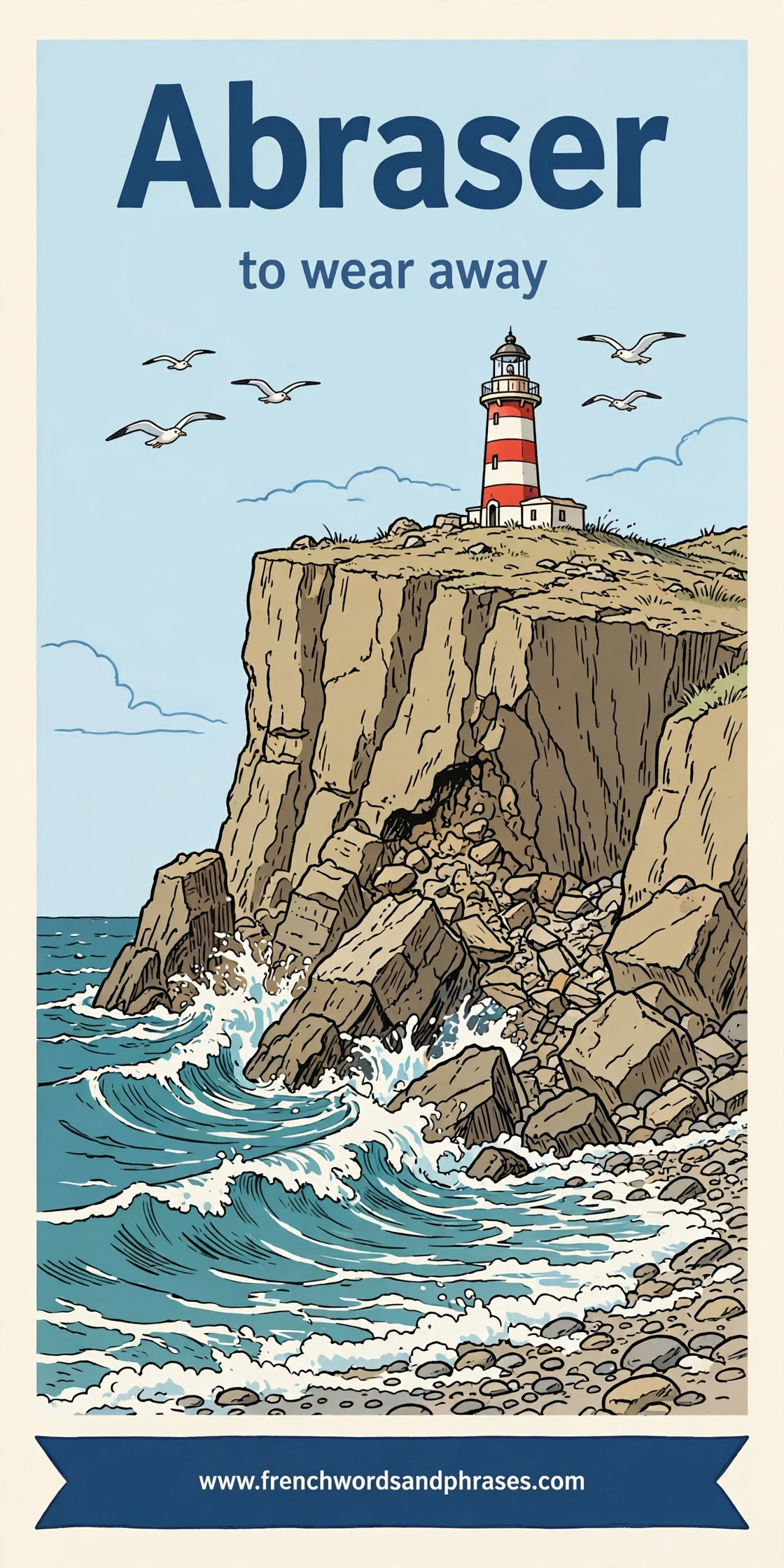
Imagine a cliff on the Channel coast. No single wave has ever hurt it; the chalk laughs at storms. But the sea comes back ten thousand times a year, each time carrying sand, and abrase the base grain by grain, until one February morning a whole white wall, patiently undermined, folds into the water.
Nothing struck the cliff. It was abraded — abrasée — by the most patient tool in the world: water, rubbing.
How to Conjugate Abraser: Complete French Conjugation Guide
Let’s explore every major conjugation of abraser, beginning with the indicative mood.
How to Conjugate Abraser in the Indicative Mood
The indicative mood is used to express facts, observations, actions, and events.
How to Conjugate Abraser in the Present Tense (Présent)
Used for actions happening now, habitual actions, and general truths.
| Subject | Conjugation |
|---|---|
| je | abrase |
| tu | abrases |
| il / elle | abrase |
| nous | abrasons |
| vous | abrasez |
| ils / elles | abrasent |
Example
Le sable abrase la coque du bateau.
The sand abrades the boat’s hull.
Quick Quiz 1
Complete the sentence:
Nous ______ la surface avant de peindre.
Reveal the answer
abrasons
Nous abrasons la surface avant de peindre.
We are abrading the surface before painting.
How to Conjugate Abraser in the Passé Composé
Used for completed actions in the past. Abraser takes the auxiliary verb avoir.
| Subject | Conjugation |
|---|---|
| j’ | ai abrasé |
| tu | as abrasé |
| il / elle | a abrasé |
| nous | avons abrasé |
| vous | avez abrasé |
| ils / elles | ont abrasé |
Example
Les vagues ont abrasé la falaise pendant des siècles.
The waves have abraded the cliff for centuries.
How to Conjugate Abraser in the Imparfait (Imperfect Tense)
Used for habitual past actions, descriptions, and ongoing situations in the past.
| Subject | Conjugation |
|---|---|
| je | abrasais |
| tu | abrasais |
| il / elle | abrasait |
| nous | abrasions |
| vous | abrasiez |
| ils / elles | abrasaient |
Example
Le vent abrasait les pierres du chemin.
The wind used to wear away the stones of the path.
Quick Quiz 2
Choose the correct form:
The waves abraded the cliff.
Les vagues ______ la falaise. (ont abrasé / sont abrasées)
Reveal the answer
ont abrasé
Les vagues ont abrasé la falaise.
Abraser takes avoir.
How to Conjugate Abraser in the Plus-que-parfait
Used to describe an action that had already been completed before another past event.
| Subject | Conjugation |
|---|---|
| j’ | avais abrasé |
| tu | avais abrasé |
| il / elle | avait abrasé |
| nous | avions abrasé |
| vous | aviez abrasé |
| ils / elles | avaient abrasé |
Example
Le frottement avait abrasé la corde jusqu’à l’âme.
The friction had worn the rope down to its core.
How to Conjugate Abraser in the Passé Simple
Primarily used in formal writing, literature, and historical narratives. It is rarely used in everyday conversation.
| Subject | Conjugation |
|---|---|
| je | abrasai |
| tu | abrasas |
| il / elle | abrasa |
| nous | abrasâmes |
| vous | abrasâtes |
| ils / elles | abrasèrent |
Example
La mer abrasa le rivage en une seule tempête.
The sea wore away the shore in a single storm.
How to Conjugate Abraser in the Passé Antérieur
A literary tense used to express an action completed immediately before another past action, generally in the passé simple.
| Subject | Conjugation |
|---|---|
| j’ | eus abrasé |
| tu | eus abrasé |
| il / elle | eut abrasé |
| nous | eûmes abrasé |
| vous | eûtes abrasé |
| ils / elles | eurent abrasé |
Example
Quand le glacier eut abrasé la vallée, un lac se forma.
When the glacier had scoured the valley, a lake formed.
How to Conjugate Abraser in the Future Tense (Futur Simple)
Used to describe actions that will take place in the future.
| Subject | Conjugation |
|---|---|
| je | abraserai |
| tu | abraseras |
| il / elle | abrasera |
| nous | abraserons |
| vous | abraserez |
| ils / elles | abraseront |
Example
Le courant abrasera les rochers les plus durs.
The current will wear away the hardest rocks.
How to Conjugate Abraser in the Futur Antérieur (Future Perfect)
Used for an action that will have been completed before a particular point in the future.
| Subject | Conjugation |
|---|---|
| j’ | aurai abrasé |
| tu | auras abrasé |
| il / elle | aura abrasé |
| nous | aurons abrasé |
| vous | aurez abrasé |
| ils / elles | auront abrasé |
Example
Dans mille ans, le vent aura abrasé ces inscriptions.
In a thousand years, the wind will have worn away these inscriptions.
How to Conjugate Abraser in the Near Future (Futur Proche)
Used to describe something that is going to happen soon. Formed with aller + infinitive.
| Subject | Conjugation |
|---|---|
| je | vais abraser |
| tu | vas abraser |
| il / elle | va abraser |
| nous | allons abraser |
| vous | allez abraser |
| ils / elles | vont abraser |
Example
Ce papier de verre va abraser la surface en douceur.
This sandpaper is going to abrade the surface gently.
How to Conjugate Abraser in the Conditional Mood
The conditional mood expresses what would happen under certain circumstances. It is also frequently used to make polite requests or express wishes.
How to Conjugate Abraser in the Present Conditional
| Subject | Conjugation |
|---|---|
| je | abraserais |
| tu | abraserais |
| il / elle | abraserait |
| nous | abraserions |
| vous | abraseriez |
| ils / elles | abraseraient |
Example
Un grain plus fin abraserait moins le bois.
A finer grit would abrade the wood less.
How to Conjugate Abraser in the Past Conditional
| Subject | Conjugation |
|---|---|
| j’ | aurais abrasé |
| tu | aurais abrasé |
| il / elle | aurait abrasé |
| nous | aurions abrasé |
| vous | auriez abrasé |
| ils / elles | auraient abrasé |
Example
La chaîne aurait abrasé l’acier sans la graisse.
The chain would have worn away the steel without the grease.
Abraser in the Literary Past Conditional Form
This less common literary form uses the imperfect subjunctive of avoir.
| Subject | Conjugation |
|---|---|
| j’ | eusse abrasé |
| tu | eusses abrasé |
| il / elle | eût abrasé |
| nous | eussions abrasé |
| vous | eussiez abrasé |
| ils / elles | eussent abrasé |
Example
Le fleuve eût abrasé la montagne sans la forêt.
The river would have worn away the mountain without the forest.
How to Conjugate Abraser in the Subjunctive Mood
The subjunctive is used to express wishes, emotions, doubts, necessity, and uncertainty. It frequently follows expressions such as il faut que (it is necessary that) or bien que (although).
How to Conjugate Abraser in the Present Subjunctive
| Subject | Conjugation |
|---|---|
| que je | abrase |
| que tu | abrases |
| qu’il / qu’elle | abrase |
| que nous | abrasions |
| que vous | abrasiez |
| qu’ils / qu’elles | abrasent |
Example
Il faut que la meule abrase régulièrement.
The grindstone must abrade evenly.
Quick Quiz 3
Complete the sentence using the subjunctive:
Il faut que vous ______ le bois en douceur.
Reveal the answer
abrasiez
Il faut que vous abrasiez le bois en douceur.
You must abrade the wood gently.
How to Conjugate Abraser in the Imperfect Subjunctive
A literary tense, rarely encountered in modern spoken French.
| Subject | Conjugation |
|---|---|
| que je | abrasasse |
| que tu | abrasasses |
| qu’il / qu’elle | abrasât |
| que nous | abrasassions |
| que vous | abrasassiez |
| qu’ils / qu’elles | abrasassent |
Example
On ne pensait pas que la glace abrasât le granit.
Nobody thought ice would wear away granite.
How to Conjugate Abraser in the Pluperfect Subjunctive
A literary construction used to express an action completed before another past action.
| Subject | Conjugation |
|---|---|
| que j’ | eusse abrasé |
| que tu | eusses abrasé |
| qu’il / qu’elle | eût abrasé |
| que nous | eussions abrasé |
| que vous | eussiez abrasé |
| qu’ils / qu’elles | eussent abrasé |
Example
On admirait que le vent eût abrasé ces formes étranges.
People admired that the wind had sculpted these strange shapes by abrasion.
How to Conjugate Abraser in the Past Subjunctive
| Subject | Conjugation |
|---|---|
| que j’ | aie abrasé |
| que tu | aies abrasé |
| qu’il / qu’elle | ait abrasé |
| que nous | ayons abrasé |
| que vous | ayez abrasé |
| qu’ils / qu’elles | aient abrasé |
Example
Je suis surpris que l’eau ait abrasé la pierre si vite.
I am surprised the water wore away the stone so quickly.
How to Conjugate Abraser in the Imperative
The imperative is used to give commands, instructions, invitations, or suggestions. Subject pronouns are omitted.
How to Conjugate Abraser in the Present Imperative
| Person | Conjugation |
|---|---|
| (tu) | abrase |
| (nous) | abrasons |
| (vous) | abrasez |
Example
Abrase doucement, sans appuyer !
Abrade gently, without pressing!
Quick Quiz 4
How would you say Abrade gently (tu form)?
Reveal the answer
Abrase doucement !
French Participles of Abraser
Participles are verb forms that can be used in compound tenses and other grammatical constructions.
Present Participle of Abraser
abrasant
En abrasant la surface, l’outil la prépare pour la peinture.
By abrading the surface, the tool prepares it for painting.
Past Participle of Abraser
abrasé
Abrasée par les vagues, la falaise recule chaque année.
Worn away by the waves, the cliff retreats every year.
Abraser in Everyday French: Real-Life Examples
Now that you know the conjugations, let’s see how abraser appears in everyday French.
Example 1 — Present
Le sable abrase la coque du bateau.
The sand abrades the boat’s hull.
Example 2 — Passé composé
Les vagues ont abrasé la falaise.
The waves have abraded the cliff.
Example 3 — Imparfait
Le vent abrasait les pierres.
The wind used to wear away the stones.
Example 4 — Future
Le courant abrasera les rochers.
The current will wear away the rocks.
Example 5 — Conditional
Un grain plus fin abraserait moins le bois.
A finer grit would abrade the wood less.
Example 6 — Imperative
Abrase doucement, sans appuyer !
Abrade gently, without pressing!
Beyond Translation: The Meaning of Abraser
English abrade is the same technical word; French abraser keeps the same laboratory coat, but its passive has a poetry the laboratory did not intend.
Abrasée is the biography of every old thing.
Steps worn hollow in a cathedral, a coin rubbed smooth in a pocket, a cliff retreating before the sea — French reads them all with one participle: time and friction, abrasant everything, politely and without pause.
How to Remember the French Verb Abraser
Remember it this way: Abraser is about the sea rubbing the cliff — the slowest force in nature.
- A technical verb of friction: seas, glaciers, winds and grindstones abrase — surfaces get abrasées.
- Regular -er: j’abrase, nous abrasons, past participle abrasé.
- Family: un abrasif (an abrasive), l’abrasion (the wearing away), abrasif (abrasive, adjective).
The key idea is the sea rubbing the cliff — the slowest force in nature.
Test Your Knowledge of Abraser
Let’s see how much you’ve learned. Try answering these questions before revealing the answers.
What kind of subjects does abraser usually have?
Reveal the answer
Things, not people — seas, glaciers, winds and tools abrase; surfaces are abrasées.
Question 2
How do you say The waves have abraded the cliff in French?
Reveal the answer
Les vagues ont abrasé la falaise.
Question 3
Translate: The sand abrades the boat’s hull.
Reveal the answer
Le sable abrase la coque du bateau.
Question 4
What is the past participle of abraser?
Reveal the answer
Abrasé.
Question 5
Complete the sentence:
Il faut que la meule ______ régulièrement.
Reveal the answer
abrase
Il faut que la meule abrase régulièrement.
The grindstone must abrade evenly.
Your Final Challenge
Can You Use It?
How would you say this in French?
The sea has been abrading the cliff for a thousand years, and the cliff retreats without ever complaining.
Reveal the answer
La mer abrase la falaise depuis mille ans, et la falaise recule sans jamais se plaindre.
The sea has been abrading the cliff for a thousand years, and the cliff retreats without ever complaining.
A little French. A little curiosity. A richer everyday life.
LEARN FRENCH ONE WORD AT A TIME