A French Word to Live By
Translate Aboulie to English
/a.bu.li/
L’Aboulie means abulia.
The list is on the table, the day is free, the phone is charged — and still nothing begins. It is not laziness; the will itself seems to have gone quiet. Doctors have a name for that silence: l’aboulie.
In this guide, you’ll learn what aboulie means in English, how to use it with its articles, how to form its plural, and how it appears in everyday French. Explore French examples, English translations, and practice quizzes.
Understanding the French Noun Aboulie
Aboulie is a feminine French noun, learned with its article: l’aboulie, une aboulie — because it begins with a vowel, la shrinks to l’. It is a term of psychology and medicine, built from Greek roots that mean, literally, an absence of will.
It means abulia — a pathological loss of willpower and decision: the inability to choose, to begin, to carry a plan through, even when the wish to act is there. Aboulie appears as a symptom in depression and certain neurological illnesses, and French also uses the word more loosely for a deep, heavy indecision that no amount of advice can lift.
Gender: Feminine
Definite article: l’ — l’aboulie (abulia)
Indefinite article: une — une aboulie (a bout of abulia)
Plural: les aboulies (rare)
Field: Psychiatry and psychology — a symptom, not a character flaw
English equivalents: Abulia; a loss of willpower, extreme indecisiveness.
One important usage detail: aboulie is a clinical word, and French uses it with care — it describes an illness of the will, not ordinary laziness (la paresse). The adjective for a person suffering from it is aboulique.
Experience the Word
Aboulie is more than a diagnosis. It names something many people have glimpsed in dark seasons: wanting to move, and finding that the lever of wanting itself has come loose.
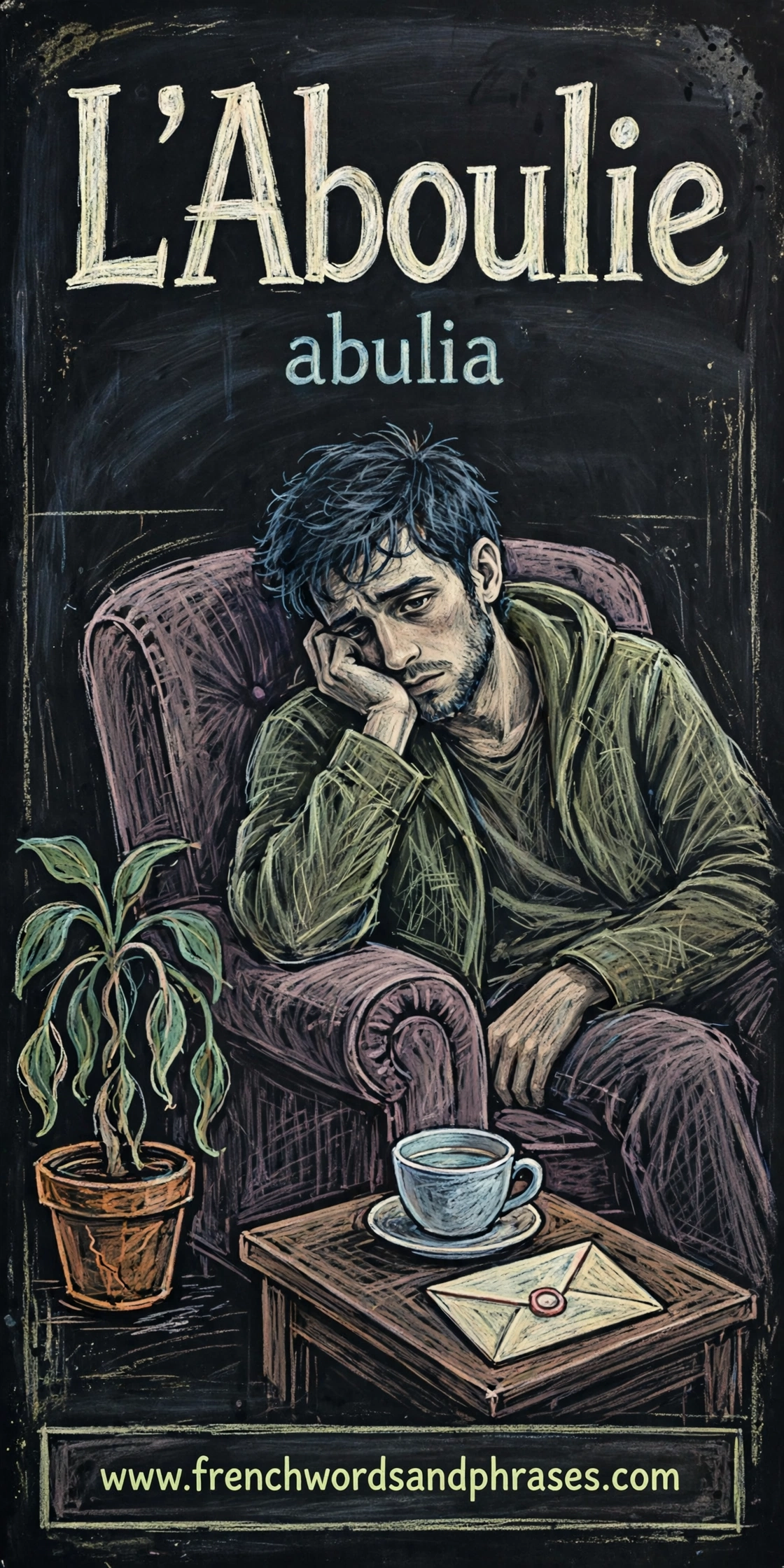
Imagine the unanswered letter on the desk — not forgotten, not refused, simply impossible to begin, day after day, while its writer watches his own silence with dismay.
You have not just lost energy. You have lost the first step — et l’aboulie commence exactement là, and abulia begins exactly there.
How to Use Aboulie in French: Complete Guide
Let’s explore how aboulie works in French, beginning with its articles — a rare, precise word for a heavy subject.
Aboulie with the Definite Article (L’, Les)
Aboulie begins with a vowel, so la shrinks to l’ — l’aboulie, the condition the doctor names.
| Form | French |
|---|---|
| Feminine singular | l’aboulie |
| Plural | les aboulies (rare) |
Example
L’aboulie fait partie des symptômes de sa maladie.
Abulia is one of the symptoms of his illness.
Aboulie with the Indefinite Article (Une, Des)
Used for one episode or form of the condition — une aboulie profonde, a deep abulia.
| Form | French |
|---|---|
| Feminine singular | une aboulie |
| Plural | des aboulies (rare) |
Example
Le patient souffre d’une aboulie profonde depuis des mois.
The patient has been suffering from deep abulia for months.
Words of the Will: Around Aboulie
Will, decisions and hesitation — the vocabulary that surrounds aboulie.
| French | In English |
|---|---|
| la volonté | the will, willpower |
| la décision | the decision |
| l’hésitation | hesitation |
| la motivation | motivation |
| agir | to act |
| l’apathie | apathy |
Example
Sans volonté, la moindre décision devient un effort.
Without willpower, the smallest decision becomes an effort.
Quick Quiz 1
Complete the sentence:
Il souffre ______ aboulie depuis son accident. (of)
Reveal the answer
d’
Il souffre d’aboulie depuis son accident.
He has suffered from abulia since his accident — souffrir de, shortened to d’ before the vowel.
The Plural of Aboulie
Aboulie can add an -s, but like most names of conditions it lives in the singular.
| Number | French |
|---|---|
| Singular | l’aboulie |
| Plural | les aboulies (rare) |
Example
Les médecins distinguent l’aboulie de la simple fatigue.
Doctors distinguish abulia from simple tiredness.
Aboulie with Possessive Adjectives (Mon, Ton, Son…)
Aboulie begins with a vowel, so it takes mon, ton, son — son aboulie, never « sa aboulie ».
| Owner | French |
|---|---|
| my | mon aboulie |
| your (tu) | ton aboulie |
| his / her | son aboulie |
| our | notre aboulie |
| your (vous) | votre aboulie |
| their | leur aboulie |
Example
Son aboulie inquiète toute sa famille.
His abulia worries his whole family.
Quick Quiz 2
Complete the sentence:
______ aboulie de mon frère s’améliore doucement. (The)
Reveal the answer
L’
L’aboulie de mon frère s’améliore doucement.
My brother’s abulia is slowly improving — l’, the elided article.
Aboulie with Demonstrative Adjectives (Cette, Ces)
Used to point at the condition under discussion: cette aboulie, this abulia.
| Form | French |
|---|---|
| Feminine singular | cette aboulie |
| Plural | ces aboulies (rare) |
Example
Cette aboulie constante épuise son entourage.
This constant abulia exhausts those around him.
Aboulie with Adjectives
Adjectives agree with the feminine noun: une aboulie profonde.
| Adjective | With Aboulie |
|---|---|
| profond (deep) | une aboulie profonde |
| total (total) | une aboulie totale |
| passager (passing) | une aboulie passagère |
| grave (serious) | une aboulie grave |
Example
Une aboulie passagère peut suivre un grand choc.
A passing abulia can follow a great shock.
Quick Quiz 3
Complete the sentence:
C’est une aboulie ______, pas de la paresse. (deep)
Reveal the answer
profonde
C’est une aboulie profonde, pas de la paresse.
It is a deep abulia, not laziness.
Everyday Expressions with Aboulie
Clinics and careful conversations — the aboulie phrases you may meet.
| Expression | In English |
|---|---|
| souffrir d’aboulie | to suffer from abulia |
| un accès d’aboulie | a bout of abulia |
| être incapable de décider | to be unable to decide |
| l’aboulie et la dépression | abulia and depression |
| traiter l’aboulie | to treat abulia |
| sortir de l’aboulie | to come out of abulia |
Example
Avec de l’aide, il commence à sortir de l’aboulie.
With help, he is beginning to come out of his abulia.
Words from the Same Family as Aboulie
Will and its shadows — the words that travel with aboulie.
| French | In English |
|---|---|
| aboulique | abulic (suffering from abulia) |
| la volonté | the will, willpower |
| vouloir | to want, to wish |
| l’apathie | apathy |
| hésiter | to hesitate |
| la décision | the decision |
Example
Un patient aboulique a besoin de patience et de soutien.
An abulic patient needs patience and support.
Quick Quiz 4
What is the difference between aboulie and paresse?
Reveal the answer
Aboulie is an illness of the will; paresse is laziness — a choice or a habit. The aboulique wants to act and cannot; the paresseux simply prefers not to.
L’aboulie est une maladie, pas un défaut.
Abulia is an illness, not a character flaw.
Aboulie in Everyday French: Real-Life Examples
Now that you know the word, let’s see how aboulie appears in everyday French.
Example 1 — At the doctor’s
Le médecin parle d’aboulie, un symptôme à traiter.
The doctor speaks of abulia, a symptom to be treated.
Example 2 — A family worry
Son aboulie rend chaque décision impossible.
His abulia makes every decision impossible.
Example 3 — Reading psychology
Le livre consacre un chapitre à l’aboulie.
The book devotes a chapter to abulia.
Example 4 — A slow recovery
Après des mois d’aboulie, elle recommence à faire des projets.
After months of abulia, she is starting to make plans again.
Example 5 — Explaining gently
Ce n’est pas de la paresse, c’est de l’aboulie.
It is not laziness; it is abulia.
Example 6 — A passing phase
Une aboulie passagère a suivi son deuil.
A passing abulia followed his bereavement.
Beyond Translation: The Meaning of Aboulie
Aboulie was named in the nineteenth century, when doctors of the mind began to map the will the way others mapped the body — and found it could break like anything else. The word remains uncommon in the street, but it carries an important kindness: it separates suffering from blame, and gives the person who cannot begin a diagnosis instead of a reproach.
To say aboulie is to say: the will is ill, not absent, and not lazy.
It evokes the silent desk and the unanswered letter — and the slow, real possibility of the first step returning.
How to Remember the French Noun Aboulie
Remember it this way: Aboulie is abulia — the clinical name for a will that has fallen ill, a feminine word built on the idea of missing will.
- You hear the silence — l’aboulie, la volonté qui se tait.
- You make the distinction — aboulie est une maladie, la paresse est un choix.
- You use the verb phrase — souffrir d’aboulie, et en sortir doucement.
The key idea is l’aboulie — the will, ill; not laziness.
Test Your Knowledge of Aboulie
Let’s see how much you’ve learned. Try answering these questions before revealing the answers.
Question 1
Is aboulie masculine or feminine?
Reveal the answer
Feminine — l’aboulie, une aboulie, cette aboulie.
Question 2
What does aboulie mean?
Reveal the answer
Abulia — a pathological loss of willpower and decision, a symptom in depression and some neurological illnesses.
Question 3
Translate: He suffers from abulia.
Reveal the answer
Il souffre d’aboulie.
Question 4
What is the adjective from aboulie?
Reveal the answer
Aboulique — un patient aboulique, a patient suffering from abulia.
Question 5
Complete the sentence:
______ aboulie est un symptôme sérieux. (The)
Reveal the answer
L’
L’aboulie est un symptôme sérieux.
Abulia is a serious symptom.
Your Final Challenge
Can You Use It?
How would you say this in French?
“Abulia is an illness of the will, not laziness.”
Reveal the answer
L’aboulie est une maladie de la volonté, pas de la paresse.
Abulia is an illness of the will, not laziness.
A little French. A little curiosity. A richer everyday life.
LEARN FRENCH ONE WORD AT A TIME