A French Word to Live By
Translate Abot to English
/a.bo/
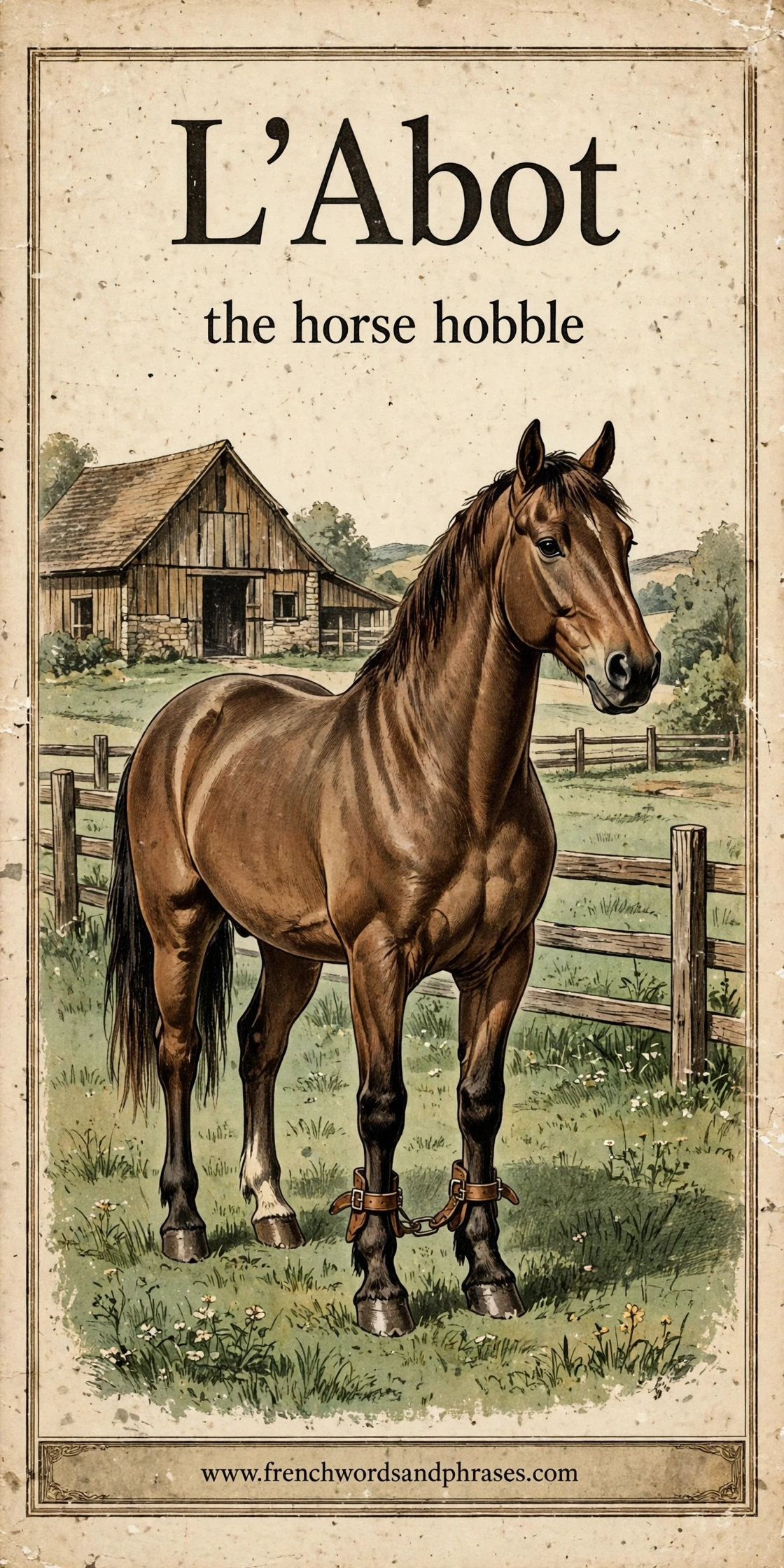
L’Abot means the horse hobble.
The meadow has no fence, yet the horses are still there at dusk, grazing in slow circles. The secret hangs between their front legs, a short strap of worn leather — l’abot.
In this guide, you’ll learn what abot means in English, how to use it with its articles, how to form its plural, and how it appears in everyday French. Explore French examples, English translations, and practice quizzes.
Understanding the French Noun Abot
Abot is a masculine French noun, learned with its article: l’abot, un abot — because it begins with a vowel, le shrinks to l’. It is a word you will almost always meet in the plural: les abots, the pair of straps that hobble a horse.
It means the horse hobble — one of the short straps fastened between the legs of a horse left to graze unfenced. The abots let the animal walk slowly and crop the grass, but trip it if it tries to gallop away. It is an old, practical word of farms and open pastures, from a time when fences were rare and horses had to be trusted — halfway.
Gender: Masculine
Definite article: l’ — l’abot (the horse hobble)
Indefinite article: un — un abot (a horse hobble)
Plural: les abots — the word lives mostly in the plural
Usage: Usually plural: mettre les abots à un cheval
English equivalents: The horse hobble; hobbles, fetters for a horse.
One important usage detail: because hobbles work in pairs, French says les abots and mettre les abots à un cheval — to hobble a horse. The singular un abot names a single strap of the pair.
Experience the Word
Abot is more than a strap. It is a small treaty between the farmer and the horse: you may wander, you may graze, but the meadow is the limit — freedom, measured in short steps.
Imagine the evening pasture: the horses moving slowly in the long light, the leather creaking softly at every step, the herd staying together without a single fence post in sight.
You have not just tied an animal. You have negotiated — les abots, la liberté à petits pas, freedom in small steps.
How to Use Abot in French: Complete Guide
Let’s explore how abot works in French, beginning with its articles — a small word that spends its life in the plural.
Abot with the Definite Article (L’, Les)
Abot begins with a vowel, so le shrinks to l’ — and les abots is the form you will meet most often.
| Form | French |
|---|---|
| Masculine singular | l’abot |
| Plural | les abots |
Example
Les abots empêchent le cheval de galoper.
The hobbles stop the horse from galloping.
Abot with the Indefinite Article (Un, Des)
Used for one strap in general — un abot, or des abots for the straps of the whole stable.
| Form | French |
|---|---|
| Masculine singular | un abot |
| Plural | des abots |
Example
Le fermier répare un abot usé dans la grange.
The farmer is mending a worn hobble strap in the barn.
In the Meadow: Words Around the Abot
Horses, grass and leather — the vocabulary of the unfenced pasture.
| French | In English |
|---|---|
| le cheval | the horse |
| le pré | the meadow |
| la corde | the rope |
| la jambe | the leg |
| paître | to graze |
| le cuir | leather |
Example
Le cheval paît tranquillement dans le pré.
The horse grazes peacefully in the meadow.
Quick Quiz 1
Complete the sentence:
Le fermier met ______ à sa jument avant la nuit. (the hobbles)
Reveal the answer
les abots
Le fermier met les abots à sa jument avant la nuit.
The farmer puts the hobbles on his mare before nightfall — les abots, in the plural, as the word prefers.
The Plural of Abot
Abot adds an -s in the plural — and the plural is the word’s natural home, since hobbles come in pairs.
| Number | French |
|---|---|
| Singular | l’abot |
| Plural | les abots |
Example
Des abots solides pendent au mur de l’écurie.
Sturdy hobbles hang on the stable wall.
Abot with Possessive Adjectives (Mon, Ton, Son…)
Abot begins with a vowel, so it takes mon, ton, son — ses abots for the straps of one horse.
| Owner | French |
|---|---|
| my | mon abot / mes abots |
| your (tu) | ton abot / tes abots |
| his / her | son abot / ses abots |
| our | notre abot / nos abots |
| your (vous) | votre abot / vos abots |
| their | leur abot / leurs abots |
Example
Le cheval connaît bien ses abots en cuir.
The horse knows its leather hobbles well.
Quick Quiz 2
Complete the sentence:
______ abots de la vieille jument sont en cuir épais. (Her)
Reveal the answer
Ses
Ses abots de la vieille jument sont en cuir épais.
The old mare’s hobbles are of thick leather — ses, the plural possessive.
Abot with Demonstrative Adjectives (Cet, Ces)
Used to point: cet abot for one strap (cet, because of the vowel), ces abots for the pair.
| Form | French |
|---|---|
| Masculine singular | cet abot |
| Plural | ces abots |
Example
Ces abots sont trop lâches pour ce cheval vif.
These hobbles are too loose for this lively horse.
Abot with Adjectives
Adjectives agree with the masculine noun, singular or plural: des abots solides.
| Adjective | With Abot |
|---|---|
| solide (sturdy) | un abot solide / des abots solides |
| usé (worn) | un abot usé / des abots usés |
| vieux (old) | un vieil abot / de vieux abots |
| neuf (new) | un abot neuf / des abots neufs |
Example
Il achète des abots neufs pour la saison.
He is buying new hobbles for the season.
Quick Quiz 3
Complete the sentence:
Ces abots sont trop ______ pour un jeune cheval. (old)
Reveal the answer
vieux
Ces abots sont trop vieux pour un jeune cheval.
These hobbles are too old for a young horse.
Everyday Expressions with Abot
Stables and pastures — the abot phrases of farm life.
| Expression | In English |
|---|---|
| mettre les abots à un cheval | to hobble a horse |
| un cheval aux abots | a hobbled horse |
| les abots en cuir | leather hobbles |
| enlever les abots | to take the hobbles off |
| paître avec les abots | to graze wearing hobbles |
| des abots solides | sturdy hobbles |
Example
Le soir, on met les abots aux chevaux dans le pré.
In the evening, the horses in the meadow are hobbled.
Words from the Same Family as Abot
Tying, grazing and holding — the words that travel with abot.
| French | In English |
|---|---|
| entraver | to hobble, to shackle |
| l’entrave | the hobble, the fetter |
| la longe | the tether, the lunge line |
| attacher | to tie, to fasten |
| le cheval | the horse |
| paître | to graze |
Example
L’entrave et l’abot servent au même travail.
The fetter and the hobble serve the same purpose.
Quick Quiz 4
What does entraver mean?
Reveal the answer
To hobble, to shackle — the verb of the same family: entraver un cheval, to hobble a horse.
On entrave les chevaux pour la nuit.
The horses are hobbled for the night.
Abot in Everyday French: Real-Life Examples
Now that you know the word, let’s see how abot appears in everyday French.
Example 1 — At the farm
Le fermier met les abots aux chevaux avant de rentrer.
The farmer hobbles the horses before going in.
Example 2 — In the meadow
Les chevaux paissent lentement, les abots aux jambes.
The horses graze slowly, hobbles on their legs.
Example 3 — At the stable
De vieux abots en cuir pendent près de la porte.
Old leather hobbles hang near the door.
Example 4 — Talking about a horse
Ce cheval calme supporte bien les abots.
This calm horse puts up with hobbles well.
Example 5 — Morning routine
Elle enlève les abots et mène la jument à l’écurie.
She takes off the hobbles and leads the mare to the stable.
Example 6 — A repair
Il coud un abot déchiré avec un fil épais.
He sews a torn hobble strap with thick thread.
Beyond Translation: The Meaning of Abot
Abot is a survivor from the open-range centuries, when a horse’s overnight freedom had to be negotiated rather than fenced. Words like this grow rare as the practices fade — you will meet les abots in farming memoirs, in regional novels, and in the speech of older country people, where the whole world of unfenced pasture still lives inside one small plural.
To say abot is to open the gate of a meadow with no fences.
It evokes leather and dusk, slow grazing and patient horses — an old countryside, preserved in a word of two syllables.
How to Remember the French Noun Abot
Remember it this way: Abot is the horse hobble — a small farm word that lives in the plural: les abots, the straps that slow a grazing horse.
- You think plural — les abots, toujours les abots.
- You see the pair — un abot par jambe, deux abots par cheval.
- You use the phrase — mettre les abots à un cheval.
The key idea is les abots — hobbles come in pairs, and so does the word.
Test Your Knowledge of Abot
Let’s see how much you’ve learned. Try answering these questions before revealing the answers.
Question 1
Is abot masculine or feminine?
Reveal the answer
Masculine — l’abot, un abot, les abots.
Question 2
Why is abot usually in the plural?
Reveal the answer
Because hobbles work in pairs — one strap for the pair of legs, so French says les abots and mettre les abots.
Question 3
Translate: The farmer hobbles the horses in the evening.
Reveal the answer
Le fermier met les abots aux chevaux le soir.
Question 4
What does paître mean?
Reveal the answer
To graze — what a hobbled horse does all day, slowly, inside its small circle.
Question 5
Complete the sentence:
Le cheval porte ______ abots en cuir.
Reveal the answer
des
Le cheval porte des abots en cuir.
The horse wears leather hobbles.
Your Final Challenge
Can You Use It?
How would you say this in French?
“In the evening, the farmer puts the hobbles on the horses.”
Reveal the answer
Le soir, le fermier met les abots aux chevaux.
In the evening, the farmer puts the hobbles on the horses.
A little French. A little curiosity. A richer everyday life.
LEARN FRENCH ONE WORD AT A TIME