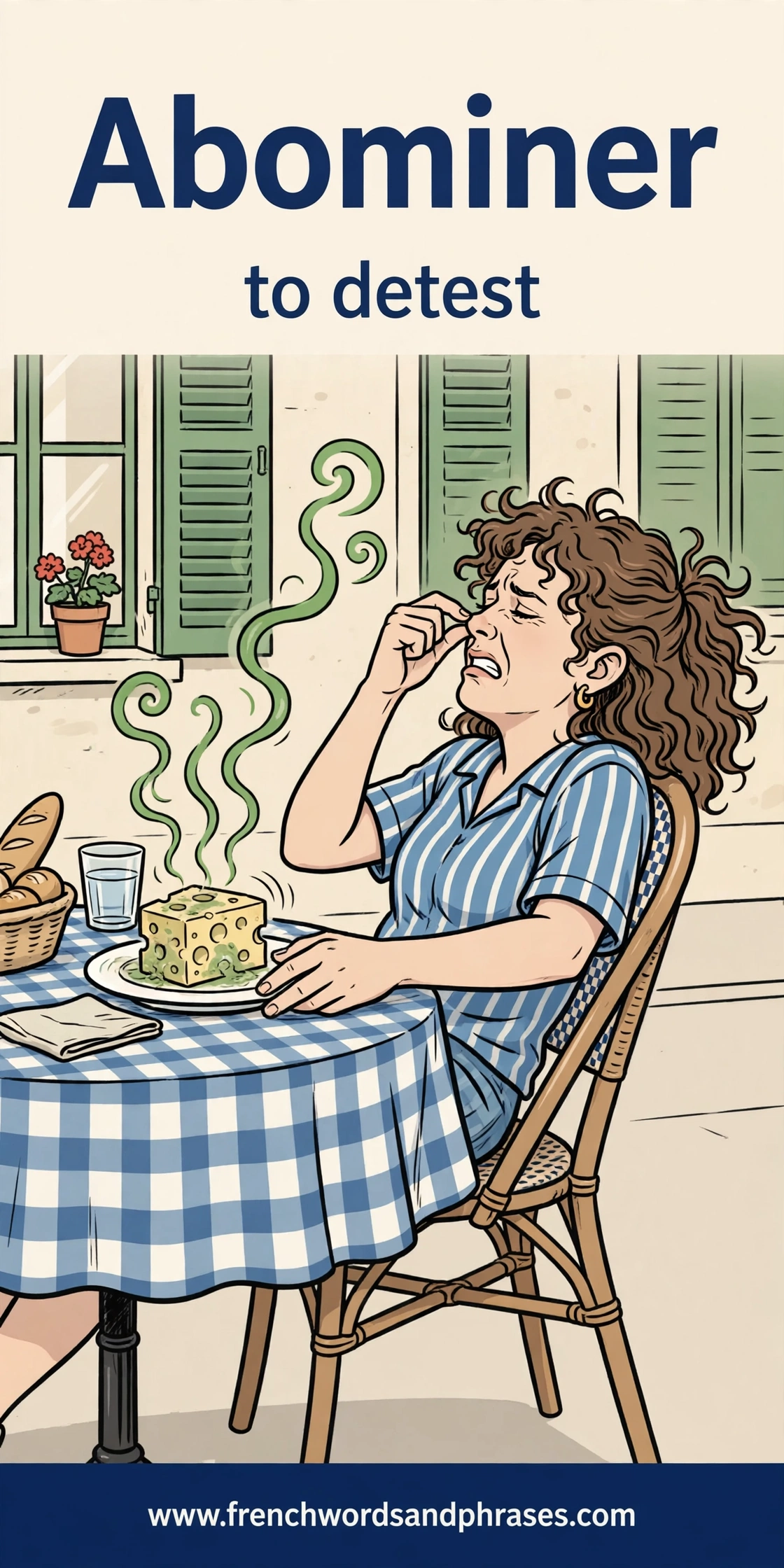
A French Word to Live By
How to Conjugate Abominer in French
/a.bɔ.mi.ne/
Abominer means to abominate — to detest something utterly, to loathe it with horror, as one loathes a crime.
A tyrant’s cruelty, a betrayal, a smell from the cellar — abominer is the strongest verb of hatred in the cupboard: not mere dislike, but loathing with a shudder, hatred as a physical recoil.
In this guide, you’ll learn how to conjugate abominer in all the major French tenses and moods. Explore complete conjugation tables, French examples, English translations, and practice quizzes.
Understanding the French Verb Abominer
Abominer is a regular French verb belonging to the first group of verbs, those ending in-er.
It means to detest. It is commonly used of moral horrors — war, cruelty, injustice — and, half-jokingly, of foods, weather and habits one cannot stand. What one abomine, one does not merely dislike: one holds it in horror, the way one holds a crime.
Verb classification: First group (-er)
Auxiliary verb: Avoir
Past participle: abominé
Present participle: abominant
English equivalents: To abominate, to detest utterly, to loathe; abominer la violence — to abhor violence; abominer les traîtres — to detest traitors; abominable — abominable; une abomination — an abomination.
One important detail: abominer is a perfectly regular -er verb, but it is a heavyweight — stronger than détester and far stronger than ne pas aimer. It belongs to sermons, editorials and melodrama, and French speakers often use it with a smile of exaggeration: j’abomine les choux de Bruxelles ! Its family carries the same charge: abominable, une abomination.
Experience the Word
Abominer is hatred at full volume — the dislike that stands up, points, and denounces.
Imagine a village mayor reading the letter that announces the factory’s closure, the third in ten years. He does not frown; he rises, red-faced — il abomine cette injustice, and the whole council hears the word land like a gavel.
He does not dislike the decision. He abominates it — il l’abomine — as one abominates a crime.
How to Conjugate Abominer: Complete French Conjugation Guide
Let’s explore every major conjugation of abominer, beginning with the indicative mood.
How to Conjugate Abominer in the Indicative Mood
The indicative mood is used to express facts, observations, actions, and events.
How to Conjugate Abominer in the Present Tense (Présent)
Used for actions happening now, habitual actions, and general truths.
| Subject | Conjugation |
|---|---|
| je | abomine |
| tu | abomines |
| il / elle | abomine |
| nous | abominons |
| vous | abominez |
| ils / elles | abominent |
Example
Elle abomine les mensonges et les demi-vérités.
She detests lies and half-truths.
Quick Quiz 1
Complete the sentence:
Nous ______ les demi-vérités.
Reveal the answer
abominons
Nous abominons les demi-vérités.
We detest half-truths.
How to Conjugate Abominer in the Passé Composé
Used for completed actions in the past. Abominer takes the auxiliary verb avoir.
| Subject | Conjugation |
|---|---|
| j’ | ai abominé |
| tu | as abominé |
| il / elle | a abominé |
| nous | avons abominé |
| vous | avez abominé |
| ils / elles | ont abominé |
Example
Il a abominé ce régime toute sa vie.
He detested that regime all his life.
How to Conjugate Abominer in the Imparfait (Imperfect Tense)
Used for habitual past actions, descriptions, and ongoing situations in the past.
| Subject | Conjugation |
|---|---|
| je | abominais |
| tu | abominais |
| il / elle | abominait |
| nous | abominions |
| vous | abominiez |
| ils / elles | abominaient |
Example
Les paysans abominaient les taxes nouvelles.
The peasants used to detest the new taxes.
Quick Quiz 2
Choose the correct form:
He detested that regime.
Il ______ ce régime. (a abominé / est abominé)
Reveal the answer
a abominé
Il a abominé ce régime.
Abominer takes avoir.
How to Conjugate Abominer in the Plus-que-parfait
Used to describe an action that had already been completed before another past event.
| Subject | Conjugation |
|---|---|
| j’ | avais abominé |
| tu | avais abominé |
| il / elle | avait abominé |
| nous | avions abominé |
| vous | aviez abominé |
| ils / elles | avaient abominé |
Example
Elle avait abominé la guerre dès son enfance.
She had abhorred war since her childhood.
How to Conjugate Abominer in the Passé Simple
Primarily used in formal writing, literature, and historical narratives. It is rarely used in everyday conversation.
| Subject | Conjugation |
|---|---|
| je | abominai |
| tu | abominas |
| il / elle | abomina |
| nous | abominâmes |
| vous | abominâtes |
| ils / elles | abominèrent |
Example
Le peuple abomina le tyran et ses ministres.
The people detested the tyrant and his ministers.
How to Conjugate Abominer in the Passé Antérieur
A literary tense used to express an action completed immediately before another past action, generally in the passé simple.
| Subject | Conjugation |
|---|---|
| j’ | eus abominé |
| tu | eus abominé |
| il / elle | eut abominé |
| nous | eûmes abominé |
| vous | eûtes abominé |
| ils / elles | eurent abominé |
Example
Quand il eut abominé l’injustice en plein conseil, le silence se fit.
When he had abominated the injustice in full council, silence fell.
How to Conjugate Abominer in the Future Tense (Futur Simple)
Used to describe actions that will take place in the future.
| Subject | Conjugation |
|---|---|
| je | abominerai |
| tu | abomineras |
| il / elle | abominera |
| nous | abominerons |
| vous | abominerez |
| ils / elles | abomineront |
Example
Les générations futures abomineront cette loi.
Future generations will detest this law.
How to Conjugate Abominer in the Futur Antérieur (Future Perfect)
Used for an action that will have been completed before a particular point in the future.
| Subject | Conjugation |
|---|---|
| j’ | aurai abominé |
| tu | auras abominé |
| il / elle | aura abominé |
| nous | aurons abominé |
| vous | aurez abominé |
| ils / elles | auront abominé |
Example
À la fin du procès, il aura abominé cent fois ce système.
By the end of the trial, he will have detested this system a hundred times.
How to Conjugate Abominer in the Near Future (Futur Proche)
Used to describe something that is going to happen soon. Formed with aller + infinitive.
| Subject | Conjugation |
|---|---|
| je | vais abominer |
| tu | vas abominer |
| il / elle | va abominer |
| nous | allons abominer |
| vous | allez abominer |
| ils / elles | vont abominer |
Example
Tu vas abominer ce plat, je te connais.
You are going to detest this dish, I know you.
How to Conjugate Abominer in the Conditional Mood
The conditional mood expresses what would happen under certain circumstances. It is also frequently used to make polite requests or express wishes.
How to Conjugate Abominer in the Present Conditional
| Subject | Conjugation |
|---|---|
| je | abominerais |
| tu | abominerais |
| il / elle | abominerait |
| nous | abominerions |
| vous | abomineriez |
| ils / elles | abomineraient |
Example
Il abominerait les compromis même pour se sauver.
He would detest compromises even to save himself.
How to Conjugate Abominer in the Past Conditional
| Subject | Conjugation |
|---|---|
| j’ | aurais abominé |
| tu | aurais abominé |
| il / elle | aurait abominé |
| nous | aurions abominé |
| vous | auriez abominé |
| ils / elles | auraient abominé |
Example
Elle aurait abominé cette trahison si elle l’avait sue.
She would have detested this betrayal if she had known of it.
Abominer in the Literary Past Conditional Form
This less common literary form uses the imperfect subjunctive of avoir.
| Subject | Conjugation |
|---|---|
| j’ | eusse abominé |
| tu | eusses abominé |
| il / elle | eût abominé |
| nous | eussions abominé |
| vous | eussiez abominé |
| ils / elles | eussent abominé |
Example
Le vieux prêtre eût abominé de tels discours.
The old priest would have abominated such speeches.
How to Conjugate Abominer in the Subjunctive Mood
The subjunctive is used to express wishes, emotions, doubts, necessity, and uncertainty. It frequently follows expressions such as il faut que (it is necessary that) or bien que (although).
How to Conjugate Abominer in the Present Subjunctive
| Subject | Conjugation |
|---|---|
| que je | abomine |
| que tu | abomines |
| qu’il / qu’elle | abomine |
| que nous | abominions |
| que vous | abominiez |
| qu’ils / qu’elles | abominent |
Example
Il est naturel qu’elle abomine la violence.
It is natural that she abhors violence.
Quick Quiz 3
Complete the sentence using the subjunctive:
Je comprends que vous ______ la violence.
Reveal the answer
abominiez
Je comprends que vous abominiez la violence.
I understand that you abhor violence.
How to Conjugate Abominer in the Imperfect Subjunctive
A literary tense, rarely encountered in modern spoken French.
| Subject | Conjugation |
|---|---|
| que je | abominasse |
| que tu | abominasses |
| qu’il / qu’elle | abominât |
| que nous | abominassions |
| que vous | abominassiez |
| qu’ils / qu’elles | abominassent |
Example
On comprenait qu’il abominât les traîtres.
People understood that he detested traitors.
How to Conjugate Abominer in the Pluperfect Subjunctive
A literary construction used to express an action completed before another past action.
| Subject | Conjugation |
|---|---|
| que j’ | eusse abominé |
| que tu | eusses abominé |
| qu’il / qu’elle | eût abominé |
| que nous | eussions abominé |
| que vous | eussiez abominé |
| qu’ils / qu’elles | eussent abominé |
Example
On disait qu’elle eût abominé la guerre toute sa vie.
It was said she had abhorred war all her life.
How to Conjugate Abominer in the Past Subjunctive
| Subject | Conjugation |
|---|---|
| que j’ | aie abominé |
| que tu | aies abominé |
| qu’il / qu’elle | ait abominé |
| que nous | ayons abominé |
| que vous | ayez abominé |
| qu’ils / qu’elles | aient abominé |
Example
Je comprends qu’il ait abominé ce régime.
I understand that he detested that regime.
How to Conjugate Abominer in the Imperative
The imperative is used to give commands, instructions, invitations, or suggestions. Subject pronouns are omitted.
How to Conjugate Abominer in the Present Imperative
| Person | Conjugation |
|---|---|
| (tu) | abomine |
| (nous) | abominons |
| (vous) | abominez |
Example
Abomine l’injustice, jamais les personnes !
Detest injustice, never people!
Quick Quiz 4
How would you say Detest injustice (tu form)?
Reveal the answer
Abomine l’injustice !
French Participles of Abominer
Participles are verb forms that can be used in compound tenses and other grammatical constructions.
Present Participle of Abominer
abominant
En abominant la guerre, elle devint pacifiste.
By abhorring war, she became a pacifist.
Past Participle of Abominer
abominé
Abominé de tous, le tyran finit seul.
Detested by all, the tyrant ended up alone.
Abominer in Everyday French: Real-Life Examples
Now that you know the conjugations, let’s see how abominer appears in everyday French.
Example 1 — Present
Elle abomine les mensonges.
She detests lies.
Example 2 — Passé composé
Il a abominé ce régime.
He detested that regime.
Example 3 — Imparfait
Les paysans abominaient les taxes.
The peasants used to detest the taxes.
Example 4 — Future
Tu abomineras ce plat, crois-moi.
You will detest this dish, believe me.
Example 5 — Conditional
Il abominerait même un compromis honnête.
He would detest even an honest compromise.
Example 6 — Imperative
Abominez l’injustice !
Detest injustice!
Beyond Translation: The Meaning of Abominer
English abominate exists but sounds like a Victorian sermon; French abominer is still alive, flexing between genuine moral horror and comic exaggeration.
It is détester with a pulpit.
From the same Latin root as abominable — originally an ill omen, something to be shunned — the verb keeps that old shudder: what one abomine is not just disliked, it is cursed.
How to Remember the French Verb Abominer
Remember it this way: Abominer is about the mayor rising to denounce — hatred at full volume.
- Stronger than détester: abominer is loathing with horror — for crimes, tyrants… and Brussels sprouts.
- Regular -er with avoir: j’abomine, nous abominons, past participle abominé.
- Its family: abominable and une abomination carry the same charge.
The key idea is the mayor rising to denounce — hatred at full volume.
Test Your Knowledge of Abominer
Let’s see how much you’ve learned. Try answering these questions before revealing the answers.
Question 1
How does abominer compare with détester?
Reveal the answer
It is stronger — abominer is to loathe with horror, détester simply to detest.
Question 2
How do you say She detests lies in French?
Reveal the answer
Elle abomine les mensonges.
Question 3
Translate: The people detested the tyrant.
Reveal the answer
Le peuple abominait le tyran.
Question 4
What is the past participle of abominer?
Reveal the answer
Abominé.
Question 5
Complete the sentence:
Il est naturel qu’elle ______ la violence.
Reveal the answer
abomine
Il est naturel qu’elle abomine la violence.
It is natural that she abhors violence.
Your Final Challenge
Can You Use It?
How would you say this in French?
She detests lies, and the whole village knows it.
Reveal the answer
Elle abomine les mensonges, et tout le village le sait.
She detests lies, and the whole village knows it.
A little French. A little curiosity. A richer everyday life.
LEARN FRENCH ONE WORD AT A TIME