A French Word to Live By
Translate Abiotique to English
/a.bjɔ.tik/
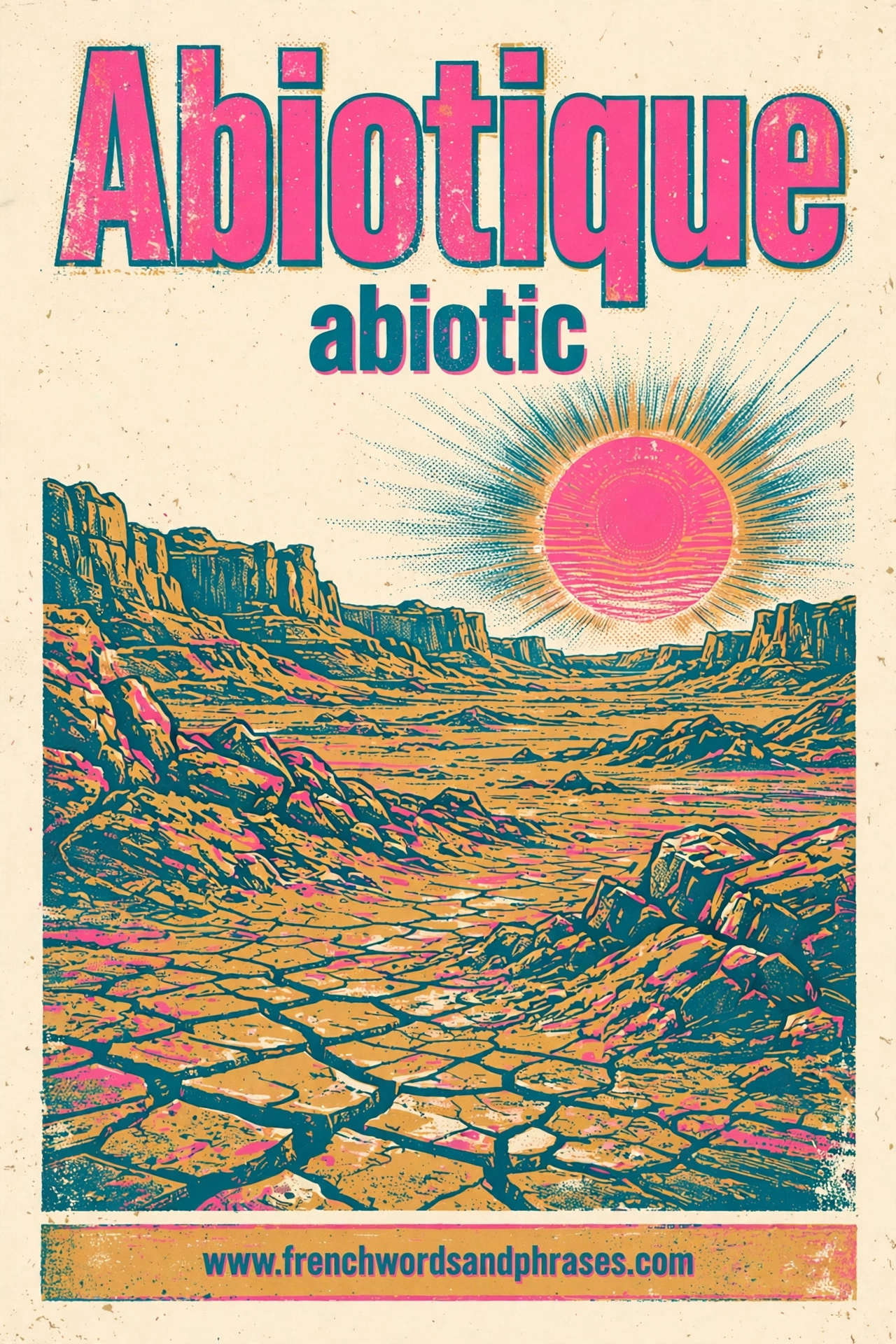
Abiotique means abiotic.
Dawn over a mountain lake, and a young biologist is making two lists in her notebook. On the left, everything alive: fish, algae, reeds. On the right, everything that is not — sunlight, stone, cold water, wind. French has one tidy adjective for that whole second list: abiotique.
In this guide, you’ll learn what abiotique means in English, why it never changes between masculine and feminine, where it stands in the sentence, and how scientists use it for light, water, rock and climate. Explore French examples, English translations, and practice quizzes.
Understanding the French Adjective Abiotique
Abiotique is a French adjective of quality — the science adjective for everything in nature that is not alive. It already ends in -e, so masculine and feminine are identical: only the plural adds an s. Un facteur abiotique, une condition abiotique, des éléments abiotiques — one form does almost all the work.
It means abiotic — non-living, not produced by living things. It describes the physical side of an ecosystem (les facteurs abiotiques, the abiotic factors): light, temperature, water, soil and air. If it shapes living things without being alive itself, abiotique is the word science reaches for.
Type: Adjective of quality — science and ecology
Answers the question: What is it like? — non-living, abiotic
Changes form: Only in the plural — abiotique / abiotiques, the same for masculine and feminine
English equivalents: Abiotic; non-living; inorganic.
One important usage detail: abiotique stands AFTER the noun — un facteur abiotique, des conditions abiotiques. Its natural partner and opposite is biotique (living): a good ecosystem description sorts the world into les facteurs biotiques et abiotiques.
Experience the Word
Abiotique is the adjective of the stage rather than the actors — the light, the water and the stone that were there long before anything lived on them.
Imagine a handful of pond water under a microscope: the darting creatures are the living cast, but the minerals dissolved invisibly around them are abiotique — silent, essential, and running the whole show from behind.
You have not just labelled something lifeless. You have named the non-living half of nature that makes the living half possible.
How to Use Abiotique in French: Complete Guide
Let’s explore how abiotique works in French, beginning with the whole word on one card.
Abiotique at a Glance
Before the details, here is the whole word on one card.
The Whole Word on One Card
Meaning, type, position and forms — abiotique in four lines.
| Point | Abiotique |
|---|---|
| Meaning | abiotic — non-living |
| Type | adjective of quality — science and ecology |
| Usual position | after the noun — un facteur abiotique |
| Form | abiotique for everyone — abiotiques in the plural |
Example
La lumière est un facteur abiotique.
Light is an abiotic factor.
The Four Forms of Abiotique
Abiotique already ends in -e, so the feminine changes nothing. Only the plural adds an s.
| Form | Abiotique | Example |
|---|---|---|
| Masculine singular | abiotique | un milieu abiotique — an abiotic environment |
| Feminine singular | abiotique | une condition abiotique — an abiotic condition |
| Masculine plural | abiotiques | des facteurs abiotiques — abiotic factors |
| Feminine plural | abiotiques | des conditions abiotiques — abiotic conditions |
Example
Les facteurs abiotiques influencent les plantes.
Abiotic factors influence the plants.
Quick Quiz 1
Does abiotique change for a feminine noun?
Reveal the answer
No
Un facteur abiotique, une condition abiotique — the form is identical.
An abiotic factor, an abiotic condition.
The Feminine of Abiotique: Nothing Changes
Most adjectives build their feminine by adding an e. Abiotique was born with one, so the feminine has nothing to add.
| Situation | Example |
|---|---|
| Masculine | un élément abiotique — an abiotic element |
| Feminine | une substance abiotique — identical |
| Why | abiotique already ends in -e, so the feminine adds nothing |
| The plural | add s — des substances abiotiques, abiotic substances |
Example
L’eau est une substance abiotique essentielle.
Water is an essential abiotic substance.
Where Abiotique Goes: After the Noun
Abiotique follows the noun it describes, like most French adjectives, and it sits comfortably after être.
| Pattern | Example |
|---|---|
| After the noun | un facteur abiotique — an abiotic factor |
| After être | ce milieu est abiotique — this environment is abiotic |
| With an adverb | un facteur purement abiotique — a purely abiotic factor |
| Before the noun | un abiotique facteur — not in everyday French |
Example
Le sol est un élément abiotique du jardin.
Soil is an abiotic element of the garden.
Quick Quiz 2
How do you say ‘an abiotic factor’ — un abiotique facteur or un facteur abiotique?
Reveal the answer
un facteur abiotique
Abiotique stands after the noun.
An abiotic factor.
Comparing with Abiotique: A Word Rarely Graded
Things are usually abiotic or not, so comparisons are rare — but the machinery exists, and scientists use it when one influence is more purely non-living than another.
| Degree | Example |
|---|---|
| As abiotic as | aussi abiotique que — as abiotic as |
| More abiotic | plus abiotique — more abiotic (rare) |
| Less abiotic | moins abiotique — less abiotic (rare) |
| The most abiotic (masc.) | le plus abiotique — le plus abiotique des facteurs |
| The most abiotic (fem.) | la plus abiotique — la plus abiotique des influences |
Example
La lumière est aussi abiotique que la température.
Light is as abiotic as temperature.
Everyday Expressions with Abiotique
Abiotique lives in textbooks, nature documentaries and ecology lessons — wherever the non-living world gets its share of the credit.
| Expression | In English |
|---|---|
| un facteur abiotique | an abiotic factor |
| un milieu abiotique | an abiotic environment |
| des conditions abiotiques | abiotic conditions |
| un stress abiotique | abiotic stress (drought, cold, salt) |
| un élément abiotique | an abiotic element |
| l’environnement abiotique | the abiotic environment |
Example
Le stress abiotique menace les récoltes.
Abiotic stress threatens the harvests.
Quick Quiz 3
What is the opposite of abiotique?
Reveal the answer
biotique
Les facteurs biotiques sont les êtres vivants.
Biotic factors are the living beings.
Abiotique and Its Neighbours
Abiotique keeps company with the vocabulary of the non-living world; across the fence, biotique and vivant cover everything that breathes, grows or swims.
| French | In English |
|---|---|
| biotique | biotic — living, the direct opposite |
| inorganique | inorganic — not from living matter |
| inanimé | inanimate — lifeless, without movement |
| minéral | mineral — of rock and stone |
| vivant | living, alive — the everyday opposite |
| organique | organic — from living things |
Example
Le monde abiotique et le monde biotique se rencontrent dans le sol.
The abiotic world and the biotic world meet in the soil.
Watch Out: The Traps Around Abiotique
The traps here are about scope: abiotique belongs to science, and it never describes a person.
| Trap | The truth |
|---|---|
| People | never say a person is abiotique — it means non-living matter, not dull |
| The classic phrase | un facteur abiotique is the set expression in ecology lessons |
| Agreement | do not add a second e — une condition abiotique, never ‘abiotiquée’ |
| The spelling | abiotique starts with a- (without life), like atypique — not ‘abbiotique’ |
Example
La température est un facteur abiotique, pas un être vivant.
Temperature is an abiotic factor, not a living being.
Quick Quiz 4
How do you say ‘abiotic conditions’?
Reveal the answer
des conditions abiotiques
Abiotique follows the noun and adds s in the plural.
Abiotic conditions.
Abiotique in Everyday French: Real-Life Examples
Now that you know the word, let’s see how abiotique appears in everyday French.
Example 1 — Ecology class
Les facteurs abiotiques du lac sont la lumière et la température.
The abiotic factors of the lake are light and temperature.
Example 2 — Gardening
Le sol est un élément abiotique, mais il nourrit les plantes.
Soil is an abiotic element, but it feeds the plants.
Example 3 — A documentary
Dans ce désert, les conditions abiotiques sont extrêmes.
In this desert, the abiotic conditions are extreme.
Example 4 — Science homework
Elle classe l’eau parmi les facteurs abiotiques.
She classifies water among the abiotic factors.
Example 5 — Farming
Le stress abiotique réduit la récolte cette année.
Abiotic stress is reducing the harvest this year.
Example 6 — At the museum
Ce rocher est un élément abiotique de l’exposition.
This rock is an abiotic element of the exhibition.
Beyond Translation: The Meaning of Abiotique
English says abiotic for the meaning of abiotique — and the two words are twins, built from Greek a- (without) and bios (life). French science uses the word with quiet pride: an ecosystem is a conversation between the living and the non-living, and abiotique names the half that never speaks.
Abiotique is the adjective of sunlight, stone and rain — everything alive depends on things that are not.
Learn it beside its opposite, biotique, and you hold the two halves of ecology in two words.
How to Remember the French Adjective Abiotique
Remember it this way: Abiotique is the non-living adjective — one form for him and her, an s for the plural, and its place quietly behind the noun.
- You see one form for everyone — un facteur abiotique, une condition abiotique.
- You sort the world in two — le biotique vit, l’abiotique ne vit pas.
- You add only an s in the plural — des éléments abiotiques, des conditions abiotiques.
The key idea is abiotique means non-living, never changes except in the plural, and its opposite is biotique.
Test Your Knowledge of Abiotique
Let’s see how much you’ve learned. Try answering these questions before revealing the answers.
Question 1
What does abiotique mean?
Reveal the answer
Abiotic — non-living, not produced by living things.
Question 2
What is the feminine of abiotique?
Reveal the answer
abiotique — identical. The word already ends in -e.
Question 3
Translate: an abiotic factor.
Reveal the answer
Un facteur abiotique.
Question 4
Complete the sentence:
La lumière est un facteur ______ .
Reveal the answer
abiotique
La lumière est un facteur abiotique.
Light is an abiotic factor.
Question 5
How do you say ‘abiotic conditions’?
Reveal the answer
des conditions abiotiques — the adjective follows the noun and takes s in the plural.
Your Final Challenge
Can You Use It?
How would you say this in French?
“Light and water are abiotic factors.”
Reveal the answer
La lumière et l’eau sont des facteurs abiotiques.
Light and water are abiotic factors.
A little French. A little curiosity. A richer everyday life.
LEARN FRENCH ONE WORD AT A TIME