A French Word to Live By
Translate Abhorrable to English
/a.bɔ.ʁabl/
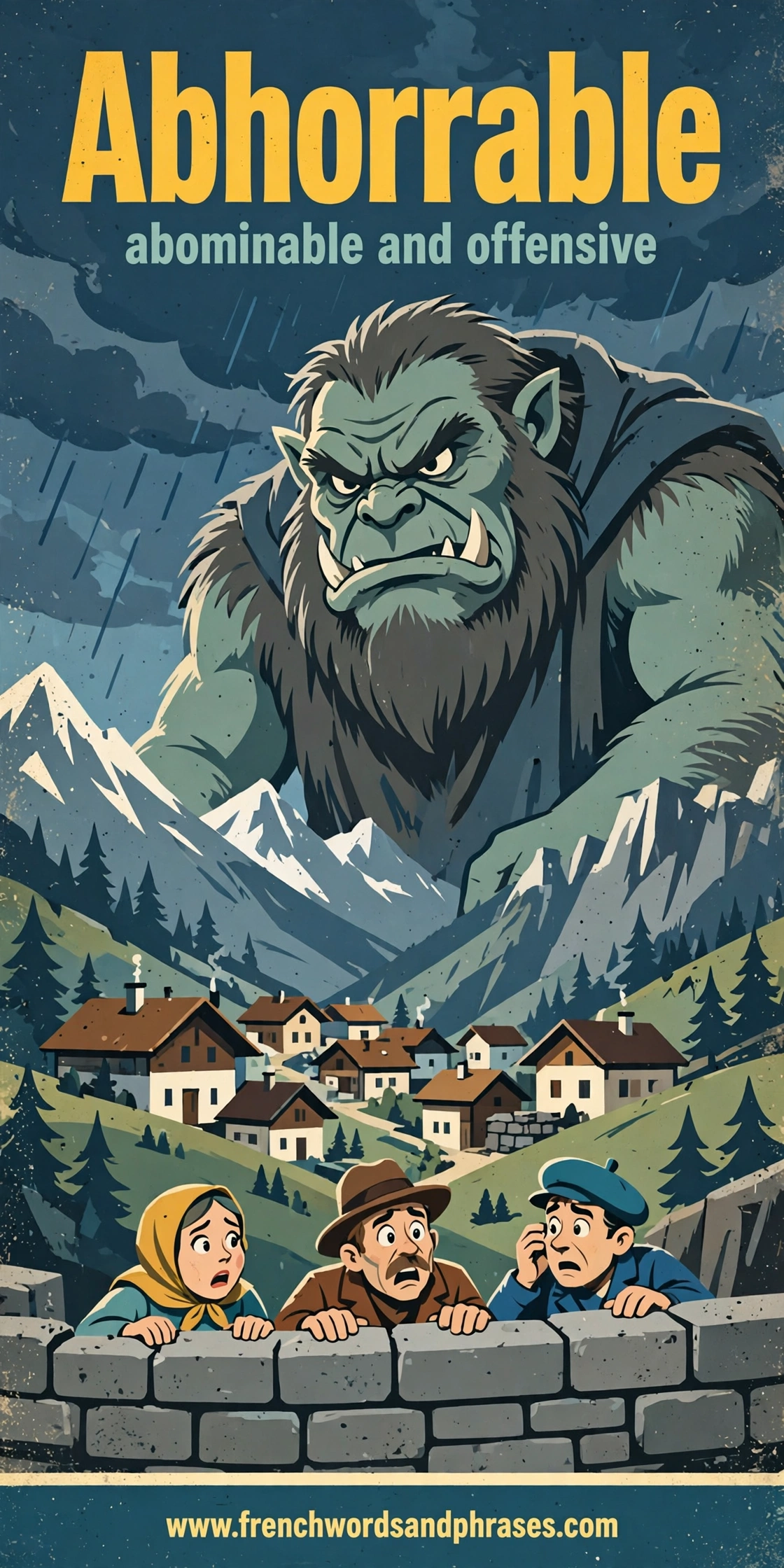
Abhorrable means abhorrent, detestable.
The old letter lies in the archive box, and the historian reads it with her lips pressed tight: page after page of cruelty, written in a calm, elegant hand. She closes the folder and gives her verdict to the empty room in a single word — the strongest word French keeps for things that deserve to be loathed: abhorrable.
In this guide, you’ll learn what abhorrable means in English, why masculine and feminine are identical, where it stands in the sentence, and how it relates to the verb abhorrer, to abhor. Explore French examples, English translations, and practice quizzes.
Understanding the French Adjective Abhorrable
Abhorrable is a French adjective of quality — the adjective of the verb abhorrer, to abhor. It already ends in -e, so masculine and feminine are identical: only the plural adds an s. Un crime abhorrable, une conduite abhorrable, des actes abhorrables — one form does nearly all the work.
It means abhorrent — deserving to be abhorred, detestable in the highest degree. It describes acts (un acte abhorrable), crimes, behaviour (une conduite abhorrable) and occasionally weather or smells in playful exaggeration. It is a strong, rather formal word: French reaches for it when détestable is not heavy enough.
Type: Adjective of quality — moral judgement, from abhorrer
Answers the question: What is it like? — abhorrent, detestable
Changes form: Only in the plural — abhorrable / abhorrables, the same for masculine and feminine
English equivalents: Abhorrent; detestable; loathsome; heinous.
One important usage detail: abhorrable stands AFTER the noun — un crime abhorrable. Because it already ends in -e, do not add another for the feminine: une conduite abhorrable, never ‘abhorrable’ with a second e. Its partner verb is abhorrer: il abhorre la violence, he abhors violence.
Experience the Word
Abhorrable is the adjective of the closed folder and the pressed lips — the word reserved for what the mind refuses to make peace with.
Imagine a village that keeps, in its little museum, the record of a single winter of betrayal two centuries ago. The schoolchildren file past the case every year, and the teacher uses no other word for what is written there: abhorrable. Some words are kept like swords, for rare and necessary use.
You have not just described something unpleasant. You have pronounced a moral verdict: this deserves to be abhorred.
How to Use Abhorrable in French: Complete Guide
Let’s explore how abhorrable works in French, beginning with the whole word on one card.
Abhorrable at a Glance
Before the details, here is the whole word on one card.
The Whole Word on One Card
Meaning, type, position and forms — abhorrable in four lines.
| Point | Abhorrable |
|---|---|
| Meaning | abhorrent, detestable |
| Type | adjective of quality — moral judgement |
| Usual position | after the noun — un acte abhorrable |
| Form | abhorrable for everyone — abhorrables in the plural |
Example
C’est un crime abhorrable.
It’s an abhorrent crime.
The Four Forms of Abhorrable
Here is one of the easiest agreements in French: abhorrable already ends in -e, so the feminine changes nothing. Only the plural adds an s.
| Form | Abhorrable | Example |
|---|---|---|
| Masculine singular | abhorrable | un acte abhorrable — an abhorrent act |
| Feminine singular | abhorrable | une conduite abhorrable — abhorrent conduct |
| Masculine plural | abhorrables | des crimes abhorrables — abhorrent crimes |
| Feminine plural | abhorrables | des pratiques abhorrables — abhorrent practices |
Example
Il a commis un acte abhorrable et défendu des pratiques abhorrables.
He committed an abhorrent act and defended abhorrent practices.
Quick Quiz 1
Does abhorrable change for a feminine noun?
Reveal the answer
No
Un crime abhorrable, une conduite abhorrable — the form is identical.
An abhorrent crime, abhorrent conduct.
The Feminine of Abhorrable: Nothing Changes
Most adjectives build their feminine by adding an e. Abhorrable was born with one, so the feminine has nothing to add — the only change in the whole word is the plural s.
| Situation | Example |
|---|---|
| Masculine | un geste abhorrable — an abhorrent gesture |
| Feminine | une trahison abhorrable — identical |
| Why | abhorrable already ends in -e, so the feminine adds nothing |
| The plural | add s — des actes abhorrables, abhorrent acts |
Example
Elle a dénoncé une trahison abhorrable.
She denounced an abhorrent betrayal.
Where Abhorrable Goes: After the Noun
Abhorrable follows the noun it describes, like most French adjectives, and it sits with full weight after être.
| Pattern | Example |
|---|---|
| After the noun | un crime abhorrable — an abhorrent crime |
| After être | ce geste est abhorrable — this gesture is abhorrent |
| With an adverb | un acte vraiment abhorrable — a truly abhorrent act |
| Before the noun | un abhorrable crime — literary at best, not everyday French |
Example
Ce comportement est abhorrable, tout simplement.
This behaviour is abhorrent, quite simply.
Quick Quiz 2
How do you say ‘an abhorrent crime’ — un abhorrable crime or un crime abhorrable?
Reveal the answer
un crime abhorrable
Abhorrable stands after the noun in everyday French.
An abhorrent crime.
More Abhorrent: Comparing with Abhorrable
Abhorrable compares the regular way, with plus, moins and aussi — though the word already stands near the very top of the scale of blame.
| Degree | Example |
|---|---|
| As abhorrent as | aussi abhorrable que — as abhorrent as |
| More abhorrent | plus abhorrable — more abhorrent |
| Less abhorrent | moins abhorrable — less abhorrent |
| The most abhorrent (masc.) | le plus abhorrable — le plus abhorrable des crimes |
| The most abhorrent (fem.) | la plus abhorrable — la plus abhorrable des trahisons |
Example
C’est le crime le plus abhorrable de l’année.
It’s the most abhorrent crime of the year.
Everyday Expressions with Abhorrable
Abhorrable belongs to formal, weighty speech — in courtrooms, in editorials and in history books, wherever blame must be total.
| Expression | In English |
|---|---|
| un crime abhorrable | an abhorrent, heinous crime |
| un acte abhorrable | an abhorrent act |
| une conduite abhorrable | abhorrent conduct |
| un temps abhorrable | abominable weather (playful exaggeration) |
| une odeur abhorrable | a loathsome smell |
| juger quelque chose abhorrable | to judge something abhorrent |
Example
Le journal a qualifié l’acte d’abhorrable.
The newspaper described the act as abhorrent.
Quick Quiz 3
What does un temps abhorrable mean?
Reveal the answer
Abominable weather
Quel temps abhorrable pour un mariage en plein air !
What abominable weather for an outdoor wedding!
Abhorrable and Its Neighbours
Abhorrable stands at the heavy end of the scale of dislike; détestable is its everyday neighbour, and adorable is the distant opposite shore.
| French | In English |
|---|---|
| détestable | detestable, hateful — the everyday strong word |
| odieux | odious, heinous — equally weighty |
| ignoble | ignoble, vile — of acts and behaviour |
| exécrable | execrable — of acts, and playfully of weather |
| désagréable | unpleasant — far milder |
| adorable | adorable, lovely — the opposite |
Example
Un acte odieux, ignoble, abhorrable : les journaux manquaient de mots.
An odious, vile, abhorrent act: the newspapers were running out of words.
Watch Out: The Traps Around Abhorrable
The traps here are the extra e that must not be added, and the strength of the word — it is easily too strong for small annoyances.
| Trap | The truth |
|---|---|
| The feminine | no second e — une conduite abhorrable, never ‘abhorrable’ doubled |
| Strength | abhorrable is a verdict, not a grumble — for a bad meal say mauvais or détestable |
| The verb | abhorrer — to abhor, to detest utterly; il abhorre la violence |
| Spelling | double r after the o — abhorrable, like abhorrer |
Example
Elle abhorre la violence, qu’elle juge abhorrable.
She abhors violence, which she judges abhorrent.
Quick Quiz 4
How do you say ‘an abhorrent act’?
Reveal the answer
un acte abhorrable
Abhorrable follows the noun and does not change for gender.
An abhorrent act.
Abhorrable in Everyday French: Real-Life Examples
Now that you know the word, let’s see how abhorrable appears in everyday French.
Example 1 — The news
Le pays entier a condamné ce crime abhorrable.
The whole country condemned this abhorrent crime.
Example 2 — History
Le professeur a décrit ces pratiques comme abhorrables.
The teacher described these practices as abhorrent.
Example 3 — Behaviour
Sa conduite envers ses employés était abhorrable.
His conduct towards his employees was abhorrent.
Example 4 — Weather (playful)
Nous avons eu un temps abhorrable pendant toutes les vacances.
We had abominable weather throughout the holiday.
Example 5 — Smells
Une odeur abhorrable montait de la cave.
A loathsome smell rose from the cellar.
Example 6 — Opinions
Elle trouve la trahison abhorrable entre toutes les fautes.
She finds betrayal abhorrent above all faults.
Beyond Translation: The Meaning of Abhorrable
English says abhorrent for the meaning of abhorrable — close cousins from the Latin abhorrere, to shrink back from in horror, the verb that also gives French its own abhorrer. Where English splits the family (abhorrent for the thing, abhorrence for the feeling), French keeps one transparent pattern: abhorrer, abhorrable, and the thing judged worthy of being abhorred carries the -able of possibilité — it can be, it deserves to be, abhorred.
Abhorrable is not dislike; it is the formal sentence passed on what deserves loathing.
Use it sparingly, as French does — a word this heavy loses its weight if it is spent on traffic jams and burnt toast.
How to Remember the French Adjective Abhorrable
Remember it this way: Abhorrable is the -able adjective of abhorrer — it ends in -e already, so it never changes except for a plural s.
- You see one form for him and her — un crime abhorrable, une conduite abhorrable.
- You add only an s in the plural — des actes abhorrables.
- You save it for verdicts — its verb is abhorrer, to abhor, the strongest form of detesting.
The key idea is abhorrable never changes except in the plural, and it is the strongest word of moral blame.
Test Your Knowledge of Abhorrable
Let’s see how much you’ve learned. Try answering these questions before revealing the answers.
Question 1
What does abhorrable mean?
Reveal the answer
Abhorrent — detestable in the highest degree, deserving to be abhorred.
Question 2
What is the feminine of abhorrable?
Reveal the answer
abhorrable — identical. The word already ends in -e.
Question 3
Translate: an abhorrent crime.
Reveal the answer
Un crime abhorrable.
Question 4
Complete the sentence:
Ils ont commis des actes ______ .
Reveal the answer
abhorrables
Ils ont commis des actes abhorrables.
They committed abhorrent acts.
Question 5
Which verb does abhorrable come from?
Reveal the answer
abhorrer — to abhor, to detest utterly.
Your Final Challenge
Can You Use It?
How would you say this in French?
“The whole country condemned this abhorrent crime.”
Reveal the answer
Le pays entier a condamné ce crime abhorrable.
The whole country condemned this abhorrent crime.
A little French. A little curiosity. A richer everyday life.
LEARN FRENCH ONE WORD AT A TIME