A French Word to Live By
How to Conjugate Abduir in French
/ab.dɥiʁ/
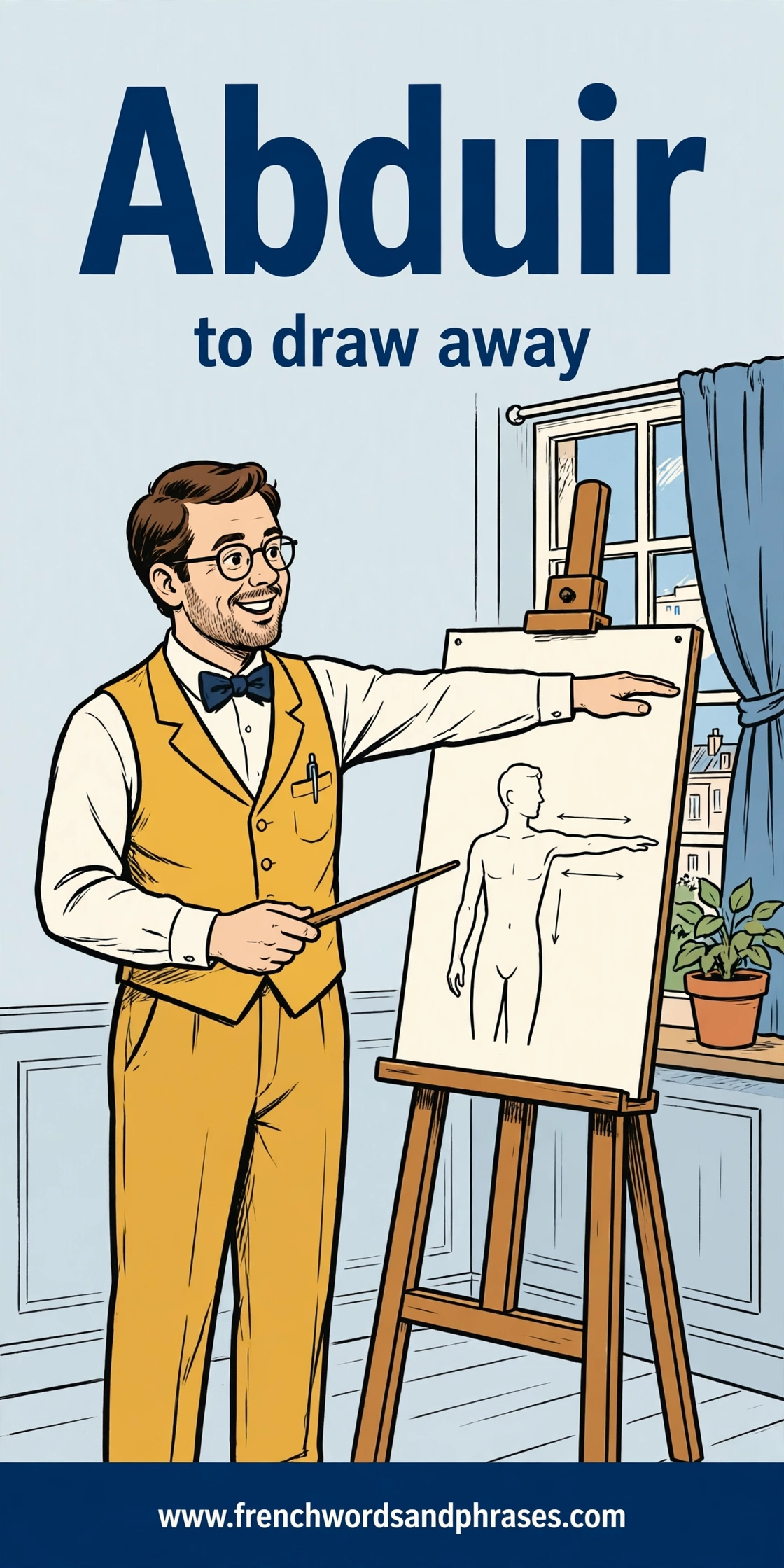
Abduir means to draw away — an old, rare form of abduire, used in anatomy for moving a limb away from the body’s midline, and in old texts for leading someone away.
A limb drawn sideways from the body in an old anatomy book, a traveller led astray in a seventeenth-century tale — abduir is a ghost of a verb: the living modern word is abduire, and abduir survives only in old dictionaries, still conjugated, still waiting, like a word in period dress.
In this guide, you’ll learn how to conjugate abduir in all the major French tenses and moods. Explore complete conjugation tables, French examples, English translations, and practice quizzes.
Understanding the French Verb Abduir
Abduir is an irregular French verb — an old variant of abduire, conjugated exactly like conduire.
It means to abduct (old form of abduire). It is honestly labelled: an obsolete variant, not a word to use in conversation. Its living relatives are everywhere in the anatomy lesson — un muscle abducteur moves a limb away from the body, l’abduction is that movement, and the modern verb abduire does the same work in current French, from physiology to the grim newspaper sense of abducting a person.
Verb classification: Irregular (-uire family)
Auxiliary verb: Avoir
Past participle: abduit
Present participle: abduisant
English equivalents: To draw away, to lead away, to abduct (anatomy: to move a limb away from the midline); the modern verb is abduire — abduire un bras, to draw an arm away from the body; un muscle abducteur — an abductor muscle; l’abduction — abduction.
One important detail: abduir is simply the old infinitive of abduire, and it follows the whole conduire family step for step: j’abduis, tu abduis, il abduit, nous abduisons, vous abduisez, ils abduisent; passé simple j’abduisis; future j’abduirai; past participle abduit; present participle abduisant. Modern French has settled on abduire — you will meet abduir only in old dictionaries and reprints, where it keeps its full paradigm like a pressed flower.
Experience the Word
Abduir is a verb in period dress — correct, complete, and centuries out of fashion, like a duelling sword in a museum case.
Imagine an old anatomy treatise, its pages foxed and its engravings solemn. The professor’s hand draws the arm away from the shoulder, and the caption, in the French of another age, explains that the muscle abduit le bras — draws it away from the body’s line. A modern student pencils abduire in the margin, and both verbs, the ghost and the heir, share the page.
Nobody has said it aloud for two hundred years. It has been preserved — abduit, pressed between dictionary pages — exactly as the old masters conjugated it.
How to Conjugate Abduir: Complete French Conjugation Guide
Let’s explore every major conjugation of abduir, beginning with the indicative mood.
How to Conjugate Abduir in the Indicative Mood
The indicative mood is used to express facts, observations, actions, and events.
How to Conjugate Abduir in the Present Tense (Présent)
Used for actions happening now, habitual actions, and general truths.
| Subject | Conjugation |
|---|---|
| je | abduis |
| tu | abduis |
| il / elle | abduit |
| nous | abduisons |
| vous | abduisez |
| ils / elles | abduisent |
Example
Ce muscle abduit le bras loin du corps.
This muscle draws the arm away from the body.
Quick Quiz 1
Complete the sentence:
Dans les planches anciennes, ce muscle ______ le pouce.
Reveal the answer
abduit
Dans les planches anciennes, ce muscle abduit le pouce.
In the old plates, this muscle draws the thumb away.
How to Conjugate Abduir in the Passé Composé
Used for completed actions in the past. Abduir takes the auxiliary verb avoir.
| Subject | Conjugation |
|---|---|
| j’ | ai abduit |
| tu | as abduit |
| il / elle | a abduit |
| nous | avons abduit |
| vous | avez abduit |
| ils / elles | ont abduit |
Example
Le ravisseur a abduit la jeune héritière, dit la chronique.
The kidnapper abducted the young heiress, says the chronicle.
How to Conjugate Abduir in the Imparfait (Imperfect Tense)
Used for habitual past actions, descriptions, and ongoing situations in the past.
| Subject | Conjugation |
|---|---|
| je | abduisais |
| tu | abduisais |
| il / elle | abduisait |
| nous | abduisions |
| vous | abduisiez |
| ils / elles | abduisaient |
Example
Dans les vieux traités, ce muscle abduisait le pouce.
In the old treatises, this muscle drew the thumb away.
Quick Quiz 2
Choose the correct form:
The chronicle says he abducted the heiress.
La chronique dit qu’il ______ l’héritière. (a abduit / est abduit)
Reveal the answer
a abduit
La chronique dit qu’il a abduit l’héritière.
Abduir takes avoir.
How to Conjugate Abduir in the Plus-que-parfait
Used to describe an action that had already been completed before another past event.
| Subject | Conjugation |
|---|---|
| j’ | avais abduit |
| tu | avais abduit |
| il / elle | avait abduit |
| nous | avions abduit |
| vous | aviez abduit |
| ils / elles | avaient abduit |
Example
Les brigands avaient abduit le messager avant l’aube.
The brigands had carried off the messenger before dawn.
How to Conjugate Abduir in the Passé Simple
Primarily used in formal writing, literature, and historical narratives. It is rarely used in everyday conversation.
| Subject | Conjugation |
|---|---|
| je | abduisis |
| tu | abduisis |
| il / elle | abduisit |
| nous | abduisîmes |
| vous | abduisîtes |
| ils / elles | abduisirent |
Example
Le muscle abduisit lentement le bras du blessé.
The muscle slowly drew the wounded man’s arm away.
How to Conjugate Abduir in the Passé Antérieur
A literary tense used to express an action completed immediately before another past action, generally in the passé simple.
| Subject | Conjugation |
|---|---|
| j’ | eus abduit |
| tu | eus abduit |
| il / elle | eut abduit |
| nous | eûmes abduit |
| vous | eûtes abduit |
| ils / elles | eurent abduit |
Example
Quand le nerf eut abduit l’orteil, le médecin nota le réflexe.
When the nerve had drawn the toe away, the doctor noted the reflex.
How to Conjugate Abduir in the Future Tense (Futur Simple)
Used to describe actions that will take place in the future.
| Subject | Conjugation |
|---|---|
| je | abduirai |
| tu | abduiras |
| il / elle | abduira |
| nous | abduirons |
| vous | abduirez |
| ils / elles | abduiront |
Example
Ce faisceau abduira l’épaule dans le nouvel atlas.
This bundle will draw the shoulder away in the new atlas.
How to Conjugate Abduir in the Futur Antérieur (Future Perfect)
Used for an action that will have been completed before a particular point in the future.
| Subject | Conjugation |
|---|---|
| j’ | aurai abduit |
| tu | auras abduit |
| il / elle | aura abduit |
| nous | aurons abduit |
| vous | aurez abduit |
| ils / elles | auront abduit |
Example
Le traité aura abduit bien des lecteurs vers les vieilles formes.
The treatise will have led many readers away towards the old forms.
How to Conjugate Abduir in the Near Future (Futur Proche)
Used to describe something that is going to happen soon. Formed with aller + infinitive.
| Subject | Conjugation |
|---|---|
| je | vais abduir |
| tu | vas abduir |
| il / elle | va abduir |
| nous | allons abduir |
| vous | allez abduir |
| ils / elles | vont abduir |
Example
Ce muscle va abduir le bras dès la première contraction.
This muscle is going to draw the arm away at the first contraction.
How to Conjugate Abduir in the Conditional Mood
The conditional mood expresses what would happen under certain circumstances. It is also frequently used to make polite requests or express wishes.
How to Conjugate Abduir in the Present Conditional
| Subject | Conjugation |
|---|---|
| je | abduirais |
| tu | abduirais |
| il / elle | abduirait |
| nous | abduirions |
| vous | abduiriez |
| ils / elles | abduiraient |
Example
Sans ce muscle, le bras ne s’abduirait pas du corps.
Without this muscle, the arm would not draw away from the body.
How to Conjugate Abduir in the Past Conditional
| Subject | Conjugation |
|---|---|
| j’ | aurais abduit |
| tu | aurais abduit |
| il / elle | aurait abduit |
| nous | aurions abduit |
| vous | auriez abduit |
| ils / elles | auraient abduit |
Example
Le vieux maître aurait abduit le membre avec plus de douceur.
The old master would have drawn the limb away more gently.
Abduir in the Literary Past Conditional Form
This less common literary form uses the imperfect subjunctive of avoir.
| Subject | Conjugation |
|---|---|
| j’ | eusse abduit |
| tu | eusses abduit |
| il / elle | eût abduit |
| nous | eussions abduit |
| vous | eussiez abduit |
| ils / elles | eussent abduit |
Example
Le ravisseur eût abduit l’enfant sans les chiens du village.
The kidnapper would have carried off the child without the village dogs.
How to Conjugate Abduir in the Subjunctive Mood
The subjunctive is used to express wishes, emotions, doubts, necessity, and uncertainty. It frequently follows expressions such as il faut que (it is necessary that) or bien que (although).
How to Conjugate Abduir in the Present Subjunctive
| Subject | Conjugation |
|---|---|
| que je | abduise |
| que tu | abduises |
| qu’il / qu’elle | abduise |
| que nous | abduisions |
| que vous | abduisiez |
| qu’ils / qu’elles | abduisent |
Example
Il faut que ce muscle abduise le bras sans douleur.
This muscle must draw the arm away without pain.
Quick Quiz 3
Complete the sentence using the subjunctive:
Il faut que nous ______ le bras sans douleur, dit le vieux traité.
Reveal the answer
abduisions
Il faut que nous abduisions le bras sans douleur, dit le vieux traité.
We must draw the arm away without pain, says the old treatise.
How to Conjugate Abduir in the Imperfect Subjunctive
A literary tense, rarely encountered in modern spoken French.
| Subject | Conjugation |
|---|---|
| que je | abduisisse |
| que tu | abduisisses |
| qu’il / qu’elle | abduisît |
| que nous | abduisissions |
| que vous | abduisissiez |
| qu’ils / qu’elles | abduisissent |
Example
L’anatomiste décrivait comment le faisceau abduisît l’épaule.
The anatomist described how the bundle drew the shoulder away.
How to Conjugate Abduir in the Pluperfect Subjunctive
A literary construction used to express an action completed before another past action.
| Subject | Conjugation |
|---|---|
| que j’ | eusse abduit |
| que tu | eusses abduit |
| qu’il / qu’elle | eût abduit |
| que nous | eussions abduit |
| que vous | eussiez abduit |
| qu’ils / qu’elles | eussent abduit |
Example
Les chroniques racontaient que les pirates eussent abduit tout l’équipage.
The chronicles told that the pirates had carried off the whole crew.
How to Conjugate Abduir in the Past Subjunctive
| Subject | Conjugation |
|---|---|
| que j’ | aie abduit |
| que tu | aies abduit |
| qu’il / qu’elle | ait abduit |
| que nous | ayons abduit |
| que vous | ayez abduit |
| qu’ils / qu’elles | aient abduit |
Example
Il est curieux que ce verbe ait abduit tant de grammairiens.
It is curious that this verb has led so many grammarians astray.
How to Conjugate Abduir in the Imperative
The imperative is used to give commands, instructions, invitations, or suggestions. Subject pronouns are omitted.
How to Conjugate Abduir in the Present Imperative
| Person | Conjugation |
|---|---|
| (tu) | abduis |
| (nous) | abduisons |
| (vous) | abduisez |
Example
Abduis le bras lentement, comme dans les planches anciennes !
Draw the arm away slowly, as in the old plates!
Quick Quiz 4
How would you say Draw the arm away slowly (tu form, old style)?
Reveal the answer
Abduis le bras lentement !
French Participles of Abduir
Participles are verb forms that can be used in compound tenses and other grammatical constructions.
Present Participle of Abduir
abduisant
En abduisant le bras, ce muscle ouvre l’épaule.
By drawing the arm away, this muscle opens the shoulder.
Past Participle of Abduir
abduit
Abduit loin du corps, le bras repose sur le coussin.
Drawn away from the body, the arm rests on the cushion.
Abduir in Everyday French: Real-Life Examples
Now that you know the conjugations, let’s see how abduir appears in everyday French.
Example 1 — Present
Ce muscle abduit le bras loin du corps.
This muscle draws the arm away from the body.
Example 2 — Passé composé
La chronique dit qu’il a abduit l’héritière.
The chronicle says he abducted the heiress.
Example 3 — Imparfait
Dans les vieux traités, ce muscle abduisait le pouce.
In the old treatises, this muscle drew the thumb away.
Example 4 — Future
Ce faisceau abduira l’épaule dans le nouvel atlas.
This bundle will draw the shoulder away in the new atlas.
Example 5 — Conditional
Le vieux maître abduirait le membre avec douceur.
The old master would draw the limb away gently.
Example 6 — Imperative
Abduisez le bras lentement, comme autrefois !
Draw the arm away slowly, as in the old days!
Beyond Translation: The Meaning of Abduir
English abduct comes from the same Latin root, abducere — to lead away — and French split the inheritance in two: the modern abduire works in today’s anatomy lessons and crime reports, while abduir keeps the old infinitive like a family portrait.
Some verbs retire; they do not die.
Abduir waits in the old dictionaries with its paradigm intact — abduis, abduisis, abduit — proof that a language forgets nothing, it only files things under history.
How to Remember the French Verb Abduir
Remember it this way: Abduir is about the ghost in the old anatomy book — abduire’s grandfather, paradigm intact.
- An old form of abduire — say abduire in real life; read abduir in old books.
- Conduire family throughout: j’abduis, nous abduisons, passé simple j’abduisis, participle abduit.
- Its home is anatomy: drawing a limb away from the body’s midline — un muscle abducteur.
The key idea is the ghost in the old anatomy book — abduire’s grandfather, paradigm intact.
Test Your Knowledge of Abduir
Let’s see how much you’ve learned. Try answering these questions before revealing the answers.
Question 1
What is the modern French verb that replaced abduir?
Reveal the answer
Abduire — abduir is its old, obsolete infinitive, found in old dictionaries.
Question 2
How do you say This muscle draws the arm away from the body in the old style?
Reveal the answer
Ce muscle abduit le bras loin du corps.
Question 3
Translate: In the old treatises, this muscle drew the thumb away.
Reveal the answer
Dans les vieux traités, ce muscle abduisait le pouce.
Question 4
What is the past participle of abduir?
Reveal the answer
Abduit — exactly like conduire’s conduit, with the ab- prefix.
Question 5
Complete the sentence:
Il faut que ce muscle ______ le bras sans douleur.
Reveal the answer
abduise
Il faut que ce muscle abduise le bras sans douleur.
This muscle must draw the arm away without pain.
Your Final Challenge
Can You Use It?
How would you say this in French?
Old dictionaries keep abduir like a family portrait: out of fashion, but one of the household.
Reveal the answer
Les vieux dictionnaires gardent abduir comme un portrait de famille : démodé, mais de la maison.
Old dictionaries keep abduir like a family portrait: out of fashion, but one of the household.
A little French. A little curiosity. A richer everyday life.
LEARN FRENCH ONE WORD AT A TIME