A French Word to Live By
Translate Abdication to English
/ab.di.ka.sjɔ̃/
L’abdication means abdication, renouncing a throne.
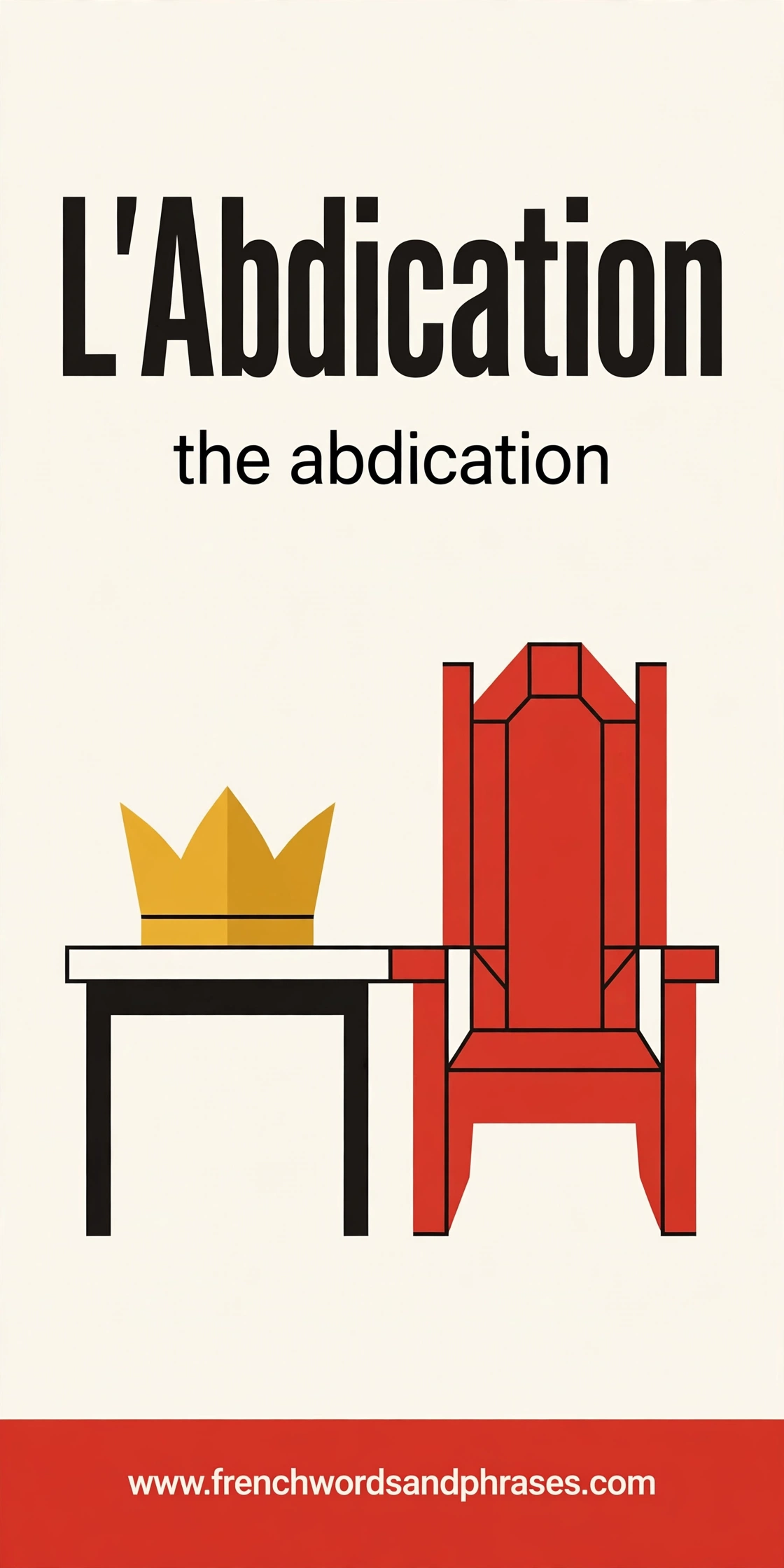
A king at his desk, a single sheet of paper, a pen that hesitates — then the signature that ends a reign: l’abdication.
In this guide, you’ll learn what abdication means in English, how to use it with its articles, how to form its plural, and how it appears in everyday French. Explore French examples, English translations, and practice quizzes.
Understanding the French Noun Abdication
Abdication is a feminine French noun, learned with its article: l’abdication, une abdication — la becomes l’ because the word begins with a vowel, but the noun stays feminine. It is the noun of the verb abdiquer, to abdicate.
It means abdication — the solemn act by which a king, a queen or another high office-holder gives up power before their time: l’abdication de Napoléon in 1814, l’abdication d’Édouard VIII in 1936. French also uses it figuratively for any surrender of responsibility: l’abdication des parents, parents giving up on their role, is a phrase of social debate.
Gender: Feminine
Feminine: Abdication is itself feminine — l’abdication, une abdication
Definite article: l’ — l’abdication (the abdication)
Indefinite article: une — une abdication (an abdication)
Plural: les abdications
English equivalents: Abdication; renunciation of a throne or high office.
One important usage detail: an abdication is signed. The classic sentence of history books is signer son abdication — and the document itself bears the same name: l’acte d’abdication. For an ordinary job, French uses a different word, la démission; abdication is kept for thrones and, figuratively, for grave surrenders of duty.
Experience the Word
Abdication is one of history’s heaviest words — a crown set down on paper. Behind it there is always a story: a lost war, a forbidden love, a revolution at the gates.
Imagine Fontainebleau in April 1814: the marshals have gone, the empire is finished, and Napoleon signs the paper that makes him an exile — one word of Latin patience ending twenty years of thunder.
You have not just read a resignation. You have watched a reign fold itself away.
How to Use Abdication in French: Complete Guide
Let’s explore how abdication works in French, beginning with its articles — a feminine noun in -tion, hiding behind l’.
Abdication with the Definite Article (L’, Les)
Used for the abdication everyone knows — l’abdication, the one in the history books.
| Form | French |
|---|---|
| Feminine singular | l’abdication |
| Plural | les abdications |
Example
L’abdication de Napoléon a eu lieu en 1814.
Napoleon’s abdication took place in 1814.
Abdication with the Indefinite Article (Une, Des)
Used for an abdication in general — une abdication, voluntary or forced.
| Form | French |
|---|---|
| Feminine singular | une abdication |
| Plural | des abdications |
Example
Ce fut une abdication forcée, signée sous la pression.
It was a forced abdication, signed under pressure.
Around the Abdication: Words of Thrones
Kings, crowns and signatures — the vocabulary that surrounds the abdication.
| French | In English |
|---|---|
| le roi | the king |
| le trône | the throne |
| la couronne | the crown |
| renoncer | to renounce, to give up |
| le successeur | the successor |
| signer | to sign |
Example
Le roi signe son abdication devant ses ministres.
The king signs his abdication before his ministers.
Quick Quiz 1
Complete the sentence:
En 1936, ______ d’Édouard VIII a surpris le monde entier.
Reveal the answer
l’abdication
En 1936, l’abdication d’Édouard VIII a surpris le monde entier.
In 1936, Edward VIII’s abdication surprised the whole world.
The Plural of Abdication
Abdication adds an -s in the plural — les abdications, rare events that historians collect.
| Number | French |
|---|---|
| Singular | l’abdication |
| Plural | les abdications |
Example
Les abdications sont rares dans l’histoire des monarchies.
Abdications are rare in the history of monarchies.
Abdication with Possessive Adjectives (Mon, Ton, Son…)
A vowel-start rule: abdication is feminine but begins with a vowel, so it takes mon, ton, son — mon abdication, never « ma abdication ».
| Owner | French |
|---|---|
| my | mon abdication |
| your (tu) | ton abdication |
| his / her | son abdication |
| our | notre abdication |
| your (vous) | votre abdication |
| their | leur abdication |
Example
Le roi a annoncé son abdication à la radio.
The king announced his abdication on the radio.
Quick Quiz 2
Complete the sentence:
Le roi a annoncé ______ abdication hier soir. (his)
Reveal the answer
son
Le roi a annoncé son abdication hier soir.
The king announced his abdication last night — son, not sa, because abdication begins with a vowel.
Abdication with Demonstrative Adjectives (Cette, Ces)
Used to point: cette abdication — cette, the full feminine form, vowel or not.
| Form | French |
|---|---|
| Feminine singular | cette abdication |
| Plural | ces abdications |
Example
Cette abdication a changé l’histoire du pays.
This abdication changed the country’s history.
Abdication with Adjectives
Adjectives agree with the hidden feminine: célèbre, volontaire, forcée.
| Adjective | With Abdication |
|---|---|
| célèbre (famous) | une abdication célèbre |
| volontaire (voluntary) | une abdication volontaire |
| forcée (forced) | une abdication forcée |
| historique (historic) | une abdication historique |
| récente (recent) | une abdication récente |
Example
Une abdication volontaire reste un événement rare.
A voluntary abdication remains a rare event.
Quick Quiz 3
Complete the sentence:
Ce fut une abdication ______, signée sous la menace. (forced)
Reveal the answer
forcée
Ce fut une abdication forcée, signée sous la menace.
It was a forced abdication, signed under threat — forcée, feminine, because abdication is feminine.
Everyday Expressions with Abdication
Signatures and announcements — the abdication phrases of history and headlines.
| Expression | In English |
|---|---|
| signer son abdication | to sign one’s abdication |
| l’acte d’abdication | the act (document) of abdication |
| annoncer son abdication | to announce one’s abdication |
| l’abdication du roi | the king’s abdication |
| une abdication forcée | a forced abdication |
| l’abdication des parents | parents giving up (figurative) |
Example
Le vieux roi signera son abdication demain.
The old king will sign his abdication tomorrow.
Words from the Same Family as Abdication
Thrones, resignations and renouncing — the words that travel with abdication.
| French | In English |
|---|---|
| abdiquer | to abdicate |
| le roi | the king |
| le trône | the throne |
| renoncer | to renounce, to give up |
| la démission | the resignation |
| le souverain | the sovereign |
Example
Avant d’abdiquer, le souverain a choisi son successeur.
Before abdicating, the sovereign chose his successor.
Quick Quiz 4
What is the difference between une abdication and une démission?
Reveal the answer
An abdication is for thrones and high office; a démission is an ordinary resignation from a job.
Le ministre donne sa démission; le roi signe son abdication.
The minister hands in his resignation; the king signs his abdication.
Abdication in Everyday French: Real-Life Examples
Now that you know the word, let’s see how abdication appears in everyday French.
Example 1 — In the history lesson
L’abdication de Napoléon marque la fin de l’Empire.
Napoleon’s abdication marks the end of the Empire.
Example 2 — Breaking news
La reine a annoncé son abdication ce matin.
The queen announced her abdication this morning.
Example 3 — A signature
Le roi a signé son abdication devant les caméras.
The king signed his abdication in front of the cameras.
Example 4 — A debate
On parle souvent de l’abdication des parents face aux écrans.
People often speak of parents giving up in the face of screens.
Example 5 — A rare event
Une abdication volontaire est très rare en Europe.
A voluntary abdication is very rare in Europe.
Example 6 — The document
L’acte d’abdication est conservé aux archives nationales.
The act of abdication is kept in the national archives.
Beyond Translation: The Meaning of Abdication
Abdication is the monarchy’s most dramatic word — the moment power voluntarily lets go of itself. French history keeps two great scenes: Napoleon at Fontainebleau in 1814, signing away an empire; and, in the language’s figurative life, the quieter modern phrase l’abdication des parents, which borrows the crown’s gravity for a family debate.
To say abdication is to watch power set itself down, in ink.
It evokes the hesitating pen, the silent ministers, the crown on the desk — and the strange dignity of knowing when a reign is over.
How to Remember the French Noun Abdication
Remember it this way: Abdication is the signing-away of a throne — the noun of abdiquer, kept for crowns, not for office jobs.
- You sign it — signer son abdication, the pen that ends a reign.
- You date it — l’abdication de Napoléon, 1814; d’Édouard VIII, 1936.
- You separate it — jobs take la démission; thrones take l’abdication.
The key idea is l’abdication — a throne, signed away.
Test Your Knowledge of Abdication
Let’s see how much you’ve learned. Try answering these questions before revealing the answers.
Question 1
What is an abdication?
Reveal the answer
The act of giving up a throne or high office — a sovereign renouncing power before their time.
Question 2
Is abdication masculine or feminine?
Reveal the answer
Feminine — une abdication, cette abdication; the l’ hides the gender.
Question 3
Translate: The king signed his abdication.
Reveal the answer
Le roi a signé son abdication.
Question 4
What verb does abdication come from?
Reveal the answer
Abdiquer — to abdicate, to renounce a throne.
Question 5
Complete the sentence:
______ abdication a surpris tout le pays. (This)
Reveal the answer
Cette
Cette abdication a surpris tout le pays.
This abdication surprised the whole country.
Your Final Challenge
Can You Use It?
How would you say this in French?
“The old king announces his abdication on the radio.”
Reveal the answer
Le vieux roi annonce son abdication à la radio.
The old king announces his abdication on the radio.
A little French. A little curiosity. A richer everyday life.
LEARN FRENCH ONE WORD AT A TIME