A French Word to Live By
How to Conjugate Abattre in French
/a.batʁ/
Abattre means to knock down — to fell a tree, bring down a wall, slaughter an animal, or break a person’s spirit until they can no longer stand.
An axe biting into an oak, a demolition crane against a condemned wall, a hunter’s shot, a piece of news that takes the legs from under a strong man — abattre is the verb of bringing down: whatever stood upright, by force, by tool or by sorrow, comes down.
In this guide, you’ll learn how to conjugate abattre in all the major French tenses and moods. Explore complete conjugation tables, French examples, English translations, and practice quizzes.
Understanding the French Verb Abattre
Abattre is an irregular French verb belonging to the third group of verbs, those ending in -re — it is conjugated exactly like battre, to beat.
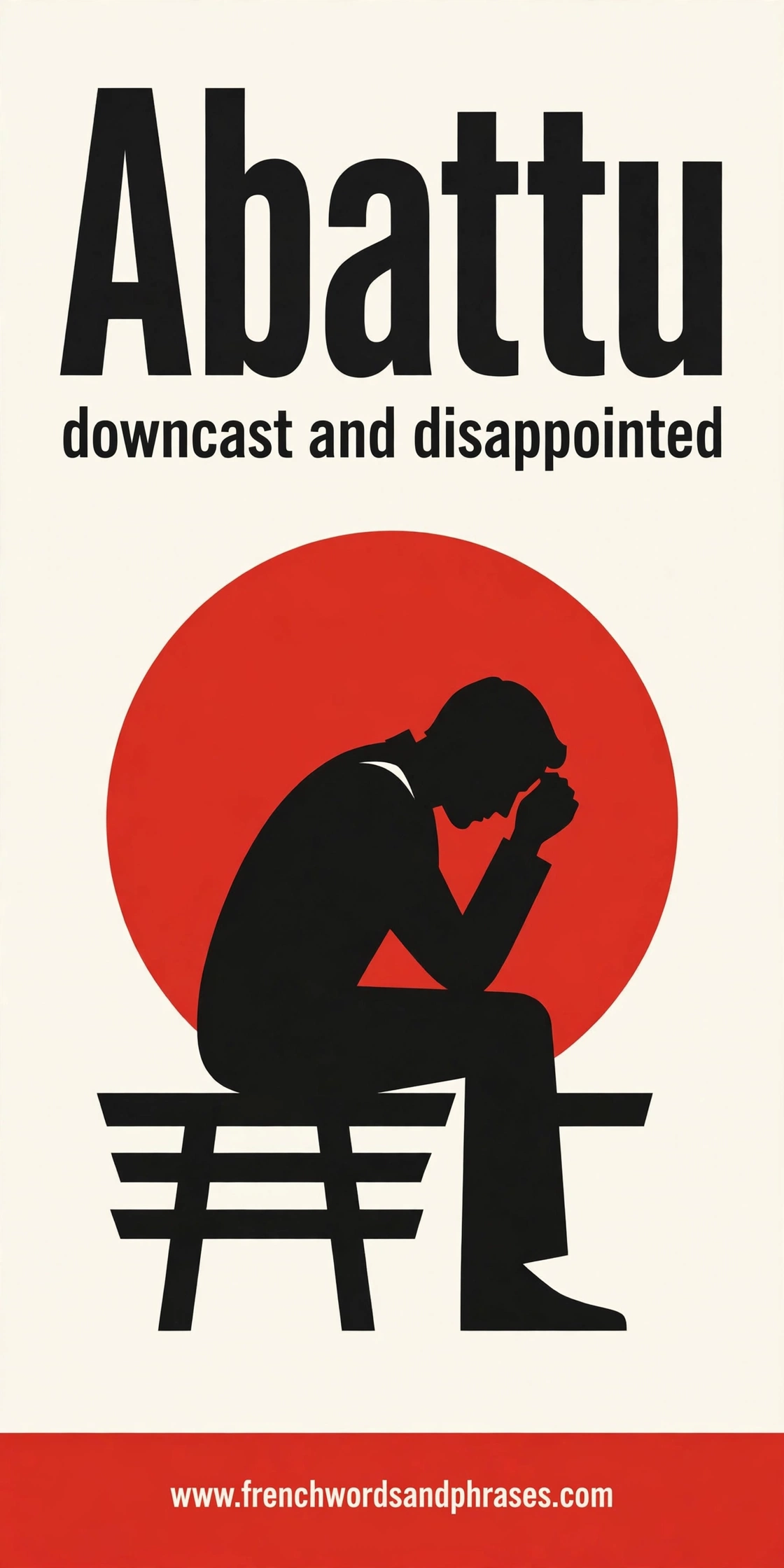
It means to knock down, to fell. It is commonly used in forestry and farming for felling trees and slaughtering animals, in building for demolishing walls, in hunting and aviation for bringing down game and aircraft, and figuratively for grief, illness and bad news that leave a person abattu — crushed in spirit. Its reflexive neighbour s’abattre means to crash down: la tempête s’abat sur la côte, the storm crashes down on the coast.
Verb classification: Third group (-re)
Auxiliary verb: Avoir
Past participle: abattu
Present participle: abattant
English equivalents: To knock down, to fell, to bring down, to slaughter, to demoralise; abattre un arbre — to fell a tree; abattre un mur — to knock down a wall; abattre du bétail — to slaughter livestock; se laisser abattre — to let oneself be discouraged; un travail abattu — a job polished off.
One important detail: abattre is battre with a prefix, and it keeps battre’s famous vanishing act: the double tt of the infinitive shrinks to a single t in the singular present — j’abats, tu abats, il abat — then returns in the plural: nous abattons, vous abattez, ils abattent. The future runs on the bare infinitive stem minus its final e: j’abattrai; the passé simple is j’abattis and the past participle abattu — itself a common adjective: un homme abattu, a downcast, demoralised man.
Experience the Word
Abattre is the verb of the falling moment — the tree, the wall, the animal, the strong heart: upright one second, down the next.
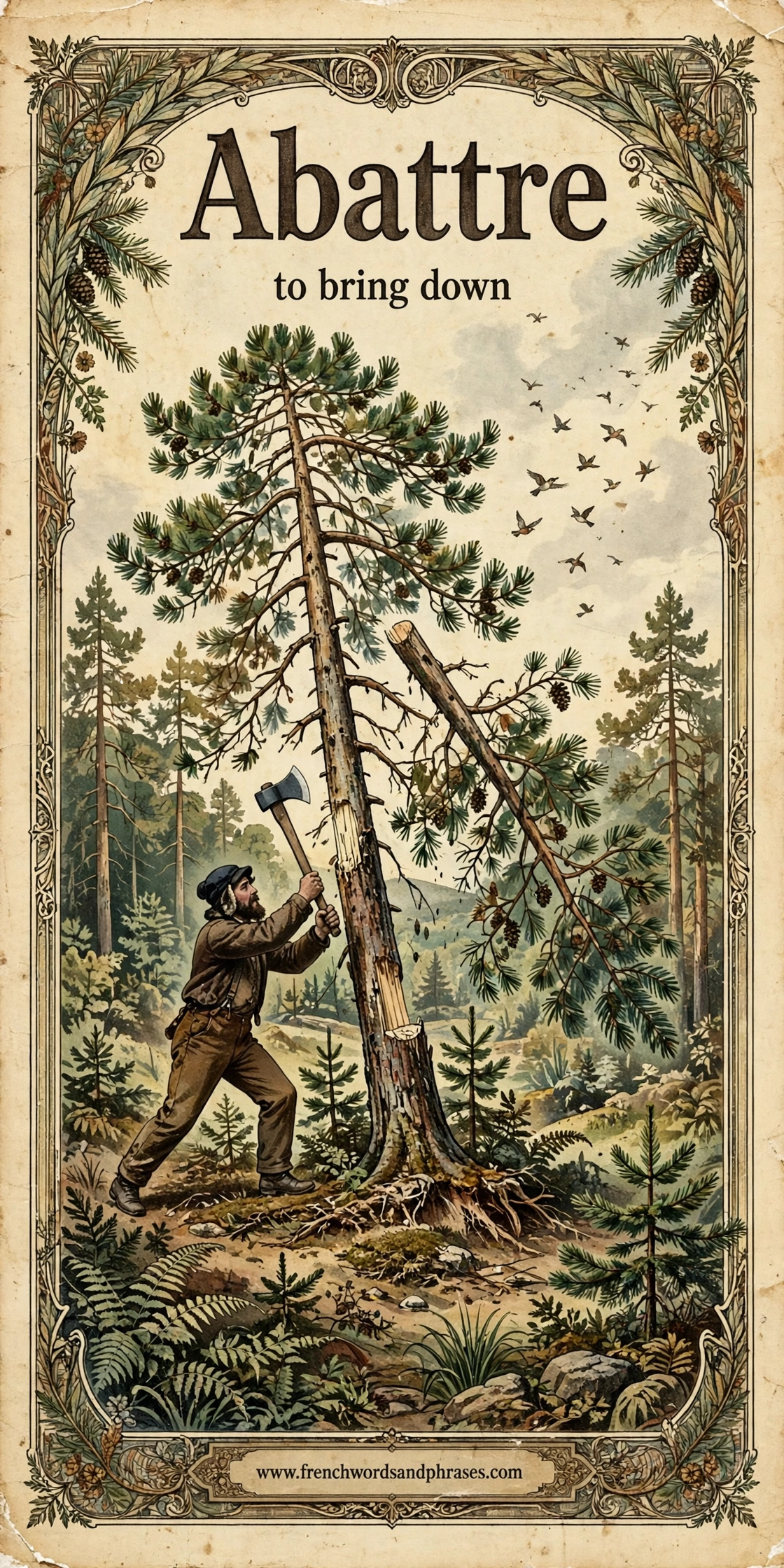
Imagine a woodcutter in a winter forest, alone with an oak older than his village. He measures, he notches, he swings — and at the fortieth blow the giant trembles, leans, and comes down with a crash that shakes the snow from every branch around: il a abattu le chêne, he has felled the oak, and the clearing is suddenly full of light.
The oak stood for two hundred years. It has been felled — abattu — in one morning, and the forest feels the gap.
How to Conjugate Abattre: Complete French Conjugation Guide
Let’s explore every major conjugation of abattre, beginning with the indicative mood.
How to Conjugate Abattre in the Indicative Mood
The indicative mood is used to express facts, observations, actions, and events.
How to Conjugate Abattre in the Present Tense (Présent)
Used for actions happening now, habitual actions, and general truths.
| Subject | Conjugation |
|---|---|
| je | abats |
| tu | abats |
| il / elle | abat |
| nous | abattons |
| vous | abattez |
| ils / elles | abattent |
Example
Le bûcheron abat un chêne centenaire.
The woodcutter is felling a hundred-year-old oak.
Quick Quiz 1
Complete the sentence:
Le bûcheron ______ un chêne centenaire.
Reveal the answer
abat
Le bûcheron abat un chêne centenaire.
The woodcutter is felling a hundred-year-old oak.
How to Conjugate Abattre in the Passé Composé
Used for completed actions in the past. Abattre takes the auxiliary verb avoir.
| Subject | Conjugation |
|---|---|
| j’ | ai abattu |
| tu | as abattu |
| il / elle | a abattu |
| nous | avons abattu |
| vous | avez abattu |
| ils / elles | ont abattu |
Example
Ils ont abattu le vieux mur en une journée.
They knocked down the old wall in one day.
How to Conjugate Abattre in the Imparfait (Imperfect Tense)
Used for habitual past actions, descriptions, and ongoing situations in the past.
| Subject | Conjugation |
|---|---|
| je | abattais |
| tu | abattais |
| il / elle | abattait |
| nous | abattions |
| vous | abattiez |
| ils / elles | abattaient |
Example
Autrefois, on abattait les porcs à la ferme en novembre.
In the old days, pigs were slaughtered on the farm in November.
Quick Quiz 2
Choose the correct form:
They knocked down the old wall.
Ils ______ le vieux mur. (ont abattu / sont abattus)
Reveal the answer
ont abattu
Ils ont abattu le vieux mur.
Abattre takes avoir.
How to Conjugate Abattre in the Plus-que-parfait
Used to describe an action that had already been completed before another past event.
| Subject | Conjugation |
|---|---|
| j’ | avais abattu |
| tu | avais abattu |
| il / elle | avait abattu |
| nous | avions abattu |
| vous | aviez abattu |
| ils / elles | avaient abattu |
Example
La mauvaise nouvelle l’avait abattu complètement.
The bad news had completely demoralised him.
How to Conjugate Abattre in the Passé Simple
Primarily used in formal writing, literature, and historical narratives. It is rarely used in everyday conversation.
| Subject | Conjugation |
|---|---|
| je | abattis |
| tu | abattis |
| il / elle | abattit |
| nous | abattîmes |
| vous | abattîtes |
| ils / elles | abattirent |
Example
D’un seul coup de hache, il abattit la porte.
With a single axe blow, he smashed down the door.
How to Conjugate Abattre in the Passé Antérieur
A literary tense used to express an action completed immediately before another past action, generally in the passé simple.
| Subject | Conjugation |
|---|---|
| j’ | eus abattu |
| tu | eus abattu |
| il / elle | eut abattu |
| nous | eûmes abattu |
| vous | eûtes abattu |
| ils / elles | eurent abattu |
Example
Quand les soldats eurent abattu la tour, la ville se rendit.
When the soldiers had brought down the tower, the town surrendered.
How to Conjugate Abattre in the Future Tense (Futur Simple)
Used to describe actions that will take place in the future.
| Subject | Conjugation |
|---|---|
| je | abattrai |
| tu | abattras |
| il / elle | abattra |
| nous | abattrons |
| vous | abattrez |
| ils / elles | abattront |
Example
Demain, nous abattrons les arbres malades du verger.
Tomorrow, we will fell the diseased trees in the orchard.
How to Conjugate Abattre in the Futur Antérieur (Future Perfect)
Used for an action that will have been completed before a particular point in the future.
| Subject | Conjugation |
|---|---|
| j’ | aurai abattu |
| tu | auras abattu |
| il / elle | aura abattu |
| nous | aurons abattu |
| vous | aurez abattu |
| ils / elles | auront abattu |
Example
À la fin de la semaine, ils auront abattu tout le pan de mur.
By the end of the week, they will have knocked down the whole section of wall.
How to Conjugate Abattre in the Near Future (Futur Proche)
Used to describe something that is going to happen soon. Formed with aller + infinitive.
| Subject | Conjugation |
|---|---|
| je | vais abattre |
| tu | vas abattre |
| il / elle | va abattre |
| nous | allons abattre |
| vous | allez abattre |
| ils / elles | vont abattre |
Example
Attention, cet arbre va abattre la clôture en tombant !
Careful, that tree is going to bring the fence down as it falls!
How to Conjugate Abattre in the Conditional Mood
The conditional mood expresses what would happen under certain circumstances. It is also frequently used to make polite requests or express wishes.
How to Conjugate Abattre in the Present Conditional
| Subject | Conjugation |
|---|---|
| je | abattrais |
| tu | abattrais |
| il / elle | abattrait |
| nous | abattrions |
| vous | abattriez |
| ils / elles | abattraient |
Example
Sans permis, personne n’abattrait cet arbre protégé.
Without a permit, nobody would fell this protected tree.
How to Conjugate Abattre in the Past Conditional
| Subject | Conjugation |
|---|---|
| j’ | aurais abattu |
| tu | aurais abattu |
| il / elle | aurait abattu |
| nous | aurions abattu |
| vous | auriez abattu |
| ils / elles | auraient abattu |
Example
La maladie aurait abattu un homme moins résistant.
The illness would have crushed a less resilient man.
Abattre in the Literary Past Conditional Form
This less common literary form uses the imperfect subjunctive of avoir.
| Subject | Conjugation |
|---|---|
| j’ | eusse abattu |
| tu | eusses abattu |
| il / elle | eût abattu |
| nous | eussions abattu |
| vous | eussiez abattu |
| ils / elles | eussent abattu |
Example
Le désespoir eût abattu le héros sans l’amitié des siens.
Despair would have crushed the hero without the friendship of his people.
How to Conjugate Abattre in the Subjunctive Mood
The subjunctive is used to express wishes, emotions, doubts, necessity, and uncertainty. It frequently follows expressions such as il faut que (it is necessary that) or bien que (although).
How to Conjugate Abattre in the Present Subjunctive
| Subject | Conjugation |
|---|---|
| que je | abatte |
| que tu | abattes |
| qu’il / qu’elle | abatte |
| que nous | abattions |
| que vous | abattiez |
| qu’ils / qu’elles | abattent |
Example
Il faut que nous abattions ce mur avant l’hiver.
We must knock down this wall before winter.
Quick Quiz 3
Complete the sentence using the subjunctive:
Il faut que vous ______ cet arbre malade.
Reveal the answer
abattiez
Il faut que vous abattiez cet arbre malade.
You must fell this diseased tree.
How to Conjugate Abattre in the Imperfect Subjunctive
A literary tense, rarely encountered in modern spoken French.
| Subject | Conjugation |
|---|---|
| que je | abattisse |
| que tu | abattisses |
| qu’il / qu’elle | abattît |
| que nous | abattissions |
| que vous | abattissiez |
| qu’ils / qu’elles | abattissent |
Example
Le roi ordonna que l’on abattît la forteresse ennemie.
The king ordered the enemy fortress to be demolished.
How to Conjugate Abattre in the Pluperfect Subjunctive
A literary construction used to express an action completed before another past action.
| Subject | Conjugation |
|---|---|
| que j’ | eusse abattu |
| que tu | eusses abattu |
| qu’il / qu’elle | eût abattu |
| que nous | eussions abattu |
| que vous | eussiez abattu |
| qu’ils / qu’elles | eussent abattu |
Example
On disait que la fièvre eût abattu la moitié du village.
People said the fever had struck down half the village.
How to Conjugate Abattre in the Past Subjunctive
| Subject | Conjugation |
|---|---|
| que j’ | aie abattu |
| que tu | aies abattu |
| qu’il / qu’elle | ait abattu |
| que nous | ayons abattu |
| que vous | ayez abattu |
| qu’ils / qu’elles | aient abattu |
Example
Je suis content qu’ils aient abattu ce bâtiment dangereux.
I am glad they demolished that dangerous building.
How to Conjugate Abattre in the Imperative
The imperative is used to give commands, instructions, invitations, or suggestions. Subject pronouns are omitted.
How to Conjugate Abattre in the Present Imperative
| Person | Conjugation |
|---|---|
| (tu) | abats |
| (nous) | abattons |
| (vous) | abattez |
Example
Abats ce vieux pommier, il ne donne plus rien !
Fell that old apple tree, it no longer bears anything!
Quick Quiz 4
How would you say Fell that old apple tree (tu form)?
Reveal the answer
Abats ce vieux pommier !
French Participles of Abattre
Participles are verb forms that can be used in compound tenses and other grammatical constructions.
Present Participle of Abattre
abattant
En abattant les arbres malades, ils ont sauvé le reste du verger.
By felling the diseased trees, they saved the rest of the orchard.
Past Participle of Abattre
abattu
Abattu par le chagrin, il ne quittait plus sa chambre.
Crushed by grief, he no longer left his room.
Abattre in Everyday French: Real-Life Examples
Now that you know the conjugations, let’s see how abattre appears in everyday French.
Example 1 — Present
Le bûcheron abat un grand chêne.
The woodcutter is felling a tall oak.
Example 2 — Passé composé
Ils ont abattu le vieux mur hier.
They knocked down the old wall yesterday.
Example 3 — Imparfait
On abattait les porcs à la ferme en novembre.
Pigs were slaughtered on the farm in November.
Example 4 — Future
Nous abattrons les arbres malades demain.
We will fell the diseased trees tomorrow.
Example 5 — Conditional
Cette nouvelle abattrait n’importe qui.
Such news would crush anyone.
Example 6 — Imperative
Abattez ce mur, il menace de tomber !
Knock down this wall, it is threatening to fall!
Beyond Translation: The Meaning of Abattre
English has no single verb for this: fell a tree, slaughter a pig, demolish a wall, crush a spirit — French abattre does all four with one swing.
Everything that stands can be abattu.
That is why its past participle became the everyday adjective of discouragement: ne te laisse pas abattre — do not let it get you down — is the tree-feller’s verb turned into a philosophy of standing back up.
How to Remember the French Verb Abattre
Remember it this way: Abattre is about the falling oak — everything that stands can come down.
- Battre with a prefix: the double tt shrinks in the singular — j’abats, il abat — and returns in the plural: nous abattons.
- Four targets, one verb: trees (fell), animals (slaughter), walls (demolish), spirits (demoralise).
- Past participle abattu — also the adjective for downcast; future j’abattrai; passé simple j’abattis.
The key idea is the falling oak — everything that stands can come down.
Test Your Knowledge of Abattre
Let’s see how much you’ve learned. Try answering these questions before revealing the answers.
Question 1
Why does j’abats have one t but nous abattons two?
Reveal the answer
It follows battre — the double tt of the infinitive shrinks to a single t in the singular present (j’abats, il abat) and returns in the plural (nous abattons).
Question 2
How do you say They knocked down the old wall in one day in French?
Reveal the answer
Ils ont abattu le vieux mur en une journée.
Question 3
Translate: Tomorrow, we will fell the diseased trees in the orchard.
Reveal the answer
Demain, nous abattrons les arbres malades du verger.
Question 4
What is the past participle of abattre?
Reveal the answer
Abattu — also an adjective: un homme abattu, a downcast man.
Question 5
Complete the sentence:
Il faut que nous ______ ce mur avant l’hiver.
Reveal the answer
abattions
Il faut que nous abattions ce mur avant l’hiver.
We must knock down this wall before winter.
Your Final Challenge
Can You Use It?
How would you say this in French?
An oak can be felled in an hour, but it takes courage never to let yourself be crushed.
Reveal the answer
On abat un arbre en une heure, mais il faut du courage pour ne jamais se laisser abattre.
An oak can be felled in an hour, but it takes courage never to let yourself be crushed.
A little French. A little curiosity. A richer everyday life.
LEARN FRENCH ONE WORD AT A TIME