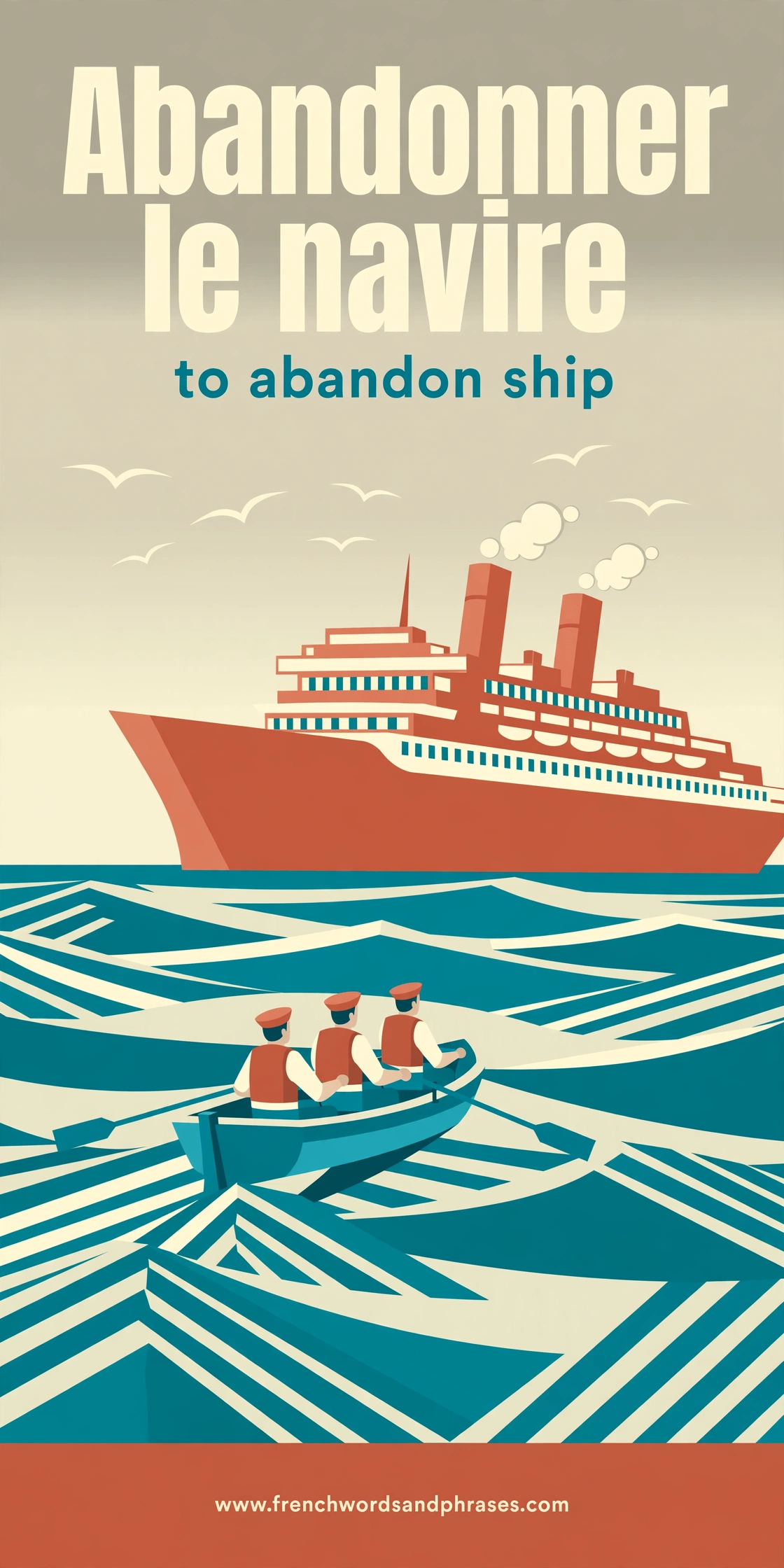
A French Word to Live By
Translate Abandonner le navire to English
/a.bɑ̃.dɔ.ne lə na.viʁ/
Abandonner le navire means to abandon ship — to walk away from a failing venture and leave it to sink.
The start-up’s office is half empty, the investors have stopped calling, and one morning the founder’s chair is empty too — laptop gone, plant left behind. The last employee locks up and texts the group: « Il a abandonné le navire. » No sea, no storm, no ship — but everyone understands: the captain left first, and the venture is going down without him.
Let’s explore how abandonner le navire works in French, beginning with the whole phrase on one card.
Understanding the French Phrase Abandonner le navire
Abandonner le navire is a French figurative expression built from abandonner (to abandon, to give up) and le navire (the ship). Born at sea, where leaving the ship is the last act of a disaster, it now describes walking away from any failing project, company or cause.
It means to abandon ship — to leave a situation that is failing, often suddenly, and often with a hint of reproach: the one who abandons the ship saves himself first. A director who resigns as the company sinks, a captain who leaves a team mid-season, a partner who walks out of a struggling business — all of them abandonnent le navire. The literal sea sense survives too: an order to abandon a real ship is quitter le navire or l’évacuation, but the figurative phrase rules everyday French.
Type: Figurative expression — departure (verb + noun, from seafaring)
Answers the need: Saying someone walked away from a failing venture
Register: Neutral — journalism, offices and everyday speech
Strength: Loaded — it implies the ship was sinking, and the leaving was early or selfish
One important usage detail: the phrase carries judgement — to say of someone il a abandonné le navire is rarely a compliment; it suggests the rats-and-captains proverb everyone knows, les rats quittent le navire, rats leave a sinking ship. For a neutral ‘he resigned’, French says il a démissionné; abandonner le navire is the version with the eyebrow raised.
Experience the Word
Abandonner le navire is desertion in a storm — the phrase always asks the same question: who left, and who stayed with the pumps?
Imagine the little company in its bad winter: the suppliers unpaid, the team working weekends, and then the founder’s farewell email arriving on a Monday morning, sent from an airport. The phrase exists for exactly that email. It measures the leaving against the loyalty that was owed, and finds the leaving early.
French kept the sea inside its business pages. Every failing venture becomes a ship, and every early exit a jump overboard.
How to Use Abandonner le navire in French: Complete Guide
Let’s explore how abandonner le navire works in French, beginning with the whole phrase on one card.
Abandonner le navire at a Glance
The Whole Phrase on One Card
Real meaning, literal picture, English twin and register — abandonner le navire in five lines.
| Point | Abandonner le navire |
|---|---|
| What it really means | to walk away from a failing venture, leaving it to sink |
| Word for word | to abandon the ship |
| English equivalent | to abandon ship / to jump ship / to bail out |
| Register | neutral — with a note of reproach |
| Use it for | resigning directors, deserting captains, partners who walk out |
Example
Le directeur a abandonné le navire en pleine crise.
The director abandoned ship in the middle of the crisis.
Word by Word: Building the Desertion
Two pieces — take them one by one and the lifeboats start to lower.
| Word | Literal meaning | Its job in the phrase |
|---|---|---|
| abandonner | to abandon, to give up | the leaving itself — the verb of walking away and not coming back |
| le navire | the ship | the venture in peril — a navire is a ship, grander than un bateau |
Example
Un capitaine n’abandonne pas son navire.
A captain does not abandon his ship.
Quick Quiz 1
What does abandonner le navire usually imply about the person who leaves?
Reveal the answer
That the leaving was early or selfish — the phrase judges: the ship was sinking and he saved himself first.
Il a abandonné le navire et laissé l’équipe se débrouiller.
He abandoned ship and left the team to cope alone.
When You Say It: The Sinking Moments
Abandonner le navire fires at moments like these — wherever someone walks out of a venture in trouble.
| Situation | Example |
|---|---|
| A resigning boss | le patron a abandonné le navire — the boss abandoned ship |
| A failing start-up | les fondateurs abandonnent le navire un à un — the founders are leaving the ship one by one |
| In sport | l’entraîneur a abandonné le navire en pleine saison — the coach walked out mid-season |
| In politics | plusieurs ministres ont abandonné le navire — several ministers have jumped ship |
| The reproach | tu abandonnes le navire dès la première tempête — you abandon ship at the first storm |
Example
Dès la première tempête, il a abandonné le navire.
At the first storm, he abandoned ship.
Make It Yours: The Desertion for Every Person
Abandonner is a regular -er verb — the ship stays le navire, the crew changes.
| Form | French | In English |
|---|---|---|
| He abandoned ship | il a abandonné le navire | he abandoned ship |
| She is leaving | elle abandonne le navire | she is abandoning ship |
| They jumped ship | ils ont abandonné le navire | they jumped ship |
| Not me | je n’abandonnerai pas le navire | I will not abandon ship |
| The question | tu abandonnes le navire ? | you’re abandoning ship? |
| The order never given lightly | abandonnez le navire ! | abandon ship! (a real emergency) |
Example
Je n’abandonnerai pas le navire, tempête ou pas.
I will not abandon ship, storm or no storm.
Quick Quiz 2
A manager retires calmly at 65 after twenty good years. Has he abandonné le navire?
Reveal the answer
No — the phrase needs a sinking ship and an early, self-saving exit. A calm retirement is prendre sa retraite.
Après vingt ans, il a pris sa retraite ; il n’a abandonné personne.
After twenty years, he retired; he abandoned nobody.
Everyday Expressions: Building on the Ship
Abandonner le navire slots into these everyday frames — each one ready to use as it stands.
| Frame | In English |
|---|---|
| abandonner le navire en pleine crise | to abandon ship in the middle of a crisis |
| les rats quittent le navire | the rats are leaving the sinking ship — the proverb |
| rester à bord | to stay on board — the loyal opposite |
| tenir la barre | to hold the helm, to steer through |
| le navire coule | the ship is sinking — the venture is failing |
Example
Quand les rats quittent le navire, les braves restent à bord.
When the rats leave the ship, the brave stay on board.
Close Cousins: The Other Ways to Leave
French has a whole shelf of leaving phrases — abandonner le navire is the judged one; its cousins are neutral, loyal or final.
| Expression | The difference |
|---|---|
| abandonner le navire | to abandon ship — leaving a failing venture, with reproach |
| démissionner | to resign — the neutral, factual word |
| quitter le navire | to leave the ship — closer to the literal sea sense, less idiomatic as blame |
| rester à bord | to stay on board — the loyal opposite, through the storm |
| jeter l’éponge | to throw in the towel — giving up a fight, from boxing, no ship required |
Example
Il a démissionné proprement ; il n’a pas abandonné le navire.
He resigned cleanly; he did not abandon ship.
Quick Quiz 3
Which cousin is the loyal opposite — staying through the storm?
Reveal the answer
Rester à bord — to stay on board. It is the answer French gives to every abandonner le navire.
La crise est là, mais nous restons à bord.
The crisis is here, but we are staying on board.
Abandonner le navire and Its Neighbours
The harbour shelf around the phrase — ships, storms and the crews that stay or go.
| French | In English |
|---|---|
| un navire | a ship |
| le capitaine | the captain |
| une tempête | a storm |
| couler | to sink |
| l’équipage | the crew |
| un canot de sauvetage | a lifeboat |
Example
L’équipage est resté, seul le capitaine a abandonné le navire.
The crew stayed; only the captain abandoned ship.
Watch Out: The Traps Around Abandonner le navire
The traps: a blame the phrase always carries, and a ship with two names.
| Trap | The truth |
|---|---|
| it always judges | the phrase implies the ship was sinking and the exit was self-serving — never use it for a neutral departure |
| navire, not bateau | the idiom’s ship is un navire, the grand word — abandonner le bateau is not the set phrase |
| the literal emergency | on a real ship in danger, the order is évacuez / quittez le navire — the idiom belongs to offices and headlines |
| abandonner does double duty | abandonner alone means to give up or abandon generally — the navire is what launches the sea picture |
Example
On dit abandonner le navire, pas le bateau : l’expression est figée.
You say abandonner le navire, not le bateau: the expression is fixed.
Quick Quiz 4
True or false: abandonner le bateau is the standard form of the expression.
Reveal the answer
False — the set phrase uses navire, the grand word for a ship. Le bateau stays in the harbour of literal boats.
Le navire coule, et lui, il regarde ailleurs.
The ship is sinking, and he is looking the other way.
Abandonner le navire in Everyday French: Real-Life Examples
Now that you know the word, let’s see how abandonner le navire appears in everyday French.
Example 1 — The boss
Le directeur a abandonné le navire en pleine crise.
The director abandoned ship in the middle of the crisis.
Example 2 — The start-up
Les investisseurs partis, les fondateurs abandonnent le navire.
The investors gone, the founders are abandoning ship.
Example 3 — The promise
Je n’abandonnerai jamais le navire.
I will never abandon ship.
Example 4 — The coach
L’entraîneur a abandonné le navire après trois défaites.
The coach abandoned ship after three defeats.
Example 5 — The proverb
Les rats quittent le navire, dit-on.
The rats are leaving the ship, as they say.
Example 6 — The loyal crew
L’équipe, elle, reste à bord et tient la barre.
The team, for its part, stays on board and holds the helm.
Beyond Translation: The Meaning of Abandonner le navire
English jumps ship and abandons ship with the same salt water in its mouth — the two languages share the sea, and the judgement. In both, the phrase only works because everyone agrees on the captain’s unwritten law: the ship is left last, or not at all. Break that law on land — in a company, a ministry, a team — and the old sea phrase is waiting to name it.
Abandonner le navire turns every resignation in a crisis into a question of honour.
That is why it stings more than démissionner ever could: paperwork says you left; the navire says you fled.
How to Remember the French Phrase Abandonner le navire
Remember it this way: Abandonner le navire is the captain leaving first — the sea’s oldest reproach, applied to offices and teams.
- You picture the lifeboat lowered too early — the ship sinking, the leader already rowing away.
- You keep the grand word — it is le navire, never le bateau; the idiom is frozen.
- You hear the eyebrow — the phrase always judges; for a neutral exit, démissionner keeps the peace.
The key idea is abandonner le navire means to abandon ship — to walk away from a failing venture.
Test Your Knowledge of Abandonner le navire
Let’s see how much you’ve learned. Try answering these questions before revealing the answers.
Question 1
What does abandonner le navire mean?
Reveal the answer
To abandon ship — to walk away from a failing venture and leave it to sink.
Question 2
What does the phrase imply about the person leaving?
Reveal the answer
That the exit was early or selfish — the phrase always carries a note of reproach.
Question 3
What is the loyal opposite of the phrase?
Reveal the answer
Rester à bord — to stay on board through the storm.
Question 4
Why navire and not bateau?
Reveal the answer
The expression is fixed with navire, the grand word for a ship — abandonner le bateau is not the set phrase.
Question 5
Complete the sentence:
Le directeur a abandonné le ______ en pleine crise. (The director abandoned ship in the middle of the crisis.)
Reveal the answer
navire
Le directeur a abandonné le navire en pleine crise.
The director abandoned ship in the middle of the crisis.
Your Final Challenge
Can You Use It?
How would you say this in French?
“The director abandoned ship in the middle of the crisis.”
Reveal the answer
Le directeur a abandonné le navire en pleine crise.
The director abandoned ship in the middle of the crisis.
A little French. A little curiosity. A richer everyday life.
LEARN FRENCH ONE WORD AT A TIME