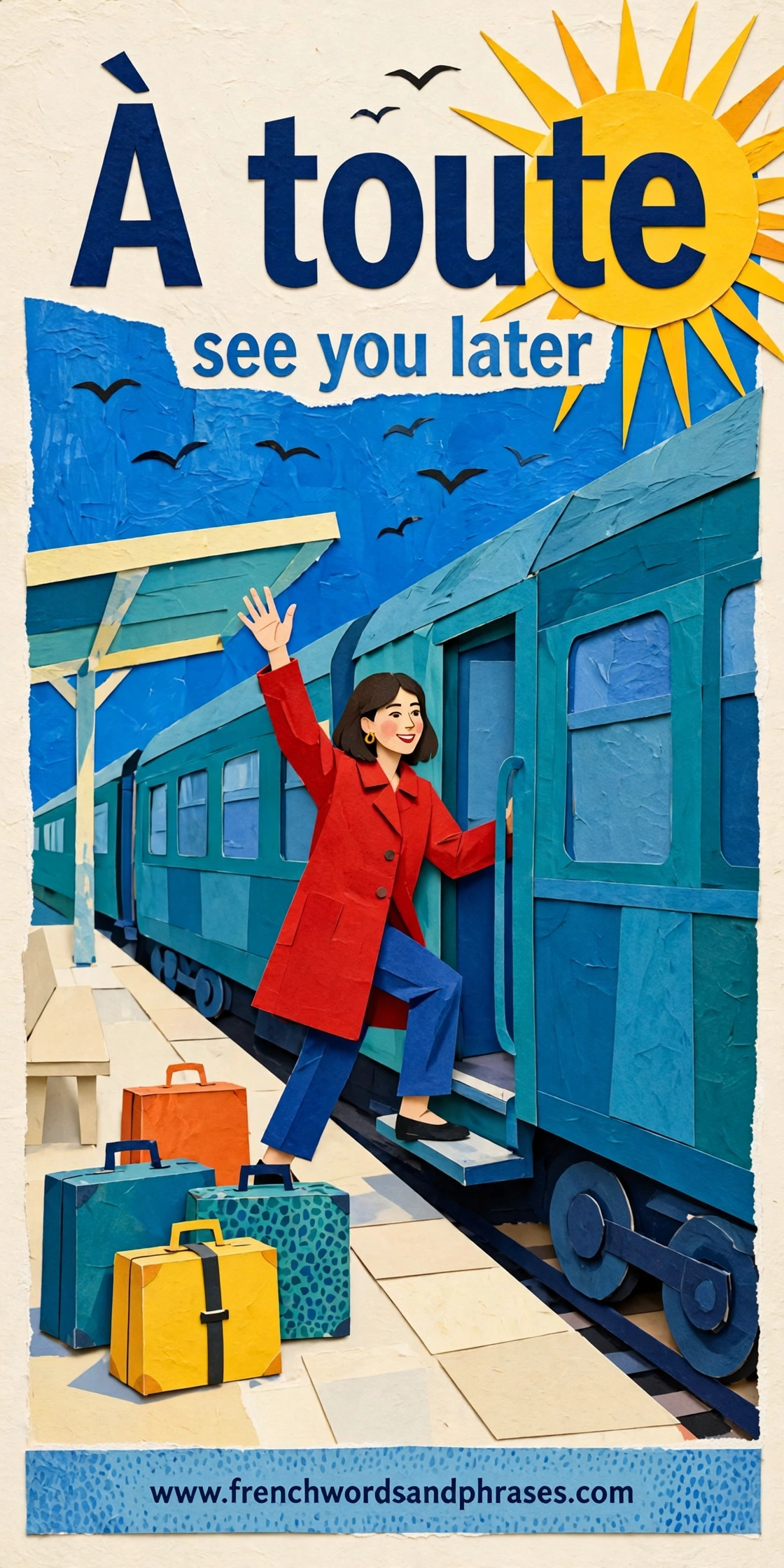
A French Word to Live By
Translate À toute to English
/a tut/
À toute means see you later — a quick, slangy goodbye, short for à tout à l’heure.
Your colleague grabs her bag, waves from the office door and tosses two words over her shoulder: « À toute ! » She will be back after lunch, but there is no time for the full ceremony of à tout à l’heure. Among friends and colleagues in France, the goodbye has been trimmed to its fastest form.
Let’s explore how à toute works in French, beginning with the whole phrase on one card.
Understanding the French Phrase À toute
À toute is a French slang farewell built by cutting à tout à l’heure (see you in a bit) down to its first beat. It is the goodbye of people in a hurry who fully expect to see each other again very soon — later today, usually within hours.
It means see you later — specifically, see you later today, in a little while. The toute is what is left of tout à l’heure once the rest has been swept away by speed. It belongs to text messages, doorways and the ends of phone calls between people who know each other well. Said to a stranger or a boss, it would sound far too familiar; that is exactly its charm among friends.
Type: Farewell — slang shortening of à tout à l’heure
Answers the need: Saying ‘see you later today’ in two quick syllables
Register: Slang, informal — friends, family, close colleagues; never formal
Strength: Light and quick — a goodbye that is already halfway out of the door
One important usage detail: à toute promises a near return — you say it when you will see the person again the same day. For a goodbye with no reunion in view, French uses au revoir or à la prochaine. In texts, à toute often travels with its even shorter cousin a+.
Experience the Word
À toute is the goodbye in running shoes — it does not stop, it waves.
Imagine the last message of the morning in a group chat: ‘je pars en réunion, à toute !’ No punctuation ceremony, no explanation. Everyone understands: back soon, same day, same story continuing. The phrase is a door closing gently, not locking.
French trims what it loves and uses daily. À toute is à tout à l’heure after a haircut — the same friend, less hair.
How to Use À toute in French: Complete Guide
Let’s explore how à toute works in French, beginning with the whole phrase on one card.
À toute at a Glance
The Whole Phrase on One Card
Real meaning, literal picture, English twin and register — à toute in five lines.
| Point | À toute |
|---|---|
| What it really means | see you later — later today, in a little while |
| Word for word | the cut-down stump of à tout à l’heure, ‘at very soon’ |
| English equivalent | see you later / see ya / later! |
| Register | slang — friends and close colleagues only |
| Use it for | doorways, texts, and the ends of calls with people you will see again today |
Example
Je file, à toute !
I’m off — see you later!
Word by Word: Building the Shortcut
Two small pieces — what is left when a whole goodbye is trimmed for speed.
| Word | Literal meaning | Its job in the phrase |
|---|---|---|
| à | at, to | the preposition that points at the future meeting |
| toute | all, every (feminine) | the survivor of tout à l’heure — it carries the whole ‘very soon’ on its own |
Example
Bon, je vais déjeuner. À toute !
Right, I’m going for lunch. See you later!
Quick Quiz 1
What is à toute short for?
Reveal the answer
À tout à l’heure — ‘see you in a bit’. À toute is the same goodbye with everything after the first beat cut away.
À tout à l’heure, ou plutôt : à toute !
See you in a bit — or rather: later!
When You Say It: The Quick-Goodbye Moments
À toute fires at moments like these — wherever the goodbye must be as fast as the leaving.
| Situation | Example |
|---|---|
| Leaving for lunch | je reviens dans une heure, à toute — I’ll be back in an hour, later! |
| Ending a call | on s’appelle ce soir, à toute — we’ll talk tonight, later! |
| A text message | bien reçu, à toute ! — got it, see you later! |
| Out of the door | je file, à toute ! — I’m off, see ya! |
| Between classes or meetings | à toute, on se voit en réunion — later, see you in the meeting |
Example
Le cours est fini, à toute !
Class is over — see you later!
Make It Yours: The Goodbye for Every Distance
French goodbyes are measured in distance — à toute is the shortest range of all.
| Form | French | In English |
|---|---|---|
| Later today | à toute | see you later (slang) |
| In a bit, full form | à tout à l’heure | see you in a bit |
| Very soon | à tout de suite | see you in just a moment — almost immediately |
| Tomorrow | à demain | see you tomorrow |
| Next time | à la prochaine | see you next time |
| In a text | a+ | see you later — texting shorthand |
Example
À tout de suite pour les intimes, à toute pour les pressés.
À tout de suite for the closest, à toute for the hurried.
Quick Quiz 2
You will not see your colleague again until next week. À toute or à la prochaine?
Reveal the answer
À la prochaine — à toute promises a reunion the same day. For next week, the ‘next time’ goodbye is the honest one.
Bonnes vacances, à la prochaine !
Have a good holiday, see you next time!
Everyday Expressions: Building on the Shortcut
À toute slots into these everyday frames — each one ready to use as it stands.
| Frame | In English |
|---|---|
| à toute ! | see you later! |
| bon, à toute ! | right, see you later! |
| je file, à toute | I’m off, see ya |
| on se voit après, à toute | see you after, later |
| à toute, bisous | later, kisses — the warm sign-off |
Example
On se voit après le travail, à toute !
See you after work, later!
Close Cousins: The Other Quick Goodbyes
French has a whole shelf of farewells — à toute is the slang sprinter; its cousins walk at different speeds.
| Expression | The difference |
|---|---|
| à toute | see you later today — slang, trimmed, among friends |
| à tout à l’heure | see you in a bit — the full form, neutral and safe |
| à plus | see you later — informal, from à plus tard, equally friendly |
| à bientôt | see you soon — warm and neutral, no fixed date |
| salut ! | hi! and bye! — the all-purpose informal word, both directions |
Example
À plus, et n’oublie pas le dossier !
See you later, and don’t forget the file!
Quick Quiz 3
Which goodbye is safe with your bank manager — à toute or à bientôt?
Reveal the answer
À bientôt — warm and neutral. À toute is slang for people you know well.
Merci, Madame, à bientôt.
Thank you, Madame, see you soon.
À toute and Its Neighbours
The farewell shelf around the phrase — from five minutes to next year.
| French | In English |
|---|---|
| à tout de suite | see you in a moment |
| à tout à l’heure | see you in a bit |
| à plus tard | see you later (on) |
| à demain | see you tomorrow |
| à la semaine prochaine | see you next week |
| au revoir | goodbye — the neutral standard |
Example
À demain pour le rapport, au revoir pour les clients.
À demain for the report, au revoir for the clients.
Watch Out: The Traps Around À toute
The traps: a reunion it must keep, a boss it must avoid, and a spelling that invites a guest.
| Trap | The truth |
|---|---|
| the promise trap | à toute implies you will see them again today — for open-ended partings, use à bientôt or à la prochaine |
| the register trap | it is slang: friends, family, close colleagues. With a boss or a stranger, à tout à l’heure keeps you safe |
| the spelling trap | it is à toute, from tout à l’heure — not à toutes; the plural belongs to other phrases |
| the texting cousin | a+ is the written twin — fine in a chat, never in a letter |
Example
Avec le directeur, on dit à tout à l’heure, pas à toute.
With the director, you say à tout à l’heure, not à toute.
Quick Quiz 4
True or false: à toute is a polite, formal goodbye.
Reveal the answer
False — it is slang, the trimmed goodbye of friends in a hurry. Formal French keeps the full à tout à l’heure or au revoir.
Entre amis, à toute ; au bureau du directeur, au revoir.
Between friends, à toute; in the director’s office, au revoir.
À toute in Everyday French: Real-Life Examples
Now that you know the word, let’s see how à toute appears in everyday French.
Example 1 — The lunch dash
Je vais manger, à toute !
I’m going to eat, see you later!
Example 2 — The text
Message reçu, à toute !
Message received, see you later!
Example 3 — The phone call
On finit ce soir, à toute.
We’ll finish tonight, later.
Example 4 — The doorway
Je file chercher les enfants, à toute !
I’m off to fetch the children, see ya!
Example 5 — The meeting break
Pause café, à toute !
Coffee break, see you in a bit!
Example 6 — The warm sign-off
Travaille bien, à toute, bisous.
Work well, later, kisses.
Beyond Translation: The Meaning of À toute
Languages trim what they use most: English turned ‘God be with you’ into ‘goodbye’, then into ‘bye’, then into a wave emoji. French took à tout à l’heure — itself already a compression of time — and cut it to à toute, then to a+.
À toute is proof of affection by erosion: only the phrases we say a hundred times a year get worn this smooth.
Nobody shortens a goodbye they rarely use.
How to Remember the French Phrase À toute
Remember it this way: À toute is à tout à l’heure after a haircut — the same friendly goodbye, trimmed for speed.
- You restore the missing piece — toute is the stump of tout à l’heure: the ‘in a bit’ is still inside it.
- You check the calendar — à toute only works when the reunion is today.
- You check the company — slang stays with friends; the full form travels everywhere.
The key idea is à toute means see you later — the slang shortcut of à tout à l’heure.
Test Your Knowledge of À toute
Let’s see how much you’ve learned. Try answering these questions before revealing the answers.
Question 1
What does à toute mean?
Reveal the answer
See you later — later today, in a little while, between people who know each other well.
Question 2
What is it short for?
Reveal the answer
À tout à l’heure — the full ‘see you in a bit’, trimmed down to its first beat.
Question 3
When should you NOT say à toute?
Reveal the answer
In formal company, and when you will not meet again today — use à tout à l’heure, à bientôt or à la prochaine instead.
Question 4
What is a+?
Reveal the answer
The texting twin of à toute — ‘see you later’ written in two characters, from à plus tard.
Question 5
Complete the sentence:
Je pars en réunion, ______ ______ ! (I’m going into a meeting, see you later!)
Reveal the answer
à toute
Je pars en réunion, à toute !
I’m going into a meeting, see you later!
Your Final Challenge
Can You Use It?
How would you say this in French?
“I’m off — see you later!”
Reveal the answer
Je file, à toute !
I’m off — see you later!
A little French. A little curiosity. A richer everyday life.
LEARN FRENCH ONE WORD AT A TIME